Learning and Development Specialist Cover Letter Example (2026)
By FindAJobAI team Updated How we built this page
Learning and development ads usually ask for instructional design skills plus a sense of what actually changes behavior on the job, not just what gets completed in a course. The cover letter works best when it names one training that changed how people perform, not a list of software you've clicked through.
Learning and Development Specialist cover letter template
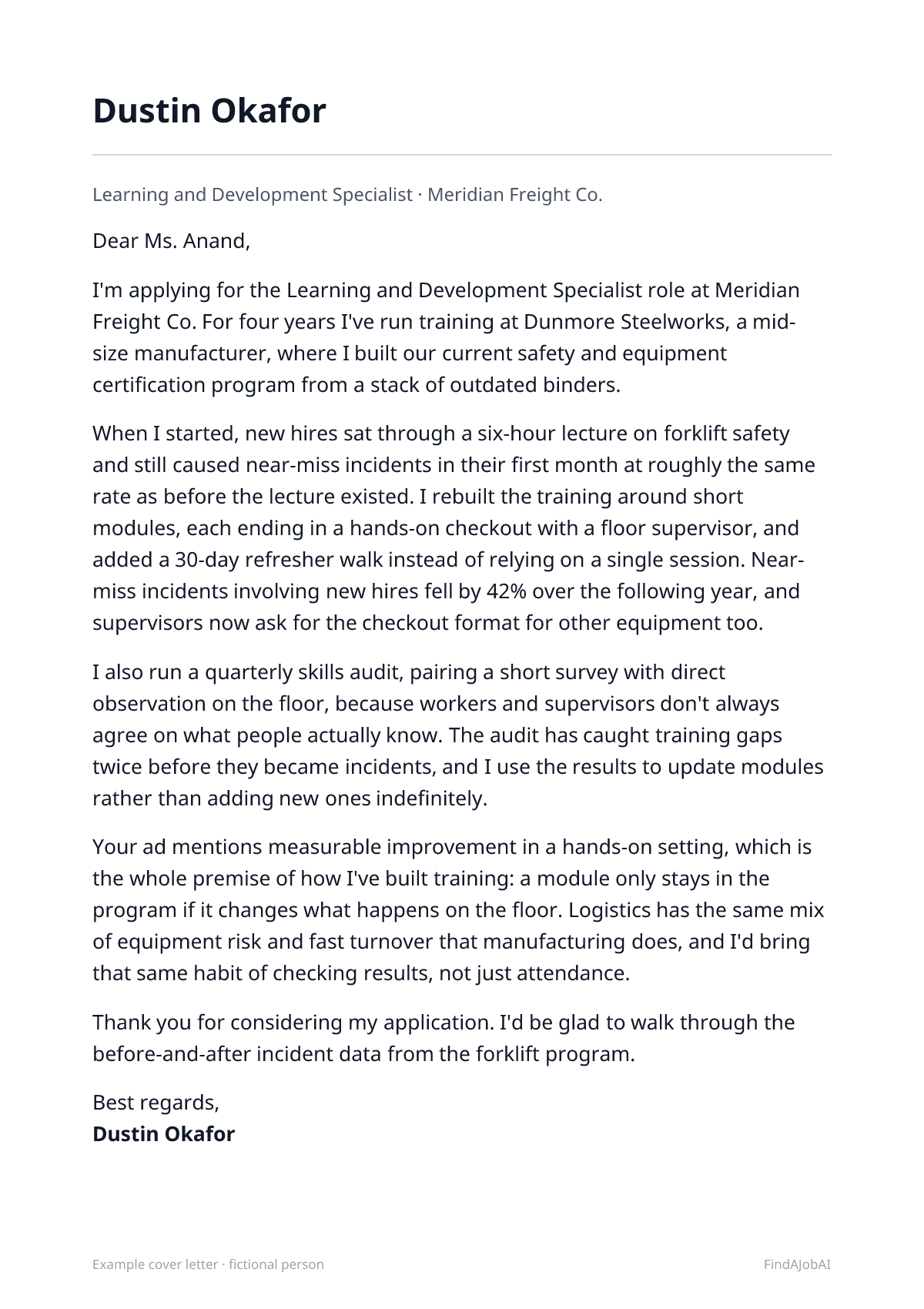
This letter as a one-page template: an opening that names the job and your strongest fact, proof that answers the ad, a reason for this employer and a short close.
After you sign up, FindAJobAI drafts your own letter for a real job from your CV in this format, and you edit it before you send it.
Example 1 · Experienced
Manufacturing trainer applying to a logistics company's L&D team
Dustin built a safety training program at a factory. The ad asks for measurable improvement in a hands-on training setting.
Example letter · fictional
Dear Ms. Anand,
I'm applying for the Learning and Development Specialist role at Meridian Freight Co. For four years I've run training at Dunmore Steelworks, a mid-size manufacturer, where I built our current safety and equipment certification program from a stack of outdated binders.
When I started, new hires sat through a six-hour lecture on forklift safety and still caused near-miss incidents in their first month at roughly the same rate as before the lecture existed. I rebuilt the training around short modules, each ending in a hands-on checkout with a floor supervisor, and added a 30-day refresher walk instead of relying on a single session. Near-miss incidents involving new hires fell by 42% over the following year, and supervisors now ask for the checkout format for other equipment too.
I also run a quarterly skills audit, pairing a short survey with direct observation on the floor, because workers and supervisors don't always agree on what people actually know. The audit has caught training gaps twice before they became incidents, and I use the results to update modules rather than adding new ones indefinitely.
Your ad mentions measurable improvement in a hands-on setting, which is the whole premise of how I've built training: a module only stays in the program if it changes what happens on the floor. Logistics has the same mix of equipment risk and fast turnover that manufacturing does, and I'd bring that same habit of checking results, not just attendance.
Thank you for considering my application. I'd be glad to walk through the before-and-after incident data from the forklift program.
Best regards,
Dustin Okafor
Example 2 · Career changer
High school teacher moving into corporate learning and development
Soledad taught for seven years and built a peer-mentoring program. The ad values instructional design and measuring whether training works.
Example letter · fictional
Dear Hiring Manager,
I'm applying for the Learning and Development Coordinator role at Hartwell Financial Group. For seven years I've taught high school biology, and for the last three I've also designed and run a peer-mentoring program for new teachers at my school, which is the work that convinced me to move into learning and development full time.
New teachers at my school used to get a single orientation day and then largely figured things out alone; a third left within two years. I built a structured first-year program instead: four workshops spaced across the semester, a trained mentor teacher for each new hire, and a short check-in survey after each unit to see what was and wasn't landing. Two years later, new-teacher retention rose to roughly 80%, and the district adopted the mentor structure at two other schools.
I've since completed a certificate in instructional design and built two e-learning modules in a course-authoring tool, including one on giving effective feedback that I tested with a small group before finalizing. I'm comfortable writing learning objectives, storyboarding a module and using a short assessment to check whether a skill actually transferred.
Your posting asks for someone who designs training and then checks whether it works, which is exactly the habit I built with the mentoring program, just without the title until now. I'd bring both the design skills and a working knowledge of how adults actually learn new material under time pressure.
Thank you for your time. I can share the mentoring program's workshop materials and the feedback module I built.
Kind regards,
Soledad Marchetti
Example 3 · Senior or lead
L&D director applying to build a first learning function at a growing company
Benedikt manages a team of three at an insurance company. The ad is for a director who will build L&D from a scattered set of local trainings.
Example letter · fictional
Dear Ms. Vance,
I'm applying for the Director of Learning and Development role at Greystone Insurance Group. I currently manage a team of three at Fennimore Mutual, where I built our first centralized L&D function, after five years as a learning and development specialist before that.
Your ad describes training that currently happens branch by branch, with no shared record of who's qualified in what. I solved a close version of that problem at Fennimore by building a single skills matrix tied to our learning management system, so any manager could see, in one screen, who on their team was certified for a given task and when it expired. Within the first year, overdue recertifications fell from a persistent backlog to near zero, and our compliance team stopped flagging it in audits.
On the design side, when claims processing time became a company priority, I ran a short needs analysis with ten adjusters before building anything, found the real gap was in a specific software step rather than general process knowledge, and built a 90-minute targeted module instead of the generic week-long onboarding course that had been planned. Average claims processing time fell by 15% in the two quarters after rollout, without the cost of a full week offline for every new adjuster.
I've hired and coached my current team of three and built our first formal training-evaluation process, but I haven't yet managed a learning budget above six figures or worked with a dedicated e-learning development team, both of which your posting mentions. I'd want to build both carefully alongside your finance and IT leads early on.
I'd welcome a conversation about which skill gap costs your branches the most right now, and where you'd want a director to start.
Sincerely,
Benedikt Olufemi
All three letters, and the short version below, are fictional: the people, employers and numbers are invented. Borrow the structure, never the facts.
- Prefer to write it yourself? Use the free cover letter template.
- Check your CV against the job first: the free CV score shows the missing keywords.
Why the first letter works, paragraph by paragraph
Paragraph 1: Opening
Names the size and type of company and the specific program the writer built, so the reader sees matching scope and hands-on relevance before any detail arrives.
Paragraph 2: The program that changed a number
States the original problem with a real rate, the redesign (short modules plus a hands-on checkout and refresher), and the measurable result, incident rate, which is the metric the hiring manager actually cares about.
Paragraph 3: A second habit: checking, not assuming
The quarterly skills audit shows ongoing measurement rather than a one-time fix, and the honest note about not adding modules endlessly shows judgment about training bloat.
Paragraph 4: Why this company
Connects the ad's own phrase, measurable improvement in a hands-on setting, to the writer's actual practice, and names a real shared condition between the two industries.
Paragraph 5: Close
Offers a concrete, checkable next step, the incident data, which respects that this is real workplace safety information handled carefully.
What the career changer's letter does differently
The career changer's letter treats a self-built mentoring program as real instructional design work rather than a side project, and gives it a number, retention near 80%, alongside the district's adoption of the structure elsewhere. It's honest that the title is new while showing the underlying skills, objective-writing, storyboarding, testing a module, are already in place.
What the senior letter does differently
A director-level letter reports organizational systems, not single courses: a skills matrix that eliminated a recertification backlog, and a needs analysis that replaced a planned week-long course with a 90-minute module and a real processing-time improvement. The letter also names a clear gap, budget size and e-learning team coordination, rather than implying full readiness.
Short learning and development specialist cover letter: an email-ready version
Many applications arrive as an email or a small text box, and a full page doesn't fit. This version runs 120 to 150 words and keeps only what a reader needs to decide whether to reply. An L&D specialist answers a hospital network's short 'why this role' application field, sent by email after a recruiter's direct request.
Short version · email · fictional128 words
Subject: Learning and Development Specialist application – clinical onboarding – Marisol Quintanar
Hello Mr. Duchamp,
I'm applying for the Learning and Development Specialist role at Everhart Health Network. I've spent three years designing training for a regional retail chain, most recently rebuilding our new-hire onboarding around hands-on checkouts instead of lecture-based sessions.
My strongest result was cutting first-90-day turnover among new hires by a third after I added a trained mentor and a short skills check at the two-week mark, replacing a single orientation day that left people guessing.
Hospital onboarding carries higher stakes but the same core problem, and I'd like to bring that same mentor-and-checkpoint structure here. My resume is attached, and I'm glad to share the onboarding redesign on request. I can also share the two-week skills check and how the mentors were trained.
Best,
Marisol Quintanar
The short version keeps one concrete, numbered result, the drop in first-90-day turnover, and draws a direct, honest line between retail and healthcare onboarding rather than overstating the similarity.
Opening lines that work for learning and development specialist cover letters
The first sentence decides whether the second gets read. Here are six openings, one for each situation you might be in. Pick the one that matches yours and swap in your own facts: every name and number below is invented.
1. You have a standout result
After I replaced a single orientation day with a mentor and a two-week skills check, first-90-day turnover among new hires fell by a third. I'd like to bring that same structure to your onboarding program.
2. The ad names a problem you've solved
Your ad describes training that happens branch by branch with no shared record of who's qualified for what. I built a skills matrix at my current company that took our recertification backlog down to near zero within a year.
3. Someone referred you
Your operations manager, Thaddeus Okonjo, worked with me on a process rollout last year from the training side. He mentioned you're looking for someone who checks whether training actually changes performance, which is the habit I built my last program around.
4. You admire what they build
I've used your company's customer-facing training materials as a parent, and the clarity of your recent product walkthrough stood out against most onboarding content I've seen; I'd like to help build more of it internally.
5. You're new to the field or switching into it
I taught high school for seven years and built a peer-mentoring program that raised new-teacher retention to roughly 80%. I'm ready to bring that same instructional design habit into a corporate learning role.
6. You have senior scope or a specialism
As L&D director for an insurance company for four years, I built our first centralized skills matrix and redesigned a claims-processing course that cut processing time by 15% in two quarters. I'm looking for a team ready to invest further in a formal learning function.
How to write a learning and development specialist cover letter
Five steps, in the order you'd write them. The shape stays the same for every job (a short opening, proof, a reason for this employer, a close), and what goes into each part is what changes with the role.
Find the real skill gap behind the ad
L&D postings often name a symptom, like turnover or compliance gaps, rather than the training problem itself. Read for what's actually breaking, onboarding, safety, a new system rollout, and pick a past program that solved a similar underlying gap.
Open with the problem, not the course catalog
Start with what wasn't working: a turnover rate, an error rate, a recertification backlog. Save your title and years of experience for the next sentence, once the reader already recognizes the problem from their own ad.
Measure the behavior change, not completions
A course finished by everyone proves attendance, not learning. Say what people could do differently afterward, or what business number moved, like an incident rate, a processing time, or a retention figure, and over what period.
Show how you decided what to build
Good instructional design starts with a needs analysis, not a format choice. One sentence on how you found the real gap, through observation, a survey, or interviews, shows judgment that a list of authoring tools can't.
Name the format you'd bring to their setting
Hands-on checkouts suit equipment-heavy jobs; short modules suit software rollouts; mentoring suits onboarding. Match your example's format to what the ad's environment needs, and close by naming a gap you'd want to study first. Choose one format, not three.
Learning and Development Specialist cover letter do's and don'ts
Do
- Open with a training program you built or improved and the specific problem it solved, not a claim of 'passion for employee growth.'
- Give the before-and-after number for one program: an error rate, a retention rate, a completion time, or a skill test result.
- Name the instructional design step the ad asks for, needs analysis, storyboarding, an LMS, inside a real example rather than as a bare list.
Don't
- Don't count the number of courses or modules you've built; show the one that changed a workplace outcome.
- Don't treat completion rates as success; say what people could do differently after training, and how you checked.
- Don't share a current employer's confidential incident numbers; use rates, percentages, or request permission before naming specifics.
Common learning and development specialist cover letter mistakes
Each one is easy to make and quick to fix before you send the letter.
Listing every authoring tool and LMS you've touched
A long tool list proves exposure, not skill. Name the one the ad uses, or the one you know best, inside a real module you built with it and the result that module produced.
Treating completion rate as the success metric
Finishing a course isn't the same as learning from it. Say what changed in performance, an error rate, a time-to-competency, a retention number, and how you measured it after the fact.
Skipping the needs analysis entirely
A letter that jumps straight to the course format can read as format-first design. Add one sentence on how you found the actual gap, through observation, interviews, or a survey, before building anything.
Calling yourself 'passionate about employee development'
Nearly every L&D applicant writes a version of this line. Replace it with one program you built and the number that moved because of it.
Sharing an employer's confidential safety or incident data
Specific incident counts or named performance issues can breach confidentiality even after the fact. Use rates or percentages, and offer full details only once you've started or with permission.
Email subject lines for learning and development specialist applications
Applying by email? Put the job title, any reference number and your name in the subject line.
- Learning and Development Specialist application – safety training redesign – Dustin Okafor
- L&D Coordinator – teacher with instructional design certificate – Soledad Marchetti
- Application: Learning & Development Specialist (Req. 3067) – Dustin Okafor
Everything for Learning and Development Specialists
- Learning and Development Specialist resume exampleA full resume, plus bullet and summary examples
- Learning and Development Specialist job descriptionDuties, skills and requirements
- Career change cover letter: template + examples
Other cover letter examples
Learning and Development Specialist cover letter FAQ
What should I write in a learning and development specialist cover letter?
One training program you built or improved: the problem, what you changed about the design, and the measurable result, whether that's an error rate, a retention number, or a skill people could demonstrate afterward. Save the full list of tools for your resume.
How do I write an L&D cover letter with no formal training experience?
Use a training, onboarding or mentoring program from teaching, retail or any job where you taught someone a skill, name the result, and add any instructional design coursework or certificate to show the skills are now formal.
Should I mention a specific LMS or authoring tool?
Yes, if the ad names one, but inside an example of a module you actually built in it, not as a bare list. A tool mentioned without a result doesn't tell the reader much.
How we built this page
The FindAJobAI team wrote the three example letters, the short email version, the opening lines and the advice for learning and development specialist roles. The people, employers and numbers in the letters are invented; the structure, the kind of evidence and the order of the paragraphs are the parts to copy.
Once we track enough live learning and development specialist job ads, this page also shows the skills they ask for most, counted the same way as our in-demand skills report.
Last reviewed on November 1, 2026.