Medical Laboratory Scientist Cover Letter Example (2026)
By FindAJobAI team Updated How we built this page
Medical laboratory scientist ads lean on certifications and instrument lists, which makes every applicant's resume look similar. A cover letter earns attention by naming a result turnaround you improved, a catch that changed a patient's care, or a validation you ran, not by repeating the certifications already on your resume.
Medical Laboratory Scientist cover letter template
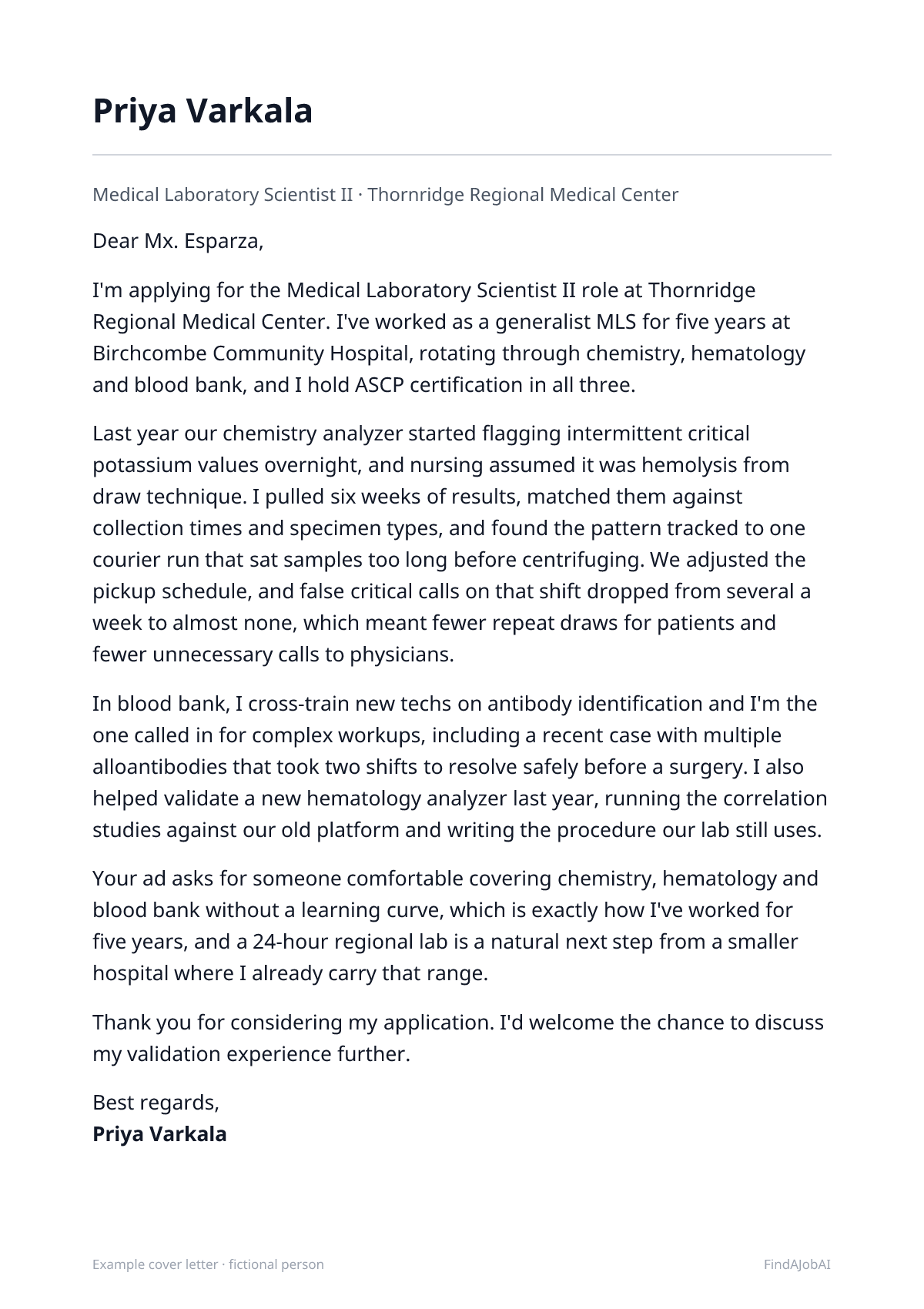
This letter as a one-page template: an opening that names the job and your strongest fact, proof that answers the ad, a reason for this employer and a short close.
After you sign up, FindAJobAI drafts your own letter for a real job from your CV in this format, and you edit it before you send it.
Example 1 · Experienced
Hospital generalist applying to a larger regional lab
Priya rotates through chemistry, hematology and blood bank at a community hospital. The ad wants someone who can cover all three.
Example letter · fictional
Dear Mx. Esparza,
I'm applying for the Medical Laboratory Scientist II role at Thornridge Regional Medical Center. I've worked as a generalist MLS for five years at Birchcombe Community Hospital, rotating through chemistry, hematology and blood bank, and I hold ASCP certification in all three.
Last year our chemistry analyzer started flagging intermittent critical potassium values overnight, and nursing assumed it was hemolysis from draw technique. I pulled six weeks of results, matched them against collection times and specimen types, and found the pattern tracked to one courier run that sat samples too long before centrifuging. We adjusted the pickup schedule, and false critical calls on that shift dropped from several a week to almost none, which meant fewer repeat draws for patients and fewer unnecessary calls to physicians.
In blood bank, I cross-train new techs on antibody identification and I'm the one called in for complex workups, including a recent case with multiple alloantibodies that took two shifts to resolve safely before a surgery. I also helped validate a new hematology analyzer last year, running the correlation studies against our old platform and writing the procedure our lab still uses.
Your ad asks for someone comfortable covering chemistry, hematology and blood bank without a learning curve, which is exactly how I've worked for five years, and a 24-hour regional lab is a natural next step from a smaller hospital where I already carry that range.
Thank you for considering my application. I'd welcome the chance to discuss my validation experience further.
Best regards,
Priya Varkala
Example 2 · Career changer
Phlebotomist moving into the laboratory bench after finishing her MLS degree
Dana has drawn blood for four years and just completed her MLS program. The ad is an entry-level bench opening.
Example letter · fictional
Dear Hiring Manager,
I'm applying for the Medical Laboratory Scientist I role at Hollyfen Diagnostics. I've worked as a phlebotomist for four years at Garnetwell Outpatient Clinic, and I recently completed my Bachelor of Science in Medical Laboratory Science along with my clinical rotations, where I worked the bench in chemistry, microbiology and urinalysis.
During my microbiology rotation, I caught a Gram stain that didn't match the requesting physician's working diagnosis; I flagged it to my preceptor instead of just logging the result, and the follow-up culture confirmed a different organism, which changed the antibiotic choice before the patient was discharged. That rotation also had me reading plates and setting up susceptibility testing daily, and I passed my ASCP certification exam last month.
Four years drawing blood taught me what a lab needs before a sample reaches the bench. I know what a short draw or a hemolyzed tube looks like before it's labeled, and I've trained two new phlebotomists on specimen handling that avoids common rejection reasons. That background means I understand why a rejected specimen matters to the tech who has to call the floor about it.
Your posting mentions a high-volume chemistry and hematology workload with cross-training into microbiology, which matches my rotations directly, and I'd bring both bench readiness and four years of knowing how specimens actually arrive. I'm eager to learn your instrument platforms and your quality control routines, and I'd treat cross-training seriously.
Thank you for your time. I'm available to start as soon as my certification is verified and would welcome an interview.
Sincerely,
Dana Okonkwo-Reyes
Example 3 · Senior or lead
Lab supervisor applying to lead a hospital's day shift
Jamie supervises eight techs on nights at a mid-size hospital. The ad is for a day-shift supervisor focused on turnaround times and audits.
Example letter · fictional
Dear Dr. Nkemelu,
I'm applying for the Laboratory Day Shift Supervisor role at Marrowfield General Hospital. For the past four years I've supervised eight medical laboratory scientists on the night shift at Coldharbor Memorial, and before that spent seven years on the bench in chemistry and microbiology.
Your ad names turnaround time on stat chemistry as a recurring complaint from the emergency department. I inherited a similar problem on nights: stat potassium and troponin results were averaging well over our 45-minute target. I mapped the path from draw to result, found the bottleneck was manual callback of critical values competing with routine runs, and moved critical value calling to a dedicated phone line staffed by whichever tech wasn't actively loading the analyzer. Average stat turnaround fell to under 30 minutes within two months, and the ED stopped escalating complaints to my director.
I also led our last two CAP inspection cycles, rewriting our competency assessment process so it's done continuously instead of in a scramble the week before. Both inspections closed with zero major deficiencies, and two other supervisors in our system have since asked for my checklist. I coach techs through difficult cases rather than just reviewing their work, and three of my night staff have been promoted to lead roles.
I haven't run a day shift directly, where staffing, pathologist traffic and specimen volume are all higher, and I'd want to spend my first weeks understanding your current bottlenecks before changing anything.
A conversation about your current turnaround numbers and your next CAP inspection date would be a good place to start.
Sincerely,
Jamie Archer
All three letters, and the short version below, are fictional: the people, employers and numbers are invented. Borrow the structure, never the facts.
- Prefer to write it yourself? Use the free cover letter template.
- Check your CV against the job first: the free CV score shows the missing keywords.
Why the first letter works, paragraph by paragraph
Paragraph 1: Opening
Names the three sections the writer covers (chemistry, hematology, blood bank) and the certification, which is what a generalist posting screens for first.
Paragraph 2: The catch that changed a process
A specific problem (false critical potassium calls), the investigation method, the root cause, and the operational fix, framed by its effect on patients and physician calls rather than just 'improved accuracy.'
Paragraph 3: Depth in one section plus a validation
Antibody workups and instrument validation are concrete signs of senior bench skill that a title alone doesn't convey.
Paragraph 4: Why this lab
Matches the ad's specific ask (coverage across three sections without a learning curve) to the writer's existing range.
Paragraph 5: Close
Offers to discuss the validation work, a natural next conversation for a technical hire.
What the career changer's letter does differently
The phlebotomist's letter leads with a bench catch from clinical rotations, since she has no paid MLS experience yet, and uses her phlebotomy years as a distinct asset, specimen quality, rather than padding, closing with exactly what the ad asked for: chemistry, hematology and microbiology cross-training.
What the senior letter does differently
A supervisor letter reports what changed under the writer's management: a specific turnaround fix, a concrete inspection result (zero major deficiencies, twice), and staff who were promoted. It also names the one real gap, day-shift specific pressures, rather than implying total readiness.
Short medical laboratory scientist cover letter: an email-ready version
Many applications arrive as an email or a small text box, and a full page doesn't fit. This version runs 120 to 150 words and keeps only what a reader needs to decide whether to reply. An MLS answers a diagnostics company's short online application field after a recruiter mentioned the role, sent by email.
Short version · email · fictional125 words
Subject: Medical Laboratory Scientist application – chemistry and hematology – Soraya Papadopoulos
Hello Mr. Castellanos,
I'm applying for the Medical Laboratory Scientist role at Quillmark Labs. I've worked three years as a generalist at Eastfall Clinic Lab, covering chemistry and hematology, with ASCP certification in both.
Last quarter I noticed our hematology analyzer was flagging an unusual number of platelet clumps on morning draws. I traced it to a courier delay before processing, got the pickup schedule moved earlier, and repeat draws for that reason dropped to almost zero.
I'd like to bring that same habit of tracing problems to their source to a higher-volume lab. My resume is attached, and I'm available for an interview any weekday afternoon. I can also send the courier timing summary I put together, with patient details removed.
Best,
Soraya Papadopoulos
The short version keeps one specific fix (the courier delay causing platelet clumping) because it's concrete and quick to verify, and cuts the certification history and any mention of instruments beyond what's needed to establish credibility.
Opening lines that work for medical laboratory scientist cover letters
The first sentence decides whether the second gets read. Here are six openings, one for each situation you might be in. Pick the one that matches yours and swap in your own facts: every name and number below is invented.
1. You have a standout result
A courier delay I traced last year was causing a wave of platelet clumping on morning draws; fixing the pickup schedule cut repeat draws to almost zero. I'd like to bring that kind of root-cause habit to your lab.
2. The ad names a problem you've solved
Your ad mentions stat turnaround complaints from the emergency department. I solved a similar problem on my current shift by moving critical value calls off the bench techs, which cut our average stat time by about a third.
3. Someone referred you
Your lab manager, Teodora Vance, trained alongside me during our ASCP boards and mentioned your microbiology opening, which is why I'm writing.
4. You admire what they build
I've had my own specimens processed at your outpatient lab for a chronic condition, and the turnaround and communication stood out enough that I looked into working here.
5. You're new to the field or switching into it
I spent four years drawing blood before finishing my MLS degree, and I still think about specimen quality the way a phlebotomist does, which is part of why I want to work the bench now.
6. You have senior scope or a specialism
As a night shift supervisor for four years, I cut our stat chemistry turnaround by nearly half and closed two CAP inspections without a major deficiency. I'm ready to bring that to a day shift.
How to write a medical laboratory scientist cover letter
Five steps, in the order you'd write them. The shape stays the same for every job (a short opening, proof, a reason for this employer, a close), and what goes into each part is what changes with the role.
Match your sections to the ad's sections
Labs hire for specific coverage: chemistry, hematology, blood bank, microbiology, or some combination. Read which sections the ad lists and lead with the ones where you have the most depth, rather than listing every rotation you've ever worked.
Open with a result, not a certification list
Your ASCP or AMT credential is already on your resume. Open instead with a specific case: a catch, a troubleshooting fix, or a validation, stated in one or two sentences so the reader sees what kind of tech you are before anything else.
Describe the effect on patients or turnaround, not just the test
A result that's technically correct but useless if it's slow doesn't help anyone. Tie your example to turnaround time, a repeat draw avoided, or a diagnosis changed, since that's what labs and the departments they serve actually care about.
Name instruments and methods inside the story
If the ad lists a specific analyzer or method, mention your experience with it as part of the case you're describing, including scale (how many samples a day) where it helps. Bare lists of platforms read the same across every applicant.
Close with availability and certification status
Labs often need to confirm licensure or certification before scheduling, so state yours clearly and your earliest start date. If a certification is pending, say when you expect it, so the reader isn't left to ask.
Medical Laboratory Scientist cover letter do's and don'ts
Do
- Name the section (chemistry, hematology, blood bank, microbiology) and the specific catch or fix, not just 'strong attention to detail.'
- Mention your ASCP or AMT certification and any instrument platforms the ad names, inside a story rather than a list.
- If you're moving from phlebotomy or a related role, name what that work taught you about specimens reaching the bench.
Don't
- Don't write "detail-oriented team player"; describe the result that caught or wasn't caught, with what happened next.
- Don't list every certification and instrument you've touched; name the ones the ad asks for and show you've used them.
- Don't share real patient details; describe cases by type and outcome, never by anything identifying.
Common medical laboratory scientist cover letter mistakes
Each one is easy to make and quick to fix before you send the letter.
Leading with 'detail-oriented and accurate'
Every applicant writes this. Replace it with one case where accuracy mattered: a mismatched Gram stain, a flagged critical value, a caught mislabel, and what happened next.
Listing every instrument you've ever touched
A long platform list reads as shallow familiarity. Name the ones the ad specifies and describe one thing you did with each, such as a validation or a troubleshooting fix.
Omitting certification status
Labs can't schedule you without knowing if you're ASCP or AMT certified, or when you will be. State it plainly near the top rather than assuming it's understood from your resume.
Describing patient cases with identifying detail
Even anonymized details can raise concerns about discretion. Describe a case by type and outcome only, such as 'a mismatched culture result' rather than specifics that could identify the patient or chart.
Hiding phlebotomy or assistant experience as a weakness
If you're moving from phlebotomy or a lab assistant role, name what it taught you about specimen quality directly; it's a real asset for bench work, not a gap to minimize.
Email subject lines for medical laboratory scientist applications
Applying by email? Put the job title, any reference number and your name in the subject line.
- Medical Laboratory Scientist II application – chemistry, hematology, blood bank – Priya Varkala
- Medical Laboratory Scientist I – phlebotomist with new MLS certification – Dana Okonkwo-Reyes
- Application: MLS, Night Shift (Req. 2214) – Priya Varkala
Everything for Medical Laboratory Scientists
- Medical Laboratory Scientist resume exampleA full resume, plus bullet and summary examples
- Medical Laboratory Scientist job descriptionDuties, skills and requirements
- Career change cover letter: template + examples
Other cover letter examples
Medical Laboratory Scientist cover letter FAQ
What should I include in a medical laboratory scientist cover letter?
One case where your work changed a result, a process, or a patient outcome: the section you were working in, what you found, and what happened because of it. Name your certification and key instruments inside that story, since they're already on your resume.
How do I write a medical laboratory scientist cover letter with no bench experience?
Use a clinical rotation case or a related lab role, such as phlebotomy or a lab assistant position, and describe what you caught or learned there. Name your certification status and which sections you rotated through.
Should I mention specific instruments or analyzers?
Yes, but only the ones the ad names or ones you've used enough to discuss, tied to what you did with them, such as a validation or a troubleshooting fix, rather than a bare list.
How long should a medical laboratory scientist cover letter be?
About half a page, four to five short paragraphs. Hiring managers in labs are reading quickly between shifts, so one clear case beats several vague claims of competence.
How we built this page
The FindAJobAI team wrote the three example letters, the short email version, the opening lines and the advice for medical laboratory scientist roles. The people, employers and numbers in the letters are invented; the structure, the kind of evidence and the order of the paragraphs are the parts to copy.
Once we track enough live medical laboratory scientist job ads, this page also shows the skills they ask for most, counted the same way as our in-demand skills report.
Last reviewed on November 1, 2026.