Pharmacist Cover Letter Example (2026)
By FindAJobAI team Updated How we built this page
Pharmacist ads assume the license and the clinical knowledge; what they're screening for is judgment under volume and how you handle the parts of the job that go wrong, an interaction caught, a patient talked through a hard conversation. The cover letter should show one of those moments, not restate the degree.
Pharmacist cover letter template
This letter as a one-page template: an opening that names the job and your strongest fact, proof that answers the ad, a reason for this employer and a short close.
After you sign up, FindAJobAI drafts your own letter for a real job from your CV in this format, and you edit it before you send it.
Example 1 · Experienced
retail pharmacist applying to a regional pharmacy chain
Angela has run a high-volume retail pharmacy for five years. The ad asks for someone comfortable with both verification speed and MTM consultations.
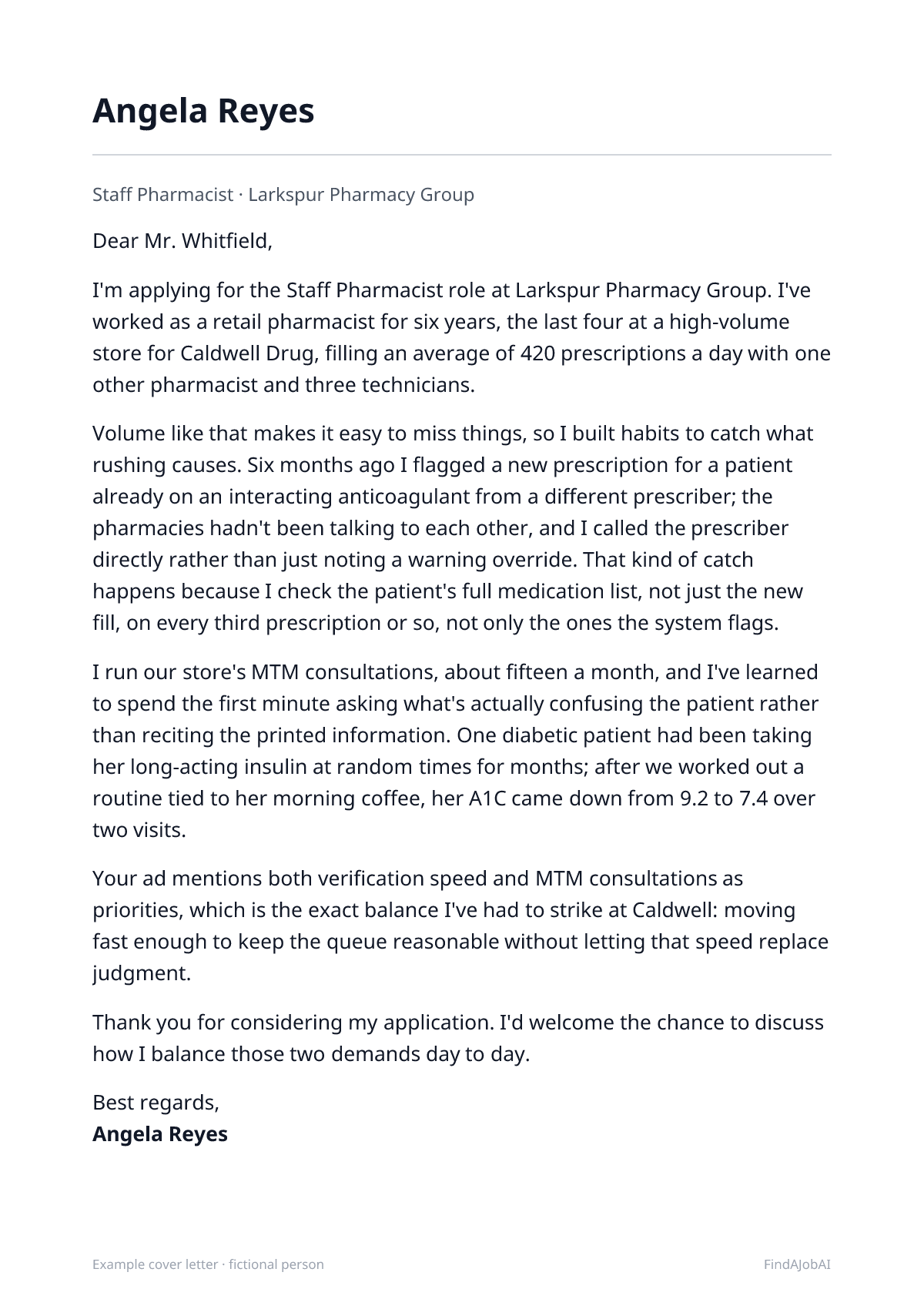
Example letter · fictional
Dear Mr. Whitfield,
I'm applying for the Staff Pharmacist role at Larkspur Pharmacy Group. I've worked as a retail pharmacist for six years, the last four at a high-volume store for Caldwell Drug, filling an average of 420 prescriptions a day with one other pharmacist and three technicians.
Volume like that makes it easy to miss things, so I built habits to catch what rushing causes. Six months ago I flagged a new prescription for a patient already on an interacting anticoagulant from a different prescriber; the pharmacies hadn't been talking to each other, and I called the prescriber directly rather than just noting a warning override. That kind of catch happens because I check the patient's full medication list, not just the new fill, on every third prescription or so, not only the ones the system flags.
I run our store's MTM consultations, about fifteen a month, and I've learned to spend the first minute asking what's actually confusing the patient rather than reciting the printed information. One diabetic patient had been taking her long-acting insulin at random times for months; after we worked out a routine tied to her morning coffee, her A1C came down from 9.2 to 7.4 over two visits.
Your ad mentions both verification speed and MTM consultations as priorities, which is the exact balance I've had to strike at Caldwell: moving fast enough to keep the queue reasonable without letting that speed replace judgment.
Thank you for considering my application. I'd welcome the chance to discuss how I balance those two demands day to day.
Best regards,
Angela Reyes
Example 2 · Career changer
pharmacy technician completing her PharmD
Sade has worked as a technician for eight years while finishing pharmacy school. The ad is an entry-level staff pharmacist opening at an independent pharmacy.
Example letter · fictional
Dear Dr. Nakamura,
I'm applying for the Staff Pharmacist role at Millbrook Family Pharmacy. I worked as a pharmacy technician for eight years while completing my PharmD at Western State, and I'll have my license by the time I could start, so I'm applying now rather than waiting.
As a technician I was the one pharmacists came to when a patient's insurance rejected a claim in a way nobody could explain; I learned to read the rejection codes and call the right person on the first try, which saved our pharmacists time every day. During my final rotation at an independent pharmacy, I ran three MTM consultations under supervision, including one where I caught that a patient's new prescription would have duplicated a therapy she was already on under a different brand name, and the prescriber changed the order before it was filled.
Eight years behind the counter taught me the operational side most new PharmDs haven't seen: how insurance adjudication actually works, how a short-staffed shift changes what gets missed, and how to talk to a patient who's frustrated before they even reach the counter. My rotations gave me the clinical reasoning; the counter work gave me the judgment about what breaks under pressure.
Your pharmacy's independence is part of why I'm applying. I've watched our technicians and pharmacists build relationships with regular patients over years, which the chain store I also worked at never had room for, and that's the kind of practice I want to build my career in.
Thank you for your time. I can provide my rotation preceptor's contact information if that's useful.
Sincerely,
Sade Bankole
Example 3 · Senior or lead
pharmacy manager applying to lead a new hospital outpatient pharmacy
Oluwaseun manages a busy retail pharmacy with four pharmacists. The ad is for a manager to open and staff a new outpatient pharmacy in a hospital system.
Example letter · fictional
Dear Dr. Marsh,
I'm applying for the Pharmacy Manager role at Castleton Health System. For the past five years I've managed a retail pharmacy for Granger Drug filling around 500 prescriptions a day, with four pharmacists and six technicians reporting to me, and before that I worked six years as a staff pharmacist.
Your ad notes this is a new outpatient pharmacy being built inside an existing hospital, which means staffing and workflow decisions from scratch rather than inherited ones. I did something similar two years ago when Granger opened a second location: I wrote the verification workflow, set technician-to-pharmacist ratios based on our actual fill-time data rather than a corporate default, and built the onboarding checklist new hires still use. That location hit its target fill-time average within ten weeks, faster than the eighteen weeks our first store took.
Error prevention is where a manager's decisions matter most. After a near-miss involving two similarly packaged medications, I changed our shelf layout, added a mandatory second check for any drug on our high-alert list, and required technicians to flag look-alike/sound-alike pairs during intake rather than leaving it to the verifying pharmacist alone. We went fourteen months without a reportable dispensing error afterward, compared to three incidents in the prior year.
I haven't yet managed a pharmacy inside a hospital system with its own EHR integration and formulary committee, and I'd expect a learning curve there that I'd want to approach deliberately with your clinical informatics team.
I'd like to talk through the timeline for opening the new location and which workflow decisions are already set versus still open.
Sincerely,
Oluwaseun Adeyemi
All three letters, and the short version below, are fictional: the people, employers and numbers are invented. Borrow the structure, never the facts.
- Prefer to write it yourself? Use the free cover letter template.
- Check your CV against the job first: the free CV score shows the missing keywords.
Why the first letter works, paragraph by paragraph
Paragraph 1: Opening
States years of experience and a specific daily volume (420 prescriptions, five staff). Pharmacy hiring managers need to know immediately whether a candidate has handled comparable throughput.
Paragraph 2: The interaction caught
A concrete clinical catch, missed by the system, caught by a habit, with the specific action taken (calling the prescriber). This is the single strongest proof of judgment a pharmacist can offer.
Paragraph 3: MTM and patient communication
Names a volume (fifteen consultations a month) and one patient result (A1C from 9.2 to 7.4), showing the softer counseling skill the ad also asked for, measured rather than asserted.
Paragraph 4: Why this company
Directly answers the ad's own stated priorities (speed and MTM) instead of a generic statement of interest.
Paragraph 5: Close
Offers a specific, relevant next step tied to the letter's content rather than a generic closing line.
What the career changer's letter does differently
The career changer's letter leads with eight years of technician experience as a credential in its own right, not a gap to explain, and uses a supervised rotation catch (a duplicate therapy caught before filling) to show clinical judgment despite being new to the licensed role. It also gives a specific, honest reason for choosing an independent pharmacy over a chain.
What the senior letter does differently
A pharmacy manager letter reports organizational decisions and their measurable effects: staffing ratios set from real fill-time data, a new location reaching target speed in ten weeks instead of eighteen, fourteen error-free months after a specific process change. The gap, hospital EHR integration and formulary committees, is named plainly rather than hidden.
Short pharmacist cover letter: an email-ready version
Many applications arrive as an email or a small text box, and a full page doesn't fit. This version runs 120 to 150 words and keeps only what a reader needs to decide whether to reply. A pharmacist answers a specialty mail-order pharmacy's posting by email after a recruiter asked for a brief note instead of a formal letter.
Short version · email · fictional131 words
Subject: Pharmacist (specialty/mail-order) – oncology verification experience – Trevor Lindqvist
Hello Ms. Okonkwo,
I'm applying for the Pharmacist role at Verity Specialty Pharmacy. I've worked as a hospital pharmacist for four years, the last two focused on oncology order verification, where dosing errors carry higher stakes than in general retail.
Six months ago I caught a chemotherapy order calculated from an outdated weight in the chart; the correct weight would have changed the dose by nearly 15%. I held the order, confirmed the current weight with nursing, and the prescriber adjusted it before it reached the patient.
Specialty pharmacy work appeals to me because it rewards that kind of careful checking. My resume is attached, and I'm glad to discuss my verification process in more detail. I also document each intervention so the next pharmacist can follow it.
Best,
Trevor Lindqvist
The short version keeps a single high-stakes catch, the chemotherapy dosing error, because it speaks to the precision a specialty pharmacy role demands, and drops the career narrative. Naming the percentage the dose would have changed makes the claim concrete without patient details.
Opening lines that work for pharmacist cover letters
The first sentence decides whether the second gets read. Here are six openings, one for each situation you might be in. Pick the one that matches yours and swap in your own facts: every name and number below is invented.
1. You have a standout result
Six months ago I caught a chemotherapy order calculated from an outdated patient weight, a mistake that would have changed the dose by nearly 15%. That kind of check is what I'd bring to your verification team.
2. The ad names a problem you've solved
Your ad asks for comfort with both fast verification and MTM consultations. I've run both sides of that at a store filling 420 prescriptions a day, and I've learned neither has to come at the expense of the other.
3. Someone referred you
Your staff pharmacist, Renata Kowalczyk, and I worked overlapping shifts for two years. She mentioned your team needs someone comfortable with high interaction-check volume, which is most of my day.
4. You admire what they build
I've filled prescriptions at your downtown location for years and have always noticed how unhurried the pharmacists seem even during a rush; I'd like to be part of a team that works that way.
5. You're new to the field or switching into it
I spent eight years as a pharmacy technician while finishing my PharmD, and I learned the operational side of the counter long before I learned the clinical side in school.
6. You have senior scope or a specialism
As a pharmacy manager overseeing four pharmacists and a 500-script daily volume, I built the onboarding process and error-prevention checks my pharmacy still uses. I'm ready to bring that to a larger operation.
How to write a pharmacist cover letter
Five steps, in the order you'd write them. The shape stays the same for every job (a short opening, proof, a reason for this employer, a close), and what goes into each part is what changes with the role.
Open with your setting and volume
State your practice setting, retail, hospital, specialty, and a rough daily or weekly volume in your first paragraph. A reviewer needs to know immediately whether your pace and environment match theirs before reading further. One line is enough; detail comes later.
Describe one clinical catch in concrete detail
Pick a real interaction, dosing error, or duplicate therapy you caught, say what tipped you off, and what you did about it, calling a prescriber, holding an order. This is the strongest evidence of judgment a pharmacist can offer, stronger than any adjective.
Give a patient communication result, without identifying detail
If you run MTM consultations or patient counseling, describe one outcome, like an A1C or adherence change, in a way that can't identify the patient. This shows the softer counseling skill most ads also ask for.
Name the ad's stated priorities specifically
Pharmacist ads often name two things at once, speed and accuracy, or clinical and operational duties. Address the specific combination the ad names rather than writing generally about being a careful, caring pharmacist. Quote the ad's own wording once.
Close with a next step tied to your experience
Offer something concrete and relevant, a rotation preceptor's contact, a verification process walkthrough, rather than a generic line about looking forward to discussing your qualifications. One sentence naming the process and what a reviewer would see is plenty for an ending.
Pharmacist cover letter do's and don'ts
Do
- Describe one clinical catch or consultation outcome with enough detail that it could be verified.
- Name your daily or weekly volume so the reader can judge whether your pace matches theirs.
- If you're coming from a technician or intern role, treat that operational experience as a real qualification, not a placeholder.
Don't
- Don't restate that you're licensed and detail-oriented; every applicant is licensed, and a specific catch shows the attention better than the adjective.
- Don't share a real patient's identifying details, even positive outcomes should be described without anything that could identify them.
- Don't pad the letter with every rotation or elective you completed; one relevant clinical moment is worth more than a full academic history.
Common pharmacist cover letter mistakes
Each one is easy to make and quick to fix before you send the letter.
Restating the license and degree as the main qualification
Every applicant is licensed. Replace a sentence about being a licensed PharmD with a specific moment that shows the judgment the license is supposed to assure.
Naming a patient or prescriber from a past job
Even a positive outcome shouldn't include anything that could identify a real patient, exact dates, names, or unusual specifics. Describe the clinical situation and result in general terms instead.
Treating technician or intern years as a gap to explain away
Operational experience behind the counter is a real qualification, not something to apologize for. State it plainly and describe what it taught you that pharmacy school didn't.
Writing about being detail-oriented in the abstract
'I'm detail-oriented and patient-focused' could describe anyone. Replace it with the specific catch or consultation that demonstrates both qualities in action.
Listing every rotation or certification without context
A list of rotations or certifications reads like a transcript. Choose the one most relevant to this job and describe what you did and learned there, rather than naming all of them.
Email subject lines for pharmacist applications
Applying by email? Put the job title, any reference number and your name in the subject line.
- Staff Pharmacist application – high-volume retail, MTM experience – Angela Reyes
- Staff Pharmacist – PharmD candidate, 8 years as pharmacy technician – Sade Bankole
- Application: Clinical Pharmacist, Ambulatory Care (Req. 2290) – Angela Reyes
Everything for Pharmacists
- Pharmacist resume exampleA full resume, plus bullet and summary examples
- Pharmacist interview questions30 questions with sample answers
- Pharmacist job descriptionDuties, skills and requirements
- Career change cover letter: template + examples
Other cover letter examples
Pharmacist cover letter FAQ
What should I write in a pharmacist cover letter?
One specific clinical catch or consultation outcome, your typical prescription volume, and how you balance speed with careful checking. Your license and degree belong on your resume; the letter should show judgment the resume can't.
How do I write a pharmacist cover letter with no post-licensure experience?
Use technician or intern experience and supervised rotation work as real qualifications. Describe one specific moment, a rejection resolved, an interaction flagged, where you exercised judgment, even under supervision.
Can I mention a specific patient outcome in a pharmacist cover letter?
Yes, as long as nothing in the description could identify the patient. Describe the clinical situation and the result, such as an A1C change, without names, exact dates, or other identifying details.
How we built this page
The FindAJobAI team wrote the three example letters, the short email version, the opening lines and the advice for pharmacist roles. The people, employers and numbers in the letters are invented; the structure, the kind of evidence and the order of the paragraphs are the parts to copy.
Once we track enough live pharmacist job ads, this page also shows the skills they ask for most, counted the same way as our in-demand skills report.
Last reviewed on November 1, 2026.