Nurse Practitioner Cover Letter Example (2026)
By FindAJobAI team Updated How we built this page
Nurse practitioner ads mostly list the same certifications and a patient panel size, so credentials alone don't separate applicants. The cover letter is where you show how you actually manage a panel: a diagnosis you caught, a chronic condition you got under control, and how you work with physicians and staff.
Nurse Practitioner cover letter template
This letter as a one-page template: an opening that names the job and your strongest fact, proof that answers the ad, a reason for this employer and a short close.
After you sign up, FindAJobAI drafts your own letter for a real job from your CV in this format, and you edit it before you send it.
Example 1 · Experienced
Family practice NP applying to a growing primary care group
Harold manages his own patient panel at a community clinic. The ad asks for comfort with chronic disease management and a high patient volume.
Example letter · fictional
Dear Dr. Larocque,
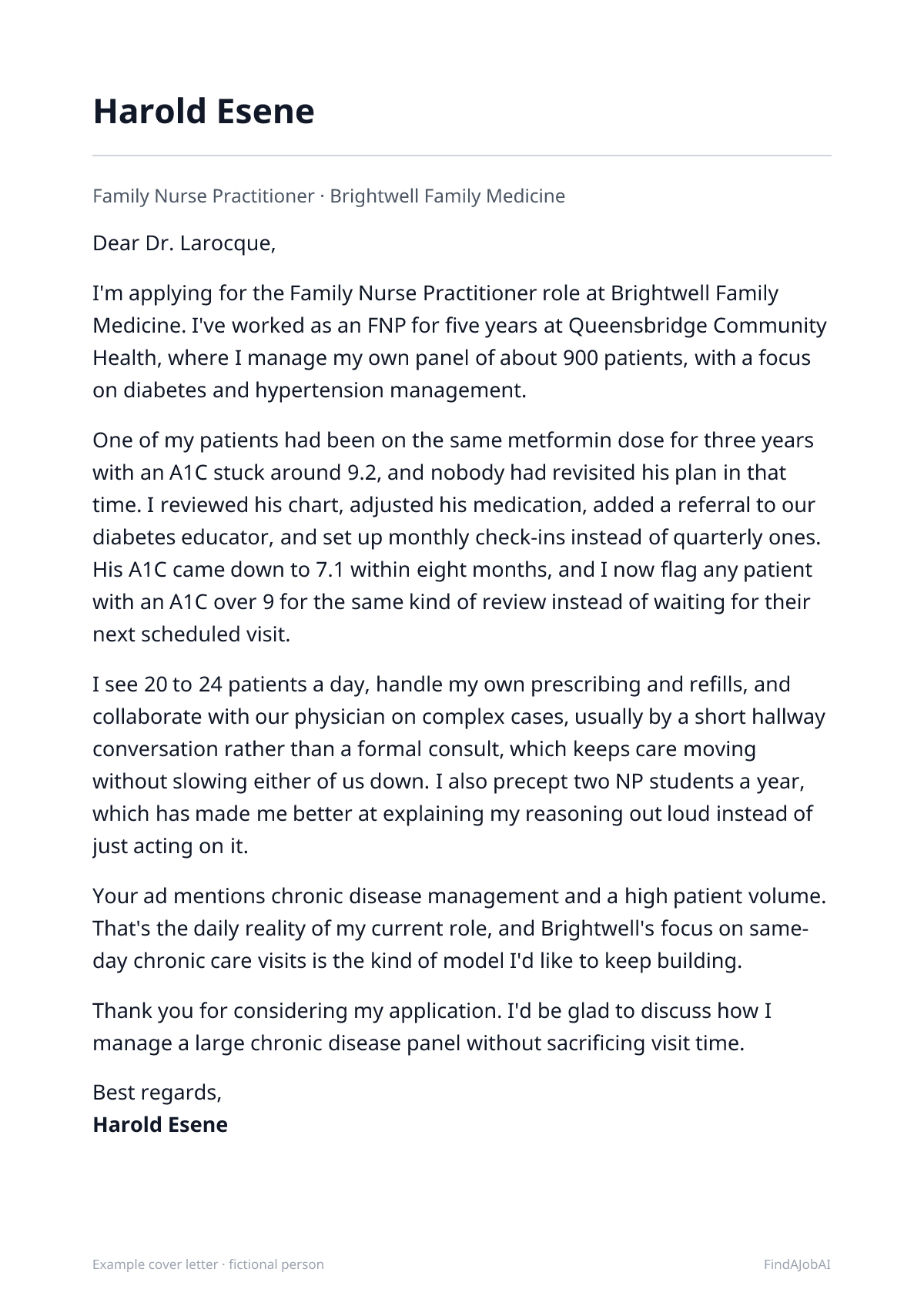
I'm applying for the Family Nurse Practitioner role at Brightwell Family Medicine. I've worked as an FNP for five years at Queensbridge Community Health, where I manage my own panel of about 900 patients, with a focus on diabetes and hypertension management.
One of my patients had been on the same metformin dose for three years with an A1C stuck around 9.2, and nobody had revisited his plan in that time. I reviewed his chart, adjusted his medication, added a referral to our diabetes educator, and set up monthly check-ins instead of quarterly ones. His A1C came down to 7.1 within eight months, and I now flag any patient with an A1C over 9 for the same kind of review instead of waiting for their next scheduled visit.
I see 20 to 24 patients a day, handle my own prescribing and refills, and collaborate with our physician on complex cases, usually by a short hallway conversation rather than a formal consult, which keeps care moving without slowing either of us down. I also precept two NP students a year, which has made me better at explaining my reasoning out loud instead of just acting on it.
Your ad mentions chronic disease management and a high patient volume. That's the daily reality of my current role, and Brightwell's focus on same-day chronic care visits is the kind of model I'd like to keep building.
Thank you for considering my application. I'd be glad to discuss how I manage a large chronic disease panel without sacrificing visit time.
Best regards,
Harold Esene
Example 2 · Career changer
Experienced RN newly credentialed as a nurse practitioner
Simone spent seven years as an ICU nurse before completing her NP program. The ad is for a hospitalist-adjacent NP role on a med-surg floor.
Example letter · fictional
Dear Hiring Manager,
I'm applying for the Acute Care Nurse Practitioner role at Thornridge Medical Center. I spent seven years as an ICU nurse at Delacroix Regional Hospital before completing my AGACNP program this spring, and I'm looking for my first role as an NP on an acute floor.
As an ICU nurse, I was often the first person to notice a patient deteriorating, and I learned to trust and act on those instincts well before an order came through; one early call on a post-surgical patient's declining blood pressure got a rapid response started ten minutes before his numbers would have triggered an automatic alert. My NP clinical rotations, including 300 hours on a hospitalist service, built on that instinct with the diagnostic and prescribing training to act on it myself.
I'm comfortable running a differential, ordering and interpreting labs and imaging, and writing orders, and my ICU background means I already know how to work fast during a rapid response and calmly explain a plan to a frightened family. My collaborating physician during rotations noted that I asked for backup appropriately rather than either overreaching or hesitating.
Your posting is for a floor managing complex, often unstable patients, which is exactly the population I spent seven years at the bedside with. I'd bring both the new prescribing authority and an ICU nurse's sense of when a patient is about to turn.
Thank you for your time. I'm board certified as an AGACNP and would welcome the chance to discuss the role.
Kind regards,
Simone Castellanos
Example 3 · Senior or lead
Lead NP applying to open a second clinic site
Winifred leads a team of four NPs at an urgent care group. The ad is for a lead NP who will help open and staff a second location.
Example letter · fictional
Dear Dr. Haddad,
I'm applying for the Lead Nurse Practitioner role at Clearpath Urgent Care. I've worked as an NP for eight years, the last three leading a team of four NPs at Meridian Urgent Care, and I'm looking for the chance to help open a second site from the ground up.
Your ad says the new location needs protocols and staffing set up before it opens. I did this once already: when our clinic added extended weekend hours, I wrote the triage protocols for what an NP could handle solo versus when to call in our physician, set the staffing ratio at one NP per 25 expected visits based on our existing volume data, and trained the two NPs who'd be covering those shifts. Weekend visits grew by 60% over the following year without a rise in complaint rates or missed diagnoses.
Clinically, I still carry a reduced patient load myself, usually the complex or uncertain cases other NPs flag to me. Last year I caught a case of early sepsis in a patient who'd been triaged as a routine flu visit, based on a subtle change in mental status the triage nurse had attributed to fatigue; the quick escalation got him transferred before he decompensated further.
I haven't opened a location from zero, including lease, equipment and initial hiring, so at Clearpath I'd want to lean on your operations team for that part while I focus on clinical protocols and staffing the NP team.
I'd welcome a conversation about your timeline for the second site and what clinical protocols you already have in place to build from.
Sincerely,
Winifred Okpara
All three letters, and the short version below, are fictional: the people, employers and numbers are invented. Borrow the structure, never the facts.
- Prefer to write it yourself? Use the free cover letter template.
- Check your CV against the job first: the free CV score shows the missing keywords.
Why the first letter works, paragraph by paragraph
Paragraph 1: Opening
States the exact panel size (900 patients) and clinical focus, which tells the reader the applicant already manages a comparable volume and population.
Paragraph 2: The patient case
A specific stalled condition (A1C stuck at 9.2), the clinical decision made, and the measurable result (down to 7.1), plus a system change (flagging high-A1C patients) that shows the lesson stuck.
Paragraph 3: Daily volume and collaboration
Names a real patient load and describes working with a physician informally, which answers the ad's implied question of how independently the NP functions.
Paragraph 4: Why this practice
Connects the ad's stated need (chronic disease management, volume) to the applicant's daily work and names something specific about the employer's model.
Paragraph 5: Close
Offers to discuss a specific capability (managing a large chronic panel without rushing visits) rather than a generic thank-you.
What the career changer's letter does differently
The career changer's letter translates seven years of ICU instincts into NP-relevant proof: a specific deterioration caught early, named clinical rotation hours, and a direct line from bedside judgment to the new scope of ordering and prescribing. It's honest that this is a first NP role while showing the experience behind it is substantial.
What the senior letter does differently
A lead NP letter reports on a system built (triage protocols, a staffing ratio, trained coverage) with a measurable result (60 percent growth without a rise in complaints), plus a clinical catch that shows the writer still practices at a high level. It names the one real gap, opening a site from zero, honestly instead of overstating operational experience.
Short nurse practitioner cover letter: an email-ready version
Many applications arrive as an email or a small text box, and a full page doesn't fit. This version runs 120 to 150 words and keeps only what a reader needs to decide whether to reply. An NP answers a specialty clinic's short online application question, sent as an email because the clinic asked applicants to email the office manager directly.
Short version · email · fictional129 words
Subject: Nurse Practitioner application – cardiology – Teodora Vasilenko
Hello Mr. Pruitt,
I'm applying for the Nurse Practitioner role at Ridgeline Cardiology Associates. I have four years of experience as an NP in a cardiology practice, where I manage post-procedure follow-ups and chronic heart failure patients.
One of my heart failure patients had three ER visits in two months for fluid overload before I restructured his follow-up schedule to weekly weight checks and a direct line to call me first. He hasn't had an ER visit in the eight months since. Catching that kind of pattern before it becomes an emergency is the work I enjoy most.
I'm comfortable managing anticoagulation, titrating heart failure medications and reading basic echo and EKG findings. My resume is attached, and I'd welcome the chance to discuss the role.
Best,
Teodora Vasilenko
The short version keeps a single patient outcome with a clear before-and-after (three ER visits down to zero) and the specific clinical skills this cardiology practice would care about, cutting the collaboration and volume details entirely.
Opening lines that work for nurse practitioner cover letters
The first sentence decides whether the second gets read. Here are six openings, one for each situation you might be in. Pick the one that matches yours and swap in your own facts: every name and number below is invented.
1. You have a standout result
One of my heart failure patients went from three ER visits in two months to none after I restructured his follow-up schedule. I'd like to bring that kind of proactive management to your panel.
2. The ad names a problem you've solved
Your ad mentions a high-volume chronic disease panel. I currently manage about 900 patients with a focus on diabetes and hypertension, and I've built habits for catching patients who are drifting before their next scheduled visit.
3. Someone referred you
Your office manager, Felix Adeyemi, has worked with me for two years on reducing no-show rates. He mentioned you need an NP who communicates clearly with patients, which is why I'm applying.
4. You admire what they build
I've been a patient at your clinic for several years, and the way your NPs explain treatment options is part of why I want to practice that way myself.
5. You're new to the field or switching into it
I spent seven years as an ICU nurse before completing my NP program this spring, and I'm looking for a role where that bedside instinct now comes with the authority to act on it directly.
6. You have senior scope or a specialism
As a lead NP for three years, I've written the triage protocols my clinic still uses, and I'm looking for a role where I can build that kind of system again.
How to write a nurse practitioner cover letter
Five steps, in the order you'd write them. The shape stays the same for every job (a short opening, proof, a reason for this employer, a close), and what goes into each part is what changes with the role.
Match the setting and acuity level in the ad
NP roles vary enormously: primary care panels, urgent care, a hospital floor, a specialty clinic. Pick a story from a setting with similar acuity and pace, since the ad is really asking whether you can handle this specific patient population.
Open with a clinical decision, not a credential list
Say what you found and what you did in one or two sentences before mentioning certifications. The reader already knows you're licensed; they want to know how you think through a case. Leave out anything that identifies a patient.
Give a measurable before-and-after
Attach your story to a number that moved: an A1C, an ER visit count, a readmission avoided, a time to escalation. If the result can't be measured cleanly, describe exactly what would have happened without your intervention.
Name your scope and collaboration clearly
State how you work with a collaborating or supervising physician, or your independent authority if your state allows it, inside the context of your story. Precision here builds trust faster than a vague claim of autonomy.
Show your volume and your judgment together
Mention your daily patient count or panel size once, then pair it with a sentence on how you decide when a case needs more time or another opinion. Volume alone sounds like stamina; paired with judgment, it sounds like competence.
Nurse Practitioner cover letter do's and don'ts
Do
- Describe one patient case where your clinical decision changed an outcome, with the before-and-after measure (A1C, blood pressure, readmission avoided).
- Name your patient panel size, daily volume or clinical setting so the reader can picture the pace you already work at.
- Mention how you work with physicians and other staff, since collaboration or independence expectations vary a lot by state and employer.
Don't
- Don't just restate your certifications (FNP-BC, AGACNP, DNP); they're already on your resume and license.
- Don't describe a case in enough detail to identify a real patient; keep details general even when the outcome was a success.
- Don't claim full practice authority or scope beyond what your state and collaborating agreement actually allow; be precise.
Common nurse practitioner cover letter mistakes
Each one is easy to make and quick to fix before you send the letter.
Restating certifications already on the resume
Repeating 'FNP-BC, board certified, licensed in three states' adds nothing the resume hasn't already said. Use that space for a clinical story that shows what the certification lets you actually do.
Describing a case with identifying detail
Even a strong outcome story can raise privacy concerns if it includes enough detail to identify a real patient. Keep the clinical details general and anonymized.
Overstating scope of practice
Claiming full independence in a state that requires physician collaboration, or vice versa, is a credibility problem a reader will likely catch. State your actual scope and collaboration arrangement precisely.
Leading with patient volume alone
"I see 25 patients a day" says you're busy, not that you're good. Pair any volume number with a specific example of a decision you made well within that pace.
Treating the letter like a second resume
A letter that just lists rotations, certifications and prior jobs in paragraph form repeats the resume instead of adding to it. Use the letter for the one story and the reasoning the resume can't show.
Email subject lines for nurse practitioner applications
Applying by email? Put the job title, any reference number and your name in the subject line.
- Family Nurse Practitioner application – chronic disease panel – Harold Esene
- Acute Care NP application, new graduate – 7 years ICU experience – Simone Castellanos
- Application: Nurse Practitioner, Primary Care (Req. 3391) – Harold Esene
Everything for Nurse Practitioners
- Nurse Practitioner resume exampleA full resume, plus bullet and summary examples
- Nurse Practitioner interview questions30 questions with sample answers
- Nurse Practitioner job descriptionDuties, skills and requirements
- Career change cover letter: template + examples
Other cover letter examples
Nurse Practitioner cover letter FAQ
What should I write in a nurse practitioner cover letter?
One patient case where your clinical judgment changed the outcome, your typical panel size or patient volume, and a sentence on how you work with physicians and staff. Your certifications belong on your resume, not repeated in the letter.
How do I write a nurse practitioner cover letter as a new graduate?
Lead with your prior clinical role (RN, paramedic, etc.) and a moment your judgment mattered, then connect it to your clinical rotation hours and the new scope you can now act on. Naming a specific rotation and hours matters more than general enthusiasm.
Should a nurse practitioner cover letter mention scope of practice or collaboration agreements?
Yes, briefly, especially if the ad or state requires a collaborating or supervising physician. A sentence showing you understand your actual scope is more convincing than vague claims about independence.
How we built this page
The FindAJobAI team wrote the three example letters, the short email version, the opening lines and the advice for nurse practitioner roles. The people, employers and numbers in the letters are invented; the structure, the kind of evidence and the order of the paragraphs are the parts to copy.
Once we track enough live nurse practitioner job ads, this page also shows the skills they ask for most, counted the same way as our in-demand skills report.
Last reviewed on November 1, 2026.