Procurement Specialist Cover Letter Example (2026)
By FindAJobAI team Updated How we built this page
Procurement specialist ads ask for negotiation and supplier management in nearly identical language, so the letter has to do the differentiating. Name the supplier, the contract term you changed, and the dollar amount it saved, and you've already said more than most applicants will.
Procurement Specialist cover letter template
This letter as a one-page template: an opening that names the job and your strongest fact, proof that answers the ad, a reason for this employer and a short close.
After you sign up, FindAJobAI drafts your own letter for a real job from your CV in this format, and you edit it before you send it.
Example 1 · Experienced
Manufacturing procurement specialist applying to an industrial equipment maker
Fatima sources raw materials and components for a mid-size manufacturer. The ad stresses supplier negotiation and reducing lead times.
Example letter · fictional
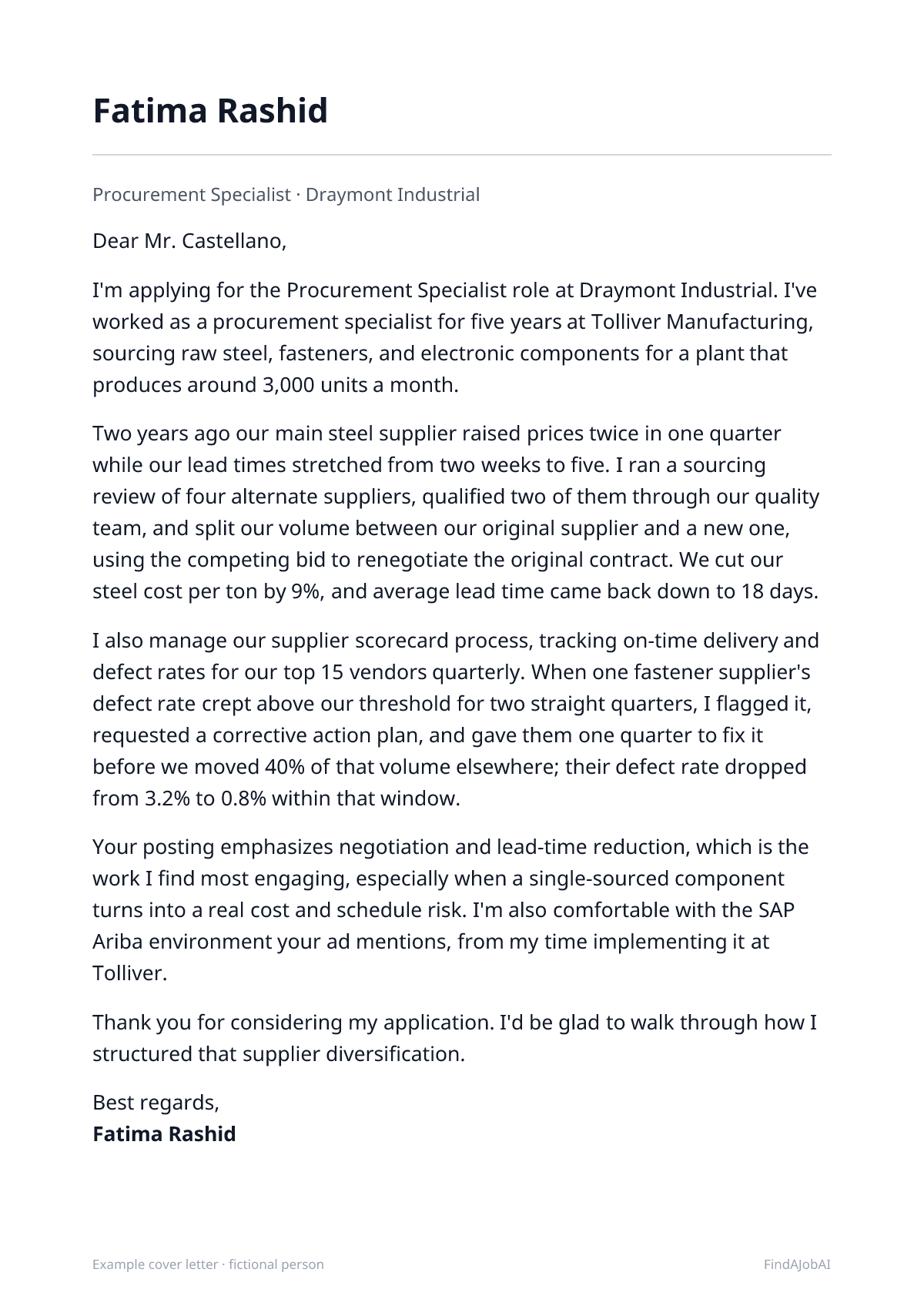
Dear Mr. Castellano,
I'm applying for the Procurement Specialist role at Draymont Industrial. I've worked as a procurement specialist for five years at Tolliver Manufacturing, sourcing raw steel, fasteners, and electronic components for a plant that produces around 3,000 units a month.
Two years ago our main steel supplier raised prices twice in one quarter while our lead times stretched from two weeks to five. I ran a sourcing review of four alternate suppliers, qualified two of them through our quality team, and split our volume between our original supplier and a new one, using the competing bid to renegotiate the original contract. We cut our steel cost per ton by 9%, and average lead time came back down to 18 days.
I also manage our supplier scorecard process, tracking on-time delivery and defect rates for our top 15 vendors quarterly. When one fastener supplier's defect rate crept above our threshold for two straight quarters, I flagged it, requested a corrective action plan, and gave them one quarter to fix it before we moved 40% of that volume elsewhere; their defect rate dropped from 3.2% to 0.8% within that window.
Your posting emphasizes negotiation and lead-time reduction, which is the work I find most engaging, especially when a single-sourced component turns into a real cost and schedule risk. I'm also comfortable with the SAP Ariba environment your ad mentions, from my time implementing it at Tolliver.
Thank you for considering my application. I'd be glad to walk through how I structured that supplier diversification.
Best regards,
Fatima Rashid
Example 2 · Career changer
Warehouse clerk moving into procurement
Marcus has handled informal vendor ordering for two years without the title. The ad mentions purchase order accuracy and vendor onboarding.
Example letter · fictional
Dear Hiring Manager,
I'm writing about the Procurement Specialist opening at Winslow Hardware Supply. I've been a warehouse clerk at a regional building supply distributor for four years, and for the past two I've reordered 30 of our fastest-moving SKUs by hand whenever our buyer was swamped.
Our reorder process used to run on a paper checklist, and we stocked out of three popular items every month because nobody tracked lead times by vendor. I built a spreadsheet that combined our sales velocity data with each vendor's actual delivery history, and set reorder points based on real lead times instead of a flat 30-day assumption. Stockouts on those 30 SKUs dropped from three a month to near zero over two quarters, and our buyer now uses my reorder points for the whole category.
I've since completed a procurement fundamentals course covering purchase order processes and vendor negotiation basics, and I'm comfortable in our ERP system for creating and tracking purchase orders, which I now do accurately enough that our buyer stopped double-checking my entries last year.
Your posting mentions purchase order accuracy and vendor onboarding, both things I've handled informally already. I'd bring that warehouse-floor understanding of what a stockout actually costs, along with the procurement fundamentals I've since built on. I'd also keep a simple vendor file with each supplier's real delivery record, so onboarding a new one starts from facts.
I'd be glad to show you the reorder spreadsheet and talk about how that work would grow into a full procurement role. Thank you for reading.
Kind regards,
Marcus Delaney
Example 3 · Senior or lead
Procurement manager applying to build a formal sourcing function
Hana manages three specialists at a food processing company. The ad is for a procurement manager to formalize supplier contracts and reduce maverick spend.
Example letter · fictional
Dear Mr. Hendricks,
I'm applying for the Procurement Manager role at Falkirk Food Group. For three years I've managed three procurement specialists at Thornbury Foods, overseeing roughly $40 million in yearly spend across packaging, ingredients and logistics contracts, after six years as a senior specialist.
Your ad mentions reducing maverick spend, purchases made outside approved contracts. I tackled the same problem at Thornbury: nearly 20% of our packaging spend was going through informal, non-contracted orders at higher per-unit prices. I built a preferred-supplier list with pre-negotiated rates, made it the default option in our ERP's requisition flow, and required a manager sign-off for any purchase outside it. Maverick spend fell to under 5% within two quarters, and packaging cost per unit dropped by 7% from the negotiated rates alone.
Procurement earns credibility through contracts that hold up under pressure, not the lowest quoted price. When one ingredient supplier's quality slipped during a volume spike, I enforced the penalty clause I'd negotiated into their contract rather than quietly switching suppliers, which got their corrective action plan moving within a week instead of the usual month, and we kept production running without a quality incident.
I've built and mentored a team of three, two of whom I hired directly, but I haven't yet managed spend at your company's scale or negotiated across international suppliers, which your ad mentions, and I'd want to lean on your existing supplier relationships while I get up to speed there.
A conversation about which contracts are costing you the most in maverick spend today, and how your approval workflow currently works, would be a good place to start.
Sincerely,
Hana Bergstrom
All three letters, and the short version below, are fictional: the people, employers and numbers are invented. Borrow the structure, never the facts.
- Prefer to write it yourself? Use the free cover letter template.
- Check your CV against the job first: the free CV score shows the missing keywords.
Why the first letter works, paragraph by paragraph
Paragraph 1: Opening
States the categories sourced and the plant's production volume so the reader can gauge the scale of procurement experience against their own.
Paragraph 2: The supplier renegotiation
A specific cost and lead-time problem, the response (qualifying alternates, splitting volume, using competing bids), and the percentage saved, the metric a procurement team tracks directly.
Paragraph 3: Supplier accountability
Shows an ongoing process (quarterly scorecards) and one enforcement example with a defect-rate number, which demonstrates follow-through beyond the initial negotiation.
Paragraph 4: Why this company
Mirrors the ad's emphasis on negotiation and lead times, and names a specific system (SAP Ariba) the company likely uses.
Paragraph 5: Close
Offers a concrete next step, a walkthrough of the diversification strategy, instead of a general thank-you.
What the career changer's letter does differently
Marcus's letter starts from a reordering fix he made before the job title existed, with a number attached: stockouts fell from three a month to near zero. A procurement course and accurate ERP entries show the skills are now formal, and the warehouse background is tied directly to what the ad asks for.
What the senior letter does differently
A procurement manager letter reports on organizational discipline: a maverick spend percentage, a preferred-supplier list built into the ERP workflow, a penalty clause enforced under pressure. The contract-enforcement example shows judgment under a real quality incident, and the gap, scale and international sourcing, is named directly.
Short procurement specialist cover letter: an email-ready version
Many applications arrive as an email or a small text box, and a full page doesn't fit. This version runs 120 to 150 words and keeps only what a reader needs to decide whether to reply. A procurement specialist replies to a medical supply company's short online application field, because the ad said to apply directly by email.
Short version · email · fictional125 words
Subject: Procurement Specialist (supplier negotiation, Coupa) – medical consumables – Owen Takahashi
Hello Ms. Abara,
I'm applying for the Procurement Specialist role at Verlinda Medical Supply. I have four years of experience sourcing medical consumables for a regional distributor, managing contracts with around 20 suppliers in Coupa.
My most useful negotiation was with a glove supplier whose prices rose sharply during a shortage. I qualified two backup suppliers and used their bids to renegotiate our original contract, which brought our cost per unit down by 12% once the shortage eased and held our supply uninterrupted throughout it.
Consumables sourcing is where I'd like to apply the same method to your team. My resume is attached, and I can share how I qualified the backup suppliers and how I score each supplier category every quarter.
Best,
Owen Takahashi
With room for only one story, this version keeps a single negotiation, a clear percentage, and the point that supply never stopped during the shortage. Offering to share how the backup suppliers were qualified shows practical value without padding the note.
Opening lines that work for procurement specialist cover letters
The first sentence decides whether the second gets read. Here are six openings, one for each situation you might be in. Pick the one that matches yours and swap in your own facts: every name and number below is invented.
1. You have a standout result
A supplier renegotiation I led last year brought our cost per unit down by 12% during a shortage while keeping our supply uninterrupted. I'd like to bring that same approach to your sourcing team.
2. The ad names a problem you've solved
Your ad mentions reducing maverick spend. At my current company, I built a preferred-supplier workflow into our ERP that cut non-contracted purchases from 20% of spend to under 5% in two quarters.
3. Someone referred you
Your operations director, Simone Pratt, and I worked together on a packaging contract last year. She mentioned your team needs someone who can hold suppliers accountable after a deal closes, which is why I'm writing.
4. You admire what they build
I've worked with your company as a vendor-side account contact for two years, and the way your team structures volume commitments made me curious about the sourcing strategy behind it.
5. You're new to the field or switching into it
Four years as a warehouse clerk doing informal vendor reordering led me to build the reorder-point model our buyer still relies on. Procurement is where I want to keep solving that kind of problem full time.
6. You have senior scope or a specialism
After six years as a senior procurement specialist sourcing raw materials, I rebuilt the supplier scorecard process my company still runs. I want a role that owns category strategy rather than single contracts.
How to write a procurement specialist cover letter
Five steps, in the order you'd write them. The shape stays the same for every job (a short opening, proof, a reason for this employer, a close), and what goes into each part is what changes with the role.
Identify the sourcing or cost problem the ad is pointing at
Procurement ads usually hint at one pain point, such as rising costs, long lead times, maverick spend or supplier quality. Find the exact phrase in the ad and choose a story from your own work that answers it closely instead of in general terms.
Open with the negotiation or fix, not your job title
Say what cost or supply problem you solved and what changed because of it, in one or two sentences. A reader looking for proof of negotiation skill should find it before your first paragraph ends.
Quantify the savings or risk avoided, not the activity
Give the percentage or dollar figure saved, the lead time reduced, or the spend brought under contract. A negotiation described without a number reads as an anecdote, not a qualification. State the period and which category of spend it covered.
Name your systems inside the negotiation, not as a list
Mention your ERP or procurement platform (SAP Ariba, Coupa, Oracle) as the tool you used to track or execute the specific deal above. Say roughly how many suppliers or how much spend it covered. Keep the name of the supplier out of it.
Show how you hold suppliers accountable after the contract is signed
One sentence on how you monitor supplier performance: a scorecard, a penalty clause enforced, a corrective action plan requested. Close by naming a specific category or supplier relationship you'd want to look into in their operation.
Procurement Specialist cover letter do's and don'ts
Do
- Name the category sourced (steel, components, packaging) and the supplier problem you solved, with the percentage or dollar figure saved.
- Mention the ERP or procurement system the ad names (SAP Ariba, Coupa, Oracle) inside a story about using it to solve something.
- Show how you hold suppliers accountable after a deal closes, not just how you negotiated it.
Don't
- Don't write "skilled negotiator with strong vendor relationships"; show the renegotiation and the percentage it saved.
- Don't count the number of POs processed; one renegotiated contract beats a thousand routine purchase orders.
- Don't disclose your current employer's actual supplier names or contract terms; describe the category and result without identifying details.
Common procurement specialist cover letter mistakes
Each one is easy to make and quick to fix before you send the letter.
Describing duties instead of a completed negotiation
"Negotiated contracts and managed vendor relationships" is a job description. Say what specific negotiation you ran, against what problem, and what it saved.
Giving a savings figure with no baseline or cause
"Reduced procurement costs" means little without the starting price, what caused the change, and the new number. State all three so the claim can be evaluated.
Listing every procurement platform without a story
A row of Ariba, Coupa, and Oracle names suggests shallow use of each. Name the one tied to the negotiation you're describing and how much spend or how many suppliers it covered.
Leaving out what you source or who you source it for
A letter that never names a category, like packaging, raw materials, or MRO supplies, could apply to any procurement job. Name the category so the reader can match it to their own spend.
Writing "strong negotiator" instead of proving it
Every applicant claims this. Replace it with the actual negotiation: the supplier, the sticking point, and the number you walked away with.
Email subject lines for procurement specialist applications
Applying by email? Put the job title, any reference number and your name in the subject line.
- Procurement Specialist application – raw materials sourcing, manufacturing – Fatima Rashid
- Procurement Specialist – warehouse clerk with ERP and reorder experience – Marcus Delaney
- Application: Procurement Specialist, Indirect Spend (Req. 3087) – Fatima Rashid
Everything for Procurement Specialists
- Procurement Specialist resume exampleA full resume, plus bullet and summary examples
- Procurement Specialist interview questions30 questions with sample answers
- Procurement Specialist job descriptionDuties, skills and requirements
- Career change cover letter: template + examples
Other cover letter examples
Procurement Specialist cover letter FAQ
What should I write in a procurement specialist cover letter?
Tell one sourcing story: the category, what went wrong, what you did and the cost or lead-time figure that improved. Add a line on how you track supplier performance afterward. Leave certifications and software names to your resume.
How do I write a procurement specialist cover letter with no formal title?
Use vendor ordering, reordering, or vendor-facing work from a warehouse, retail, or admin role, even informal. Name a specific stockout or cost problem you fixed, then add any procurement coursework and the systems you're comfortable in.
Should I name specific suppliers in a procurement cover letter?
Name the category (steel, packaging, electronic components) rather than your current employer's actual supplier, which may be confidential. Describe the negotiation and result specifically enough to be credible without naming the vendor.
How we built this page
The FindAJobAI team wrote the three example letters, the short email version, the opening lines and the advice for procurement specialist roles. The people, employers and numbers in the letters are invented; the structure, the kind of evidence and the order of the paragraphs are the parts to copy.
Once we track enough live procurement specialist job ads, this page also shows the skills they ask for most, counted the same way as our in-demand skills report.
Last reviewed on November 1, 2026.