Special Education Teacher Cover Letter Example (2026)
By FindAJobAI team Updated How we built this page
Special education postings ask for the same credential and the same caseload math, so a cover letter has to show how you actually run an IEP, not just that you hold one. Name a student's goal, what you changed in the room to reach it, and how you kept parents and related-service providers in the loop.
Special Education Teacher cover letter template
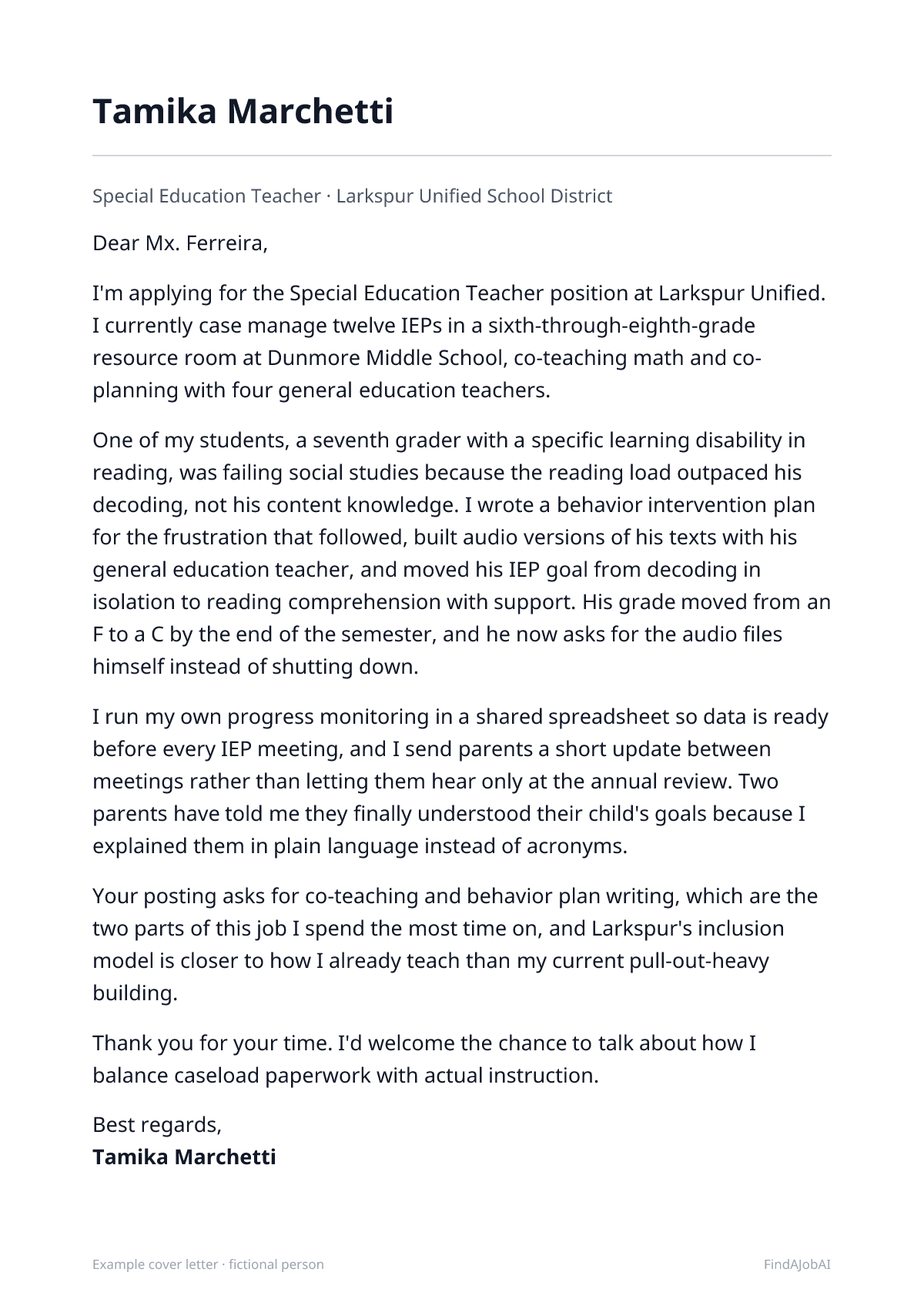
This letter as a one-page template: an opening that names the job and your strongest fact, proof that answers the ad, a reason for this employer and a short close.
After you sign up, FindAJobAI drafts your own letter for a real job from your CV in this format, and you edit it before you send it.
Example 1 · Experienced
Middle school case manager applying to a larger district
Tamika manages twelve IEPs in a resource room. The ad asks for co-teaching experience and behavior plan writing.
Example letter · fictional
Dear Mx. Ferreira,
I'm applying for the Special Education Teacher position at Larkspur Unified. I currently case manage twelve IEPs in a sixth-through-eighth-grade resource room at Dunmore Middle School, co-teaching math and co-planning with four general education teachers.
One of my students, a seventh grader with a specific learning disability in reading, was failing social studies because the reading load outpaced his decoding, not his content knowledge. I wrote a behavior intervention plan for the frustration that followed, built audio versions of his texts with his general education teacher, and moved his IEP goal from decoding in isolation to reading comprehension with support. His grade moved from an F to a C by the end of the semester, and he now asks for the audio files himself instead of shutting down.
I run my own progress monitoring in a shared spreadsheet so data is ready before every IEP meeting, and I send parents a short update between meetings rather than letting them hear only at the annual review. Two parents have told me they finally understood their child's goals because I explained them in plain language instead of acronyms.
Your posting asks for co-teaching and behavior plan writing, which are the two parts of this job I spend the most time on, and Larkspur's inclusion model is closer to how I already teach than my current pull-out-heavy building.
Thank you for your time. I'd welcome the chance to talk about how I balance caseload paperwork with actual instruction.
Best regards,
Tamika Marchetti
Example 2 · Career changer
Paraprofessional moving into a special education teacher role
Devon has worked as a one-to-one aide for three years and just finished an alternative certification. The ad is for an elementary self-contained classroom.
Example letter · fictional
Dear Ms. Quintrell,
I'm applying for the Special Education Teacher opening in the self-contained classroom at Abernethy Elementary. For three years I've worked as a one-to-one paraprofessional for a nonverbal student with autism, and I just finished my alternative certification in special education so I can take on my own classroom.
My student communicated almost entirely through a picture exchange system when I started. I worked with our speech-language pathologist to introduce a speech-generating device, built a visual schedule for every transition in his day, and tracked which prompts he still needed versus which he'd dropped. Over a year he went from needing a full physical prompt to board a bus to waiting at the door with his schedule card on his own, and he now initiates requests with the device instead of grabbing.
That year also meant sitting through every one of his IEP meetings, which taught me how goals get written, how data gets reported, and how a case manager talks to a nervous parent. I completed my student teaching in a kindergarten self-contained room this spring, where I wrote and led two IEP meetings under my mentor's supervision.
Your posting is for a self-contained elementary classroom, which is exactly the setting I trained in, and I already know how to read a child's frustration before it becomes a crisis, because I've spent three years doing it from the aide's seat.
I'd appreciate the chance to discuss the role. Thank you for considering my application.
Sincerely,
Devon Okonkwo-Hale
Example 3 · Senior or lead
Autism program lead applying to start a new district program
Noor runs an autism support program at one school. The ad asks her to design and launch a second program at another building.
Example letter · fictional
Dear Dr. Castellanos,
I'm applying for the Special Education Program Lead role at Wrenfield, building the district's second autism support program. I've run the autism program at Hollis Creek Elementary for five years, growing it from one classroom of six students to two classrooms serving fourteen, and I supervise three teachers and five paraprofessionals.
Your posting says Wrenfield has students with autism dispersed across general education classrooms with inconsistent support. I built Hollis Creek's program the same way it started: I ran a building-wide training on visual supports and de-escalation for every classroom teacher, then set up a resource room staffed on a rotating basis so support traveled to the student instead of pulling every student out. Within two years, four students who'd needed a self-contained placement were able to move to inclusion with push-in support, and our out-of-district placement requests dropped from three a year to zero.
I also rebuilt how we track behavior data. Teachers were filling out incident reports nobody read until a crisis forced a meeting. I replaced it with a one-page weekly tracker reviewed every Friday by me and the student's teacher, so patterns show up before a placement decision has to be made under pressure. Two students avoided a change of placement because the data caught a trigger, a lunchroom transition, that a schedule change fixed.
I haven't opened a second site from scratch, only grown one, and I haven't yet hired a full team rather than inheriting most of mine, so I'd want to lean on your HR team early for a realistic timeline on staffing.
I'd welcome a conversation about which buildings you're prioritizing first and what data you already have on where support is thinnest.
Sincerely,
Noor Behrens-Adeyemi
All three letters, and the short version below, are fictional: the people, employers and numbers are invented. Borrow the structure, never the facts.
- Prefer to write it yourself? Use the free cover letter template.
- Check your CV against the job first: the free CV score shows the missing keywords.
Why the first letter works, paragraph by paragraph
Paragraph 1: Opening
Names the exact caseload and co-teaching arrangement, which tells the reader the scale and model Tamika already works in before any story starts.
Paragraph 2: The student example
One student, one specific gap between ability and the paperwork trail, the fix across two documents (BIP and IEP goal), and a result in the student's own grade and behavior, not a vague 'improved outcomes.'
Paragraph 3: Data and family communication
Shows the unglamorous parts of the job, progress monitoring and parent updates, with a concrete habit (a shared spreadsheet, between-meeting updates) rather than a claim of being 'communicative.'
Paragraph 4: Why this district
Matches the ad's two named requirements and gives an honest, specific reason the model suits her, rather than generic enthusiasm for the district.
Paragraph 5: Close
Names the real tension of the job, paperwork versus instruction, which signals she understands the role's actual pressure points.
What the career changer's letter does differently
The paraprofessional's letter leads with hands-on experience with one student rather than a philosophy statement, measures progress in the student's own independence (a physical prompt to an unprompted wait), and uses the IEP meetings he sat through as evidence he already understands case management before naming his new certification and student teaching.
What the senior letter does differently
A program lead letter reports the shape of a program over years, not one student's semester: a self-contained room grown into two classrooms, out-of-district placements dropping to zero, a weekly data review that caught problems before a crisis forced a placement change. The gap, launching a site from scratch rather than growing one, is named rather than hidden.
Short special education teacher cover letter: an email-ready version
Many applications arrive as an email or a small text box, and a full page doesn't fit. This version runs 120 to 150 words and keeps only what a reader needs to decide whether to reply. A speech-impairment resource teacher answers a district's short online form after a referral from a colleague, sent as a follow-up email.
Short version · email · fictional128 words
Subject: Special Education Teacher (Mild-Moderate) application – Tamsin Oyelaran
Hello Mr. Castellano,
I'm applying for the Mild-Moderate Special Education Teacher role at Birchgate, referred by your current resource teacher, Odalys Freitag, who was my mentor during student teaching.
I case manage nine IEPs in a resource room at Coppervale Middle School, mostly students with specific learning disabilities in reading and math. One student's math goal moved from failing to passing after I paired explicit instruction with a visual fraction model his general education teacher now uses with the whole class.
I'm drawn to Birchgate's co-teaching model, which matches how I already split my week. My resume is attached, and I'm glad to share a sample progress report. I'd welcome the chance to talk through how I split a co-taught lesson with a general educator.
Best,
Tamsin Oyelaran
The short version keeps the referral, one student result with a concrete teaching method, and a reason the specific model fits, cutting the broader data-and-communication habits the full letter covers for space.
Opening lines that work for special education teacher cover letters
The first sentence decides whether the second gets read. Here are six openings, one for each situation you might be in. Pick the one that matches yours and swap in your own facts: every name and number below is invented.
1. You have a standout result
One student on my caseload moved from a failing grade to passing after I paired his reading goal with an audiobook accommodation his teacher still uses. I'd like to bring that kind of problem-solving to your resource room.
2. The ad names a problem you've solved
Your posting mentions a caseload of co-teaching and pull-out support split across three grade levels. I currently split my week the same way between two grade bands, so the schedule is already familiar.
3. Someone referred you
Your current case manager, Odalys Freitag, supervised my student teaching and suggested I apply, which is why I'm writing.
4. You admire what they build
I substitute taught in your district's resource rooms last spring and noticed how consistently your staff use visual schedules; that's the kind of building I'd like to teach in permanently.
5. You're new to the field or switching into it
I spent three years as a one-to-one paraprofessional before finishing my certification, and I'd like to bring that hands-on experience to a classroom of my own.
6. You have senior scope or a specialism
As an autism program lead for five years, I've grown one classroom into two and cut outside placements to zero. I'm looking for a role that lets me build a second program from the ground up.
How to write a special education teacher cover letter
Five steps, in the order you'd write them. The shape stays the same for every job (a short opening, proof, a reason for this employer, a close), and what goes into each part is what changes with the role.
Name the setting and caseload the ad describes
Resource room, self-contained, inclusion, and co-teach are different jobs with different daily rhythms. Read the ad for the setting, grade band, and disability categories, then open by naming experience that matches, so the reader doesn't have to guess whether you've done this specific job.
Tell one student's story with a real before and after
Pick a student whose goal, intervention, and result you can describe without identifying them. State what wasn't working, what you changed in instruction or the IEP, and what changed in the student's grades, behavior, or independence. One clear story carries more weight than a list of strategies.
Show your IEP and data habits, not just your philosophy
Mention a concrete practice: how you track progress monitoring data, how often you update parents, or how you prepare for a meeting. Administrators read many letters claiming to be 'data-driven'; a specific habit, like a weekly tracker or a plain-language parent update, is what actually reads as credible.
Address collaboration with specific people, not a category
Name the roles you've worked alongside, a speech-language pathologist, a behavior specialist, a general education co-teacher, and what you did together. Saying you co-built a visual schedule with a related-service provider shows you know this job runs through other adults, not just the student.
Close on the part of the ad that matches you best
Pick the one line in the posting, a specific model, population, or responsibility, that most matches your experience, and say plainly why it suits you. A reason tied to the actual posting reads as more sincere than a general statement about loving to teach.
Special Education Teacher cover letter do's and don'ts
Do
- Describe one student's goal, what you changed in the room or the IEP, and how the student's own behavior or data changed.
- Name the setting the ad asks for (resource room, self-contained, inclusion, co-teach) and show you've worked in something close to it.
- Mention how you handle paperwork and parent communication between meetings, not just at the annual review.
Don't
- Don't describe a student in enough identifying detail that a reader outside the school could guess who it is; change or omit identifying details.
- Don't write "I have a passion for helping all learners"; show one learner and what you actually did.
- Don't claim a specific diagnosis category you haven't actually taught if the ad asks for a different one; name what you have taught honestly.
Common special education teacher cover letter mistakes
Each one is easy to make and quick to fix before you send the letter.
Writing about students in identifying detail
Describing a real student's grade, diagnosis, and school by name risks violating confidentiality even in a cover letter. Describe the type of need and the intervention, and change or drop details that could identify the child.
Leading with a philosophy statement
"I believe every child deserves a chance to succeed" could be written by any applicant. Replace it with one sentence naming the setting you teach in, then move straight into a specific student example.
Listing certifications without showing the work
A credential tells the reader you're qualified on paper, not that you can run a classroom. Pair your certification or endorsement with one example of using it, such as writing a behavior plan or leading an IEP meeting.
Treating paraprofessional experience as a footnote
Aide experience is real classroom experience with a specific student, often more hands-on than some teaching assignments. Describe it with the same detail you'd give a lead teaching role, including what you changed and what resulted.
Ignoring the ad's stated model or population
A generic letter that could apply to any special education opening signals you haven't read the posting closely. Name the specific setting, grade band, or population the ad describes and connect it to matching experience.
Email subject lines for special education teacher applications
Applying by email? Put the job title, any reference number and your name in the subject line.
- Special Education Teacher application – resource room case manager – Tamika Marchetti
- Special Education Teacher – paraprofessional, newly certified – Devon Okonkwo-Hale
- Application: Special Education Teacher, Grades 3-5 (Posting 2241) – Tamika Marchetti
Everything for Special Education Teachers
- Special Education Teacher resume exampleA full resume, plus bullet and summary examples
- Special Education Teacher interview questions30 questions with sample answers
- Special Education Teacher job descriptionDuties, skills and requirements
- Career change cover letter: template + examples
Other cover letter examples
Special Education Teacher cover letter FAQ
What should I write in a special education teacher cover letter?
One student's goal, what you changed in instruction or in the IEP to reach it, and how the student's own performance or behavior changed. Then a line on how you handle data and parent communication. Your certification and endorsement are already on your resume.
How do I write a special education teacher cover letter with no classroom experience of my own?
Use your work as a paraprofessional, student teacher, or in a related role, naming one student's progress you helped produce. Add your certification program and anything from student teaching where you ran a lesson, wrote a goal, or sat in an IEP meeting.
Should I name a student's disability in my cover letter?
Keep identifying details general; describe the type of need (reading comprehension, communication, behavior) rather than anything that could identify a real child, since FERPA protects student records even in an informal cover letter.
How long should a special education teacher cover letter be?
About one page. Principals reading dozens of applications want one clear example of your work with a student and a sense of the setting you've taught in, not a full philosophy of education.
How we built this page
The FindAJobAI team wrote the three example letters, the short email version, the opening lines and the advice for special education teacher roles. The people, employers and numbers in the letters are invented; the structure, the kind of evidence and the order of the paragraphs are the parts to copy.
Once we track enough live special education teacher job ads, this page also shows the skills they ask for most, counted the same way as our in-demand skills report.
Last reviewed on November 1, 2026.