Speech-Language Pathologist Cover Letter Example (2026)
By FindAJobAI team Updated How we built this page
Speech-language pathologist ads often list the same caseload categories, articulation, language, fluency, feeding, so most applicants look alike on paper. A cover letter stands out by naming one student or client, the goal you set, and the progress you can actually measure.
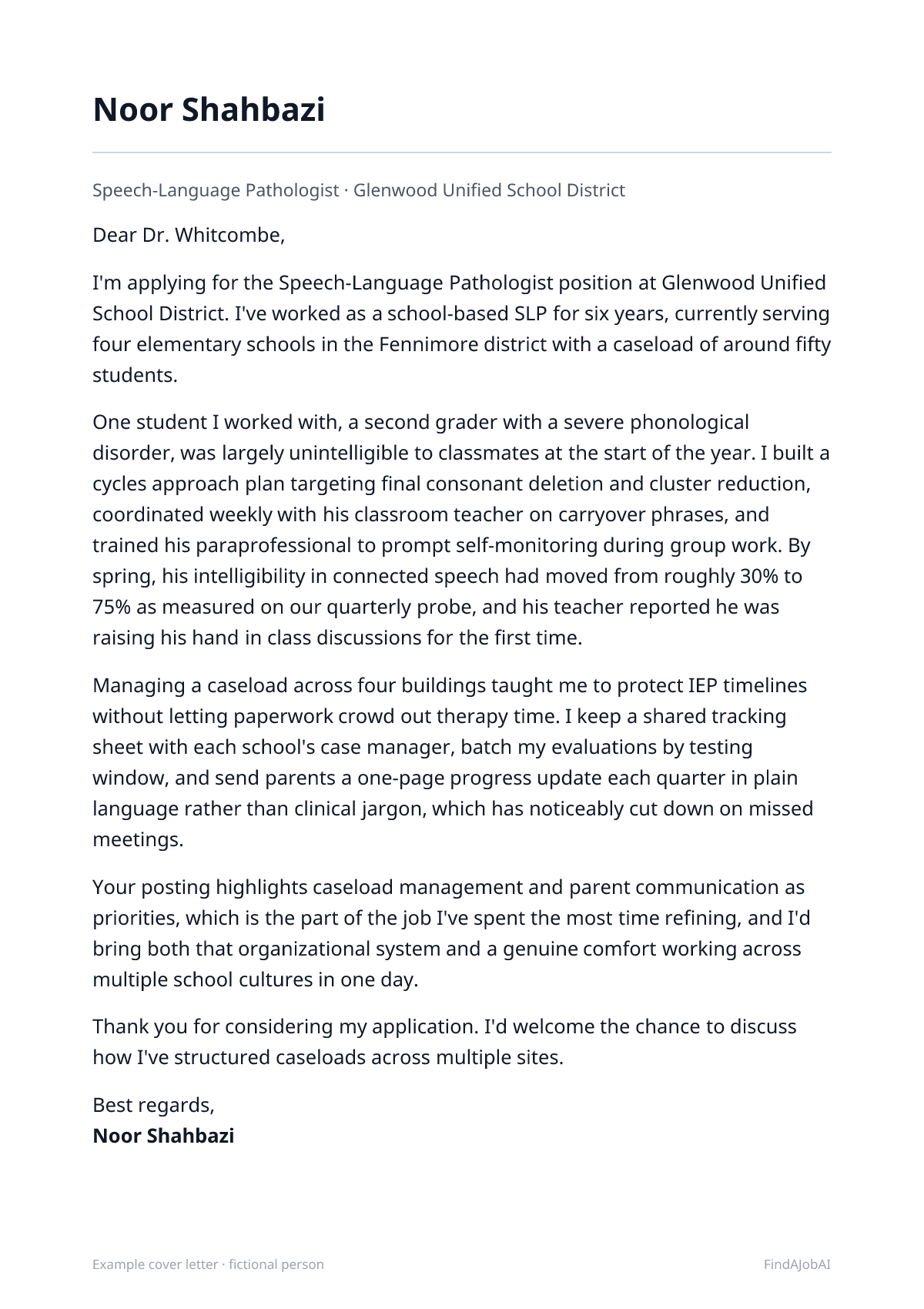
Speech-Language Pathologist cover letter template
This letter as a one-page template: an opening that names the job and your strongest fact, proof that answers the ad, a reason for this employer and a short close.
After you sign up, FindAJobAI drafts your own letter for a real job from your CV in this format, and you edit it before you send it.
Example 1 · Experienced
Elementary school SLP applying to a district with a large caseload
Noor serves four elementary schools and manages IEP compliance. The ad stresses caseload management and parent communication.
Example letter · fictional
Dear Dr. Whitcombe,
I'm applying for the Speech-Language Pathologist position at Glenwood Unified School District. I've worked as a school-based SLP for six years, currently serving four elementary schools in the Fennimore district with a caseload of around fifty students.
One student I worked with, a second grader with a severe phonological disorder, was largely unintelligible to classmates at the start of the year. I built a cycles approach plan targeting final consonant deletion and cluster reduction, coordinated weekly with his classroom teacher on carryover phrases, and trained his paraprofessional to prompt self-monitoring during group work. By spring, his intelligibility in connected speech had moved from roughly 30% to 75% as measured on our quarterly probe, and his teacher reported he was raising his hand in class discussions for the first time.
Managing a caseload across four buildings taught me to protect IEP timelines without letting paperwork crowd out therapy time. I keep a shared tracking sheet with each school's case manager, batch my evaluations by testing window, and send parents a one-page progress update each quarter in plain language rather than clinical jargon, which has noticeably cut down on missed meetings.
Your posting highlights caseload management and parent communication as priorities, which is the part of the job I've spent the most time refining, and I'd bring both that organizational system and a genuine comfort working across multiple school cultures in one day.
Thank you for considering my application. I'd welcome the chance to discuss how I've structured caseloads across multiple sites.
Best regards,
Noor Shahbazi
Example 2 · Career changer
Speech-language paraprofessional moving into the SLP role
Yevgenia has completed her CF-eligible coursework and clinical hours while working as a paraprofessional. The ad accepts new graduates with a CCC-SLP pending.
Example letter · fictional
Dear Hiring Manager,
I'm applying for the Speech-Language Pathologist, Clinical Fellow position at Birchgrove Pediatric Therapy. I've spent three years as a speech paraprofessional supporting SLPs in an elementary resource room, and I recently completed my master's degree and clinical practicum hours to become a CF-eligible clinician.
During my student placement, I worked under supervision with a nonverbal preschooler using an AAC device for the first time. I built a core vocabulary board around his daily routines, coached his parents on modeling two-word combinations at home instead of only prompting requests, and within ten weeks he was initiating four-word phrases independently at snack time. My supervisor used that case in her own report to the district as an example of successful early AAC implementation.
As a paraprofessional, I ran small-group articulation drills, documented data for the SLPs I supported, and sat in on IEP meetings, which gave me an unusually clear view of what makes a therapy plan practical for a classroom to actually carry out day to day. I'm comfortable with the Goldman-Fristoe and CELF-5 from my practicum testing, and familiar with PECS and core vocabulary AAC systems.
Your posting welcomes new graduates completing a clinical fellowship, and I'd bring both that fresh assessment training and three years of hands-on classroom experience most new CFs haven't had yet. I'm also eager to learn your documentation templates and the way your supervisors give feedback on session notes.
Thank you for your time. I'd welcome the opportunity to discuss my practicum caseload and how I'd approach my CF year with your supervision.
Kind regards,
Yevgenia Sorokina
Example 3 · Senior or lead
Clinical supervisor applying to lead a growing pediatric therapy team
Baaba supervises eight SLPs and clinical fellows at a pediatric clinic. The ad is for a first clinical director who will set protocols and manage growth.
Example letter · fictional
Dear Ms. Pemberton,
I'm applying for the Clinical Director, Speech-Language Pathology role at Hollyfern Pediatric Center. For the last four years I've supervised a team of eight SLPs and clinical fellows at Thistlewood Pediatric Clinic, and before that I spent seven years as a treating clinician. I'd like to take on building out a clinical program as its first director.
Your ad says new clinical fellows often feel unsupported after their first few months, with inconsistent mentorship across supervisors. I saw the same pattern at Thistlewood. I built a structured CF onboarding plan with monthly competency checkpoints tied to ASHA's standards, paired each fellow with a dedicated mentor rather than rotating supervision, and our fellow retention through the full CF year went from roughly half to nearly all of them staying on afterward.
A clinical program earns trust through consistent outcomes, not just caseload volume. When our feeding therapy referrals tripled after a new NICU partnership, I noticed our discharge criteria varied clinician to clinician, so I led the team through writing shared feeding protocol benchmarks, and our average time to safe oral intake across the team became something we could actually report to referring physicians with confidence.
I've hired five of our current SLPs and run monthly peer case review sessions across the team. I haven't managed a program's budget or built a referral network from a cold start, and at Hollyfern I'd expect to lean on your administrative team early on while I learn those pieces.
A conversation about which referral sources you most want to grow and how fellows are currently mentored would be a good place to start.
Sincerely,
Baaba Asantewaa
All three letters, and the short version below, are fictional: the people, employers and numbers are invented. Borrow the structure, never the facts.
- Prefer to write it yourself? Use the free cover letter template.
- Check your CV against the job first: the free CV score shows the missing keywords.
Why the first letter works, paragraph by paragraph
Paragraph 1: Opening
States the setting (four elementary schools) and caseload size, which tells a school district reviewer the writer's scope and level before reading further.
Paragraph 2: The student and the progress made
A specific disorder, the treatment approach named by its clinical method (cycles approach), the collaboration with teacher and paraprofessional, and a measured outcome (intelligibility moving from roughly 30% to 75%) rather than a vague claim of improvement.
Paragraph 3: How the writer manages a caseload
Names concrete systems, a shared tracking sheet, batched evaluations, plain-language parent updates, that speak directly to the ad's stated priority and show organizational maturity beyond clinical skill.
Paragraph 4: Why this district
Mirrors the ad's two named priorities and adds a genuine reason, comfort across multiple school cultures, that fits a multi-site caseload.
Paragraph 5: Close
Offers a concrete, low-pressure next step, discussing the multi-site caseload system, rather than a generic request for an interview.
What the career changer's letter does differently
The career changer's letter starts from real, supervised clinical work (the AAC case) with a measured outcome, independent four-word phrases within ten weeks, and uses the supervisor's own reliance on that case as outside validation. It then explains how three years as a paraprofessional gives a practical view most new graduates lack, directly answering the ad's openness to a clinical fellow.
What the senior letter does differently
A clinical director letter reports program-level habits, a structured CF onboarding plan, shared feeding protocol benchmarks, fellow retention that improved, rather than one clinician's caseload. The feeding protocol example shows the writer's leadership changing team-wide practice, and the gap, no budget or referral-network experience, is named plainly.
Short speech-language pathologist cover letter: an email-ready version
Many applications arrive as an email or a small text box, and a full page doesn't fit. This version runs 120 to 150 words and keeps only what a reader needs to decide whether to reply. An SLP answers a private practice's short application form after a referral from a former colleague, by email since the ad asked for a direct introduction.
Short version · email · fictional124 words
Subject: Speech-Language Pathologist application – pediatric caseload – Idris Okonkwo
Hello Ms. Caldeira,
I'm applying for the Speech-Language Pathologist role at Marrowbrook Speech Clinic. I have five years of pediatric experience in an outpatient setting, focused mainly on articulation and childhood apraxia of speech.
One case I'm proud of involved a kindergartner with moderate apraxia who started therapy nearly unintelligible to his parents. Using a motor-based approach with high-frequency drilling, he was producing clear three-word sentences within six months, and his parents told me it was the first time they understood him without guessing.
I'd welcome the chance to bring that approach to your caseload. My resume is attached, and I'm happy to discuss my current openings and availability. I can also send an anonymized case summary and my certification details.
Best,
Idris Okonkwo
A short application field forces one case, so the version keeps the apraxia example and its concrete, parent-reported outcome rather than a list of settings worked in. Naming the specific therapy approach signals clinical substance even in a few sentences.
Opening lines that work for speech-language pathologist cover letters
The first sentence decides whether the second gets read. Here are six openings, one for each situation you might be in. Pick the one that matches yours and swap in your own facts: every name and number below is invented.
1. You have a standout result
A kindergartner I treated for apraxia went from largely unintelligible to speaking in clear three-word sentences within six months, and his parents told me it was the first time they understood him without guessing. I'd like to do that kind of work for your caseload.
2. The ad names a problem you've solved
Your ad mentions clinical fellows feeling unsupported in their first months. At my current clinic I built a structured onboarding plan with monthly checkpoints, and fellow retention through the full CF year improved noticeably as a result.
3. Someone referred you
Your lead SLP, Marguerite Delacroix, supervised my practicum two years ago and suggested I apply, since she knew I'd be a strong fit for your AAC-heavy caseload.
4. You admire what they build
I've volunteered at your clinic's community hearing screening events for two years, and the way your team talks with families about next steps is part of why I'd like to join full time.
5. You're new to the field or switching into it
I spent three years as a speech paraprofessional before completing my CF year, and the practical classroom view that gave me is something I still rely on with every student I treat now.
6. You have senior scope or a specialism
As a clinical supervisor for four years, I built the CF onboarding plan my clinic still uses and led a team-wide rewrite of our feeding therapy protocols. I'm looking for a role where I can build a clinical program from its first hires.
How to write a speech-language pathologist cover letter
Five steps, in the order you'd write them. The shape stays the same for every job (a short opening, proof, a reason for this employer, a close), and what goes into each part is what changes with the role.
Match the caseload the ad is actually describing
School, pediatric outpatient, adult rehab, and skilled nursing caseloads call for different stories. Read what disorder areas and ages the ad lists, then choose a real case of yours in that category. An adult dysphagia case won't land in a letter for a pediatric articulation caseload.
Open with the student or client's progress, not your credentials
Name the goal area and a measurable or clearly observed change in one or two sentences before describing your approach or certifications. A reader who sees a real outcome in your first paragraph trusts the rest of the letter more.
Describe the method and the result together
Pair the clinical approach you used, such as the cycles approach, PROMPT, or a core vocabulary AAC system, with what changed for the client. Naming an approach without an outcome reads like a list; naming an outcome without the approach reads like luck.
Keep every case example anonymous
Use a grade level, age range, or disorder type instead of a name or identifying detail. This protects confidentiality and is expected in the field, and a specific-enough description still reads as credible without crossing that line.
Show how you work with the people around the client
Mention one concrete way you coordinate with teachers, parents, or caregivers to support carryover outside the therapy room. Close by naming a type of case or goal area you're drawn to on this caseload, so the reader sees where you'd focus early on.
Speech-Language Pathologist cover letter do's and don'ts
Do
- Name one student or client, the goal and method you used, and a measurable change, even an informal classroom observation counts.
- Mention specific assessments or approaches the ad implies (cycles approach, PROMPT, AAC systems) only where you've actually used them.
- Show how you work with teachers, parents or caregivers, since carryover outside the therapy room is often what makes progress stick.
Don't
- Don't describe yourself as "passionate about helping children communicate"; show it with one case and its outcome.
- Don't use a student's real name or identifying details, even informally; a grade level and disorder type is specific enough.
- Don't list every assessment tool you've ever administered; name the ones relevant to this caseload and how you used them.
Common speech-language pathologist cover letter mistakes
Each one is easy to make and quick to fix before you send the letter.
Writing "passionate about communication" as the reason
Nearly every SLP applicant writes some version of this. Replace it with one real case and its outcome, which shows the motivation instead of asserting it.
Naming a student or identifying details
Even informal identifying details can raise confidentiality concerns. Use a grade level and disorder or goal area instead, which is specific enough to be convincing on its own.
Listing every assessment and approach ever used
A long list of tools and methods reads as unfocused. Name the ones relevant to this caseload and attach one of them to a real case and outcome.
Describing caseload size without describing outcomes
"Managed a caseload of sixty students" says nothing about results. Pick one case from that caseload and describe the goal, the approach, and what changed.
Skipping how you work with teachers or caregivers
A letter focused only on direct therapy time misses half the job. Add one sentence on how you coordinate carryover, since that's often what makes progress stick between sessions.
Email subject lines for speech-language pathologist applications
Applying by email? Put the job title, any reference number and your name in the subject line.
- Speech-Language Pathologist application – multi-site elementary caseload – Noor Shahbazi
- SLP Clinical Fellow – AAC and articulation experience – Yevgenia Sorokina
- Application: School-Based SLP, Elementary (Req. 3017) – Noor Shahbazi
Everything for Speech-Language Pathologists
- Speech-Language Pathologist resume exampleA full resume, plus bullet and summary examples
- Speech-Language Pathologist interview questions30 questions with sample answers
- Speech-Language Pathologist job descriptionDuties, skills and requirements
- Career change cover letter: template + examples
Other cover letter examples
Speech-Language Pathologist cover letter FAQ
What should I write in a speech-language pathologist cover letter?
One student or client whose goal you worked on, the approach you used, and a measurable or observed change. Add a sentence on how you work with teachers or caregivers to support carryover. Your certifications and assessment tools are already on your resume.
How do I write an SLP cover letter as a new graduate or clinical fellow?
Use a supervised case from your practicum with a specific goal and outcome, then note which assessments you administered during training. Name a strength from a prior related role, such as paraprofessional or tutoring work, that gives you practical experience most new graduates lack.
Should I mention a student's name or specific details in my cover letter?
No. Keep any case example anonymous, a grade level and disorder type or goal area is specific enough to be convincing without identifying anyone.
Do I need to mention my ASHA certification or state license in the letter?
A brief mention is fine if the ad asks about licensure status directly, but your resume is the right place for certification numbers and dates. Use the letter's space for the case example and your fit for this caseload instead.
How we built this page
The FindAJobAI team wrote the three example letters, the short email version, the opening lines and the advice for speech-language pathologist roles. The people, employers and numbers in the letters are invented; the structure, the kind of evidence and the order of the paragraphs are the parts to copy.
Once we track enough live speech-language pathologist job ads, this page also shows the skills they ask for most, counted the same way as our in-demand skills report.
Last reviewed on November 1, 2026.