Tax Accountant Cover Letter Example (2026)
By FindAJobAI team Updated How we built this page
Tax accountant ads usually list the same software and certifications, so a cover letter earns its place by naming a filing, a notice or a deadline you actually handled. Say what the return involved, what you caught or saved, and who relied on the number being right.
Tax Accountant cover letter template
This letter as a one-page template: an opening that names the job and your strongest fact, proof that answers the ad, a reason for this employer and a short close.
After you sign up, FindAJobAI drafts your own letter for a real job from your CV in this format, and you edit it before you send it.
Example 1 · Experienced
Senior tax accountant applying to a manufacturing company
Desmond handles multi-state filings for a mid-size manufacturer. The ad asks for experience with apportionment and nexus questions.
Example letter · fictional
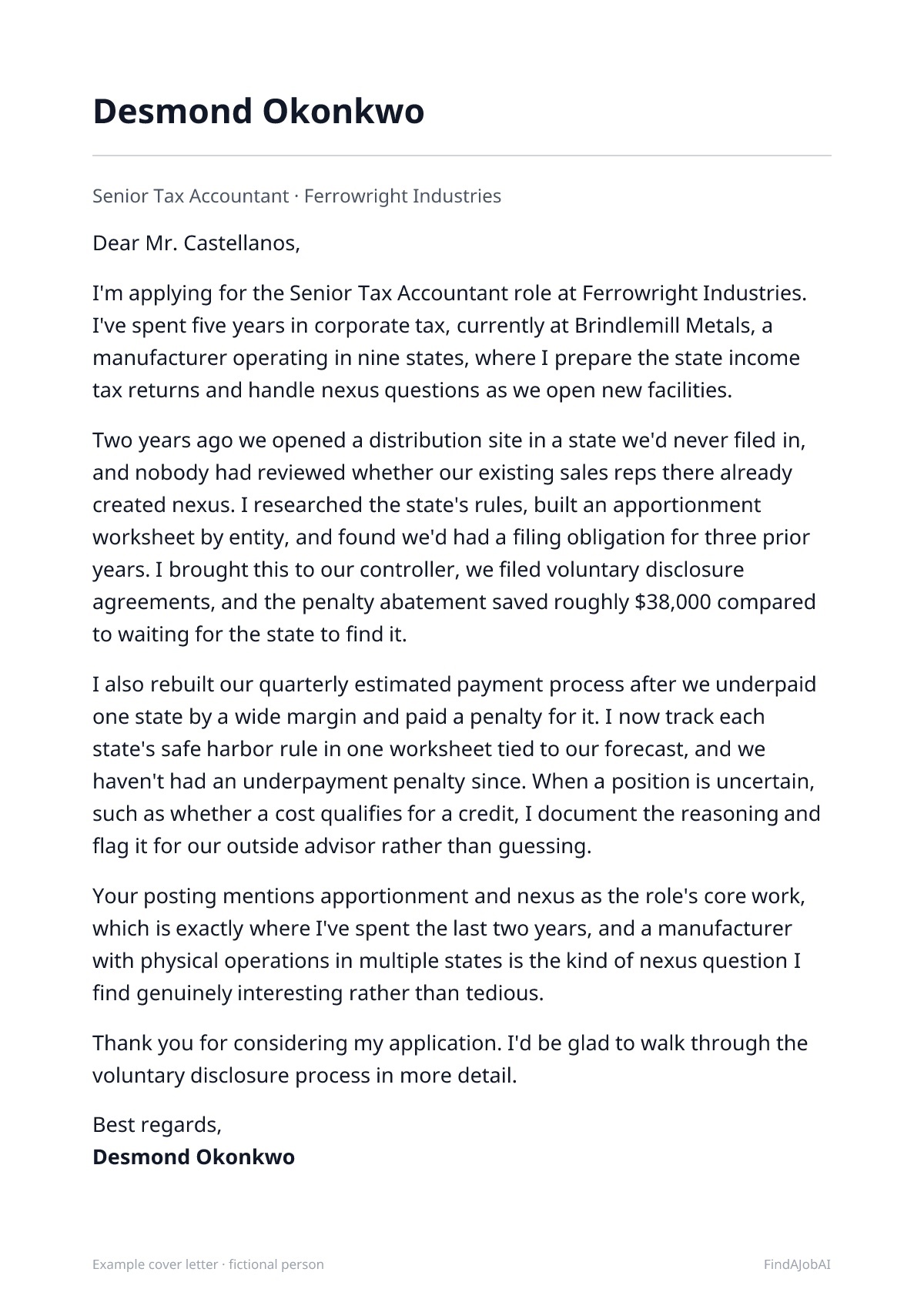
Dear Mr. Castellanos,
I'm applying for the Senior Tax Accountant role at Ferrowright Industries. I've spent five years in corporate tax, currently at Brindlemill Metals, a manufacturer operating in nine states, where I prepare the state income tax returns and handle nexus questions as we open new facilities.
Two years ago we opened a distribution site in a state we'd never filed in, and nobody had reviewed whether our existing sales reps there already created nexus. I researched the state's rules, built an apportionment worksheet by entity, and found we'd had a filing obligation for three prior years. I brought this to our controller, we filed voluntary disclosure agreements, and the penalty abatement saved roughly $38,000 compared to waiting for the state to find it.
I also rebuilt our quarterly estimated payment process after we underpaid one state by a wide margin and paid a penalty for it. I now track each state's safe harbor rule in one worksheet tied to our forecast, and we haven't had an underpayment penalty since. When a position is uncertain, such as whether a cost qualifies for a credit, I document the reasoning and flag it for our outside advisor rather than guessing.
Your posting mentions apportionment and nexus as the role's core work, which is exactly where I've spent the last two years, and a manufacturer with physical operations in multiple states is the kind of nexus question I find genuinely interesting rather than tedious.
Thank you for considering my application. I'd be glad to walk through the voluntary disclosure process in more detail.
Best regards,
Desmond Okonkwo
Example 2 · Career changer
Bookkeeper moving into tax accounting
Vera prepared simple returns for small-business clients before earning her credential. The ad wants comfort with individual and small-business returns.
Example letter · fictional
Dear Hiring Manager,
I'm applying for the Tax Accountant role at Oakspire Financial Group. For four years I've worked as a bookkeeper for a small accounting practice, and over the last two tax seasons I prepared individual and small-business returns under a partner's review. I recently earned my Enrolled Agent credential and want to move into tax work full time.
One client, a landscaping business, had mixed personal and business expenses in one account for years, which made their Schedule C unreliable. I rebuilt three years of transactions into a clean chart of accounts, reclassified a home office deduction they'd been missing, and their refund that year was about $2,400 higher than the prior preparer's estimate. The partner now has me review new small-business files before they go to her.
Since earning my EA, I've prepared around sixty individual returns and a dozen small-business returns, covering Schedule C, basic depreciation and estimated tax vouchers. I'm comfortable in UltraTax and QuickBooks, and I've started learning multi-state individual returns for clients who work across state lines.
Your posting asks for comfort with both individual and small-business returns, which describes the two years of review work I've just come through, and I'd bring both the preparation experience and the bookkeeping background that lets me spot a messy ledger before it becomes a bad return.
Thank you for your time. I'm glad to share a redacted sample of the Schedule C rebuild if that would help. I can also explain how I decide which returns need a partner's second look.
Kind regards,
Vera Pruitt
Example 3 · Senior or lead
Tax manager applying to build a first in-house tax function
Yolanda manages a team of three at a logistics firm. The ad is for a tax manager who will bring filings in-house from an outside firm.
Example letter · fictional
Dear Mr. Linnane,
I'm applying for the Tax Manager role at Casterbridge Freight. For the past three years I've managed a team of three tax accountants at Wrenfield Logistics, where we handle federal and multi-state filings for a trucking operation, and before that I spent seven years as a senior tax accountant. I'd like to bring that experience to building a team from its early stage.
Your ad says Casterbridge currently outsources its tax work and wants it brought in-house within a year. Wrenfield did the same move four years ago. I started by mapping every filing our outside firm handled, which state registrations existed, and which didn't but should have, given where our trucks actually ran. We found two states with filing obligations nobody had registered for. I built the transition plan around the firm's existing deadlines so nothing was missed mid-year, and we were fully in-house within ten months, cutting our outside fees from about $190,000 a year to under $40,000.
Tax managers earn trust by catching problems before they become penalties, not by filing faster. When a new terminal opened in a state with unusual fuel tax rules, I found our trucking apportionment method didn't match that state's mileage-based formula, which would have understated our liability. We corrected it before the first filing, and that review is now a standing step whenever we open a new terminal.
I've hired two of my three accountants and run a quarterly technical review where each of us presents a tricky position we took. I haven't managed a transition away from an outside firm before, and at Casterbridge I'd want to understand which filings carry the most risk before committing to a full timeline.
A conversation about which states or filings concern you most as you bring this in-house would be a useful place to start.
Sincerely,
Yolanda Pruitt
All three letters, and the short version below, are fictional: the people, employers and numbers are invented. Borrow the structure, never the facts.
- Prefer to write it yourself? Use the free cover letter template.
- Check your CV against the job first: the free CV score shows the missing keywords.
Why the first letter works, paragraph by paragraph
Paragraph 1: Opening
Names the industry (manufacturing), the scope (nine states) and the specific tax question (nexus) the ad asks about, so the reader sees a match before any example.
Paragraph 2: The filing problem caught and fixed
A concrete gap (unreviewed nexus), the fix (research and a voluntary disclosure agreement) and a dollar figure for the penalty avoided. This is the kind of judgment call that separates a senior accountant from someone who just files what's handed to them.
Paragraph 3: A recurring process fixed
The underpayment penalty and the safe harbor tracker show the writer fixes systems, not just one-off problems, and names how uncertain positions are handled, which signals judgment under ambiguity.
Paragraph 4: Why this company
Mirrors the ad's own language (apportionment, nexus) and gives an honest reason the specific business type suits the writer.
Paragraph 5: Close
Offers to go deeper on the one example that matters most, without promising to share anything confidential.
What the career changer's letter does differently
The career changer's letter starts from real preparation work done under review, not a credential alone, and gives one client story with a specific dollar result (a refund about $2,400 higher). It names an honest scope (sixty individual returns, a dozen small-business) rather than inflating experience, and ties the bookkeeping background directly to a skill the tax role needs.
What the senior letter does differently
A tax manager letter reports what the writer built: a transition plan, a dollar figure for fees saved, and a standing review step added after catching a formula mismatch. It names the one thing the writer hasn't done before (an outsourcing transition) honestly, rather than overclaiming.
Short tax accountant cover letter: an email-ready version
Many applications arrive as an email or a small text box, and a full page doesn't fit. This version runs 120 to 150 words and keeps only what a reader needs to decide whether to reply. A tax accountant answers a retail chain's short application form, sent as an email because the portal rejected the attachment format.
Short version · email · fictional120 words
Subject: Tax Accountant application (multi-state, sales tax) – Hollis Bramante
Hello Ms. Oduya,
I'm applying for the Tax Accountant role at Fennimore Retail Group. I have four years of experience with sales and use tax for a retail chain operating in twelve states, where I manage monthly filings and respond to state notices.
Last year I found we'd been overpaying sales tax on a category of exempt equipment purchases in two states. I filed refund claims going back three years, which recovered about $52,000, and I updated our exemption certificate process so it doesn't happen again.
Retail sales tax work rewards someone who checks the exemption rules closely, which I enjoy doing. My resume is attached, and I can walk through the refund claim process if useful.
Best,
Hollis Bramante
The short version keeps one recovered-refund story with its dollar figure and drops the process details, since a short application rewards one memorable result over a full case study. Naming the exact states or vendor isn't needed here, so it's left out.
Opening lines that work for tax accountant cover letters
The first sentence decides whether the second gets read. Here are six openings, one for each situation you might be in. Pick the one that matches yours and swap in your own facts: every name and number below is invented.
1. You have a standout result
Last year I found a sales tax overpayment going back three years and recovered about $52,000 in refunds for my current employer. I'd like to bring that same attention to detail to your tax team.
2. The ad names a problem you've solved
Your ad mentions a backlog of unresolved state notices. At my current company I built a tracker that cut our open notices from a persistent pile to a handful reviewed each week, and I'd like to do the same here.
3. Someone referred you
Your controller, Fitzgerald Nnamdi, and I worked together on a multi-state audit two years ago, from opposite sides of the table. He mentioned this opening, which is why I'm writing.
4. You admire what they build
I've followed your company's expansion into new states over the past two years and the nexus questions that come with it; that kind of multi-state puzzle is exactly what I want to work on next.
5. You're new to the field or switching into it
I managed the books for a chain of retail stores for five years, then earned my Enrolled Agent credential preparing returns under a partner's review. Tax is where I want to keep building that skill.
6. You have senior scope or a specialism
As the senior tax accountant for a nine-state manufacturer for six years, I built the nexus review process the company still uses. I'm looking for a role where I can manage that work for a bigger footprint.
How to write a tax accountant cover letter
Five steps, in the order you'd write them. The shape stays the same for every job (a short opening, proof, a reason for this employer, a close), and what goes into each part is what changes with the role.
Identify the filings and footprint this ad covers
Tax roles differ by scope: federal only, multi-state, sales and use tax, or international. Read the ad for the states or jurisdictions named and the return types listed. Then choose an example of yours from a similar scope, so the reader sees matching complexity, not just a shared job title.
Open with the problem you found, not the return you filed
Say what was wrong, missing or at risk before you describe the filing itself. A missed nexus obligation or an exemption error is more memorable than 'I prepare returns accurately.' The filing is how you fixed it, so mention it second.
Attach a dollar figure or concrete outcome to one example
Tie one filing, correction or process change to a number: a penalty avoided, a refund recovered, fees cut, or a deadline that stopped being missed. If an exact figure isn't available, describe what changed afterward, such as a notice backlog that cleared.
Name your software and credential inside the story
Mention UltraTax, ProSystem fx, Avalara or your EA or CPA status as part of what you used to solve the problem, not as a separate list. A credential is more convincing attached to a return you actually prepared with it.
Show how you handle uncertainty and deadlines
One sentence on what you do when a position is unclear, such as documenting your reasoning or flagging it to a reviewer. Close with a reason this employer's specific filings or industry genuinely interest you, so the letter doesn't read as interchangeable.
Tax Accountant cover letter do's and don'ts
Do
- Name the return type, the issue (nexus, a missed deduction, a penalty) and what you did about it, in that order.
- Give one dollar figure tied to a specific filing or correction, not a vague claim of saving the company money.
- Mention the software the ad names (UltraTax, ProSystem fx, QuickBooks) inside an example, not as a bare list.
Don't
- Don't write "detail-oriented and deadline-driven"; show it with one return you got right under a tight deadline.
- Don't count how many returns you filed; one return you caught an error on beats a hundred routine ones.
- Don't share a real client's or employer's figures; round them or describe the result as a percentage change instead.
Common tax accountant cover letter mistakes
Each one is easy to make and quick to fix before you send the letter.
Listing credentials without a filing to back them up
An EA or CPA license on its own doesn't show judgment. Attach it to one return or review where it mattered, such as catching a deduction or defending a position under notice.
Naming a dollar figure with no context
"Saved the company $40,000" means little without knowing what caused the saving. State the filing or process involved and roughly how the figure was reached, so the claim holds up.
Treating every state or jurisdiction the same
A letter that doesn't mention which states or return types you've actually worked with reads as generic. Name the footprint you've handled, even roughly, so it matches the ad's scope.
Burying a penalty or error instead of explaining the fix
Leaving out a correction you made looks like you're hiding something, and it's often your best example. Name the gap, what you built to close it, and the result since, without naming a real employer's exact figures.
Writing "strong attention to detail" as the whole pitch
Every applicant claims this. Replace it with one specific thing you caught that someone else missed, and let the reader draw the conclusion themselves.
Email subject lines for tax accountant applications
Applying by email? Put the job title, any reference number and your name in the subject line.
- Senior Tax Accountant application – multi-state and nexus experience – Desmond Okonkwo
- Tax Accountant – EA with individual and small-business prep – Vera Pruitt
- Application: Tax Accountant, Corporate Tax (Req. 2214) – Desmond Okonkwo
Everything for Tax Accountants
- Tax Accountant resume exampleA full resume, plus bullet and summary examples
- Tax Accountant interview questions30 questions with sample answers
- Tax Accountant job descriptionDuties, skills and requirements
- Career change cover letter: template + examples
Other cover letter examples
Tax Accountant cover letter FAQ
What should I write in a tax accountant cover letter?
One filing or review where you caught a problem or improved a process, with the return type, what you found, and a dollar figure or concrete outcome. Then a sentence on how you handle uncertain positions. Your credentials and software are already on your resume.
How do I write a tax accountant cover letter with no experience?
Use tax or bookkeeping work from another role, such as returns you prepared under review or a ledger you cleaned up, then name your credential (EA, CPA candidate) and the volume of returns you've handled. Be honest about what was reviewed versus done independently.
Should I mention specific tax software in a tax accountant cover letter?
Yes, if the ad names one and you've used it on a real filing. Attach it to the example rather than listing it on its own; a sentence like 'I built the worksheet in UltraTax' is more credible than a software list.
How do I talk about a mistake or penalty in a tax accountant cover letter?
If you fixed it, it's a strength: name the process gap, what you built to prevent it, and the result since. Avoid naming a real client or employer's exact figures; round them or describe the change in relative terms.
How we built this page
The FindAJobAI team wrote the three example letters, the short email version, the opening lines and the advice for tax accountant roles. The people, employers and numbers in the letters are invented; the structure, the kind of evidence and the order of the paragraphs are the parts to copy.
Once we track enough live tax accountant job ads, this page also shows the skills they ask for most, counted the same way as our in-demand skills report.
Last reviewed on November 1, 2026.