Data Architect Resume Example (2026)
By FindAJobAI team Updated How we built this page
Data architect postings usually blend platform depth (warehouses, modeling, pipelines) with the ability to set standards other teams follow. The resumes that stand out name the systems designed and the outcome once they shipped: faster queries, lower cost, fewer broken pipelines, not just a list of technologies touched.
The example below has seven years split between a logistics company and a mid-size insurer, moving from building pipelines to owning the warehouse's structure and rules. Each bullet pairs a design decision with what it changed for the teams who depended on the data.
Data Architect resume template
This example as a one-page template: one column, standard headings and plain text, the format applicant tracking systems read most reliably.
After you sign up, Create my CV builds your own resume in this same one-column layout, from your real experience.
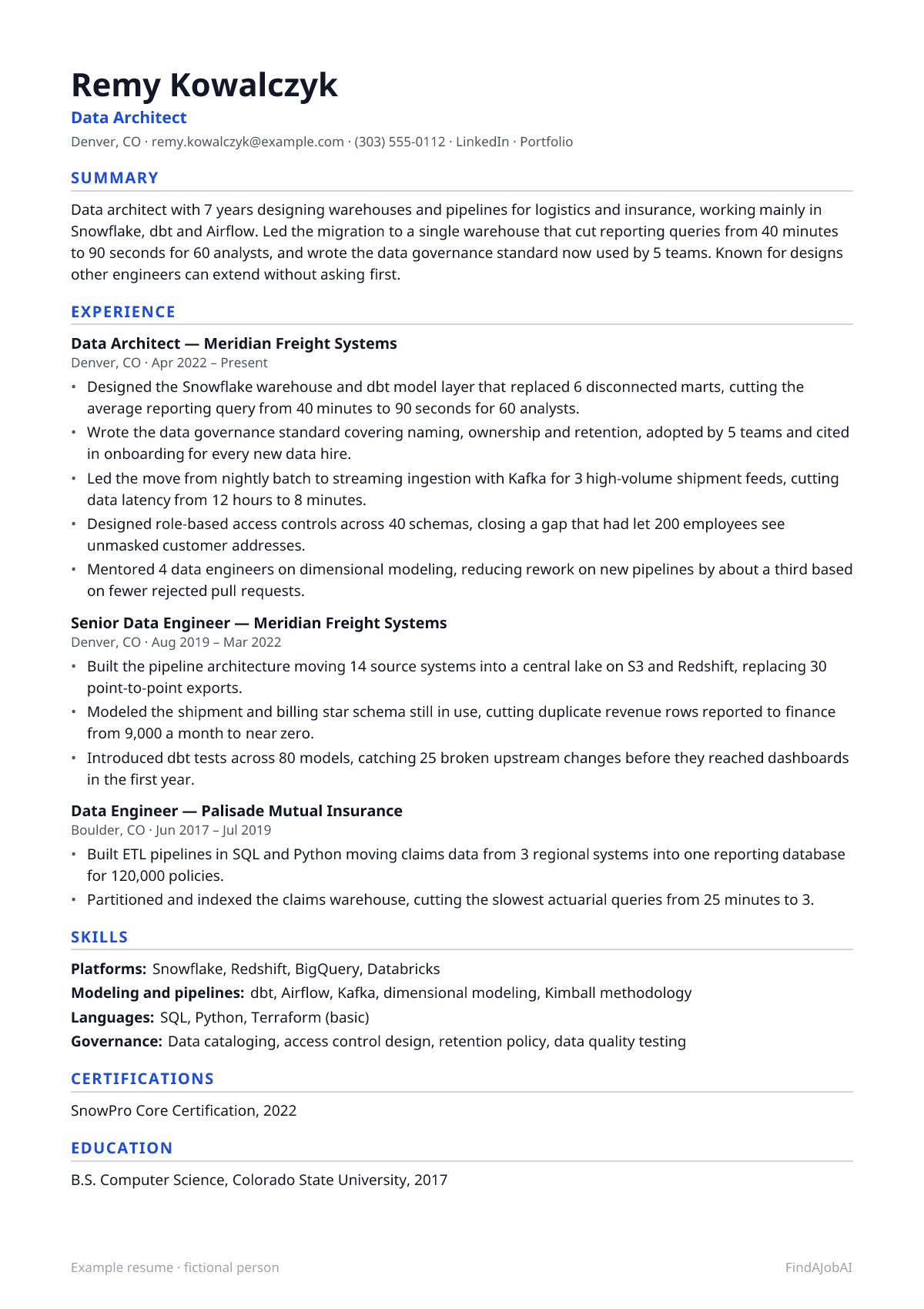
Mid-level data architect resume example
A complete one-page example for a fictional data architect: every bullet pairs an action with what changed because of it.
Example resume · fictional person
Summary
Data architect with 7 years designing warehouses and pipelines for logistics and insurance, working mainly in Snowflake, dbt and Airflow. Led the migration to a single warehouse that cut reporting queries from 40 minutes to 90 seconds for 60 analysts, and wrote the data governance standard now used by 5 teams. Known for designs other engineers can extend without asking first.
Experience
Data Architect, Meridian Freight Systems
Denver, CO · Apr 2022 – Present
- Designed the Snowflake warehouse and dbt model layer that replaced 6 disconnected marts, cutting the average reporting query from 40 minutes to 90 seconds for 60 analysts.
- Wrote the data governance standard covering naming, ownership and retention, adopted by 5 teams and cited in onboarding for every new data hire.
- Led the move from nightly batch to streaming ingestion with Kafka for 3 high-volume shipment feeds, cutting data latency from 12 hours to 8 minutes.
- Designed role-based access controls across 40 schemas, closing a gap that had let 200 employees see unmasked customer addresses.
- Mentored 4 data engineers on dimensional modeling, reducing rework on new pipelines by about a third based on fewer rejected pull requests.
Senior Data Engineer, Meridian Freight Systems
Denver, CO · Aug 2019 – Mar 2022
- Built the pipeline architecture moving 14 source systems into a central lake on S3 and Redshift, replacing 30 point-to-point exports.
- Modeled the shipment and billing star schema still in use, cutting duplicate revenue rows reported to finance from 9,000 a month to near zero.
- Introduced dbt tests across 80 models, catching 25 broken upstream changes before they reached dashboards in the first year.
Data Engineer, Palisade Mutual Insurance
Boulder, CO · Jun 2017 – Jul 2019
- Built ETL pipelines in SQL and Python moving claims data from 3 regional systems into one reporting database for 120,000 policies.
- Partitioned and indexed the claims warehouse, cutting the slowest actuarial queries from 25 minutes to 3.
Skills
- Platforms: Snowflake, Redshift, BigQuery, Databricks
- Modeling and pipelines: dbt, Airflow, Kafka, dimensional modeling, Kimball methodology
- Languages: SQL, Python, Terraform (basic)
- Governance: Data cataloging, access control design, retention policy, data quality testing
Certifications
- SnowPro Core Certification, 2022
Education
- B.S. Computer Science, Colorado State University, 2017
Fictional example by the FindAJobAI team: the person, employers and numbers are invented. Keep the structure; use your own work and numbers you can explain in an interview.
Entry-level data architect resume example
A data engineer two years in, aiming at architecture roles before she's held the title. Her bullets lean on a capstone warehouse project and modeling work inside a larger team, with design reasoning spelled out rather than assumed.
Entry-level example resume · fictional person
Thandeka Oyelaran
Data Engineer, aiming for Data Architecture
Austin, TX · [email protected] · (512) 555-0128 · LinkedIn · GitHub
Summary
Data engineer with 2 years building pipelines and warehouse models on AWS, working toward data architecture. Designed the star schema behind a capstone analytics project processing 5 years of transit data, and supports warehouse modeling decisions on a 4-person engineering team. Comfortable explaining tradeoffs between normalized and denormalized designs.
Experience
Data Engineer, Barrington Transit Analytics
Austin, TX · Jul 2024 – Present
- Proposed and built a dimensional model for ridership data replacing 3 flat tables, cutting a key report's query time from 6 minutes to 20 seconds.
- Wrote dbt models and tests for 30 tables feeding the weekly ridership dashboard used by 10 planners.
- Documented table lineage for 50 models in a shared wiki after repeated confusion over which source fed which report.
Data Engineering Intern, Barrington Transit Analytics
Austin, TX · Jan 2024 – Jun 2024
- Built an Airflow pipeline loading daily ridership CSVs into Redshift, replacing a manual upload done by hand twice a week.
- Wrote SQL validation checks catching 400 malformed records a month before they reached analyst-facing tables.
Skills
- Platforms: Snowflake, Redshift, AWS (S3, Glue)
- Modeling and pipelines: dbt, Airflow, dimensional modeling, slowly changing dimensions
- Languages: SQL, Python
Projects
- City transit warehouse (Snowflake, dbt): designed a star schema over 5 years of public ridership data and cut a sample reporting query from 4 minutes to 8 seconds versus the flat-file version.
- Retail inventory model (PostgreSQL): modeled a slowly changing dimension for store inventory across 6 locations and documented the design tradeoffs in a short write-up.
Education
- B.S. Computer Science, University of Texas at Austin, 2024
Senior data architect resume example
A principal architect ten years in, now setting standards across business units rather than designing a single warehouse. The bullets move from building pipelines to funding migrations, mentoring architects and resolving cross-team data disputes.
Senior example resume · fictional person
Bartholomew Nkemelu
Principal Data Architect
Charlotte, NC · [email protected] · (704) 555-0187 · LinkedIn
Summary
Principal data architect with 10 years across banking and retail, setting data standards for 6 business units and mentoring 8 architects and senior engineers. Led the enterprise migration to a lakehouse on Databricks that retired 40 legacy marts, and owns the governance model behind $2.3M in annual warehouse spend.
Experience
Principal Data Architect, Ashworth Financial Group
Charlotte, NC · May 2020 – Present
- Led the migration from 40 siloed Oracle marts to a Databricks lakehouse, cutting cross-team reporting discrepancies from a weekly occurrence to about one a quarter.
- Set data architecture standards adopted across 6 business units, including a medallion layering model now required for all new pipelines.
- Negotiated the governance model behind $2.3M in annual warehouse spend, cutting unused compute by $400,000 a year through workload review.
- Mentor 8 architects and senior engineers, running a monthly design review that has caught 15 schemas likely to duplicate existing data.
- Resolved a year-long dispute between risk and finance over revenue definitions by designing one certified metrics layer now used in both teams' reporting.
Senior Data Architect, Dunmore Retail Holdings
Charlotte, NC · Feb 2016 – Apr 2020
- Designed the enterprise warehouse on Redshift consolidating 25 regional databases, cutting month-end close reporting from 4 days to 6 hours.
- Built the access control and masking framework protecting PII across 500,000 customer records, passing its first external audit without findings.
- Led a team of 5 engineers implementing a new ingestion layer that cut pipeline failure incidents from 20 to 3 a month.
Data Architect, Tallowmere Logistics
Raleigh, NC · Jun 2014 – Jan 2016
- Designed the shipment and billing data model still used as the system of record, replacing 4 conflicting spreadsheets used for revenue reporting.
- Set up the first data quality monitoring layer, cutting executive-reported data errors from 10 a month to 2.
Skills
- Platforms: Databricks, Redshift, Snowflake, BigQuery
- Modeling and governance: Medallion architecture, dimensional modeling, data cataloging, access control design
- Leadership: Architecture roadmaps, mentoring architects, cross-team metric standards, vendor evaluation
Certifications
- Databricks Certified Data Engineer Professional, 2021
Education
- B.S. Information Systems, North Carolina State University, 2014
How to write a data architect resume
Five steps, in the order a recruiter reads the page. The format around them stays plain for every job: one column, standard headings, newest role first.
Header: name, target title and links
Use the title “Data Architect” even if your employer called it Lead Data Engineer or Platform Architect, and keep a portfolio link if you have design write-ups to share; hiring managers at this level often want to see your reasoning, not just your stack.
Summary: what you do and your best proof
Name the platform you design on, the scale of your largest system, and one architecture decision that changed cost, speed or reliability. Skip generic claims like "strong technical leader"; name the systems instead.
Experience: newest first, a result in every bullet
Open each bullet with the system or decision, then the scale and the result: what you designed, how many tables or teams it touched, and what got faster, cheaper or more reliable. A list of platforms with no outcome reads like a tools inventory, not architecture work.
Skills: grouped, in the ad's words
Group by platform, modeling and pipeline tools, languages, and governance. Put the specific warehouse (Snowflake, BigQuery, Databricks) first since job ads usually name one, and only list governance tools you've actually implemented.
Education and certifications
List your degree with the year, plus a relevant certification such as SnowPro or a Databricks credential if you hold one. Early-career candidates should add a Projects section showing a schema design with its stated tradeoffs.
Skills to put on a data architect resume
Hard skills are the tools and methods of the job; soft skills are how you work with people. Each comes with one way to prove it, because a skill named only in a list counts for little. Add the ones you really have.
Hard skills
- Snowflake or BigQuery
- Name the platform and a design decision you made on it, such as clustering keys or partitioning, and its effect on query time.
- dbt
- Mention how many models or tests you wrote and the manual process or legacy procedure they replaced.
- Dimensional modeling
- Name a star or snowflake schema you designed and the report or team it served.
- Airflow or orchestration
- Point to a pipeline you orchestrated, how many sources it pulled from, and its reliability before and after.
- Data governance
- Name a standard you wrote (naming, retention, access) and how many teams or tables adopted it.
- Access control design
- Give the number of records or schemas protected and what the control closed off or passed.
- Kafka or streaming
- State the volume handled and the latency improvement over the batch process it replaced.
- SQL performance tuning
- Name a slow query or table you fixed and the before-and-after run time.
- Cost optimization
- Give a dollar figure for compute or storage saved and the change that caused it.
- Lakehouse architecture
- Name the platform (Databricks, Delta Lake) and what the medallion or layer design replaced.
Soft skills
- Design reviews
- Give how many reviews or schemas you've reviewed and a design you redirected before it shipped.
- Cross-team negotiation
- Describe a metric or standard dispute you resolved and how many teams were involved.
- Mentoring
- Count the engineers or architects you mentored and one skill they grew into.
- Documentation
- Mention a lineage map or standards doc you wrote and the confusion it ended.
- Tradeoff communication
- Describe a tradeoff you explained to a non-technical stakeholder and the decision it led to.
- Prioritization
- Give your backlog of migration or design requests and how you sequenced them.
- Risk awareness
- Name a data risk you flagged before it caused an incident, with its potential size.
Data Architect resume bullet examples: weak vs strong
The same work, written two ways. The strong version names the tool, the scope and a result; the numbers are examples, yours must be real.
Weak: Designed data architecture.
Strong: Designed the warehouse schema and ingestion layer behind a 20-store retail chain's inventory reporting, cutting stock-count discrepancies reported to finance by 60%.
Names the system, the audience and a measurable result.
Weak: Worked with Snowflake and dbt.
Strong: Migrated 90 legacy stored procedures into dbt models with tests, cutting a recurring data-quality incident from monthly to twice a year.
Turns tool names into a migration with a measured outcome.
Weak: Improved data quality.
Strong: Added schema and null checks to 45 pipelines, catching 18 broken source feeds before they reached the executive dashboard.
Quality work shown as a specific catch rate, not a vague claim.
Weak: Built data pipelines.
Strong: Rebuilt the customer events pipeline on Kafka and Spark, raising throughput from 2,000 to 40,000 events a minute during peak sign-up periods.
Shows the technology and the scale the design handled.
Weak: Set data standards.
Strong: Wrote the naming and ownership standard for 300 warehouse tables, ending a recurring dispute between marketing and finance over which revenue table was correct.
A governance claim tied to the conflict it actually resolved.
Weak: Reduced costs.
Strong: Re-partitioned the largest fact table and rewrote its refresh job, cutting the warehouse's monthly compute bill by $18,000.
A cost result with the specific change behind it.
15 more data architect resume bullet examples
Grouped by area of the job, so you can find the ones closest to your work. Keep the shape (action, scope, result) and replace the invented numbers with your own.
Warehouse and schema design
- Designed a star schema for order and fulfillment data replacing 5 conflicting spreadsheets, cutting the monthly revenue reconciliation from 3 days to 4 hours.
- Redesigned a customer dimension with slowly changing history, fixing a bug that had overwritten 18 months of address history for 90,000 accounts.
- Consolidated 12 regional databases into one Snowflake warehouse, cutting the infrastructure bill by $9,500 a month.
- Rebuilt a flat, denormalized events table into a dimensional model, cutting a key dashboard's load time from 3 minutes to 15 seconds.
Pipelines and ingestion
- Designed a Kafka-based ingestion layer for 8 real-time inventory feeds, cutting stock-count latency from 6 hours to 4 minutes.
- Replaced 20 scheduled scripts with an Airflow DAG covering dependency checks, cutting pipeline failures reaching production from 15 to 2 a month.
- Built a change-data-capture pipeline from the production database to the warehouse, retiring a nightly full-table dump that took 5 hours.
Governance and data quality
- Wrote the data retention policy covering 60 tables, closing a compliance gap flagged in the prior year's audit.
- Introduced schema and freshness tests across 100 dbt models, catching 30 broken source loads in the first 6 months.
- Built a data catalog documenting 400 fields and their owners, cutting new analyst onboarding time from 2 weeks to 3 days.
- Designed row-level security for a shared sales warehouse, giving 12 regional teams visibility into only their own data.
Cost and scale
- Re-architected a nightly batch job's partitioning strategy, cutting its runtime from 5 hours to 35 minutes and its compute cost by 70%.
- Right-sized 15 overprovisioned warehouse clusters after a usage audit, saving $120,000 a year.
- Scaled a pipeline from processing 1 million to 50 million daily events by moving aggregation upstream into the ingestion layer.
- Negotiated a storage tiering policy that moved 3 years of cold data to cheaper storage, cutting the storage bill by $30,000 a year.
Data Architect resume summary examples
Two or three lines on what you do and your strongest proof. Start from the one closest to your level and use your own facts.
Data architect in training with 2 years as a data engineer building pipelines on AWS and a certificate in data modeling. Designed the warehouse schema behind a 6-store retail analytics project and wrote dbt models tested against 3 source systems. Comfortable in SQL, Python and Airflow.
Data architect with 5 years in healthcare technology, working mainly in BigQuery, dbt and Airflow. Designed the patient-data warehouse used by 18 analysts and a governance policy that passed its first HIPAA audit with zero data-access findings.
Principal data architect with 13 years designing platforms for banking and retail, now setting data architecture standards across 6 business units. Led the enterprise move to a lakehouse on Databricks that replaced 40 legacy marts and mentors 8 architects and senior engineers.
Common data architect resume mistakes
Each one is easy to make and quick to fix before you apply.
Listing platforms with no design decision
Naming Snowflake, dbt and Airflow says what you've touched, not what you decided. Pair each with a schema, pipeline or standard you designed and its result.
Confusing architecture with engineering work
Building a pipeline someone else designed is engineering; deciding its structure, standards and tradeoffs is architecture. If you've done both, label which bullets are which.
No scale mentioned at all
A warehouse serving 5 analysts and one serving 500 call for different designs. State the number of tables, users or data volume your system handled.
Governance claims with no specifics
"Improved data governance" is unverifiable. Name the standard, policy or control you wrote and how many teams or tables it covers.
ATS tips for a data architect resume
Applicant tracking systems turn your file into text that recruiters search, mostly for the skills and titles in the ad. They rarely reject a resume on their own; one that parses badly or misses the ad's words just doesn't come up.
- Name the warehouse or lakehouse platform (Snowflake, BigQuery, Databricks) rather than saying "cloud data platform".
- Describe a schema or pipeline by what it replaced and what got faster or cheaper, not by how many tables it has.
- List governance work (access control, retention, naming standards) as its own line; ATS systems often search for it by name.
- Mention the modeling approach you use, such as Kimball dimensional modeling or a medallion architecture, if the job ad names one.
- If you led a migration, state the before-and-after state in one sentence: source systems, destination, and what improved.
For the format itself, run the free ATS resume checklist.
Everything for Data Architects
- Data Architect cover letter examplesThree example letters and a short email version
- Data Architect interview questions30 questions with sample answers
- Data Architect job descriptionDuties, skills and requirements
- How to tailor your resume without lying
Other resume examples
Data Architect resume FAQ
What is the difference between a data architect and a data engineer resume?
A data engineer resume emphasizes building and maintaining pipelines; a data architect resume emphasizes designing the overall structure, standards and tradeoffs other engineers then build against. If you've done both, split your bullets so the design decisions stand out from the implementation work.
Do I need cloud certifications to get a data architect job?
They help pass some initial screens, but hiring managers weigh a track record of warehouse or pipeline designs that held up at scale more heavily than certificates alone. List certifications, but lead with results.
How do I show governance experience on a data architect resume?
Name a specific standard you wrote or policy you enforced, such as access control rules or a naming convention, and the number of teams or tables it covered. Governance is easy to claim and hard to prove, so specifics matter.
Should a data architect resume include an architecture diagram?
A resume itself should stay text, but a portfolio or one-page case study linked from it can include a simplified diagram. Keep the resume bullets focused on the decision and the result.
How we built this page
The FindAJobAI team wrote the three example resumes, the bullets, the skills and the advice for data architect roles. The people, employers and numbers in the examples are invented; the structure, the tools and the way each bullet is built are the parts to copy.
Once we track enough live data architect job ads, this page also shows the skills they ask for most, counted the same way as our in-demand skills report.
Last reviewed on November 1, 2026.