Medical Coder Resume Example (2026)
By FindAJobAI team Updated How we built this page
Medical coder job ads tend to ask for the same core: a certification such as CPC or CCS, fluency in ICD-10-CM, CPT and HCPCS, and comfort with an EHR or encoder. What separates candidates is evidence that their coding held up under audit and kept claims from bouncing back. A medical coder resume should say what you code, how accurately, and what happened to denials because of it.
The example below is a medical coder with four years split between a hospital system and a multi-specialty clinic group. Notice how each bullet names the coding systems, the chart volume and the dollar or percentage result, instead of just listing duties.
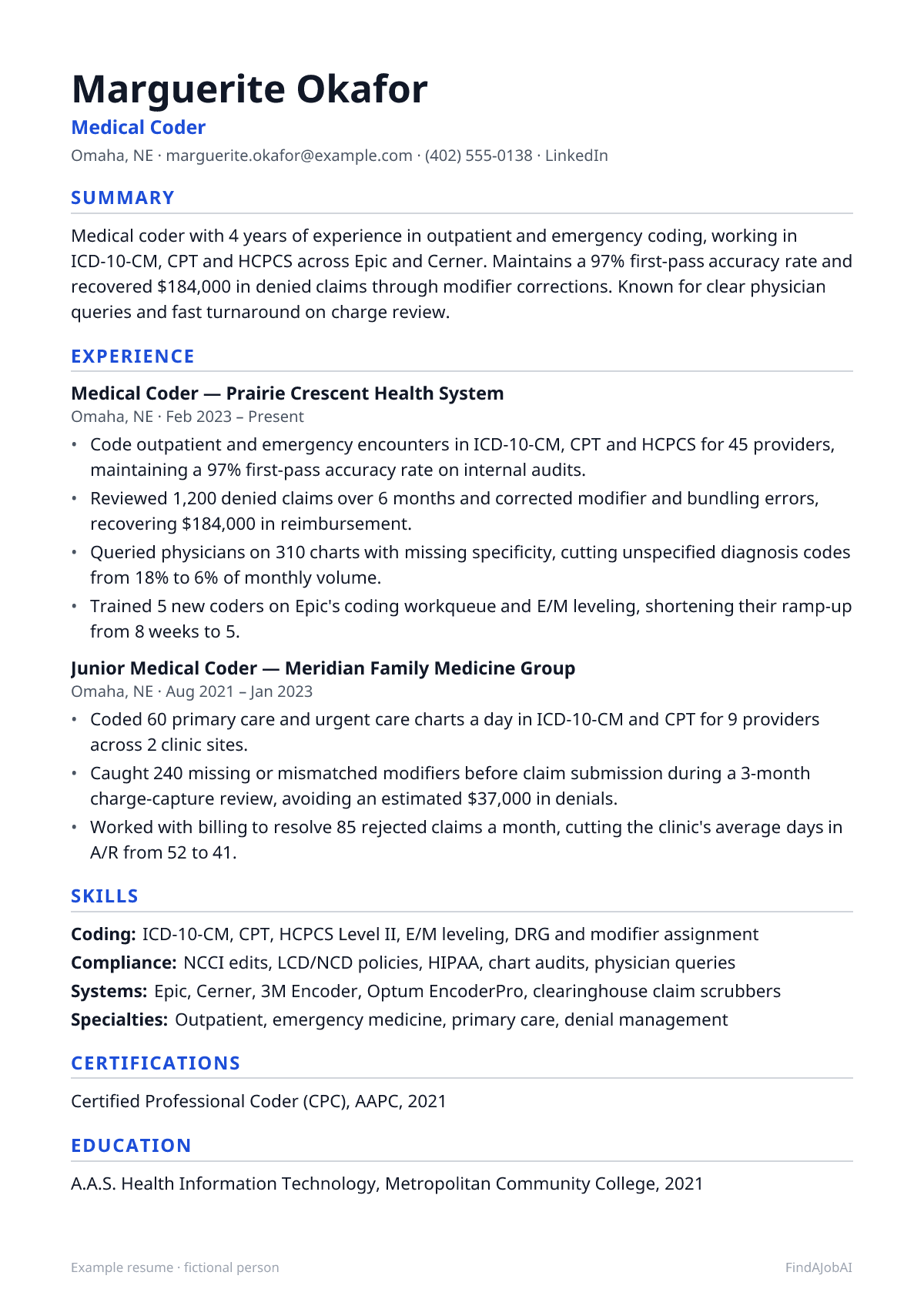
Medical Coder resume template
This example as a one-page template: one column, standard headings and plain text, the format applicant tracking systems read most reliably.
After you sign up, Create my CV builds your own resume in this same one-column layout, from your real experience.
Mid-level medical coder resume example
A complete one-page example for a fictional medical coder: every bullet pairs an action with what changed because of it.
Example resume · fictional person
Summary
Medical coder with 4 years of experience in outpatient and emergency coding, working in ICD-10-CM, CPT and HCPCS across Epic and Cerner. Maintains a 97% first-pass accuracy rate and recovered $184,000 in denied claims through modifier corrections. Known for clear physician queries and fast turnaround on charge review.
Experience
Medical Coder, Prairie Crescent Health System
Omaha, NE · Feb 2023 – Present
- Code outpatient and emergency encounters in ICD-10-CM, CPT and HCPCS for 45 providers, maintaining a 97% first-pass accuracy rate on internal audits.
- Reviewed 1,200 denied claims over 6 months and corrected modifier and bundling errors, recovering $184,000 in reimbursement.
- Queried physicians on 310 charts with missing specificity, cutting unspecified diagnosis codes from 18% to 6% of monthly volume.
- Trained 5 new coders on Epic's coding workqueue and E/M leveling, shortening their ramp-up from 8 weeks to 5.
Junior Medical Coder, Meridian Family Medicine Group
Omaha, NE · Aug 2021 – Jan 2023
- Coded 60 primary care and urgent care charts a day in ICD-10-CM and CPT for 9 providers across 2 clinic sites.
- Caught 240 missing or mismatched modifiers before claim submission during a 3-month charge-capture review, avoiding an estimated $37,000 in denials.
- Worked with billing to resolve 85 rejected claims a month, cutting the clinic's average days in A/R from 52 to 41.
Skills
- Coding: ICD-10-CM, CPT, HCPCS Level II, E/M leveling, DRG and modifier assignment
- Compliance: NCCI edits, LCD/NCD policies, HIPAA, chart audits, physician queries
- Systems: Epic, Cerner, 3M Encoder, Optum EncoderPro, clearinghouse claim scrubbers
- Specialties: Outpatient, emergency medicine, primary care, denial management
Certifications
- Certified Professional Coder (CPC), AAPC, 2021
Education
- A.A.S. Health Information Technology, Metropolitan Community College, 2021
Fictional example by the FindAJobAI team: the person, employers and numbers are invented. Keep the structure; use your own work and numbers you can explain in an interview.
Entry-level medical coder resume example
A recent Health Information Technology graduate with a coding externship and a prior front-desk job. Education sits right under the summary, and the externship bullets focus on supervised accuracy rates rather than independent production numbers.
Entry-level example resume · fictional person
Summary
Entry-level medical coder with an A.A.S. in Health Information Technology and a 6-month coding externship at a family health clinic. Codes ICD-10-CM and CPT for primary care visits and reached 93% first-pass accuracy during supervised review. Comfortable with Epic and payer eligibility checks.
Education
- A.A.S. Health Information Technology, Lakeshore Technical College, 2026
Experience
Coding Extern, Brightwater Family Health Clinic
Sheboygan, WI · Feb 2026 – Aug 2026
- Coded 25 primary care charts a day in ICD-10-CM and CPT under supervision, reaching 93% first-pass accuracy by the end of the externship.
- Queried providers on 40 charts missing diagnosis specificity, following up until all were resolved before billing.
- Shadowed the denial-management coder on 50 rejected claims, learning common modifier and bundling errors.
Front Desk Coordinator, Lindqvist Dental Associates
Sheboygan, WI · May 2024 – Jan 2026
- Entered insurance and patient demographic data for 30 patients a day, keeping claim rejections for data errors under 2%.
- Verified insurance eligibility for every visit, cutting same-day billing holds by half.
Skills
- Coding: ICD-10-CM, CPT, HCPCS Level II (externship and coursework)
- Systems: Epic (practice environment), Dentrix, Optum EncoderPro
- Office: Insurance verification, data entry, patient scheduling
Certifications
- Certified Professional Coder - Apprentice (CPC-A), AAPC, 2026
Senior medical coder resume example
A department lead ten years in, now managing coders instead of only coding charts. The bullets move from chart production to building protocols, training staff and recovering money at scale, and the summary names the team size and the dollar figure she oversees.
Senior example resume · fictional person
Summary
Lead medical coder with 10 years across hospital and specialty-clinic coding, now managing a team of 6 coders for a multi-site orthopedic group. Owns the denial-prevention program behind a 98% clean-claim rate and leads compliance audits across $40M in annual outpatient billing.
Experience
Lead Medical Coder, Granite Hill Orthopedic Partners
Charlotte, NC · Apr 2021 – Present
- Lead a team of 6 coders across 5 orthopedic clinics, auditing a sample of 400 charts a month against ICD-10-CM, CPT and payer-specific policy.
- Built the denial-prevention program that raised the group's clean-claim rate from 89% to 98% in 18 months.
- Negotiated coding policy clarifications with 3 major payers after tracking $1.1M in recoverable denials to 2 recurring modifier errors.
- Rolled out quarterly coder certification tracking and continuing education, keeping 100% of the team's CPCs current.
Senior Medical Coder, Chesterfield Regional Medical Center
Charlotte, NC · Jun 2016 – Mar 2021
- Coded complex inpatient and outpatient surgical charts in ICD-10-CM and CPT, averaging 98% accuracy on quarterly external audits.
- Served as the escalation coder for 900 high-dollar claims a year, recovering $640,000 through corrected coding and appeals.
- Mentored 4 junior coders on E/M leveling and modifier use, cutting their average error rate by half within 6 months.
Medical Coder, Piedmont Family Practice Alliance
Charlotte, NC · Aug 2013 – May 2016
- Coded outpatient visits for 8 family medicine providers, processing 70 charts a day in ICD-10-CM and CPT.
- Reduced the practice's unspecified-diagnosis rate from 24% to 9% through targeted physician queries.
Skills
- Coding: ICD-10-CM, CPT, HCPCS Level II, DRG validation, surgical and E/M coding
- Compliance: NCCI edits, payer policy audits, appeals, OIG work plan awareness
- Leadership: Coder staffing and QA, certification tracking, payer negotiation
Certifications
- Certified Professional Coder (CPC), AAPC, 2013
- Certified Coding Specialist (CCS), AHIMA, 2017
Education
- B.S. Health Information Management, University of North Carolina at Charlotte, 2013
How to write a medical coder resume
Five steps, in the order a recruiter reads the page. The format around them stays plain for every job: one column, standard headings, newest role first.
Header: name, target title and links
Use the title “Medical Coder” even if your title was Coding Specialist or Health Information Coder, and put your certification (CPC, CCS or CCA) right next to your name so it's the first qualification a reviewer sees.
Summary: what you do and your best proof
Name your certification, the coding systems you use and the care setting, then one result such as an accuracy rate or a denial recovery amount. Skip lines like “detail-oriented coder”; certifications already imply that.
Experience: newest first, a result in every bullet
Open each bullet with the chart volume or setting, then the coding systems and the result: an accuracy rate, a denial caught, or money recovered. Listing software alone says little; a specific denial pattern you fixed says a lot.
Skills: grouped, in the ad's words
Group them into coding systems, compliance and software. Name the EHR or encoder you've coded in next to your systems, and list HCPCS Level II separately from CPT since payers treat them differently.
Education and certifications
List your degree or certificate with the year, plus your certification status if it's not already in your header. Without coding experience, add an externship or practicum with your accuracy rate and the systems you used.
Skills to put on a medical coder resume
Hard skills are the tools and methods of the job; soft skills are how you work with people. Each comes with one way to prove it, because a skill named only in a list counts for little. Add the ones you really have.
Hard skills
- ICD-10-CM
- Name the setting (outpatient, inpatient, emergency) and give your accuracy or denial rate from that coding.
- CPT
- Mention a specialty you code for and a case where correct CPT selection avoided a denial or bundling error.
- HCPCS Level II
- Reference supply or drug codes you assign and how often, especially in infusion or DME settings.
- E/M leveling
- Give the volume of E/M charts you level weekly and your accuracy against payer audits.
- Modifier assignment
- Point to a modifier error you caught or corrected and the dollar amount it affected.
- NCCI edits
- Describe a bundling conflict you resolved using NCCI edits before a claim went out.
- Chart audits
- State how many charts you audit in a period and the error rate you found or improved.
- Physician queries
- Give your query volume and response rate, since a slow query process stalls billing.
- Denial management
- Name the denial type you tackled, the root cause found, and the recovery amount.
- Epic or Cerner
- Mention the coding workqueue or module you used and a workflow you improved in it.
- DRG validation
- If you work inpatient, note a DRG mismatch you caught and its reimbursement impact.
- HIPAA compliance
- Reference an audit or training where you applied HIPAA rules to chart handling.
Soft skills
- Attention to detail
- Cite a coding error you caught before submission, with the dollar or chart count involved.
- Communication
- Describe a query or training session with providers and the response rate it produced.
- Time management
- Give your daily or weekly chart volume alongside your turnaround time.
- Problem-solving
- Point to a denial pattern you traced to its root cause and fixed.
- Teamwork
- Mention coders or providers you trained or coordinated with, and the result.
- Adaptability
- Note a payer policy or coding guideline change you adopted quickly across your workload.
- Integrity
- Reference a compliance risk you flagged rather than let pass, even without being asked.
Medical Coder resume bullet examples: weak vs strong
The same work, written two ways. The strong version names the tool, the scope and a result; the numbers are examples, yours must be real.
Weak: Coded patient charts.
Strong: Coded 55 inpatient rehabilitation charts a week in ICD-10-CM and CPT, keeping denial-related rework under 4% of claims.
Names the setting, the systems and the error rate.
Weak: Knowledge of ICD-10 and CPT.
Strong: Applied ICD-10-CM and CPT guidelines to resolve 140 claims flagged for medical necessity, overturning 60% on appeal.
Shows the coding knowledge used to win a real appeal outcome.
Weak: Reduced claim denials.
Strong: Traced a spike in denied wellness visits to an outdated preventive care code and fixed it clinic-wide, cutting that denial type by 80% in 2 months.
Gives the root cause found and the scale of the fix.
Weak: Worked with providers on documentation.
Strong: Ran a 20-minute documentation training for 12 physicians on specificity requirements, raising their query response rate from 55% to 90%.
Turns a vague collaboration claim into a measurable training result.
Weak: Familiar with HIPAA and compliance.
Strong: Audited 300 charts a quarter against NCCI edits and payer policy, flagging 22 recurring compliance risks before they reached a payer audit.
Compliance knowledge shown through a concrete audit scope and catch rate.
Weak: Experienced with Epic.
Strong: Built 4 saved search filters in Epic's coding workqueue that cut the team's average chart review time from 9 to 6 minutes.
Software familiarity demonstrated by a workflow improvement with a number.
15 more medical coder resume bullet examples
Grouped by area of the job, so you can find the ones closest to your work. Keep the shape (action, scope, result) and replace the invented numbers with your own.
Coding accuracy
- Coded 65 emergency department charts a day in ICD-10-CM and CPT, holding a 96% first-pass accuracy rate across 2 quarters.
- Leveled 500 E/M visits a month for 10 providers, aligning 99% with documentation on internal audit.
- Corrected DRG assignment on 40 inpatient charts a quarter, adjusting reimbursement by an average of $1,400 per catch.
- Reviewed 300 surgical charts for CPT bundling conflicts, cutting unbundling errors from 14 to 3 a month.
Denial management
- Analyzed 6 months of denied claims and traced 45% to 3 recurring modifier errors, which were fixed clinic-wide.
- Appealed 220 denied claims with corrected coding documentation, recovering $310,000 over a year.
- Built a denial-tracking spreadsheet by payer and reason code, cutting the average days to resolve a denial from 35 to 19.
- Partnered with billing to resolve 90 rejected claims a month, lowering the clinic's denial rate from 11% to 5%.
Compliance and audits
- Audited 350 charts a quarter against NCCI edits and payer LCD policy, flagging 28 compliance risks before a payer audit.
- Prepared coding documentation for an external payer audit covering 500 charts, resulting in zero findings against the practice.
- Reviewed OIG work plan updates each quarter and adjusted internal audit focus areas to match, ahead of 2 payer reviews.
- Maintained HIPAA-compliant chart handling across 1,100 patient records a month with zero reported incidents.
Training and process improvement
- Trained 8 new coders on Epic's coding workqueue and modifier logic, cutting their error rate in half within 2 months.
- Ran monthly documentation workshops for 15 providers, raising specificity in diagnosis coding by double over 6 months.
- Standardized the charge-capture checklist used by 6 coders, reducing missed charges from 22 to 4 a month.
Medical Coder resume summary examples
Two or three lines on what you do and your strongest proof. Start from the one closest to your level and use your own facts.
Medical coder with a Health Information Technology degree and a coding internship at a multi-specialty clinic. Codes ICD-10-CM and CPT for primary care visits and is studying for the CPC exam. Comfortable with Epic and chart audits.
Medical coder with 4 years in outpatient and emergency coding, fluent in ICD-10-CM, CPT and HCPCS. Built the modifier-review process that recovered $184,000 in denied claims and trained 5 new coders on Epic's workqueue.
Senior medical coder with 10 years across hospital and specialty-clinic coding, now leading a team of 6 coders. Owns the denial-prevention program behind a 98% clean-claim rate and audits coding accuracy for a $40M outpatient billing operation.
Common medical coder resume mistakes
Each one is easy to make and quick to fix before you apply.
Listing certifications without a status
If your CPC is pending or apprentice-level (CPC-A), say so; hiring managers plan training differently for a credentialed coder versus one still earning hours.
No accuracy or denial numbers
A coding manager wants to know your first-pass accuracy or denial rate. If you don't track one yet, use your audit results from training or an externship.
Mixing up coder and biller duties
Keep code assignment, chart review and queries in coder bullets, and leave claim submission and payer follow-up to a billing resume unless your job genuinely covered both.
Naming only the EHR, not the coding system
Epic or Cerner experience matters less than which code sets you assigned inside them. Always pair the software with ICD-10-CM, CPT or HCPCS.
No mention of specialty or setting
Denial patterns differ by setting. State whether you coded outpatient, inpatient, emergency or a specialty like orthopedics or oncology.
ATS tips for a medical coder resume
Applicant tracking systems turn your file into text that recruiters search, mostly for the skills and titles in the ad. They rarely reject a resume on their own; one that parses badly or misses the ad's words just doesn't come up.
- List your certification exactly as issued (CPC, CCS, CCA) since ATS systems often search for the acronym.
- Name the coding systems you use (ICD-10-CM, CPT, HCPCS Level II) rather than just writing "medical coding".
- Include your coding accuracy rate or denial rate if you track one; it's one of the first things coding managers ask about.
- Mention the EHR or encoder software you've coded in, such as Epic, Cerner, 3M or EncoderPro.
- Specify your coding setting (outpatient, inpatient, emergency, specialty) since denial patterns and pay differ by setting.
For the format itself, run the free ATS resume checklist.
Everything for Medical Coders
- Medical Coder cover letter examplesThree example letters and a short email version
- Medical Coder job descriptionDuties, skills and requirements
- How to tailor your resume without lying
Other resume examples
Medical Coder resume FAQ
What certification do I need to work as a medical coder?
Most employers want CPC (AAPC) or CCA/CCS (AHIMA) either in hand or in progress. List the certification and its status (active, exam scheduled) near the top of your resume.
How do I write a medical coder resume with no experience?
Lead with your coding certification and externship or practicum, and count any chart review, billing or data entry work as related experience. Note the coding systems you practiced with, even in coursework.
Should I include my coding accuracy rate on my resume?
Yes, if you track it. A first-pass accuracy or clean-claim rate gives a coding manager a concrete number to compare across candidates.
What's the difference between a medical coder and a medical biller resume?
A coder resume should emphasize ICD-10-CM, CPT and HCPCS assignment and chart review; a biller resume should emphasize claim submission, payer follow-up and accounts receivable. Many job ads blend both, so mirror the ad's own split.
How we built this page
The FindAJobAI team wrote the three example resumes, the bullets, the skills and the advice for medical coder roles. The people, employers and numbers in the examples are invented; the structure, the tools and the way each bullet is built are the parts to copy.
Once we track enough live medical coder job ads, this page also shows the skills they ask for most, counted the same way as our in-demand skills report.
Last reviewed on November 1, 2026.