Medical Coder Cover Letter Example (2026)
By FindAJobAI team Updated How we built this page
Medical coder ads lean on certifications and specialty experience, which already sit on your resume, so the cover letter should show how you actually handle a denial, a backlog, or an ambiguous chart. Name the code set, the specialty, and the result a provider or billing team noticed.
Medical Coder cover letter template
This letter as a one-page template: an opening that names the job and your strongest fact, proof that answers the ad, a reason for this employer and a short close.
After you sign up, FindAJobAI drafts your own letter for a real job from your CV in this format, and you edit it before you send it.
Example 1 · Experienced
Certified inpatient coder applying to a hospital system's coding team
Adaeze codes inpatient charts for a hospital and handles denial appeals. The ad asks for ICD-10-CM/PCS and DRG accuracy.
Example letter · fictional
Dear Ms. Falkner,
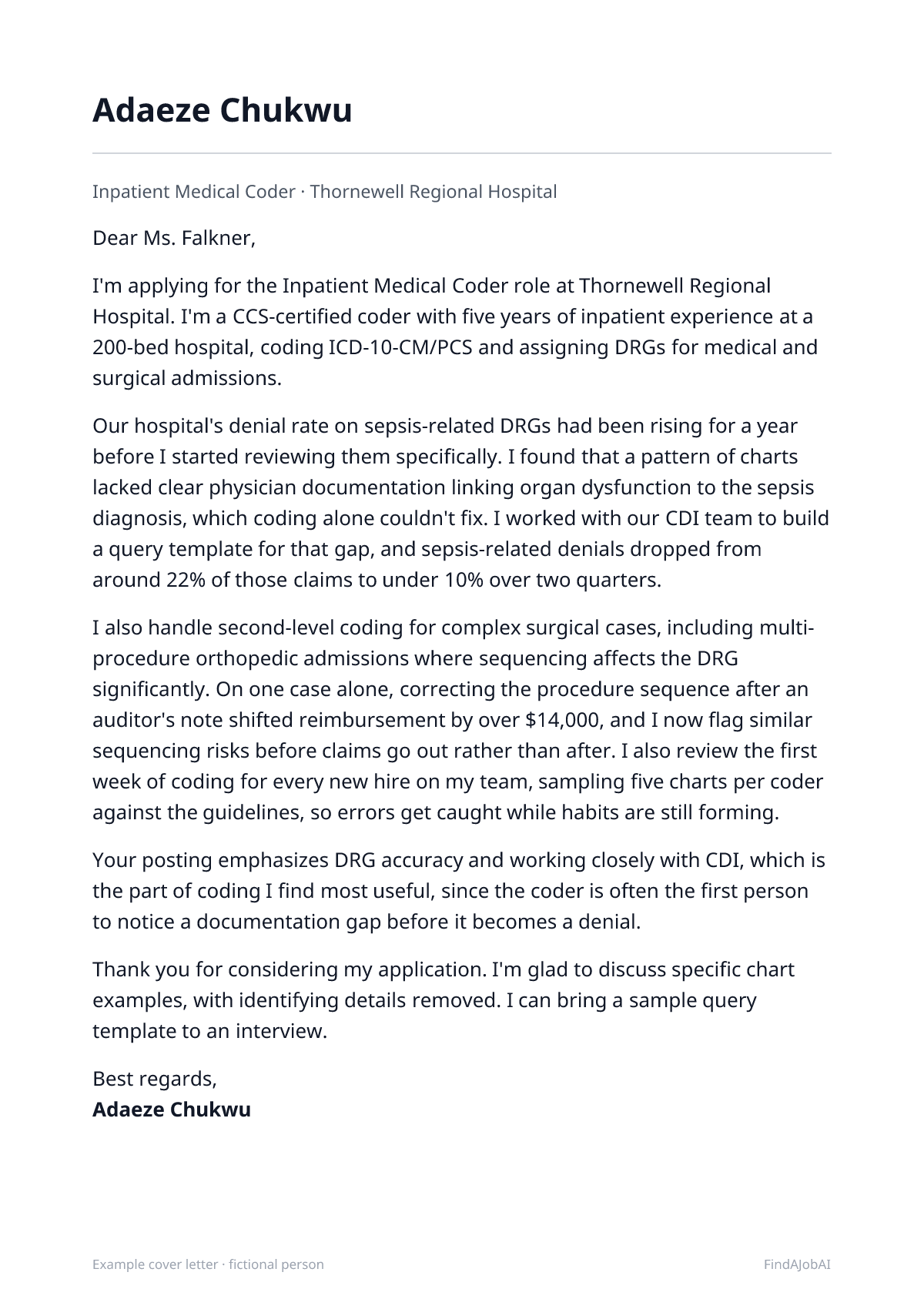
I'm applying for the Inpatient Medical Coder role at Thornewell Regional Hospital. I'm a CCS-certified coder with five years of inpatient experience at a 200-bed hospital, coding ICD-10-CM/PCS and assigning DRGs for medical and surgical admissions.
Our hospital's denial rate on sepsis-related DRGs had been rising for a year before I started reviewing them specifically. I found that a pattern of charts lacked clear physician documentation linking organ dysfunction to the sepsis diagnosis, which coding alone couldn't fix. I worked with our CDI team to build a query template for that gap, and sepsis-related denials dropped from around 22% of those claims to under 10% over two quarters.
I also handle second-level coding for complex surgical cases, including multi-procedure orthopedic admissions where sequencing affects the DRG significantly. On one case alone, correcting the procedure sequence after an auditor's note shifted reimbursement by over $14,000, and I now flag similar sequencing risks before claims go out rather than after. I also review the first week of coding for every new hire on my team, sampling five charts per coder against the guidelines, so errors get caught while habits are still forming.
Your posting emphasizes DRG accuracy and working closely with CDI, which is the part of coding I find most useful, since the coder is often the first person to notice a documentation gap before it becomes a denial.
Thank you for considering my application. I'm glad to discuss specific chart examples, with identifying details removed. I can bring a sample query template to an interview.
Best regards,
Adaeze Chukwu
Example 2 · Career changer
Medical scribe moving into medical coding
Soraya scribes for an ED physician and just earned her CPC. The ad asks for ED and outpatient coding with payer follow-up.
Example letter · fictional
Dear Hiring Manager,
I'm applying for the Medical Coder role at Linden Creek Medical Group. For three years I've worked as a medical scribe in a busy emergency department, documenting physician encounters in real time, and I recently earned my CPC certification to move into coding directly.
Scribing taught me to read a chart the way a coder has to: looking for what actually supports a diagnosis, not just what was said in the room. I noticed our ED was consistently under-documenting the specificity needed for certain injury codes, which I flagged to our coding team, and two physicians started including that detail after I brought it up. That small change reduced the number of queries sent back to our physicians for those visit types.
Since earning my CPC, I've completed a 100-chart practicum coding outpatient ED visits under supervision, with an accuracy rate the practicum instructor confirmed in writing, and I'm comfortable with ICD-10-CM, CPT and HCPCS Level II for emergency and outpatient encounters. I'm also familiar with payer follow-up from fielding billing questions as a scribe when patients called about their visit. I keep a personal cheat sheet of the documentation phrases that change a code, which I add to after every chart review.
Your posting asks for ED and outpatient coding with payer follow-up, and I'd bring both the fresh certification and three years of seeing exactly what emergency documentation looks like before it reaches a coder.
Thank you for your time. I'd welcome the chance to discuss my practicum results in more detail.
Sincerely,
Soraya Hadad
Example 3 · Senior or lead
Coding supervisor applying to lead a growing outpatient coding team
Andre supervises eight coders at a multi-specialty clinic. The ad is for a supervisor overseeing a backlog and a new EHR rollout.
Example letter · fictional
Dear Ms. Larkspur,
I'm applying for the Medical Coding Supervisor role at Westbridge Medical Associates. For the past three years I've supervised a team of eight outpatient coders at a multi-specialty clinic, and before that I coded cardiology and orthopedic charts directly for six years. I'd like to bring that mix of hands-on coding judgment and team management to your team.
Your posting mentions a coding backlog that's grown alongside an EHR transition, which is a problem I've managed through directly. When our clinic switched systems two years ago, our backlog grew to over three weeks of unworked charts within a month. I reassigned coders temporarily by specialty rather than by queue order, built a daily production and accuracy dashboard, and worked with IT to fix a template error that was dropping modifier fields. The backlog came down to under four days within two months, and it's stayed there since.
I also run our quality audit program, reviewing a sample of each coder's charts weekly and tracking error patterns by type rather than by person. When I noticed a recurring issue with laterality codes across three coders, I built a short training session around it instead of issuing individual corrections, and that error type dropped by more than half across the team the following month.
I manage coder assignments, productivity targets and new hire training, but I haven't yet run a team through a full EHR migration from the start, only the aftermath of one, so I'd want to understand your rollout timeline early.
I'd welcome a conversation about where your current backlog stands and which specialties are giving your team the most trouble right now.
Sincerely,
Andre Fitzgerald
All three letters, and the short version below, are fictional: the people, employers and numbers are invented. Borrow the structure, never the facts.
- Prefer to write it yourself? Use the free cover letter template.
- Check your CV against the job first: the free CV score shows the missing keywords.
Why the first letter works, paragraph by paragraph
Paragraph 1: Opening
States the certification (CCS) and the setting (a 200-bed hospital, inpatient coding) so the reader knows the credential and the complexity level match the posting before reading further.
Paragraph 2: The denial problem solved
Names a specific DRG category, the documentation gap found, the fix built with CDI, and the measured drop in denial rate, which is what hospital coding teams are evaluated on.
Paragraph 3: Complex case handling
A single sequencing correction with a dollar impact shows the writer catches errors that matter, not just volume of charts coded.
Paragraph 4: Why this company
Connects the ad's stated emphasis on DRG accuracy and CDI collaboration to the writer's actual daily work.
Paragraph 5: Close
Offers to discuss de-identified chart examples, which respects HIPAA while still offering proof.
What the career changer's letter does differently
The career changer's letter uses scribing, not coding, as the credibility base: real-time chart documentation, a physician documentation fix that reduced queries, and a supervised practicum with a confirmed accuracy rate. It argues the scribing background makes the fresh CPC certification more trustworthy, not less.
What the senior letter does differently
A supervisor's letter reports team-level recovery, not individual charts: a three-week backlog cut to under four days, an audit program that tracks error types across coders rather than blaming individuals, and a training fix that cut a specific error type in half. The gap, running a migration from its start, is named plainly.
Short medical coder cover letter: an email-ready version
Many applications arrive as an email or a small text box, and a full page doesn't fit. This version runs 120 to 150 words and keeps only what a reader needs to decide whether to reply. A coder answers a specialty clinic's short online application field after the portal flagged her resume for a phone screen.
Short version · email · fictional132 words
Subject: Medical Coder application – CPC, orthopedic outpatient coding – Francesca Osei
Hello Mr. Castellan,
I'm applying for the Medical Coder role at Hawkridge Orthopedic Group. I'm CPC-certified with three years coding outpatient orthopedic visits, including surgical follow-ups and injection procedures, at a mid-size orthopedic practice. I also review denials with the billing team every Friday.
My clearest result was catching a recurring modifier error on post-op visits that had been causing denials for months. After I flagged the pattern and corrected our template, denials for that visit type dropped sharply and haven't returned.
Orthopedic coding has enough procedural detail to keep the work interesting, which is part of why I'm applying. My resume is attached, and I'm glad to walk through the modifier fix in more detail. I can also share the modifier checklist I built for the front desk.
Best,
Francesca Osei
The short version keeps one concrete fix, the modifier error behind recurring post-op denials, instead of a full list of code sets or daily volume, and the closing line signals genuine interest in the specialty rather than coding work in general.
Opening lines that work for medical coder cover letters
The first sentence decides whether the second gets read. Here are six openings, one for each situation you might be in. Pick the one that matches yours and swap in your own facts: every name and number below is invented.
1. You have a standout result
After I traced a rising sepsis denial rate to a specific documentation gap and built a query template to close it, our denials for that DRG category fell by more than half. I'd like to bring that same pattern-finding to your coding team.
2. The ad names a problem you've solved
Your ad mentions a coding backlog that's grown alongside your EHR rollout. I managed an almost identical backlog down from three weeks to under four days without pulling in extra staff, and I'd like to help your team do the same.
3. Someone referred you
Your billing manager, Thandiwe Mabaso, mentioned your team is looking for a coder who can explain denials to physicians in plain terms, not just code around them. That's the part of the job I've focused on, which led me to this posting.
4. You admire what they build
I've been a patient at your clinic for several years and noticed how quickly my claims process compared to other providers I've used. I'd like to help keep that standard as part of your coding team.
5. You're new to the field or switching into it
I spent three years scribing in an emergency department before earning my CPC, which means I've seen exactly what documentation looks like before it ever reaches a coder. I'm applying to put that perspective to use directly.
6. You have senior scope or a specialism
As a coding supervisor for the past three years, I've learned that most backlogs are training problems wearing a staffing costume. I'm looking for a team where I can fix the training first.
How to write a medical coder cover letter
Five steps, in the order you'd write them. The shape stays the same for every job (a short opening, proof, a reason for this employer, a close), and what goes into each part is what changes with the role.
Match your certification and specialty to the ad precisely
Note whether the ad asks for CPC, CCS, or CCA, and which specialty or setting (inpatient, ED, orthopedic, oncology) it names. Lead with the credential and setting that match most closely, rather than listing every certification you hold.
Open with a denial or documentation pattern you fixed
Describe one recurring issue, a modifier error, a sequencing mistake, a documentation gap, that you identified and corrected. This shows you catch patterns rather than just processing charts one at a time, which is what experienced coders are hired for.
Quantify the result without naming any patient
Give a before-and-after denial rate, accuracy rate, or backlog measure, always de-identified. If exact figures from your current employer are sensitive, use a relative change, such as a rate cut by half, and specify the timeframe involved.
Name code sets inside the story, not as a skills list
Mention ICD-10-CM/PCS, CPT, or HCPCS Level II as part of describing what you actually coded and fixed, not as a standalone line. A code set named while explaining a real correction is more convincing than a list repeated from your resume.
Close with a HIPAA-aware offer of proof
Offer to discuss a de-identified chart, audit result, or practicum score rather than sending documents upfront. This signals you understand patient privacy rules without having to state them outright, which matters to any coding employer.
Medical Coder cover letter do's and don'ts
Do
- Name the code sets and specialty the ad asks for (ICD-10-CM/PCS, CPT, DRG) inside a specific chart or denial example.
- Mention your certification (CPC, CCS, CCA) and credentialing body once, early, without repeating it.
- Show a denial rate, accuracy rate, or turnaround time you affected, with the before-and-after figure.
Don't
- Don't describe real patient details; keep every chart example de-identified or hypothetical.
- Don't just count charts coded per day; show one chart or denial pattern that mattered, not daily volume alone.
- Don't write "strong attention to detail"; show it with a sequencing correction or a documentation gap you caught.
Common medical coder cover letter mistakes
Each one is easy to make and quick to fix before you send the letter.
Including any detail that could identify a patient
Even a vague patient detail is a problem in a coding cover letter. Describe the code pattern, denial category, or documentation issue only, and say explicitly that details have been changed or removed if you reference a real case.
Reporting daily chart volume as the main achievement
"Coded 40 charts a day" says nothing about accuracy or impact. Replace it with one pattern you caught or one denial category you reduced, and let volume appear on the resume instead.
Naming every code set and credential without context
A paragraph listing ICD-10-CM, CPT, HCPCS, CPC, CCS and CCA in one sentence reads like a resume restated. Pick the certification and code set most relevant to this ad and use the rest of the space on a real example.
Treating denial rates as something that just happens
"Our denial rate was high" without explaining why or what you did leaves no impression of skill. Name the specific cause you found, such as a documentation gap or modifier error, and the fix you built.
Writing "detail-oriented" instead of proving it
Every coding applicant claims attention to detail. Replace the phrase with the actual sequencing correction, modifier fix, or documentation query that shows you catch what others miss.
Email subject lines for medical coder applications
Applying by email? Put the job title, any reference number and your name in the subject line.
- Inpatient Medical Coder application – CCS, DRG accuracy – Adaeze Chukwu
- Medical Coder – CPC-certified, ED and outpatient background – Soraya Hadad
- Application: Medical Coder, Outpatient Surgery (Req. 2290) – Adaeze Chukwu
Everything for Medical Coders
- Medical Coder resume exampleA full resume, plus bullet and summary examples
- Medical Coder job descriptionDuties, skills and requirements
- Career change cover letter: template + examples
Other cover letter examples
Medical Coder cover letter FAQ
What should I write in a medical coder cover letter?
One denial pattern, documentation gap, or complex case you handled, with the code set involved and the measured result. Mention your certification once, then let a specific chart story carry the rest of the letter.
How do I write a medical coder cover letter with no coding experience?
Use adjacent clinical or billing experience, such as scribing, medical records, or front-desk billing, and name your certification and any supervised practicum with its accuracy rate. Be specific about which code sets and specialty you trained on.
Should I mention patient details or specific cases in a medical coder cover letter?
No. Keep every example de-identified, describing the code pattern, documentation issue, or denial category rather than any detail that could identify a patient or violate HIPAA.
How we built this page
The FindAJobAI team wrote the three example letters, the short email version, the opening lines and the advice for medical coder roles. The people, employers and numbers in the letters are invented; the structure, the kind of evidence and the order of the paragraphs are the parts to copy.
Once we track enough live medical coder job ads, this page also shows the skills they ask for most, counted the same way as our in-demand skills report.
Last reviewed on November 1, 2026.