Occupational Therapist Resume Example (2026)
By FindAJobAI team Updated How we built this page
Occupational therapist job ads ask for the same core: a caseload number, the settings you've worked in (pediatric, outpatient, skilled nursing), your documentation system and an outcome measure such as FIM or COPM. What separates candidates is evidence that their treatment plans changed a patient's function, not just a count of sessions run.
The example below is an OT with five years split between an outpatient pediatric clinic and a skilled nursing facility. Each bullet names the caseload, the measure used and the functional gain, instead of listing modalities with no result attached.
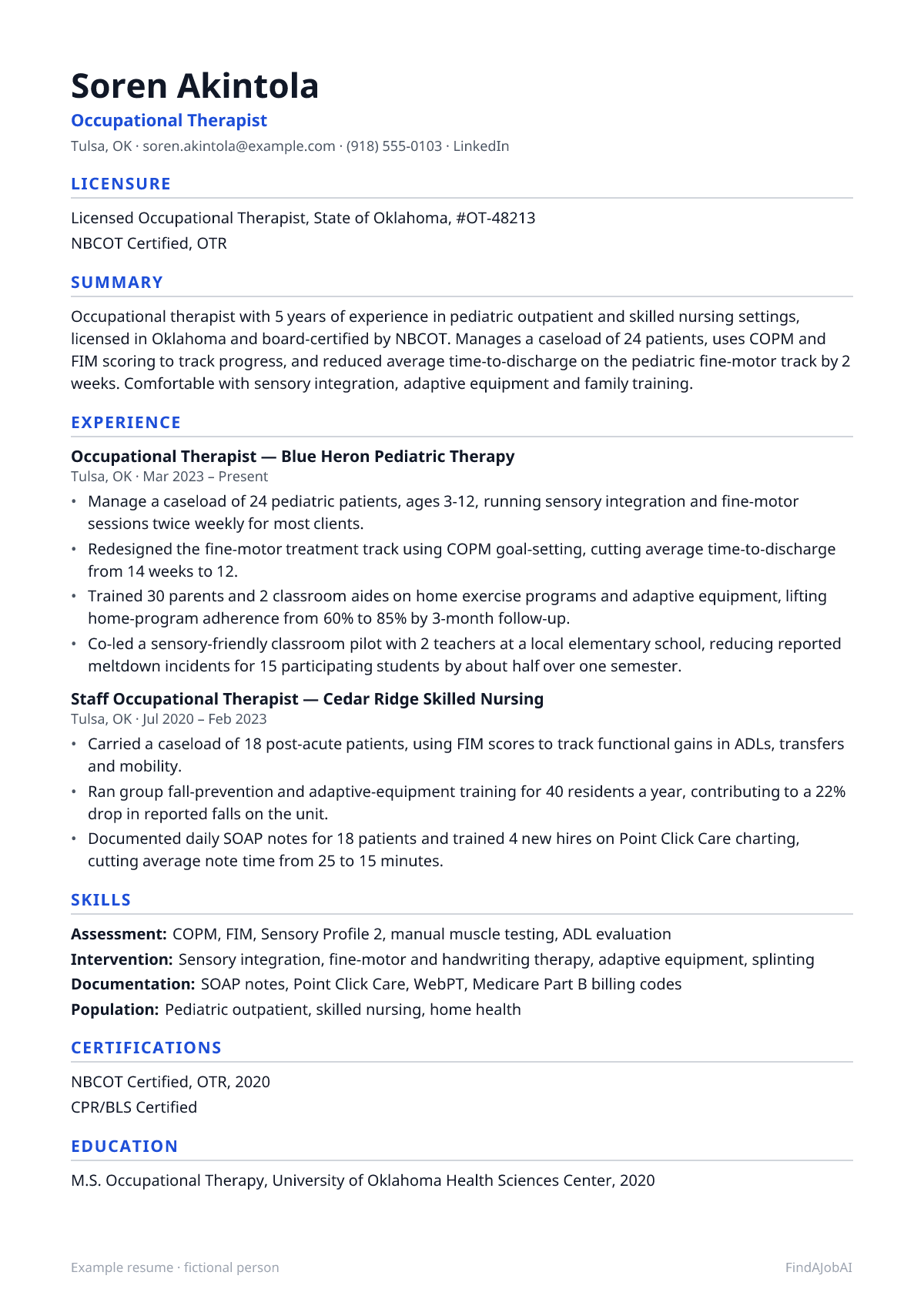
Occupational Therapist resume template
This example as a one-page template: one column, standard headings and plain text, the format applicant tracking systems read most reliably.
After you sign up, Create my CV builds your own resume in this same one-column layout, from your real experience.
Mid-level occupational therapist resume example
A complete one-page example for a fictional occupational therapist: every bullet pairs an action with what changed because of it.
Example resume · fictional person
Licensure
- Licensed Occupational Therapist, State of Oklahoma, #OT-48213
- NBCOT Certified, OTR
Summary
Occupational therapist with 5 years of experience in pediatric outpatient and skilled nursing settings, licensed in Oklahoma and board-certified by NBCOT. Manages a caseload of 24 patients, uses COPM and FIM scoring to track progress, and reduced average time-to-discharge on the pediatric fine-motor track by 2 weeks. Comfortable with sensory integration, adaptive equipment and family training.
Experience
Occupational Therapist, Blue Heron Pediatric Therapy
Tulsa, OK · Mar 2023 – Present
- Manage a caseload of 24 pediatric patients, ages 3-12, running sensory integration and fine-motor sessions twice weekly for most clients.
- Redesigned the fine-motor treatment track using COPM goal-setting, cutting average time-to-discharge from 14 weeks to 12.
- Trained 30 parents and 2 classroom aides on home exercise programs and adaptive equipment, lifting home-program adherence from 60% to 85% by 3-month follow-up.
- Co-led a sensory-friendly classroom pilot with 2 teachers at a local elementary school, reducing reported meltdown incidents for 15 participating students by about half over one semester.
Staff Occupational Therapist, Cedar Ridge Skilled Nursing
Tulsa, OK · Jul 2020 – Feb 2023
- Carried a caseload of 18 post-acute patients, using FIM scores to track functional gains in ADLs, transfers and mobility.
- Ran group fall-prevention and adaptive-equipment training for 40 residents a year, contributing to a 22% drop in reported falls on the unit.
- Documented daily SOAP notes for 18 patients and trained 4 new hires on Point Click Care charting, cutting average note time from 25 to 15 minutes.
Skills
- Assessment: COPM, FIM, Sensory Profile 2, manual muscle testing, ADL evaluation
- Intervention: Sensory integration, fine-motor and handwriting therapy, adaptive equipment, splinting
- Documentation: SOAP notes, Point Click Care, WebPT, Medicare Part B billing codes
- Population: Pediatric outpatient, skilled nursing, home health
Certifications
- NBCOT Certified, OTR, 2020
- CPR/BLS Certified
Education
- M.S. Occupational Therapy, University of Oklahoma Health Sciences Center, 2020
Fictional example by the FindAJobAI team: the person, employers and numbers are invented. Keep the structure; use your own work and numbers you can explain in an interview.
Entry-level occupational therapist resume example
A new OT graduate with Level I and II fieldwork and the NBCOT exam scheduled. Education sits under the summary since the degree and fieldwork are the strongest credentials so far, and each rotation is written with its caseload and one outcome, the way a first job would be.
Entry-level example resume · fictional person
Marisol Devereux
Occupational Therapist
Shreveport, LA · [email protected] · (318) 555-0164 · LinkedIn
Licensure
- Louisiana OT License, pending NBCOT exam results
- NBCOT Exam scheduled, 2026
Summary
Entry-level occupational therapist with an M.S. in Occupational Therapy and Level II fieldwork in pediatric outpatient and skilled nursing settings. Co-treated a caseload of 12 children on sensory and fine-motor goals and built a home-program handout families used an average of 4 days a week. NBCOT exam scheduled for next month; seeking a first OTR role in pediatric or outpatient care.
Education
- M.S. Occupational Therapy, Louisiana State University Health Sciences Center, 2026
Experience
Level II Fieldwork Student, Magnolia Pediatric Therapy
Shreveport, LA · Jan 2026 – Apr 2026
- Co-treated a caseload of 12 children ages 4-9 on sensory integration and fine-motor goals under a supervising OT, progressing 9 of 12 toward their COPM goals within the rotation.
- Built a home-exercise handout with picture cues that families reported using an average of 4 days a week at the midpoint check-in.
- Observed and documented 20 initial evaluations, learning the clinic's SOAP note format and billing codes.
Level I Fieldwork Student, Caddo Parish Skilled Nursing
Shreveport, LA · Jun 2025 – Aug 2025
- Shadowed and co-treated 8 post-acute patients on ADL retraining and transfer safety, under supervision, using FIM scoring to track change.
- Led 2 group fall-prevention sessions for residents, using a checklist that the facility later adopted for new fieldwork students.
Skills
- Assessment: COPM, FIM (supervised), Sensory Profile 2, ADL evaluation
- Intervention: Sensory integration, fine-motor and handwriting therapy, basic splinting
- Documentation: SOAP notes, Point Click Care (fieldwork use)
Certifications
- CPR/BLS Certified
Senior occupational therapist resume example
A clinical lead eleven years in, now overseeing a department instead of only a personal caseload. Bullets move from individual treatment plans to protocols adopted facility-wide, mentoring new OTs and reducing falls and readmissions across multiple sites.
Senior example resume · fictional person
Benedikt Osei
Senior Occupational Therapist, Clinical Lead
Richmond, VA · [email protected] · (804) 555-0147 · LinkedIn
Licensure
- Licensed Occupational Therapist, Commonwealth of Virginia, #OT-19042
- NBCOT Certified, OTR, since 2015
Summary
Senior occupational therapist with 11 years across acute care, skilled nursing and outpatient pediatrics, now clinical lead for a 6-therapist department across 3 facilities. Built the fall-prevention protocol adopted system-wide that cut reported falls by 28%, and mentors new OTs through their first year, including 2 who passed the NBCOT exam on their first attempt this year.
Experience
Senior Occupational Therapist, Clinical Lead, Shenandoah Rehabilitation Network
Richmond, VA · Feb 2021 – Present
- Lead a department of 6 occupational therapists across 3 facilities, setting caseload standards and reviewing documentation for compliance.
- Built the fall-prevention protocol now used system-wide, combining home evaluations and group training, cutting reported falls by 28% over 18 months.
- Mentor new-hire OTs through their first year, including structured case review, with 2 of 3 passing the NBCOT exam on their first attempt this year.
- Redesigned the department's COPM-based goal-setting process, cutting average time-to-discharge across the pediatric and ortho tracks by 9 days.
Occupational Therapist, Tidewater General Hospital
Norfolk, VA · Aug 2016 – Jan 2021
- Carried a caseload of 20 acute-care patients, using FIM scoring to guide discharge recommendations for 300+ patients a year.
- Built a splinting protocol for hand-trauma patients adopted by the surgical floor, cutting average splint-fitting wait time from 2 days to 4 hours.
- Trained 10 nursing staff a year on safe transfer techniques, contributing to a unit-wide drop in transfer-related injuries.
Staff Occupational Therapist, Blue Ridge Skilled Nursing
Roanoke, VA · Jul 2013 – Jul 2016
- Managed a caseload of 16 post-acute residents, documenting daily SOAP notes and tracking ADL progress with FIM scoring.
- Ran monthly caregiver training for families of 25 residents a year on safe home transfers and adaptive equipment use.
Skills
- Leadership: Caseload standards, documentation audits, hiring and mentoring new OTs
- Clinical: FIM, COPM, splinting, fall-prevention protocols, discharge planning
- Systems: Point Click Care, Epic, WebPT, Medicare Part A/B billing compliance
Education
- M.S. Occupational Therapy, Virginia Commonwealth University, 2013
How to write an occupational therapist resume
Five steps, in the order a recruiter reads the page. The format around them stays plain for every job: one column, standard headings, newest role first.
Header: name, target title and links
Use the title "Occupational Therapist" or "OTR" as listed on the job ad, and put your license state, number and NBCOT certification near the top; many facilities screen resumes for license status before reading further.
Summary: what you do and your best proof
Name your setting (pediatric, outpatient, skilled nursing), your caseload size and one outcome measure you use, then a result such as a discharge-time or falls reduction. Skip lines like "compassionate caregiver"; every OT resume says that.
Experience: newest first, a result in every bullet
Open each bullet with the caseload and setting, then the assessment or intervention and the functional result: a FIM or COPM change, a discharge-time shift or a safety outcome. Listing modalities with no result reads like a class syllabus.
Skills: grouped, in the ad's words
Group into assessment tools, interventions, documentation systems and populations served. Name the specific outcome measures and EMR the job ad lists, since many facilities train on only one system.
Education and certifications
List your degree, year and school, plus NBCOT certification and your state license. Without full-time experience, write Level I and II fieldwork like jobs, each with a caseload, supervision level and one outcome.
Skills to put on an occupational therapist resume
Hard skills are the tools and methods of the job; soft skills are how you work with people. Each comes with one way to prove it, because a skill named only in a list counts for little. Add the ones you really have.
Hard skills
- COPM
- Name the goals you set with a patient using it and the score change by discharge.
- FIM scoring
- Give the admission and discharge FIM scores for a caseload or patient group you tracked.
- Sensory integration
- Describe the population and one behavior or skill that changed after a sensory-based plan.
- Splinting
- Name the splint type and the wait time or healing outcome it affected.
- ADL retraining
- State the caseload and the specific ADL, such as dressing or bathing, with the independence level gained.
- Fall-prevention programs
- Give the number of patients or residents in the program and the drop in reported falls.
- Home health evaluations
- Count the home visits or equipment fittings and the safety incident change that followed.
- Documentation (SOAP notes)
- Mention your caseload size and the average note-writing time you achieved or improved.
- Point Click Care / WebPT
- Name the system and a training or efficiency result, such as new hires trained or time saved.
- Caregiver and family training
- Give the number of caregivers trained and the home-adherence rate that followed.
- Interdisciplinary rounds
- Name the other disciplines involved and a length-of-stay or goal-alignment result.
- Pediatric fine-motor and handwriting therapy
- State the age group and a measured gain, such as a grade-level jump in legibility.
Soft skills
- Patient rapport
- Describe adapting your approach for a specific patient, such as a nonverbal child or an anxious adult, and the result.
- Communication
- Show a time you explained a treatment plan or home program clearly enough that adherence improved.
- Interdisciplinary teamwork
- Name the other roles you coordinate with regularly and a shared outcome, like shorter length of stay.
- Time management
- Give your daily caseload and how you kept documentation current without falling behind.
- Patience
- Describe a slow-progress case and the eventual functional gain reached over a stated number of weeks.
- Cultural competence
- Mention adapting a home program or evaluation for a patient's language, culture or home setup.
- Mentorship
- Count new OTs or fieldwork students you supervised and one outcome, like an exam pass rate.
Occupational Therapist resume bullet examples: weak vs strong
The same work, written two ways. The strong version names the tool, the scope and a result; the numbers are examples, yours must be real.
Weak: Provided occupational therapy to patients.
Strong: Managed a caseload of 22 outpatient adults recovering from stroke, using FIM scoring to track gains in dressing and transfers.
Names the caseload, the population and the measurement tool.
Weak: Created treatment plans.
Strong: Built COPM-based treatment plans for 15 pediatric clients that raised average handwriting-legibility scores by 2 grade levels in 10 weeks.
Pairs the planning tool with a measured functional change.
Weak: Worked with families.
Strong: Trained 25 caregivers on home exercise programs for dementia patients, raising at-home adherence from 55% to 80% at 60-day follow-up.
Shows the training activity and the adherence it produced.
Weak: Documented patient progress.
Strong: Wrote SOAP notes for a caseload of 20 and trained 3 new therapists on Point Click Care, cutting average documentation time from 30 to 18 minutes.
Documentation becomes a measurable efficiency gain.
Weak: Recommended adaptive equipment.
Strong: Fitted 12 patients with adaptive kitchen and bathing equipment after home evaluations, cutting reported fall incidents at home by a third over 6 months.
Equipment recommendation tied to a safety outcome.
Weak: Collaborated with the care team.
Strong: Ran weekly rounds with 2 PTs and a speech-language pathologist on 18 shared patients, aligning goals that shortened average length of stay by 4 days.
Shows interdisciplinary work with a concrete result.
15 more occupational therapist resume bullet examples
Grouped by area of the job, so you can find the ones closest to your work. Keep the shape (action, scope, result) and replace the invented numbers with your own.
Pediatric and sensory therapy
- Built a sensory-integration program for 15 preschoolers with autism spectrum diagnoses, with 10 meeting their COPM goals within 12 weeks.
- Ran a handwriting club for 20 first-graders twice weekly, raising average legibility scores by 2 grade levels over one semester.
- Fitted 8 children with adaptive seating and utensils, cutting mealtime assistance needs reported by teachers by half.
- Co-designed a sensory room with a school's special education team, used by 25 students a week for self-regulation breaks.
Adult rehab and skilled nursing
- Carried a caseload of 20 post-stroke adults, using FIM scoring to guide discharge planning for a unit averaging 40 admissions a month.
- Built a hand-therapy protocol for post-surgical patients that cut average time-to-return-to-work from 8 to 6 weeks.
- Ran group fall-prevention training for 50 skilled-nursing residents a year, contributing to a 25% drop in reported falls.
- Led bedside ADL retraining for 12 acute-care patients a week, raising independent-dressing rates at discharge from 45% to 65%.
Documentation and systems
- Documented SOAP notes for a caseload of 22 patients, maintaining a same-day charting rate above 95% for a full year.
- Trained 6 new hires on Point Click Care documentation, cutting their average note-writing time from 35 to 20 minutes within a month.
- Audited 100 charts for Medicare Part B compliance, catching 18 missing goal updates before a facility audit.
- Switched a clinic's intake paperwork to a digital form, cutting average evaluation prep time by 15 minutes per patient.
Caregiver training and outcomes
- Trained 30 parents on home exercise programs for fine-motor goals, raising reported at-home practice from 2 to 5 days a week.
- Ran quarterly caregiver workshops on safe transfers for families of 40 home-health patients a year.
- Built a one-page visual home-program guide adopted clinic-wide, cited by 70% of surveyed families as easier to follow than prior handouts.
Occupational Therapist resume summary examples
Two or three lines on what you do and your strongest proof. Start from the one closest to your level and use your own facts.
Occupational therapist with a master's degree and a Level II fieldwork rotation in pediatric outpatient care. Co-treated a caseload of 10 children on sensory integration and fine-motor goals under supervision, and built a home-exercise handout families reported using 4 days a week on average. NBCOT exam scheduled; comfortable with COPM and basic splinting.
Occupational therapist with 5 years in home health and outpatient orthopedics, managing a caseload of 20 adult patients. Built a post-surgical hand-therapy protocol that cut average time-to-return-to-work by 10 days, and trained 3 new hires on WebPT documentation.
Senior occupational therapist with 11 years across acute care, skilled nursing and outpatient pediatrics, now clinical lead for a 6-therapist department. Built the fall-prevention protocol adopted across 3 facilities, cutting reported falls by 28%, and mentors new OTs through their first year of practice.
Common occupational therapist resume mistakes
Each one is easy to make and quick to fix before you apply.
Burying the license and NBCOT status
Put your license state, number and NBCOT certification near the top of the resume, since many facilities can't move an application forward without it.
Listing modalities with no outcome
Sensory integration and splinting in Skills show what you can do; a bullet should show the caseload and the functional change that followed.
No caseload size or setting
A caseload of 10 pediatric outpatients and one of 30 skilled-nursing residents are different jobs. State both clearly.
Vague phrases like "provided quality care"
Replace it with the measure that moved: a FIM or COPM score, a discharge timeline or a drop in falls or readmissions.
Treating fieldwork as less than real experience
Level I and II fieldwork had real caseloads and supervision; write them with the same structure as a job, including one measurable outcome.
ATS tips for an occupational therapist resume
Applicant tracking systems turn your file into text that recruiters search, mostly for the skills and titles in the ad. They rarely reject a resume on their own; one that parses badly or misses the ad's words just doesn't come up.
- State your caseload size and setting (pediatric outpatient, skilled nursing, home health); it tells a hiring manager what kind of day you're used to.
- Name the outcome measure you use (COPM, FIM, Sensory Profile) and a result it tracked, not just that you're 'skilled in assessment'.
- Include your license state and number, and NBCOT certification status, near the top since many postings require it before an interview is scheduled.
- Describe documentation systems by name (Point Click Care, WebPT, Epic) since many facilities train on one and screen for familiarity.
- If you treat a specific population, such as pediatric sensory integration or post-surgical hand therapy, lead with it; OT roles are often filled by specialty.
For the format itself, run the free ATS resume checklist.
Everything for Occupational Therapists
- Occupational Therapist cover letter examplesThree example letters and a short email version
- Occupational Therapist job descriptionDuties, skills and requirements
- How to tailor your resume without lying
Other resume examples
Occupational Therapist resume FAQ
What should an occupational therapist put on a resume?
License state and number, NBCOT certification, caseload size and setting, the outcome measures you use (COPM, FIM), and documentation systems. Tie each to a treatment result, not just a list of modalities.
How do I write an occupational therapy resume with only fieldwork experience?
Describe your Level I and II fieldwork rotations like jobs: caseload size, setting, supervision level and one outcome from a treatment plan you helped build, plus your NBCOT exam date.
Is it wise to list every certification I hold?
List NBCOT certification and your state license first, then certifications relevant to the job, such as sensory integration or splinting. Skip one-day course certificates that don't apply to the role.
How do I show outcomes without violating patient privacy?
Use aggregate numbers and never real patient names or identifying details: caseload size, average improvement in a measure, or a percentage change in a group outcome like falls or readmissions.
How we built this page
The FindAJobAI team wrote the three example resumes, the bullets, the skills and the advice for occupational therapist roles. The people, employers and numbers in the examples are invented; the structure, the tools and the way each bullet is built are the parts to copy.
Once we track enough live occupational therapist job ads, this page also shows the skills they ask for most, counted the same way as our in-demand skills report.
Last reviewed on November 1, 2026.