Occupational Therapist Cover Letter Example (2026)
By FindAJobAI team Updated How we built this page
Occupational therapist ads usually list the same license and setting requirements, so the cover letter is where a reader learns how you actually work with patients and the team around them. Name a case, the functional goal you were working toward, and what changed for that person.
Occupational Therapist cover letter template
This letter as a one-page template: an opening that names the job and your strongest fact, proof that answers the ad, a reason for this employer and a short close.
After you sign up, FindAJobAI drafts your own letter for a real job from your CV in this format, and you edit it before you send it.
Example 1 · Experienced
Inpatient rehab OT applying to a stroke recovery unit
Odalys treats stroke patients at a rehab hospital. The ad asks for experience with upper-extremity recovery and family training.
Example letter · fictional
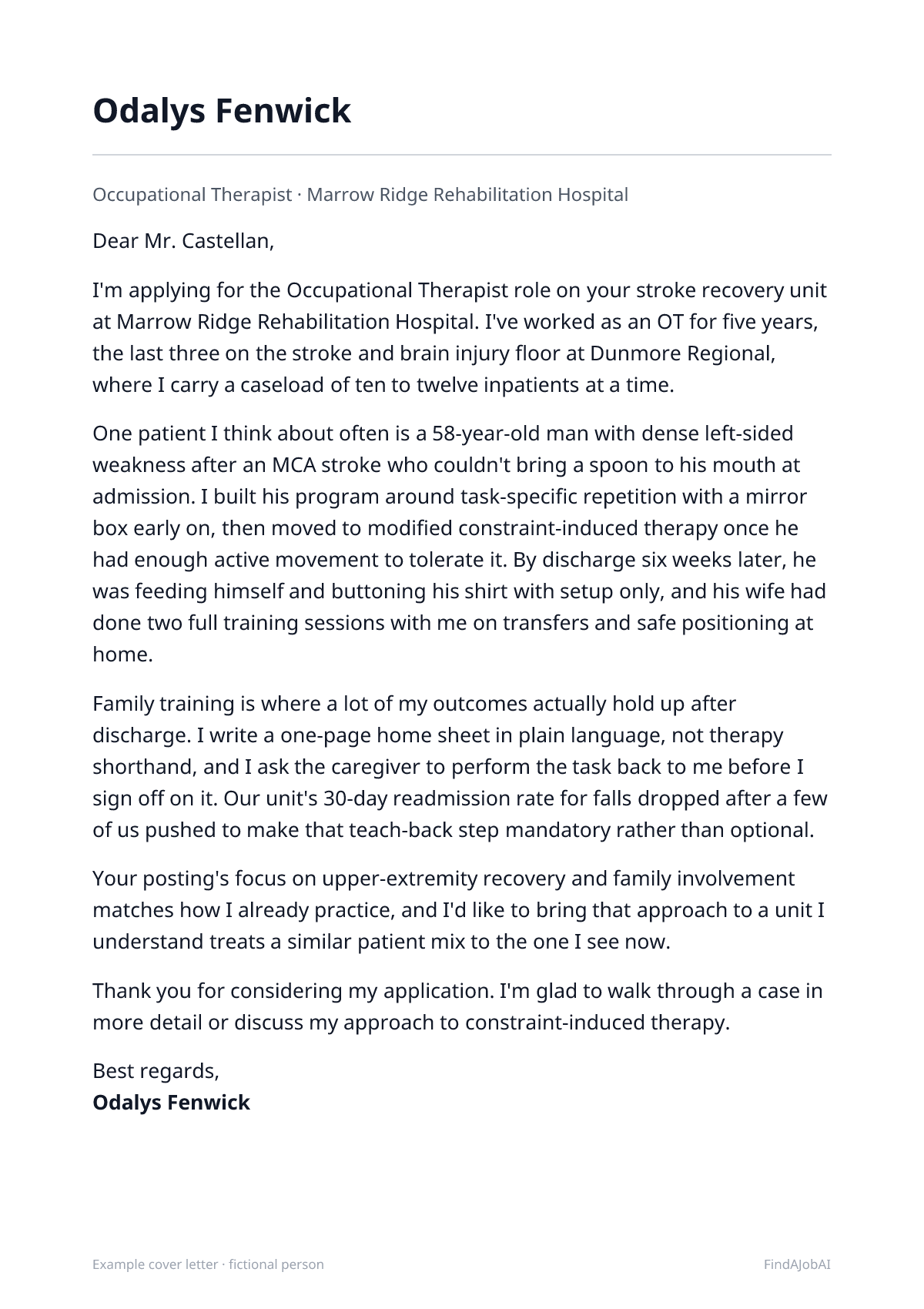
Dear Mr. Castellan,
I'm applying for the Occupational Therapist role on your stroke recovery unit at Marrow Ridge Rehabilitation Hospital. I've worked as an OT for five years, the last three on the stroke and brain injury floor at Dunmore Regional, where I carry a caseload of ten to twelve inpatients at a time.
One patient I think about often is a 58-year-old man with dense left-sided weakness after an MCA stroke who couldn't bring a spoon to his mouth at admission. I built his program around task-specific repetition with a mirror box early on, then moved to modified constraint-induced therapy once he had enough active movement to tolerate it. By discharge six weeks later, he was feeding himself and buttoning his shirt with setup only, and his wife had done two full training sessions with me on transfers and safe positioning at home.
Family training is where a lot of my outcomes actually hold up after discharge. I write a one-page home sheet in plain language, not therapy shorthand, and I ask the caregiver to perform the task back to me before I sign off on it. Our unit's 30-day readmission rate for falls dropped after a few of us pushed to make that teach-back step mandatory rather than optional.
Your posting's focus on upper-extremity recovery and family involvement matches how I already practice, and I'd like to bring that approach to a unit I understand treats a similar patient mix to the one I see now.
Thank you for considering my application. I'm glad to walk through a case in more detail or discuss my approach to constraint-induced therapy.
Best regards,
Odalys Fenwick
Example 2 · Career changer
Physical education teacher moving into pediatric occupational therapy
Garrison finished OT school after years teaching PE and coaching kids with motor delays. The ad wants sensory processing experience.
Example letter · fictional
Dear Hiring Manager,
I'm applying for the Occupational Therapist, Pediatrics role at Thistlewood Children's Therapy Center. I taught elementary PE for seven years before going back to school for my OT degree, and the reason I made the switch was a handful of kids each year who struggled with basic motor tasks that nobody on staff knew how to address beyond extra practice.
One third grader I taught could not catch a ball, tie his shoes, or sit through circle time without falling out of his chair. I didn't have the training to help him then, which is part of what sent me back to school. During my pediatric fieldwork rotation, I worked with a boy with similar sensory processing differences, built a sensory diet around proprioceptive input before transition times, and within eight weeks his teacher reported far fewer meltdowns during the midday schedule change.
I finished my OTD at Harwick University in May and completed two fieldwork rotations in pediatric settings, one in a school and one in an outpatient sensory gym, totaling over 24 weeks of supervised practice. I hold my NBCOT certification and state license, and I'm comfortable with sensory integration frameworks, fine motor programming, and writing goals that classroom teachers can actually use.
Your ad's emphasis on sensory processing work is exactly the population I sought this career out for, and I'd bring eight years of reading kids in a classroom setting alongside a therapist's toolkit for what to do about what I see.
Thank you for your time. I'd welcome the chance to discuss my fieldwork cases and how I'd approach a caseload like yours.
Sincerely,
Garrison Oyelaran
Example 3 · Senior or lead
Lead OT applying to build out a pediatric clinic's therapy program
Perpetua supervises six OTs at a growing pediatric clinic. The ad is for a lead OT who will set protocols and mentor new hires.
Example letter · fictional
Dear Dr. Nkemdirim,
I'm applying for the Lead Occupational Therapist role at Hollin Brook Pediatric Therapy. I've spent the last four years supervising a team of six OTs at Varrow Children's Clinic, and before that I worked six years as a staff therapist in pediatric outpatient settings. I'd like to take on building out a program rather than only running my own caseload.
Your ad mentions inconsistent evaluation protocols across therapists, which was exactly the problem I inherited at Varrow. New hires were each writing goals their own way, and parents sometimes got different explanations of the same diagnosis from different staff. I wrote a standardized initial evaluation packet built around the Sensory Profile and the School Function Assessment, trained the team on it over three sessions, and built a shared goal bank so similar cases weren't reinvented from scratch. Within two quarters, our average time from evaluation to a signed plan of care dropped from eleven days to four.
The case I'm proudest of as a supervisor isn't my own. I mentored a therapist in her first year through a toddler with severe feeding aversion who'd been tube-fed since infancy; I supervised her sessions, helped her adjust the desensitization pace twice when progress stalled, and the child was taking purees by mouth within four months. Watching a newer therapist get that result, and knowing she could repeat it without me in the room, is what I want more of.
I haven't managed a program's budget or hiring directly, only caseload and clinical supervision, and at Hollin Brook I'd want to learn that side from whoever currently owns it.
I'd welcome a conversation about which parts of your evaluation or onboarding process feel inconsistent right now, and where a lead therapist could help first.
Sincerely,
Perpetua Ashworth
All three letters, and the short version below, are fictional: the people, employers and numbers are invented. Borrow the structure, never the facts.
- Prefer to write it yourself? Use the free cover letter template.
- Check your CV against the job first: the free CV score shows the missing keywords.
Why the first letter works, paragraph by paragraph
Paragraph 1: Opening
States years of experience and the specific unit type (stroke and brain injury), which tells the reader the caseload will transfer directly.
Paragraph 2: The case that shows the method
One patient, a clear starting deficit, the specific technique (mirror box, then constraint-induced therapy), and a functional outcome at discharge the reader can picture.
Paragraph 3: Family training as a second skill
Shows outcomes don't stop at discharge, and the teach-back detail is a concrete practice, not a claim of being 'family-centered.'
Paragraph 4: Why this unit
Connects the ad's named priorities (upper-extremity recovery, family involvement) to the letter's actual content rather than restating them generically.
Paragraph 5: Close
Offers to discuss a specific technique by name, which signals depth rather than a general willingness to 'talk more.'
What the career changer's letter does differently
The career changer's letter opens with the classroom moment that motivated the switch, then uses a fieldwork case rather than paid work history, since none exists yet in OT. It's explicit about license status, fieldwork hours, and frameworks learned, and it turns the teaching background into an asset (reading kids, classroom-usable goals) instead of treating it as a gap to explain away.
What the senior letter does differently
A lead OT letter reports on a team's systems, not a single patient: a standardized evaluation packet, time-to-plan-of-care cut from eleven days to four, and a mentoring case where the writer's supervision produced another therapist's result. The gap (budget and hiring) is named rather than glossed over.
Short occupational therapist cover letter: an email-ready version
Many applications arrive as an email or a small text box, and a full page doesn't fit. This version runs 120 to 150 words and keeps only what a reader needs to decide whether to reply. An OT answers a hand therapy clinic's short online application question after a colleague mentioned the opening.
Short version · email · fictional123 words
Subject: OT, Hand Therapy – CHT candidate, post-surgical caseload – Wendell Achebe
Hello Ms. Okonjo,
I'm applying for the Occupational Therapist, Hand Therapy role at Stillwater Hand & Upper Extremity Clinic. I've spent four years treating post-surgical hand and wrist patients at an outpatient ortho clinic and I'm currently logging hours toward my CHT.
A recent case was a flexor tendon repair patient referred to me at two weeks post-op. I followed a modified Duran protocol, adjusted splinting twice as his edema changed, and he regained full composite flexion by week ten without a rupture or significant scar restriction.
I'd like to work somewhere that treats a high volume of post-surgical referrals, which Stillwater clearly does. My resume is attached, and I can share more detail on the Duran protocol case if useful.
Best,
Wendell Achebe
The short version keeps one post-surgical case with a specific protocol name and a clean outcome, and states CHT progress since hand therapy roles often screen for it directly. It drops the family-training detail entirely since the question only allows room for one example.
Opening lines that work for occupational therapist cover letters
The first sentence decides whether the second gets read. Here are six openings, one for each situation you might be in. Pick the one that matches yours and swap in your own facts: every name and number below is invented.
1. You have a standout result
A flexor tendon repair patient I treated regained full composite flexion by week ten using a modified Duran protocol, with no rupture. That's the kind of post-surgical caseload I'd like to bring to your clinic.
2. The ad names a problem you've solved
Your ad mentions sensory processing support for young kids. During a recent fieldwork rotation, I built a sensory diet around proprioceptive input that cut a student's midday meltdowns noticeably within eight weeks.
3. Someone referred you
Your clinic's occupational therapy supervisor, Thaddeus Ilomuanya, worked alongside me for two years on a stroke unit. He suggested I apply, which is what prompted this letter.
4. You admire what they build
I've referred two family members to your outpatient OT program over the years, and the way your therapists explained home exercises stuck with me; I'd like to be part of a team that communicates that clearly.
5. You're new to the field or switching into it
I spent seven years teaching elementary PE before training as an OT, and the kids I couldn't help back then are a large part of why I chose this field.
6. You have senior scope or a specialism
As the supervisor of a six-person OT team for four years, I rebuilt our evaluation protocol and cut time-to-plan-of-care by more than half. I'm ready to build a program rather than only run my own caseload.
How to write an occupational therapist cover letter
Five steps, in the order you'd write them. The shape stays the same for every job (a short opening, proof, a reason for this employer, a close), and what goes into each part is what changes with the role.
Identify the setting and population the ad names
Inpatient, outpatient, school-based, home health, and hand therapy all call for different stories. Read the ad for the population (stroke, pediatric sensory, post-surgical hand) and lead with a case from that exact population, not your broadest experience.
Open with one case, not a diagnosis list
Name a single patient or client, their starting deficit, and what you did. A reader who sees a specific technique and a specific person in the first paragraph trusts the rest of the letter more than one that lists every diagnosis you've treated.
Name the technique, then the outcome
Mirror therapy, constraint-induced movement therapy, sensory integration, a Duran protocol: naming the actual method you used, then the functional change that followed, reads as real practice. A method named without an outcome reads as a certificate you're listing.
Include family or caregiver training if it applies
Many OT outcomes depend on what happens after discharge. If your role involves caregivers, describe one concrete teaching moment, such as a teach-back check, rather than claiming to be 'family-centered' in the abstract. Keep the family details anonymous.
State your license and credentials without burying them
Put your license status, relevant certifications (CHT, SIPT, NBCOT), and setting experience where a reader can find them quickly, ideally in the first or second paragraph. Close by naming a question about their caseload or protocols you'd want to ask in an interview.
Occupational Therapist cover letter do's and don'ts
Do
- Open with one patient or client case and the specific technique or frame of reference you used, not a list of diagnoses treated.
- Name your setting (inpatient, outpatient, school-based, home health) since OT practice differs enough by setting that generic letters read as unfocused.
- Mention family or caregiver training as its own skill if the role involves it; it's often where real-world outcomes are won or lost.
- State your license and certification status plainly if you're newly credentialed; don't make the reader hunt for it.
Don't
- Don't write "I'm passionate about helping people" as your reason for the field; show one case where your specific intervention changed a functional outcome.
- Don't list every modality you're trained in; name the one or two the ad asks for and show you've used them.
- Don't share identifying patient details; change names, ages, or minor facts the way the examples here do.
Common occupational therapist cover letter mistakes
Each one is easy to make and quick to fix before you send the letter.
Listing diagnoses instead of describing a case
"Treated patients with CVA, TBI, and orthopedic conditions" tells the reader nothing about your method. Pick one patient, one technique, and one outcome instead.
Claiming to be 'passionate' without a case to show it
Every OT applicant writes some version of this. Replace it with a specific moment, like a teach-back session or a stalled case you adjusted, that shows the trait rather than naming it.
Naming a treatment frame you haven't actually used
Borrowing language like "sensory integration" or "NDT" from a textbook without a case behind it is easy for an experienced reader to spot. Only name a framework you can describe applying to a real client.
Omitting license and certification status
Hiring managers often screen for license eligibility first. State your license state, NBCOT status, or relevant certification progress plainly rather than assuming your resume covers it.
Sharing identifying patient details
Specific cases are persuasive, but names, exact ages, or employer-identifying details can breach confidentiality. Change minor details the way a case study would, while keeping the clinical facts intact.
Email subject lines for occupational therapist applications
Applying by email? Put the job title, any reference number and your name in the subject line.
- Occupational Therapist application – stroke recovery unit – Odalys Fenwick
- OT, Pediatrics – sensory integration, OTD and fieldwork completed – Garrison Oyelaran
- Application: Occupational Therapist, Outpatient Hand Clinic – Odalys Fenwick
Everything for Occupational Therapists
- Occupational Therapist resume exampleA full resume, plus bullet and summary examples
- Occupational Therapist job descriptionDuties, skills and requirements
- Career change cover letter: template + examples
Other cover letter examples
Occupational Therapist cover letter FAQ
What should I write in an occupational therapist cover letter?
One patient or client case: the functional deficit, the technique or frame of reference you used, and the outcome. Add a sentence on family or caregiver training if that's part of the role. Your license and setting experience belong early, not buried.
How do I write an occupational therapist cover letter with no clinical job experience yet?
Use a fieldwork rotation case the same way you'd use a work case: the deficit, your intervention, the result. State your license status, fieldwork hours, and any frameworks you learned, and connect a prior career to skills the role needs.
Should I mention specific treatment frameworks like sensory integration or CIMT?
Yes, if you've actually used them and the ad's population suggests they're relevant. Naming a framework inside a real case is credible; listing frameworks without a case reads as borrowed language.
How long should an occupational therapist cover letter be?
Four to five paragraphs is enough for most postings. A short, email-ready version of two or three paragraphs works when a posting asks for a quick note rather than a formal letter.
How we built this page
The FindAJobAI team wrote the three example letters, the short email version, the opening lines and the advice for occupational therapist roles. The people, employers and numbers in the letters are invented; the structure, the kind of evidence and the order of the paragraphs are the parts to copy.
Once we track enough live occupational therapist job ads, this page also shows the skills they ask for most, counted the same way as our in-demand skills report.
Last reviewed on November 1, 2026.