Ophthalmic Technician Resume Example (2026)
By FindAJobAI Team Updated How we built this page
Ophthalmic technician postings usually ask for the same core skills: patient history, visual acuity, tonometry, refraction, OCT and visual field testing, and keeping a busy ophthalmologist's clinic moving. Nearly every applicant lists those tests. A stronger resume shows how many patients you work up a day, which instruments you run, how reliable your measurements are and what you did to keep the schedule on time.
The example below covers five years in a retina practice and a cataract surgery center. Each bullet counts patients or tests and names a result, such as fewer repeat scans, shorter wait times or accurate lens calculations.
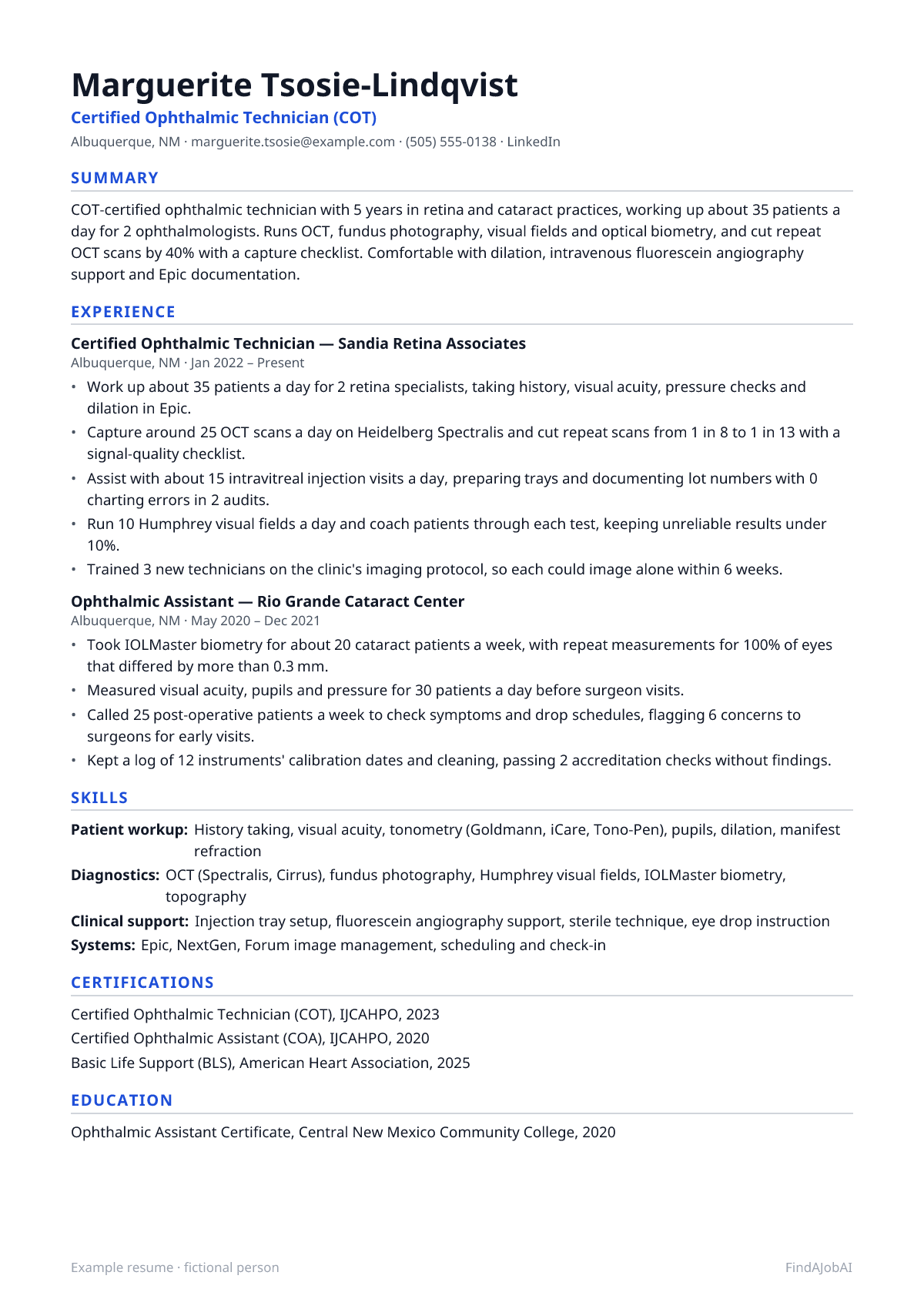
Ophthalmic Technician resume template
This example as a one-page template: one column, standard headings and plain text, the format applicant tracking systems read most reliably.
After you sign up, Create my CV builds your own resume in this same one-column layout, from your real experience.
Mid-level ophthalmic technician resume example
A complete one-page example for a fictional ophthalmic technician: every bullet pairs an action with what changed because of it.
Example resume · fictional person
Marguerite Tsosie-Lindqvist
Certified Ophthalmic Technician (COT)
Albuquerque, NM · [email protected] · (505) 555-0138 · LinkedIn
Summary
COT-certified ophthalmic technician with 5 years in retina and cataract practices, working up about 35 patients a day for 2 ophthalmologists. Runs OCT, fundus photography, visual fields and optical biometry, and cut repeat OCT scans by 40% with a capture checklist. Comfortable with dilation, intravenous fluorescein angiography support and Epic documentation.
Experience
Certified Ophthalmic Technician, Sandia Retina Associates
Albuquerque, NM · Jan 2022 – Present
- Work up about 35 patients a day for 2 retina specialists, taking history, visual acuity, pressure checks and dilation in Epic.
- Capture around 25 OCT scans a day on Heidelberg Spectralis and cut repeat scans from 1 in 8 to 1 in 13 with a signal-quality checklist.
- Assist with about 15 intravitreal injection visits a day, preparing trays and documenting lot numbers with 0 charting errors in 2 audits.
- Run 10 Humphrey visual fields a day and coach patients through each test, keeping unreliable results under 10%.
- Trained 3 new technicians on the clinic's imaging protocol, so each could image alone within 6 weeks.
Ophthalmic Assistant, Rio Grande Cataract Center
Albuquerque, NM · May 2020 – Dec 2021
- Took IOLMaster biometry for about 20 cataract patients a week, with repeat measurements for 100% of eyes that differed by more than 0.3 mm.
- Measured visual acuity, pupils and pressure for 30 patients a day before surgeon visits.
- Called 25 post-operative patients a week to check symptoms and drop schedules, flagging 6 concerns to surgeons for early visits.
- Kept a log of 12 instruments' calibration dates and cleaning, passing 2 accreditation checks without findings.
Skills
- Patient workup: History taking, visual acuity, tonometry (Goldmann, iCare, Tono-Pen), pupils, dilation, manifest refraction
- Diagnostics: OCT (Spectralis, Cirrus), fundus photography, Humphrey visual fields, IOLMaster biometry, topography
- Clinical support: Injection tray setup, fluorescein angiography support, sterile technique, eye drop instruction
- Systems: Epic, NextGen, Forum image management, scheduling and check-in
Certifications
- Certified Ophthalmic Technician (COT), IJCAHPO, 2023
- Certified Ophthalmic Assistant (COA), IJCAHPO, 2020
- Basic Life Support (BLS), American Heart Association, 2025
Education
- Ophthalmic Assistant Certificate, Central New Mexico Community College, 2020
Fictional example by the FindAJobAI team: the person, employers and numbers are invented. Keep the structure; use your own work and numbers you can explain in an interview.
Entry-level ophthalmic technician resume example
A recent ophthalmic assistant graduate with an externship and optical retail experience. Education and the COA come first, and the externship bullets count real patients and tests rather than listing coursework.
Entry-level example resume · fictional person
Ezequiel Hartmann-Oduya
Ophthalmic Technician (COA)
Tucson, AZ · [email protected] · (520) 555-0153 · LinkedIn
Summary
Entry-level ophthalmic technician with a COA credential and a certificate from Pima Community College. Completed a 6-month externship working up about 20 patients a day at a general ophthalmology clinic, including visual fields and OCT. Brings 2 years of optical shop experience helping patients with frames and lens orders.
Education
- Ophthalmic Assistant Certificate, Pima Community College, 2026
Experience
Ophthalmic Technician Extern, Catalina Eye Physicians
Tucson, AZ · Jan 2026 – Jun 2026
- Worked up about 20 patients a day under supervision, taking histories, acuities, pupils and pressures.
- Ran 6 to 8 Humphrey visual fields a day and learned to spot fixation losses early.
- Captured 15 OCT scans a day on Cirrus with supervisor sign-off, 90% accepted on first review.
Optical Sales Associate, Saguaro Vision Optical
Tucson, AZ · Mar 2024 – Dec 2025
- Helped about 25 customers a day choose frames and took pupillary distance measurements.
- Checked 40 incoming lens orders a week against prescriptions, catching 5 errors before pickup.
Skills
- Workup: History, visual acuity, pupils, iCare and Tono-Pen tonometry, lensometry
- Testing: Humphrey visual fields, Cirrus OCT, autorefraction
- Patient care: Bilingual English and Spanish, calm explanations, eye drop instruction
Certifications
- Certified Ophthalmic Assistant (COA), IJCAHPO, 2026
- BLS, American Heart Association, 2026
Clinical Training
- Ophthalmic assistant program: 240 hours of coursework in anatomy, optics, tonometry and lensometry.
- Skills checkoffs: passed 18 competency checks, including Goldmann tonometry and manual lensometry.
Senior ophthalmic technician resume example
A lead technician twelve years in who now supervises other technicians. The bullets shift from individual tests to staffing, training, imaging standards and clinic flow across several doctors.
Senior example resume · fictional person
Philippa Nakamura-Ashworth
Lead Ophthalmic Technician (COMT)
Portland, OR · [email protected] · (503) 555-0110 · LinkedIn
Summary
Lead ophthalmic technician and COMT with 12 years in multi-specialty ophthalmology, supervising 9 technicians across 3 clinics for 6 doctors. Built a training program and imaging standards that cut repeat testing by a third, and manages daily clinic flow. Supports YAG laser and minor procedures and coordinates research study visits.
Experience
Lead Ophthalmic Technician, Willamette Eye Institute
Portland, OR · Mar 2020 – Present
- Supervise 9 technicians across 3 clinics, building daily schedules for 6 doctors and about 180 patients a day.
- Created an 8-week training program with 25 competency checks, cutting new technicians' time to work alone from 4 months to 2.
- Set imaging standards for OCT, fields and photos, reducing repeat testing by 33% across all sites.
- Coordinate visits for 2 clinical research studies, completing 140 study visits with no protocol deviations.
Certified Ophthalmic Technician, Columbia Gorge Eye Care
Hood River, OR · Jun 2016 – Feb 2020
- Worked up about 32 patients a day for glaucoma and cornea specialists.
- Performed corneal topography and pachymetry for 15 refractive surgery consults a week.
- Assisted with 10 YAG laser procedures a week, preparing patients and documenting pressure checks afterwards.
Ophthalmic Assistant, Columbia Gorge Eye Care
Hood River, OR · Aug 2013 – May 2016
- Measured acuity and pressure for about 25 patients a day.
- Kept 8 exam lanes stocked and instruments cleaned between patients.
Skills
- Leadership: Technician supervision, scheduling, training programs, competency checks
- Advanced testing: OCT angiography, topography, pachymetry, specular microscopy, A-scan
- Procedures and research: YAG laser support, minor procedure setup, research study visits, GCP basics
Certifications
- Certified Ophthalmic Medical Technologist (COMT), IJCAHPO, 2019
- Certified Ophthalmic Technician (COT), IJCAHPO, 2016
Education
- A.A.S. Ophthalmic Medical Technology, Portland Community College, 2013
How to write an ophthalmic technician resume
Five steps, in the order a recruiter reads the page. The format around them stays plain for every job: one column, standard headings, newest role first.
Header: name, target title and links
Use “Ophthalmic Technician” or the exact title in the ad, and add your credential (COA, COT, COMT) in the headline so it is seen immediately.
Summary: what you do and your best proof
State your credential, years of experience, subspecialties, patients per day and main instruments, plus one result such as fewer repeat scans or shorter waits.
Experience: newest first, a result in every bullet
Open each bullet with the test or task, add volume and the instrument, then the result: reliability, wait time, audit outcome or a finding you flagged to the doctor.
Skills: grouped, in the ad's words
Group into patient workup, diagnostics, clinical support and systems. Name instruments and EHRs exactly, since many postings list them.
Education and certifications
List your ophthalmic program or degree with year, then IJCAHPO credentials and BLS. Early in your career, add a Clinical Training section with externship hours and checkoffs.
Skills to put on an ophthalmic technician resume
Hard skills are the tools and methods of the job; soft skills are how you work with people. Each comes with one way to prove it, because a skill named only in a list counts for little. Add the ones you really have.
Hard skills
- Patient history and workup
- Give patients per day and the subspecialty you supported.
- Visual acuity and refraction
- Mention refractions per day and how often the doctor changed your result.
- Tonometry
- Name the methods and how closely your readings matched rechecks.
- OCT imaging
- State the device, scans per day and your repeat-scan rate.
- Visual field testing
- Count tests per day and how you kept results reliable.
- Optical biometry
- Mention eyes measured and unusual readings you flagged.
- Fundus photography
- Describe image quality and the conditions you photographed.
- Topography and pachymetry
- Count refractive or cornea consults you tested.
- Procedure assistance
- Name the procedures, such as injections or YAG laser, and weekly volume.
- Sterile technique
- Mention tray setups and audit results.
- EHR documentation (Epic, NextGen)
- Point to charting accuracy or audit outcomes.
- Instrument care and calibration
- Say how you logged maintenance and passed checks.
Soft skills
- Patient reassurance
- Describe calming an anxious patient before an injection or test.
- Clear instructions
- Show how your coaching improved test reliability.
- Speed with accuracy
- Pair patients per day with a quality measure.
- Teamwork with doctors
- Mention how you kept a doctor's clinic on time.
- Attention to change
- Give an example of noticing a sudden drop in vision and alerting the doctor.
- Teaching
- Count technicians or students you trained.
- Adaptability
- Describe switching between subspecialty clinics or doctors.
Ophthalmic Technician resume bullet examples: weak vs strong
The same work, written two ways. The strong version names the tool, the scope and a result; the numbers are examples, yours must be real.
Weak: Worked up patients.
Strong: Completed full workups for 30 glaucoma patients a day, keeping the doctor's average wait under 10 minutes on clinic days.
Volume plus an effect on clinic flow.
Weak: Did OCT scans.
Strong: Performed about 120 OCT scans a week on Cirrus HD-OCT, with fewer than 5% sent back by doctors for poor quality.
Shows instrument, scale and quality.
Weak: Checked eye pressure.
Strong: Measured intraocular pressure with Goldmann tonometry for 25 patients a day, matching the doctor's recheck within 2 mmHg on spot audits.
Proves accuracy, the measure doctors trust.
Weak: Helped with cataract patients.
Strong: Took biometry for 300 cataract eyes a year and flagged 9 unusual readings that led doctors to change lens plans.
Connects careful measurement to patient outcomes.
Weak: Taught patients about eye drops.
Strong: Wrote a one-page drop schedule handout in English and Spanish, cutting post-op calls about drop timing by a third.
Turns patient teaching into a measured improvement.
Weak: Kept the clinic running.
Strong: Reordered morning tasks so dilation started at check-in, lifting the clinic's daily capacity from 40 to 46 patients.
Shows a process change with a clear number.
15 more ophthalmic technician resume bullet examples
Grouped by area of the job, so you can find the ones closest to your work. Keep the shape (action, scope, result) and replace the invented numbers with your own.
Workup and testing
- Performed manifest refractions for 18 patients a day with doctor changes needed in fewer than 1 in 10.
- Recognized sudden vision loss in a walk-in patient during triage and had them seen by the retina specialist within 20 minutes.
- Measured pupils and color vision for 12 neuro-ophthalmology patients a week using standard plates.
- Ran 8 Goldmann tonometry checks an hour during busy glaucoma clinics without falling behind.
Imaging quality
- Captured fundus photos for 50 diabetic screening patients a week, with 95% graded as readable.
- Built a laminated OCT capture guide for 4 exam rooms that new staff use on day one.
- Reviewed 200 visual field printouts a month for reliability before doctors saw them.
- Kept biometry repeat rates under 5% by checking tear film and fixation before each scan.
Clinic flow
- Started pre-dilation for returning retina patients at check-in, cutting average visit time by 15 minutes.
- Covered 3 doctors' clinics on short-staffed days, working up 45 patients without overtime.
- Prepared charts and imaging for 30 next-day patients each afternoon so mornings started on time.
- Managed the walk-in triage line for 10 urgent eye calls a day using the practice's protocol.
Safety and training
- Cleaned and disinfected tonometer tips for 6 lanes on a logged schedule, with no infection-control findings.
- Mentored 4 ophthalmic assistant students during externships, all of whom passed their COA exams.
- Updated the clinic's eye drop handout in 3 languages for 600 surgery patients a year.
Ophthalmic Technician resume summary examples
Two or three lines on what you do and your strongest proof. Start from the one closest to your level and use your own facts.
Entry-level ophthalmic technician with a COA credential and a 6-month externship at a busy general ophthalmology clinic. Worked up about 20 patients a day under supervision, ran visual fields and OCT, and brings 2 years of front desk experience at an optical shop.
Certified ophthalmic technician with 5 years in retina and cataract practices, working up about 35 patients a day. Runs OCT, visual fields and biometry, cut repeat scans with a quality checklist and trains new technicians.
Lead ophthalmic technician (COMT) with 12 years in multi-specialty ophthalmology, supervising 9 technicians across 3 clinics. Built training and imaging standards, manages clinic flow for 6 doctors and supports minor procedures and research visits.
Common ophthalmic technician resume mistakes
Each one is easy to make and quick to fix before you apply.
Naming eye tests with no daily counts
Saying you do OCT and fields tells little. Add how many patients and scans you handle each day.
Leaving out instrument names
Clinics use specific devices such as Spectralis or IOLMaster. Name them so the reader knows you can start quickly.
Hiding your COA or COT at the bottom
COA, COT and COMT carry weight with ophthalmologists. Put yours in the headline, not only at the bottom.
No sign of measurement quality
Doctors care whether they can trust your numbers. Mention repeat-scan rates, matched readings or audit results.
Ignoring patient care
Technicians spend the whole day with nervous patients. Include one bullet on reassurance, coaching or patient teaching.
ATS tips for an ophthalmic technician resume
Applicant tracking systems turn your file into text that recruiters search, mostly for the skills and titles in the ad. They rarely reject a resume on their own; one that parses badly or misses the ad's words just doesn't come up.
- List each instrument by name (Spectralis, Cirrus, IOLMaster, Humphrey), since ads and ATS filters often do.
- Give patients worked up per day and the subspecialties you supported.
- Show reliability with repeat-scan rates, audit results or matched measurements.
- Put your COA, COT or COMT credential in the headline or right under your name.
- Mention clinic flow results, such as wait times or daily capacity, not only tests.
For the format itself, run the free ATS resume checklist.
Everything for Ophthalmic Technicians
- Ophthalmic Technician cover letter examplesThree example letters and a short email version
- Ophthalmic Technician interview questions30 questions with sample answers
- Ophthalmic Technician job descriptionDuties, skills and requirements
- How to tailor your resume without lying
Other resume examples
Ophthalmic Technician resume FAQ
What should an ophthalmic technician put on a resume?
Your certification, the subspecialties you worked in, the tests and instruments you run, how many patients you work up a day, and results such as fewer repeat scans or shorter waits.
Do I need certification for an ophthalmic technician resume?
Many employers prefer or require IJCAHPO credentials such as COA, COT or COMT. If you are working toward one, list the expected exam date.
How do I write an ophthalmic technician resume with no experience?
Put your training program and externship first, count the patients and tests you handled there, and add any optical, medical assistant or front desk experience that involved patient care.
How we built this page
The FindAJobAI team wrote the three example resumes, the bullets, the skills and the advice for ophthalmic technician roles. The people, employers and numbers in the examples are invented; the structure, the tools and the way each bullet is built are the parts to copy.
Once we track enough live ophthalmic technician job ads, this page also shows the skills they ask for most, counted the same way as our in-demand skills report.
Last reviewed on November 1, 2026.