Software Architect Resume Example (2026)
By FindAJobAI team Updated How we built this page
Software architect postings mix two different jobs: deep technical authority over a system, and the influence to get a dozen engineers aligned on how to build it. A resume that only lists technologies reads like a senior engineer's; one that only lists meetings reads like a manager's. The strongest bullets name a real tradeoff you made, the constraint behind it, and what happened to the system after.
The example below is an architect with nine years split between a logistics platform and a payments startup. Each bullet states the decision, the alternative you turned down, and a concrete outcome like latency, incident count or migration time, instead of just naming the pattern.
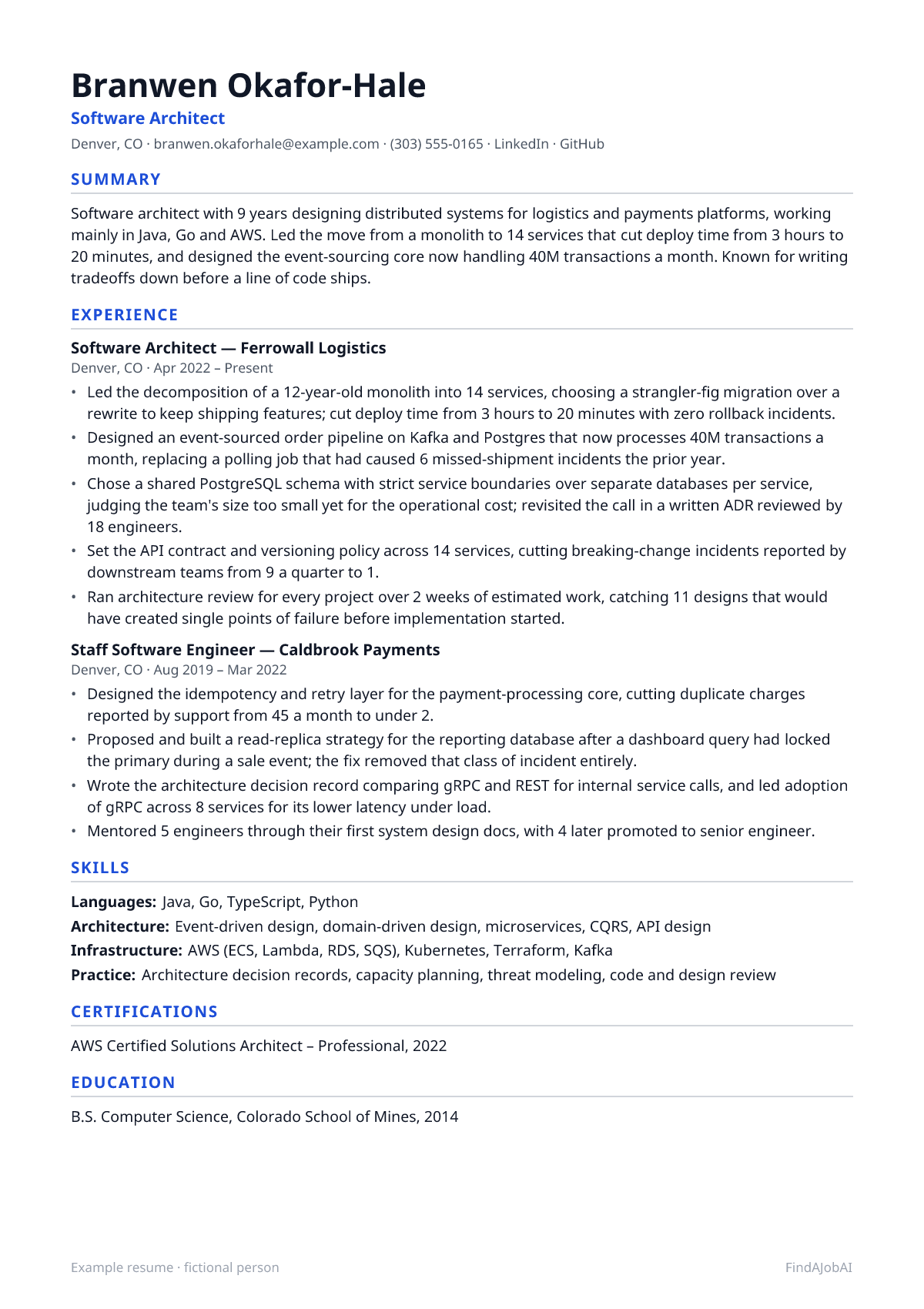
Software Architect resume template
This example as a one-page template: one column, standard headings and plain text, the format applicant tracking systems read most reliably.
After you sign up, Create my CV builds your own resume in this same one-column layout, from your real experience.
Mid-level software architect resume example
A complete one-page example for a fictional software architect: every bullet pairs an action with what changed because of it.
Example resume · fictional person
Branwen Okafor-Hale
Software Architect
Denver, CO · [email protected] · (303) 555-0165 · LinkedIn · GitHub
Summary
Software architect with 9 years designing distributed systems for logistics and payments platforms, working mainly in Java, Go and AWS. Led the move from a monolith to 14 services that cut deploy time from 3 hours to 20 minutes, and designed the event-sourcing core now handling 40M transactions a month. Known for writing tradeoffs down before a line of code ships.
Experience
Software Architect, Ferrowall Logistics
Denver, CO · Apr 2022 – Present
- Led the decomposition of a 12-year-old monolith into 14 services, choosing a strangler-fig migration over a rewrite to keep shipping features; cut deploy time from 3 hours to 20 minutes with zero rollback incidents.
- Designed an event-sourced order pipeline on Kafka and Postgres that now processes 40M transactions a month, replacing a polling job that had caused 6 missed-shipment incidents the prior year.
- Chose a shared PostgreSQL schema with strict service boundaries over separate databases per service, judging the team's size too small yet for the operational cost; revisited the call in a written ADR reviewed by 18 engineers.
- Set the API contract and versioning policy across 14 services, cutting breaking-change incidents reported by downstream teams from 9 a quarter to 1.
- Ran architecture review for every project over 2 weeks of estimated work, catching 11 designs that would have created single points of failure before implementation started.
Staff Software Engineer, Caldbrook Payments
Denver, CO · Aug 2019 – Mar 2022
- Designed the idempotency and retry layer for the payment-processing core, cutting duplicate charges reported by support from 45 a month to under 2.
- Proposed and built a read-replica strategy for the reporting database after a dashboard query had locked the primary during a sale event; the fix removed that class of incident entirely.
- Wrote the architecture decision record comparing gRPC and REST for internal service calls, and led adoption of gRPC across 8 services for its lower latency under load.
- Mentored 5 engineers through their first system design docs, with 4 later promoted to senior engineer.
Skills
- Languages: Java, Go, TypeScript, Python
- Architecture: Event-driven design, domain-driven design, microservices, CQRS, API design
- Infrastructure: AWS (ECS, Lambda, RDS, SQS), Kubernetes, Terraform, Kafka
- Practice: Architecture decision records, capacity planning, threat modeling, code and design review
Certifications
- AWS Certified Solutions Architect – Professional, 2022
Education
- B.S. Computer Science, Colorado School of Mines, 2014
Fictional example by the FindAJobAI team: the person, employers and numbers are invented. Keep the structure; use your own work and numbers you can explain in an interview.
Entry-level software architect resume example
A senior engineer stepping into architecture for the first time. Experience still leans on shipped features, but the newest role shows her taking on a design-lead slice of work, and one bullet names a tradeoff she argued for rather than just a feature she built.
Entry-level example resume · fictional person
Ilse Vandermeer
Software Engineer, Architect track
Minneapolis, MN · [email protected] · (612) 555-0119 · LinkedIn · GitHub
Summary
Backend-focused software engineer with 5 years in Java and AWS, moving into architecture through a lead role on a new notifications platform. Argued for and built an event-driven design over a scheduled-polling approach, now handling 2M notifications a day across 6 services. Comfortable writing design docs and reviewing them for peer teams.
Experience
Senior Software Engineer, Thornquist Retail Group
Minneapolis, MN · Feb 2023 – Present
- Led the design of a new notifications platform, choosing an event-driven architecture on SQS over the team's original polling-job proposal; it now delivers 2M notifications a day with under 3 seconds of delay.
- Wrote the design doc and ran review sessions with 2 peer teams before implementation, catching a data-ownership conflict that would have blocked a later migration.
- Built the retry and dead-letter-queue handling for the notification service, cutting silently dropped messages from roughly 200 a day to near zero.
- Reviewed designs for 8 pull requests a month from 2 junior engineers, focused on service boundaries and failure handling rather than style.
Software Engineer, Birchlane Insurance Services
St. Paul, MN · Jul 2020 – Jan 2023
- Built a claims-status API in Java and Spring Boot serving 40,000 daily requests from the customer portal and a partner integration.
- Migrated a nightly batch report to an incremental job, cutting its run time from 3 hours to 18 minutes.
- Wrote integration tests covering 90% of the claims service's core paths, catching 3 regressions before they reached staging over one year.
Skills
- Languages: Java, Python, SQL
- Architecture: Event-driven design, API design, service boundaries, design docs
- Infrastructure: AWS (SQS, Lambda, RDS), Docker, basic Kubernetes
- Practice: Design review, integration testing, on-call rotation
Education
- B.S. Computer Science, University of Minnesota, 2020
Senior software architect resume example
A principal architect eleven years in, now setting direction across the whole engineering org rather than one team. Bullets shift from individual designs to standards, governance and migrations spanning multiple teams, and the summary names the scale of what she's responsible for.
Senior example resume · fictional person
Ozgur Castellan
Principal Software Architect
Seattle, WA · [email protected] · (206) 555-0165 · LinkedIn
Summary
Principal software architect with 11 years across e-commerce and logistics platforms, setting technical direction for 60 engineers across 9 teams. Led the platform's move to a service mesh that cut cross-service latency incidents by half, and chairs the architecture review board that has approved or redirected 70 major designs over 3 years.
Experience
Principal Software Architect, Haldric Commerce Platform
Seattle, WA · May 2020 – Present
- Set platform-wide technical direction for 9 teams and 60 engineers, chairing a monthly architecture review board that has approved or redirected 70 major designs over 3 years.
- Led adoption of a service mesh (Istio) over hand-rolled retry and auth logic in each service, cutting cross-service latency incidents reported in postmortems by half within a year.
- Designed the migration path from a single AWS region to 2, choosing active-passive over active-active to limit data-consistency risk; it cut regional outage impact from a full platform outage to a 4-minute failover.
- Set the org's API design standard, including versioning and deprecation rules, now followed by all 9 teams and enforced in CI for new services.
- Ran a build-vs-buy evaluation for a new fraud-detection layer and recommended buying, citing the 18-month build estimate against a 6-week integration; the recommendation was adopted and shipped on schedule.
Staff Software Engineer, Dunraven Freight Technologies
Seattle, WA · Jan 2016 – Apr 2020
- Designed the routing engine's move from a single large service to 5 domain-aligned services, cutting average incident resolution time from 3 hours to 45 minutes by narrowing the blast radius of failures.
- Led the technical evaluation that chose Kafka over RabbitMQ for the platform's event backbone, based on projected throughput at 5x current volume.
- Mentored 6 senior engineers toward architecture roles, 3 of whom moved into staff or principal titles within 4 years.
Skills
- Languages: Java, Go, Python, SQL
- Architecture: Service mesh, domain-driven design, multi-region design, event-driven systems
- Infrastructure: AWS (multi-region), Kubernetes, Istio, Terraform, Kafka
- Leadership: Architecture review boards, build-vs-buy evaluation, org-wide standards, mentoring staff engineers
Education
- B.S. Computer Science, Oregon State University, 2015
How to write a software architect resume
Five steps, in the order a recruiter reads the page. The format around them stays plain for every job: one column, standard headings, newest role first.
Header: name, target title and links
Use the title “Software Architect” (or the closer variant, like Solutions Architect, if that was your actual title) and keep a GitHub or portfolio link if you have design docs or diagrams you can share publicly.
Summary: what you do and your best proof
Name your primary stack, the scale of system you've designed (transactions, services, teams affected) and one migration or decision that changed a real metric. Skip broad claims like “strategic technical leader” without a system behind them.
Experience: newest first, a result in every bullet
Open each bullet with the decision and what you chose not to do, then the result: a latency number, an incident count, or how many teams were affected. A pattern name alone (microservices, event-driven) says nothing about judgment; the tradeoff does.
Skills: grouped, in the ad's words
Group into languages, architecture patterns, infrastructure and practice (ADRs, reviews, capacity planning). List the specific cloud services or tools you've designed against rather than just the platform name.
Education and certifications
A computer science degree is standard; list it plainly with the year. Certifications like AWS Solutions Architect Professional are worth including if you hold one, since some ATS filters search for them by name.
Skills to put on a software architect resume
Hard skills are the tools and methods of the job; soft skills are how you work with people. Each comes with one way to prove it, because a skill named only in a list counts for little. Add the ones you really have.
Hard skills
- Event-driven design
- Name the broker (Kafka, SQS) and the problem it solved, like decoupling two teams' release schedules.
- Microservices
- Give the split rationale, such as team ownership or scaling needs, and one metric that improved after.
- API design and versioning
- Mention a versioning scheme you set and the breaking-change count it reduced.
- Domain-driven design
- Point to a bounded context you defined and a confusion or bug class it ended.
- Cloud architecture (AWS/GCP/Azure)
- List the specific services you've designed against, not just the platform name.
- Kubernetes
- Describe what you run on it and a reliability or cost result, like reduced pod restarts or lower spend.
- Database design and sharding
- Name the sharding or partitioning key you chose and the latency or scale it unlocked.
- Architecture decision records (ADRs)
- Say how many you've written or reviewed and one decision an ADR changed.
- System design documentation
- Mention a design doc that multiple teams reviewed before a large project started.
- Service mesh
- Name the tool (Istio, Linkerd) and the cross-cutting problem it replaced, like retry logic in every service.
Soft skills
- Technical communication
- Point to a design doc or ADR that got a contested decision agreed across teams.
- Stakeholder alignment
- Give the number of teams or leaders you aligned on a shared standard or migration plan.
- Tradeoff reasoning
- State one alternative you rejected and why, inside a real bullet rather than as a skill label.
- Mentoring
- Count engineers you've mentored toward design or architecture work and how many were promoted.
- Pragmatism
- Describe a time you chose the simpler design over the more impressive one, and what it saved.
- Influence without authority
- Name a standard or practice you got adopted across teams you didn't manage.
Software Architect resume bullet examples: weak vs strong
The same work, written two ways. The strong version names the tool, the scope and a result; the numbers are examples, yours must be real.
Weak: Designed system architecture.
Strong: Designed the move from a single relational database to a sharded Postgres cluster, choosing shard-by-customer-region over shard-by-ID to keep support queries simple; p99 write latency fell from 800ms to 90ms.
States the decision, the rejected alternative and the measured result.
Weak: Worked on microservices.
Strong: Split a checkout monolith into 6 services along team ownership lines rather than technical layers, cutting cross-team deploy coordination from 5 teams to 1 per release.
Names the split rationale and what it changed day to day.
Weak: Improved system scalability.
Strong: Replaced synchronous inventory checks with an eventually-consistent cache refreshed every 2 seconds, letting checkout hold up under a 5x traffic spike during a flash sale with no added servers.
Gives the specific tradeoff (consistency for scale) and the outcome.
Weak: Led technical decisions for the team.
Strong: Wrote and defended the ADR choosing a message queue over direct service calls for order fulfillment, a call that let 2 downstream teams ship independently without a shared release calendar.
Shows ownership of a decision and its organizational effect.
Weak: Reduced technical debt.
Strong: Retired a 7-year-old SOAP integration layer by wrapping it behind a new internal API, letting 3 teams migrate off it over 6 months without a single joint outage window.
Quantifies the debt and the low-risk path chosen to remove it.
15 more software architect resume bullet examples
Grouped by area of the job, so you can find the ones closest to your work. Keep the shape (action, scope, result) and replace the invented numbers with your own.
System design decisions
- Chose a single shared cache layer over per-service caches after measuring that per-service caching would have tripled memory cost for under 5% latency gain.
- Designed a multi-tenant data model using row-level security over separate databases per tenant, cutting onboarding time for new enterprise customers from 2 weeks to 2 days.
- Rejected a proposed rewrite of the billing service in favor of an incremental refactor, delivering the same reliability goal in 3 months instead of an estimated 10.
- Designed the caching strategy for a product catalog serving 8M monthly page views, cutting average page load time from 1.4s to 380ms.
Cross-team and organizational impact
- Set the service-ownership model across 7 teams after a production incident revealed no team owned a shared library; follow-up incidents from that library dropped to zero over the next year.
- Ran architecture reviews for 25 major designs over 2 years, sending 6 back for redesign before implementation began and saving an estimated 4 months of rework.
- Negotiated a shared authentication service across 5 teams that had each built their own, retiring 4 duplicate implementations within 6 months.
- Built the onboarding guide and reference architecture for new services, cutting the time for a new team to stand up a production-ready service from 6 weeks to 10 days.
Migrations and modernization
- Led the migration of 30 services from self-managed servers to Kubernetes, completing the move with zero unplanned downtime over 9 months.
- Migrated a legacy SOAP API layer to REST for 12 internal consumers, removing the last SOAP dependency and retiring a 15-year-old integration server.
- Replaced a single-region deployment with an active-passive multi-region setup, cutting disaster-recovery failover time from 6 hours to 8 minutes.
- Moved a monolith's background jobs to a managed queue service, cutting job-processing failures from roughly 50 a week to under 5.
Reliability and performance
- Diagnosed a cascading failure pattern across 3 services and introduced circuit breakers, cutting platform-wide outages caused by a single service failure from 4 a quarter to 0.
- Set capacity-planning targets ahead of a known seasonal traffic spike, sizing infrastructure that handled 6x normal load without a single autoscaling failure.
- Reduced p99 API latency from 1.2s to 220ms by redesigning a synchronous call chain into an async, event-driven flow across 4 services.
Software Architect resume summary examples
Two or three lines on what you do and your strongest proof. Start from the one closest to your level and use your own facts.
Software engineer moving into architecture, with 4 years building backend services and a lead role designing a new notifications system for a 6-service platform. Comfortable writing ADRs and reviewing designs for 2 peer teams; strong in Java and AWS.
Software architect with 6 years across fintech and logistics, designing event-driven systems in Java and AWS. Led the service split that cut a platform's deploy time by 85% and set the API versioning policy now followed by 10 teams.
Principal software architect with 14 years leading platform-wide technical direction for a company processing $2B a year in payments. Sets architecture standards for 60 engineers across 9 teams and has led 3 major migrations without a customer-facing outage.
Common software architect resume mistakes
Each one is easy to make and quick to fix before you apply.
Naming the pattern without the tradeoff
“Designed microservices architecture” says nothing a reviewer can evaluate. State what you chose over what, and why, in one sentence.
No measurable outcome for major decisions
Every significant design choice should end in a number: latency, incident count, deploy time, or team count affected.
All technical, no organizational influence
Architect roles are judged on cross-team effect too. Include at least 2-3 bullets about standards, reviews or alignment across teams.
Listing every technology ever touched
A long tool list reads as unfocused. Keep skills to what you've actually architected with, and let bullets carry the depth.
ATS tips for a software architect resume
Applicant tracking systems turn your file into text that recruiters search, mostly for the skills and titles in the ad. They rarely reject a resume on their own; one that parses badly or misses the ad's words just doesn't come up.
- Open bullets with the decision and the alternative you rejected, not just the pattern you used (microservices, event-driven, etc.).
- Give a measured result for each major decision: latency, incident count, deploy time or team count affected.
- Mention architecture decision records (ADRs) by name if you write them; many hiring managers search for the practice specifically.
- List the cloud platform and its specific services you've designed against (ECS, Lambda, RDS), not just the platform name.
For the format itself, run the free ATS resume checklist.
Everything for Software Architects
- Software Architect cover letter examplesThree example letters and a short email version
- Software Architect interview questions30 questions with sample answers
- Software Architect job descriptionDuties, skills and requirements
- How to tailor your resume without lying
Other resume examples
Software Architect resume FAQ
What's the difference between a software architect and a senior engineer resume?
A senior engineer resume centers on code and features shipped. An architect resume centers on decisions: the tradeoff considered, the alternative rejected and the system-wide effect, often across more than one team.
Do I need an ADR (architecture decision record) section on my resume?
Not a separate section, but naming the practice in a bullet or your skills list signals that you document decisions rather than just making them, which many architect interviews ask about directly.
How technical should a software architect resume be versus about leadership?
Both; aim for roughly half the bullets on technical design decisions and half on cross-team influence like standards, reviews and mentoring, since most architect roles are judged on both.
How we built this page
The FindAJobAI team wrote the three example resumes, the bullets, the skills and the advice for software architect roles. The people, employers and numbers in the examples are invented; the structure, the tools and the way each bullet is built are the parts to copy.
Once we track enough live software architect job ads, this page also shows the skills they ask for most, counted the same way as our in-demand skills report.
Last reviewed on November 1, 2026.