Speech-Language Pathologist Resume Example (2026)
By FindAJobAI team Updated How we built this page
Speech-language pathologist job ads ask for a license, a setting (schools, hospitals, private practice) and specific populations or disorder areas. What separates candidates is evidence that their therapy actually moved a student or patient forward. An SLP resume should name the caseload, the approach used and what changed in a student's or patient's communication or swallowing function.
The example below is an SLP with five years split between an elementary school and an outpatient pediatric clinic. Notice how each bullet names the caseload size, the disorder area or technique, and the measurable progress, instead of listing duties like "provided speech therapy."
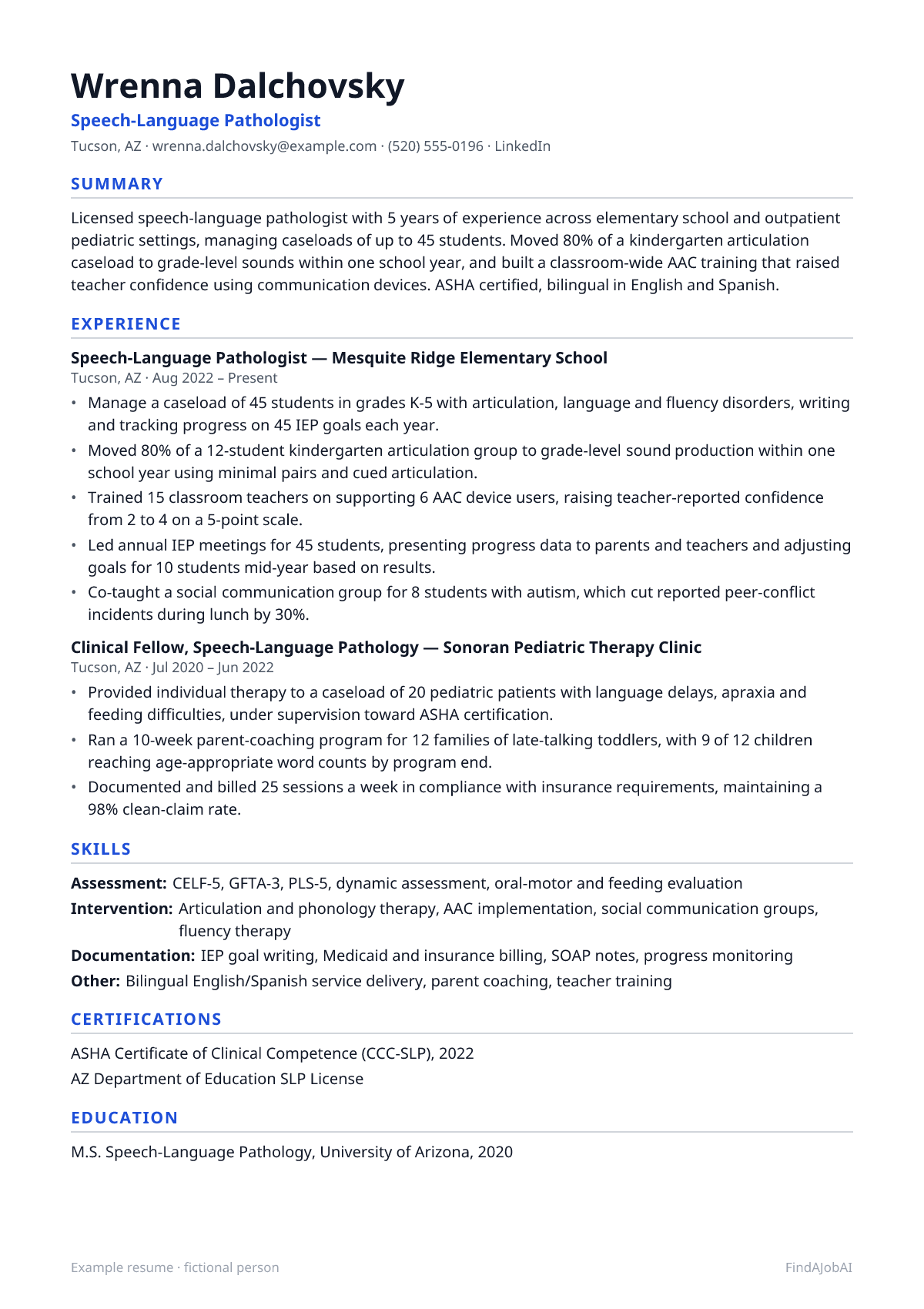
Speech-Language Pathologist resume template
This example as a one-page template: one column, standard headings and plain text, the format applicant tracking systems read most reliably.
After you sign up, Create my CV builds your own resume in this same one-column layout, from your real experience.
Mid-level speech-language pathologist resume example
A complete one-page example for a fictional speech-language pathologist: every bullet pairs an action with what changed because of it.
Example resume · fictional person
Wrenna Dalchovsky
Speech-Language Pathologist
Tucson, AZ · [email protected] · (520) 555-0196 · LinkedIn
Summary
Licensed speech-language pathologist with 5 years of experience across elementary school and outpatient pediatric settings, managing caseloads of up to 45 students. Moved 80% of a kindergarten articulation caseload to grade-level sounds within one school year, and built a classroom-wide AAC training that raised teacher confidence using communication devices. ASHA certified, bilingual in English and Spanish.
Experience
Speech-Language Pathologist, Mesquite Ridge Elementary School
Tucson, AZ · Aug 2022 – Present
- Manage a caseload of 45 students in grades K-5 with articulation, language and fluency disorders, writing and tracking progress on 45 IEP goals each year.
- Moved 80% of a 12-student kindergarten articulation group to grade-level sound production within one school year using minimal pairs and cued articulation.
- Trained 15 classroom teachers on supporting 6 AAC device users, raising teacher-reported confidence from 2 to 4 on a 5-point scale.
- Led annual IEP meetings for 45 students, presenting progress data to parents and teachers and adjusting goals for 10 students mid-year based on results.
- Co-taught a social communication group for 8 students with autism, which cut reported peer-conflict incidents during lunch by 30%.
Clinical Fellow, Speech-Language Pathology, Sonoran Pediatric Therapy Clinic
Tucson, AZ · Jul 2020 – Jun 2022
- Provided individual therapy to a caseload of 20 pediatric patients with language delays, apraxia and feeding difficulties, under supervision toward ASHA certification.
- Ran a 10-week parent-coaching program for 12 families of late-talking toddlers, with 9 of 12 children reaching age-appropriate word counts by program end.
- Documented and billed 25 sessions a week in compliance with insurance requirements, maintaining a 98% clean-claim rate.
Skills
- Assessment: CELF-5, GFTA-3, PLS-5, dynamic assessment, oral-motor and feeding evaluation
- Intervention: Articulation and phonology therapy, AAC implementation, social communication groups, fluency therapy
- Documentation: IEP goal writing, Medicaid and insurance billing, SOAP notes, progress monitoring
- Other: Bilingual English/Spanish service delivery, parent coaching, teacher training
Certifications
- ASHA Certificate of Clinical Competence (CCC-SLP), 2022
- AZ Department of Education SLP License
Education
- M.S. Speech-Language Pathology, University of Arizona, 2020
Fictional example by the FindAJobAI team: the person, employers and numbers are invented. Keep the structure; use your own work and numbers you can explain in an interview.
Entry-level speech-language pathologist resume example
A clinical fellow finishing her fellowship year before earning full ASHA certification. Her graduate practicum placements stand in for a longer work history, and the summary is upfront that her CCC is still in progress, which is normal and expected at this stage.
Entry-level example resume · fictional person
Fionnuala Abiodun-Castellanos
Speech-Language Pathologist, CF
Richmond, VA · [email protected] · (804) 555-0130 · LinkedIn
Summary
Clinical fellow speech-language pathologist completing supervised hours at a pediatric outpatient clinic, with a caseload of 18 patients covering language delays, articulation disorders and early feeding difficulties. Ran a 10-week parent-coaching program that helped 7 of 9 toddlers reach age-appropriate word counts. M.S. in Speech-Language Pathology; ASHA CCC expected June 2026.
Experience
Clinical Fellow, Speech-Language Pathology, Tidewater Pediatric Therapy
Richmond, VA · Aug 2025 – Present
- Provide individual therapy to a caseload of 18 pediatric patients with language delays, articulation disorders and early feeding difficulties, under supervision toward ASHA certification.
- Ran a 10-week parent-coaching group for 9 families of late-talking toddlers, with 7 of 9 children reaching age-appropriate word counts by program end.
- Documented 20 sessions a week using SOAP notes within clinic turnaround standards, maintaining zero late-submission flags during the fellowship.
Graduate Clinician, School-Based Practicum, James River Elementary School
Richmond, VA · Jan 2025 – May 2025
- Co-treated a caseload of 10 students with articulation and language disorders under a supervising SLP, contributing to IEP goal drafts for 6 students.
- Led a 4-session classroom lesson on augmentative communication for 22 general-education students, building peer understanding of a classmate's AAC device.
Skills
- Assessment: GFTA-3, PLS-5, informal language sampling, oral-motor screening
- Intervention: Articulation therapy, early language stimulation, parent coaching, basic AAC exposure
- Documentation: SOAP notes, IEP goal drafting (supervised), progress tracking
Certifications
- ASHA CCC-SLP expected June 2026
Education
- M.S. Speech-Language Pathology, Virginia Commonwealth University, 2025
Senior speech-language pathologist resume example
A senior SLP ten years in, now supervising clinical fellows and running programs across campuses instead of just carrying a caseload. The bullets shift toward building systems (referral processes, training programs) and the summary leads with what she oversees district-wide.
Senior example resume · fictional person
Zephyrine Okafor-Lindqvist
Senior Speech-Language Pathologist
Portland, OR · [email protected] · (503) 555-0191 · LinkedIn
Summary
Senior speech-language pathologist with 10 years in school and medical settings, supervising 4 clinical fellows and managing AAC and dysphagia programs across 2 elementary campuses serving 650 students. Built the district's current AAC referral process, cutting average time from referral to device trial from 6 weeks to 3, and leads quarterly training for 40 teachers on classroom communication supports.
Experience
Senior Speech-Language Pathologist, Willamette Valley School District
Portland, OR · Sep 2020 – Present
- Oversee speech and language services for 2 elementary campuses totaling 650 students, supervising 4 clinical fellows and 2 speech-language pathology assistants.
- Built the district's AAC referral and trial process, reducing average time from referral to device trial from 6 weeks to 3 across 12 schools.
- Lead quarterly training for 40 classroom teachers on supporting AAC users and students with language disorders, with post-training surveys showing 90% felt more confident.
- Manage a personal caseload of 25 students with the district's most complex language and AAC needs, writing and tracking 25 IEP goals a year.
- Chair the district's annual speech-language program review, presenting outcome data for 400 students to the special education director.
Speech-Language Pathologist, Cascadia Rehabilitation Hospital
Portland, OR · Jun 2016 – Aug 2020
- Treated adult inpatients with dysphagia and aphasia following stroke and traumatic brain injury, carrying a daily caseload of 8-10 patients.
- Performed 200+ modified barium swallow study readings with a radiologist over 4 years, adjusting diet recommendations based on results.
- Trained 15 nursing staff on dysphagia-safe feeding techniques, contributing to a drop in aspiration-related incident reports from 9 to 2 a year.
Clinical Fellow, Speech-Language Pathology, Cascadia Rehabilitation Hospital
Portland, OR · Jun 2015 – May 2016
- Completed clinical fellowship treating adult inpatients with dysphagia, aphasia and cognitive-communication disorders under supervision.
Skills
- Clinical: Dysphagia management, modified barium swallow interpretation, AAC evaluation and implementation, aphasia therapy
- Leadership: Clinical fellow supervision, district program development, staff training, outcome reporting
- Documentation: IEP goal writing, Medicaid billing compliance, interdisciplinary care notes
Certifications
- ASHA Certificate of Clinical Competence (CCC-SLP), 2016
- OR Department of Education SLP License
Education
- M.S. Speech-Language Pathology, University of Washington, 2015
How to write a speech-language pathologist resume
Five steps, in the order a recruiter reads the page. The format around them stays plain for every job: one column, standard headings, newest role first.
Header: name, target title and links
Use the title "Speech-Language Pathologist" and list your ASHA CCC-SLP and state license clearly near the top; most districts and clinics filter applications by these before reading further.
Summary: what you do and your best proof
State your years of experience, your setting (school, medical, private practice), your typical caseload size and one measurable outcome your therapy produced. If you're a clinical fellow, say so directly along with your expected certification date.
Experience: newest first, a result in every bullet
Open each bullet with your caseload or population, then the approach or tool you used, then the measurable result: a goal met, a percentage improved, a device mastered. "Provided therapy to students" says nothing a reviewer can evaluate.
Skills: grouped, in the ad's words
Group assessment tools, intervention approaches and documentation separately. Name specific assessments (CELF-5, GFTA-3) since districts and clinics often search for them directly, and list any additional languages you serve clients in.
Education and certifications
List your graduate degree, program and year. Add your ASHA CCC-SLP and state license as certifications, and if you're still in your clinical fellowship, note the expected completion date rather than omitting certification status.
Skills to put on a speech-language pathologist resume
Hard skills are the tools and methods of the job; soft skills are how you work with people. Each comes with one way to prove it, because a skill named only in a list counts for little. Add the ones you really have.
Hard skills
- Articulation and phonology therapy
- Name the technique used (minimal pairs, cued articulation) and the percentage of students or patients who reached target sounds.
- AAC implementation
- Give the number of device users supported and a measure of their communication gains or staff confidence.
- IEP goal writing
- State how many goals you write and track yearly and how often you adjust them based on data.
- CELF-5 / GFTA-3 / PLS-5
- List the specific assessments you administer and roughly how many evaluations you complete per year.
- Dysphagia management
- Mention swallow study involvement or diet modifications and a related safety outcome, like reduced aspiration incidents.
- Fluency therapy
- Name the approach used and a measurable change in stuttering frequency or student confidence.
- Social communication groups
- Give the group size, population and a behavioral or social outcome, like reduced peer conflicts.
- Billing and documentation
- State your session volume and a compliance metric, such as clean-claim rate or on-time note completion.
- Bilingual service delivery
- Name the languages and whether you provide full therapy or only screening in that language.
- Parent and caregiver coaching
- Give the program length, number of families served and an outcome, like words gained per child.
- Early intervention
- Mention the age range served and a developmental milestone met within a specific caseload.
- Swallow study interpretation
- State your volume of study readings and how your findings changed diet or therapy recommendations.
Soft skills
- Caregiver communication
- Describe explaining evaluation results to a parent or family member in plain language, with the decision that followed.
- Interdisciplinary collaboration
- Name the other professionals you coordinate with (OT, PT, teachers, physicians) and the shared outcome.
- Caseload prioritization
- State your caseload size and a scheduling system you used to manage it without missed sessions.
- Cultural responsiveness
- Describe adapting therapy materials or goals for a specific population's language or cultural context.
- Patience under pressure
- Give an example of a difficult session or behavior challenge you worked through to a therapy goal.
- Mentoring
- Count the clinical fellows, students or assistants you've supervised and one thing they improved on under your guidance.
Speech-Language Pathologist resume bullet examples: weak vs strong
The same work, written two ways. The strong version names the tool, the scope and a result; the numbers are examples, yours must be real.
Weak: Provided speech therapy to students.
Strong: Provided individual and group therapy to 45 students with articulation, language and fluency disorders, moving 80% of one caseload to grade-level speech sounds in a school year.
States caseload size, disorder areas and a measured outcome.
Weak: Wrote IEP goals.
Strong: Wrote and tracked 45 IEP goals a year, adjusting targets for 10 students mid-year after reviewing progress data with their teachers.
Shows goal-writing as an ongoing, data-driven process, not a one-time task.
Weak: Worked with AAC devices.
Strong: Trained 15 classroom teachers to support 6 AAC device users, raising staff-reported confidence from 2 to 4 on a 5-point scale.
Quantifies both the training reach and its measured effect.
Weak: Conducted speech and language evaluations.
Strong: Conducted 60 initial and triennial evaluations a year using CELF-5 and GFTA-3, determining eligibility and writing findings parents could understand without jargon.
Names the tools, volume and a communication skill valued by schools.
Weak: Collaborated with teachers and parents.
Strong: Ran monthly check-ins with 12 classroom teachers to align classroom accommodations with therapy goals, cutting reported communication breakdowns in class by a third.
Turns vague collaboration into a specific process and result.
Weak: Treated patients with feeding and swallowing difficulties.
Strong: Treated 15 pediatric patients with feeding and swallowing difficulties, using oral-motor exercises that moved 10 of them from puree to regular textures within 4 months.
Gives caseload size, method and a concrete clinical outcome.
Weak: Managed a caseload.
Strong: Managed a caseload of 45 students across 3 elementary campuses, prioritizing sessions using a tiered scheduling system that kept missed-session rates under 5%.
Shows organizational skill with a specific, verifiable number.
15 more speech-language pathologist resume bullet examples
Grouped by area of the job, so you can find the ones closest to your work. Keep the shape (action, scope, result) and replace the invented numbers with your own.
Caseload and therapy outcomes
- Carried a caseload of 35 students across articulation, language and fluency disorders, with 75% meeting their annual IEP goal by year-end review.
- Ran a 12-week fluency therapy program for 6 students using easy-onset techniques, cutting average stuttering frequency by half as measured by weekly samples.
- Treated 15 adult outpatients with aphasia following stroke, with 10 regaining functional conversational speech within 6 months.
- Provided feeding therapy to 8 toddlers with oral aversions, moving 6 of them to accepting 10+ new food textures within 3 months.
Assessment and evaluation
- Completed 50 comprehensive speech and language evaluations a year using CELF-5, GFTA-3 and informal sampling, determining eligibility within state-mandated timelines.
- Reduced the district's average evaluation-to-eligibility-meeting timeline from 45 to 30 days by restructuring the testing and scoring workflow.
- Conducted oral-motor and feeding assessments for 20 infants in a NICU follow-up clinic, referring 8 for further swallow studies.
- Screened 120 kindergartners for speech and language delays in 3 weeks each fall, referring 18 for full evaluations.
AAC and assistive technology
- Implemented AAC devices for 10 nonverbal students, increasing independent requesting behaviors from an average of 3 to 15 times a day within 2 months.
- Trained a classroom aide to program and troubleshoot an AAC device for 1 student, cutting daily setup delays from 15 minutes to under 5.
- Built a device-trial tracking system for 25 AAC candidates, shortening the average wait from referral to trial by 3 weeks.
Collaboration and training
- Trained 20 classroom teachers on language-based learning disabilities, with 85% reporting increased confidence identifying students who may need a referral.
- Co-led a monthly interdisciplinary team meeting with 3 occupational therapists and 2 school psychologists to coordinate goals for 15 shared students.
- Presented a district-wide in-service on dysphagia safety to 30 cafeteria and classroom staff, following 2 choking incidents the prior year.
- Mentored 2 graduate student clinicians through their school-based practicum, both passing their certification exams on the first attempt.
Speech-Language Pathologist resume summary examples
Two or three lines on what you do and your strongest proof. Start from the one closest to your level and use your own facts.
Speech-language pathologist completing a clinical fellowship year in an outpatient pediatric clinic, with a caseload of 20 patients covering language delays, apraxia and feeding difficulties. Ran a 10-week parent-coaching program that helped 9 of 12 toddlers reach age-appropriate word counts. ASHA Certificate of Clinical Competence in progress.
Speech-language pathologist with 5 years in elementary schools and pediatric outpatient care, managing caseloads of up to 45 students. Moved 80% of an articulation caseload to grade-level sounds in one school year and built an AAC training program for classroom teachers.
Senior speech-language pathologist with 10 years in school and medical settings, now supervising 4 clinical fellows and managing dysphagia and AAC programs for 2 elementary campuses. Built the district's current AAC referral process and reduced average evaluation wait times from 6 weeks to 3.
Common speech-language pathologist resume mistakes
Each one is easy to make and quick to fix before you apply.
Omitting ASHA certification and license status
Hiring managers filter by CCC-SLP and state license status first. State yours clearly, or note your clinical fellowship status and expected completion date if not yet certified.
Vague caseload descriptions
"Worked with students with speech disorders" doesn't say how many or what kind. Give the caseload size and the specific disorder areas you treated.
No measurable therapy outcomes
Listing techniques without results leaves out the most important part. Pair each approach with a percentage, goal count or specific gain the client made.
Mixing school and medical terminology incorrectly
IEP goals belong to school settings; diagnosis codes and physician orders belong to medical ones. Match your language to the setting you're applying to.
Treating documentation as an afterthought
Billing accuracy and note turnaround matter as much as therapy skill in many settings. Include a compliance metric, like clean-claim rate or on-time note completion, when you have one.
ATS tips for a speech-language pathologist resume
Applicant tracking systems turn your file into text that recruiters search, mostly for the skills and titles in the ad. They rarely reject a resume on their own; one that parses badly or misses the ad's words just doesn't come up.
- State your caseload size and setting (school, hospital, private practice, early intervention); each setting expects different experience.
- Name the assessment tools you use (CELF-5, GFTA-3, PLS-5); these are often searched directly by school districts and clinics.
- List your ASHA CCC status and state license clearly near the top; many postings will not consider a candidate without them.
- Describe therapy outcomes in measurable terms, such as sound accuracy percentages or words gained, not just "provided therapy."
For the format itself, run the free ATS resume checklist.
Everything for Speech-Language Pathologists
- Speech-Language Pathologist cover letter examplesThree example letters and a short email version
- Speech-Language Pathologist interview questions30 questions with sample answers
- Speech-Language Pathologist job descriptionDuties, skills and requirements
- How to tailor your resume without lying
Other resume examples
Speech-Language Pathologist resume FAQ
What certifications should an SLP resume include?
List your ASHA Certificate of Clinical Competence (CCC-SLP) and your state license prominently, since many employers require both before considering an application.
How should a new SLP without full certification format their resume?
Lead with your clinical fellowship or practicum experience, list your degree and note that your CCC is in progress, including the expected completion date.
Should a school-based SLP resume differ from a medical setting one?
Yes. School resumes should emphasize IEP goal writing, caseload management and classroom collaboration, while medical settings expect evaluation tools, diagnosis codes and documentation speed to stand out more.
How do I show therapy outcomes without violating patient privacy?
Use caseload-level statistics and de-identified examples, such as percentage of students reaching a goal, rather than naming or describing an identifiable patient.
How we built this page
The FindAJobAI team wrote the three example resumes, the bullets, the skills and the advice for speech-language pathologist roles. The people, employers and numbers in the examples are invented; the structure, the tools and the way each bullet is built are the parts to copy.
Once we track enough live speech-language pathologist job ads, this page also shows the skills they ask for most, counted the same way as our in-demand skills report.
Last reviewed on November 1, 2026.