Career Counselor Cover Letter Example (2026)
By FindAJobAI Team Updated How we built this page
Career centers want counselors who can calm a panicked senior in a thirty-minute appointment and also bring employers to campus who will hire that student. A strong cover letter shows the advising you do, the programs you built and what happened to the people you served, such as internships landed or jobs started.
Career Counselor cover letter template
This letter as a one-page template: an opening that names the job and your strongest fact, proof that answers the ad, a reason for this employer and a short close.
After you sign up, FindAJobAI drafts your own letter for a real job from your CV in this format, and you edit it before you send it.
Example 1 · Experienced
University career counselor applying to a larger career center
Ingrid advises arts and sciences students at a mid-size university. The ad wants someone to serve humanities majors and build employer ties.
Example letter · fictional
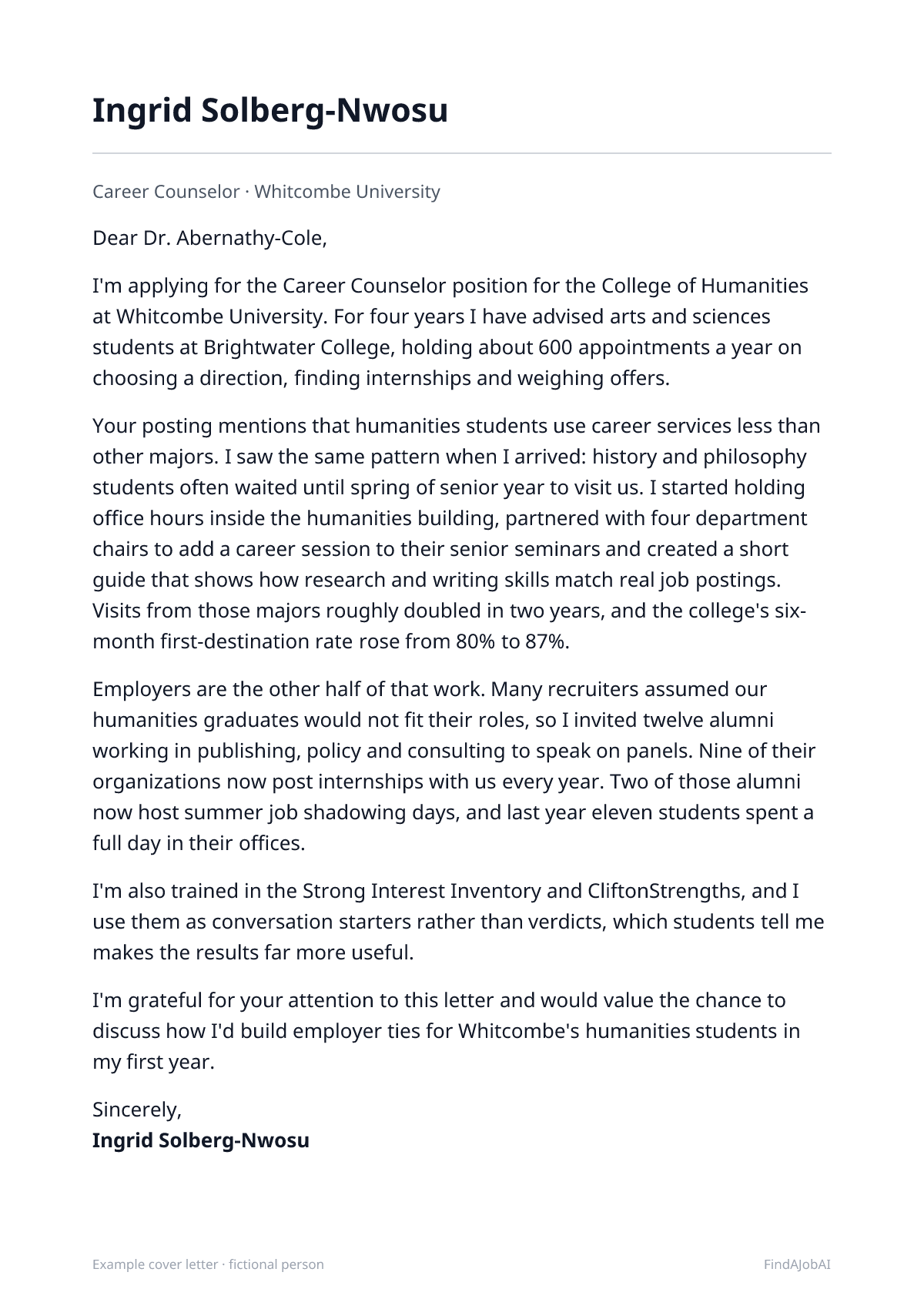
Dear Dr. Abernathy-Cole,
I'm applying for the Career Counselor position for the College of Humanities at Whitcombe University. For four years I have advised arts and sciences students at Brightwater College, holding about 600 appointments a year on choosing a direction, finding internships and weighing offers.
Your posting mentions that humanities students use career services less than other majors. I saw the same pattern when I arrived: history and philosophy students often waited until spring of senior year to visit us. I started holding office hours inside the humanities building, partnered with four department chairs to add a career session to their senior seminars and created a short guide that shows how research and writing skills match real job postings. Visits from those majors roughly doubled in two years, and the college's six-month first-destination rate rose from 80% to 87%.
Employers are the other half of that work. Many recruiters assumed our humanities graduates would not fit their roles, so I invited twelve alumni working in publishing, policy and consulting to speak on panels. Nine of their organizations now post internships with us every year. Two of those alumni now host summer job shadowing days, and last year eleven students spent a full day in their offices.
I'm also trained in the Strong Interest Inventory and CliftonStrengths, and I use them as conversation starters rather than verdicts, which students tell me makes the results far more useful.
I'm grateful for your attention to this letter and would value the chance to discuss how I'd build employer ties for Whitcombe's humanities students in my first year.
Sincerely,
Ingrid Solberg-Nwosu
Example 2 · Career changer
Corporate recruiter moving into career counseling
Benedikt has recruited for a regional bank for five years and volunteers as a resume reviewer. The ad is for a counselor at a community college.
Example letter · fictional
Dear Ms. Petrakis,
I am applying for the Career Counselor role at Riverbend Community College. I have spent five years as a recruiter at Lakeshore Federal Bank, screening roughly 2,000 applications a year and hiring for branch, operations and entry-level analyst roles.
Recruiting taught me exactly what makes a hiring manager say yes or pass. I have seen strong candidates rejected because their resume buried the one skill the role needed, and I've watched nervous applicants talk themselves out of offers in interviews. I want to spend my time on the other side of the table, helping people avoid those mistakes before they apply.
I've already started. For three years I have volunteered with a local reentry program, reviewing resumes and running monthly mock interview evenings for adults returning to work. Of the 34 people I worked with closely, 21 started jobs within six months. I enjoy that work more than anything in my day job, and it convinced me to begin a master's in counseling, which I will finish in May. One of those 21 clients, a former forklift operator, now works as a logistics coordinator, and he still sends me updates on his progress every few months.
I know I'll need to learn career assessments properly and adjust to advising students who may still be exploring rather than ready to apply. I've completed the GCDF coursework and would welcome any training your office provides.
I appreciate you reading about this change of direction, and I'd be glad to talk about how a recruiter's view could help Riverbend students reach interviews and offers.
Best regards,
Benedikt Afolayan-Shaw
Example 3 · Senior or lead
Senior counselor applying to become associate director
Octavia has led a career cohort program for nine years. The ad seeks an associate director to manage six counselors and adopt industry-based advising.
Example letter · fictional
Dear Dr. Vandermolen,
I'm applying for the Associate Director of Career Advising role at Northgate State University. I've worked in career services at Halloway University for nine years, the last four as senior counselor, where I supervise two graduate interns each term and lead our first-generation career cohort.
Your posting describes a move to advising by industry cluster. I helped Halloway make that shift two years ago. I mapped every major to one of five clusters, interviewed employers in each about the skills they wanted and drafted the counselor roles and handoff rules. In the first full year, the share of students who used career services before graduating rose from 54% to 66%, and employers told us our students arrived better prepared for interviews.
Building counselors is the part of my work I enjoy most. I created a training checklist for new staff covering assessments, appointment notes and difficult conversations, and I run monthly case reviews where counselors bring their hardest appointments. Three of the interns I supervised now hold full-time counselor jobs at other universities. Our new counselors now reach full caseloads about a month sooner than before, and their appointment ratings match those of experienced staff.
I have not yet managed a full team's performance reviews or an office budget on my own. I'd want to spend my first weeks meeting each counselor one-to-one and learning Northgate's budget cycle with the director before proposing changes.
With thanks for your consideration, I would welcome a conversation about how Northgate plans to staff its clusters and measure their success.
Sincerely,
Octavia Lindgren-Mensah
All three letters, and the short version below, are fictional: the people, employers and numbers are invented. Borrow the structure, never the facts.
- Prefer to write it yourself? Use the free cover letter template.
- Check your CV against the job first: the free CV score shows the missing keywords.
Why the first letter works, paragraph by paragraph
Paragraph 1: Opening
Names the student group, appointment volume and topics in two sentences, so the director sees the scope of the counselor's work right away.
Paragraph 2: The engagement problem
Answers a problem in the ad with specific actions and two results: more visits and a higher first-destination rate.
Paragraph 3: Employer paragraph
Shows the counselor can build jobs and internships, not only advise, using alumni as the bridge.
Paragraph 4: Assessments
Names the tools and describes a thoughtful way of using them, which signals real counseling skill.
Paragraph 5: Close
Offers to discuss a first-year plan, which pushes the interview toward practical goals.
What the career changer's letter does differently
The recruiter's letter turns hiring experience into an advantage: knowing what managers look for. It backs the switch with volunteer outcomes and a degree in progress, then names the real gaps, assessments and exploratory advising, which keeps it credible.
What the senior letter does differently
A senior letter moves from one caseload to a service model and the people who deliver it. It links a cluster redesign to an engagement number, shows staff development with concrete results and admits the gaps in performance reviews and budgets with a sensible first step.
Short career counselor cover letter: an email-ready version
Many applications arrive as an email or a small text box, and a full page doesn't fit. This version runs 120 to 150 words and keeps only what a reader needs to decide whether to reply. A workforce employment specialist emails a career center director after meeting at a regional career development conference.
Short version · email · fictional125 words
Subject: Career Counselor application – met at the Midwest careers conference – Lucian Abara-Hollis
Hello Dr. Quennell,
Thank you for the conversation after your session on alumni mentoring last week. As promised, I'm applying for the Career Counselor opening at Marbury College.
For three years I've been an employment specialist at Prairie Gate Workforce Center, carrying a caseload of about 50 adult job seekers. I run weekly interview labs, review resumes daily and have helped 96 clients start jobs since 2023. I'm also GCDF certified and trained in CliftonStrengths. Clients often tell me the mock interviews are what finally made them feel ready.
I'd love to bring that practical, job-ready focus to Marbury's students, especially the adult learners in your evening programs. I can start in January, and my resume is attached for your review.
Kind regards,
Lucian Abara-Hollis
The short email opens with the conference talk so the director places the writer quickly, then gives caseload, job starts and credentials in two sentences, and links them to a student group the director mentioned.
Opening lines that work for career counselor cover letters
The first sentence decides whether the second gets read. Here are six openings, one for each situation you might be in. Pick the one that matches yours and swap in your own facts: every name and number below is invented.
1. You have a standout result
I helped raise our college's six-month first-destination rate from 80% to 87% by taking career advising into the departments that used it least.
2. The ad names a problem you've solved
Your ad asks for someone who can reach humanities majors. Visits from those students doubled after I moved my office hours into their building.
3. Someone referred you
Your employer relations director, Paloma Treadwell, worked with me on a hiring panel last spring and encouraged me to apply for this role.
4. You admire what they build
I hold about 600 career appointments a year, and most of them start with a student who isn't sure what to do next.
5. You're new to the field or switching into it
As a recruiter I've screened thousands of resumes, and now I want to help people write the ones that get the call back.
6. You have senior scope or a specialism
I helped redesign our career center around industry clusters, and student use of career services rose by 12 points in the first year.
How to write a career counselor cover letter
Five steps, in the order you'd write them. The shape stays the same for every job (a short opening, proof, a reason for this employer, a close), and what goes into each part is what changes with the role.
Open with who you serve and how many
State the students or job seekers you advise and your yearly appointment count or caseload in the first two sentences. Directors compare candidates by experience with similar populations, so be specific about majors, adult learners or first-generation students rather than writing about helping people in general.
Show one program you built
Describe a workshop series, cohort or outreach change you designed. Explain why you started it and what changed afterward, such as attendance, engagement or outcomes. One clear example with a number tells a committee much more than a list of every event you have supported.
Include employer or alumni work
Many career centers now expect counselors to bring opportunities, not just advice. Mention employers you recruited, alumni panels you organized or internships that came from your partnerships. If you are new, point to recruiting or industry contacts you could bring with you.
Name your assessments and how you use them
List the tools you can interpret, such as the Strong Interest Inventory, MBTI or CliftonStrengths, and add one line on how you use them in a session. This shows real training and a thoughtful approach, which matters more than simply naming instruments.
Name what you still need to learn
If you have not supervised staff, managed a budget or used Handshake, say so briefly and describe how you will learn. Career services teams value honesty and a clear plan, and the habit mirrors the advice you would give your own clients.
Career Counselor cover letter do's and don'ts
Do
- Give your appointment volume or caseload and the groups you serve early in the letter.
- Show one program or change you made and what happened to engagement or outcomes.
- Mention employer or alumni work, since many centers expect counselors to build partnerships.
Don't
- Don't describe your passion for helping people without any results to back it up.
- Don't take full credit for placement rates the whole office worked on; describe your part.
- Don't fill the letter with counseling theory; show how you apply it with real clients.
Common career counselor cover letter mistakes
Each one is easy to make and quick to fix before you send the letter.
Talking only about your passion for helping
Every applicant says it. Replace it with numbers: appointments held, programs built and the internships or jobs that followed for the people you advised.
Claiming office-wide outcomes as your own
First-destination rates belong to the whole team. Say what you did that contributed, such as a new workshop or outreach to one college, and how it moved the number.
Ignoring the employer side
Show at least one partnership or employer event. Directors want counselors who can open doors for students, not only polish their resumes.
Writing a generic letter for every school
Name the institution, its students and one program or value that matches your work. Committees notice letters that could have gone to any career center.
Letting a counseling letter run past one page
Aim for well under a page. A career counselor's letter is itself a writing sample, so it should model the clear, focused style you teach.
Email subject lines for career counselor applications
Applying by email? Put the job title, any reference number and your name in the subject line.
- Career Counselor, College of Humanities – 4 years university advising – Ingrid Solberg-Nwosu
- Career Counselor application – recruiter and reentry program volunteer – Benedikt Afolayan-Shaw
- Application: Career Counselor, Arts and Sciences (Position 4418) – Ingrid Solberg-Nwosu
Everything for Career Counselors
- Career Counselor resume exampleA full resume, plus bullet and summary examples
- Career Counselor interview questions30 questions with sample answers
- Career Counselor job descriptionDuties, skills and requirements
- Career change cover letter: template + examples
Other cover letter examples
Career Counselor cover letter FAQ
What should a career counselor cover letter include?
Your advising experience and volume, a program or workshop you built, employer or alumni partnerships and the outcomes that followed, plus the assessments you can interpret.
How do I become a career counselor without counseling experience?
Use recruiting, HR, teaching, coaching or volunteer advising. Show results with numbers, such as people placed or resumes reviewed, and mention any degree or credential you're working on.
Should I mention career theories in my cover letter?
Only briefly, if the posting asks for them. Hiring committees care more about how you help real students than about naming theories.
How we built this page
The FindAJobAI team wrote the three example letters, the short email version, the opening lines and the advice for career counselor roles. The people, employers and numbers in the letters are invented; the structure, the kind of evidence and the order of the paragraphs are the parts to copy.
Once we track enough live career counselor job ads, this page also shows the skills they ask for most, counted the same way as our in-demand skills report.
Last reviewed on November 1, 2026.