Mental Health Counselor Cover Letter Example (2026)
By FindAJobAI team Updated How we built this page
Mental health counselor ads ask for a license, a theoretical orientation, and a population you can work with, so a cover letter earns its place by naming a client group and the way you actually work with them, not a list of modalities you were trained in but rarely use.
Mental Health Counselor cover letter template
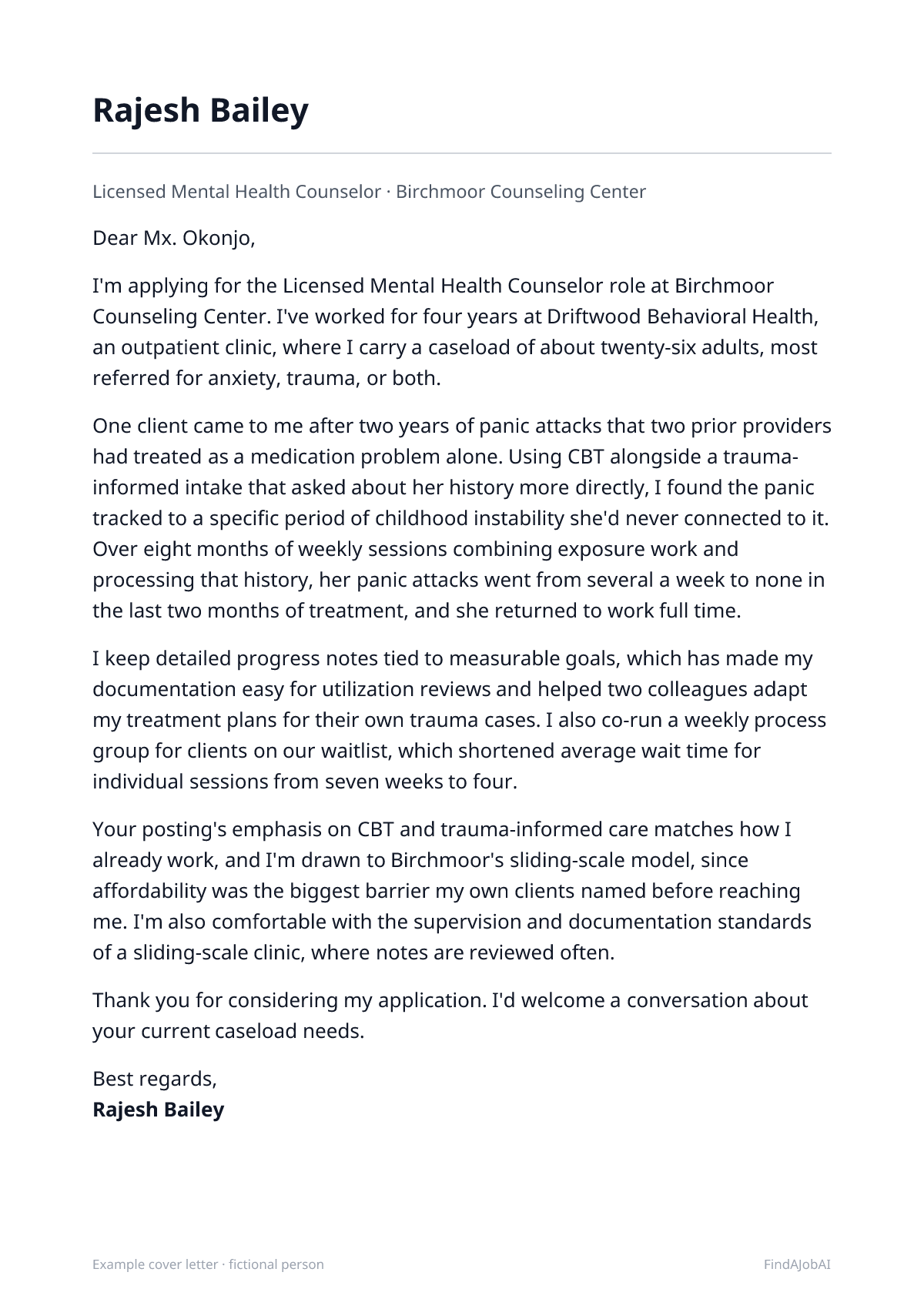
This letter as a one-page template: an opening that names the job and your strongest fact, proof that answers the ad, a reason for this employer and a short close.
After you sign up, FindAJobAI drafts your own letter for a real job from your CV in this format, and you edit it before you send it.
Example 1 · Experienced
Licensed counselor applying to a community mental health clinic
Rajesh counsels adults with anxiety and trauma histories at an outpatient clinic. The ad asks for CBT and a trauma-informed approach.
Example letter · fictional
Dear Mx. Okonjo,
I'm applying for the Licensed Mental Health Counselor role at Birchmoor Counseling Center. I've worked for four years at Driftwood Behavioral Health, an outpatient clinic, where I carry a caseload of about twenty-six adults, most referred for anxiety, trauma, or both.
One client came to me after two years of panic attacks that two prior providers had treated as a medication problem alone. Using CBT alongside a trauma-informed intake that asked about her history more directly, I found the panic tracked to a specific period of childhood instability she'd never connected to it. Over eight months of weekly sessions combining exposure work and processing that history, her panic attacks went from several a week to none in the last two months of treatment, and she returned to work full time.
I keep detailed progress notes tied to measurable goals, which has made my documentation easy for utilization reviews and helped two colleagues adapt my treatment plans for their own trauma cases. I also co-run a weekly process group for clients on our waitlist, which shortened average wait time for individual sessions from seven weeks to four.
Your posting's emphasis on CBT and trauma-informed care matches how I already work, and I'm drawn to Birchmoor's sliding-scale model, since affordability was the biggest barrier my own clients named before reaching me. I'm also comfortable with the supervision and documentation standards of a sliding-scale clinic, where notes are reviewed often.
Thank you for considering my application. I'd welcome a conversation about your current caseload needs.
Best regards,
Rajesh Bailey
Example 2 · Career changer
Psychiatric technician moving into mental health counseling
Priya ran psychoeducation groups on an inpatient unit before finishing her counseling license. The ad mentions group work and a diverse caseload.
Example letter · fictional
Dear Hiring Manager,
I'm applying for the Mental Health Counselor role at Hollowbrook Family Services. For five years I worked as a psychiatric technician on an inpatient unit, and I recently completed my clinical mental health counseling degree and the supervised hours needed for licensure, with my exam scheduled next month.
On the unit, I noticed our psychoeducation groups were poorly attended because they ran at shift-change times. I moved them to mid-afternoon and rebuilt the curriculum around coping skills patients could use within a day of discharge, like grounding techniques and a one-page relapse plan. Attendance roughly doubled, and our discharge nurses reported fewer readmission calls citing a lack of a plan.
During my supervised hours at a nonprofit clinic, I carried eight individual clients and co-led a grief group, working with a caseload that included several non-English-speaking families through an interpreter. I'm trained in CBT and motivational interviewing, and I'm comfortable sitting with crisis presentations without escalating unnecessarily, a skill the inpatient unit required daily.
Your posting mentions group work and a diverse caseload, both areas where my inpatient background gives me more direct experience than most newly licensed counselors have, even though the title is new to me. I'm ready to take direction from your clinical supervisor, keep thorough notes from the first session and learn how your clinic assigns group and individual caseloads, since I want to grow into the team rather than reshape it.
Thank you for your time. I can provide my supervisor's contact information and would welcome the chance to discuss my hours and training further.
Kind regards,
Priya Ramanathan
Example 3 · Senior or lead
Clinical supervisor applying to lead a growing counseling team
Grażyna supervises six counselors at a nonprofit clinic. The ad is for a clinical director who will build supervision structure and manage a waitlist crisis.
Example letter · fictional
Dear Mr. Fennimore,
I'm applying for the Clinical Director role at Larchmere Counseling Collective. For the past three years I've supervised a team of six counselors at Thistlewood Family Center, and before that I spent seven years as a licensed counselor myself, mostly with adolescents and families.
Your ad mentions a waitlist that's grown past three months, which was Thistlewood's exact problem when I arrived. I introduced a brief triage assessment so new referrals were matched to the right counselor on intake rather than assigned by whoever had an opening, and I restructured supervision from individual weekly meetings into a mix of individual and group case consultation. Average wait time fell from fourteen weeks to six, and counselor turnover, which had been a major driver of the backlog, dropped from four departures a year to one.
Supervision at Larchmere's scale is about catching risk early, not just reviewing notes. I built a standing checklist for suicide risk documentation after a near-miss case taught me our notes were inconsistent across staff, and I now review every high-risk case file within a week rather than at the next scheduled supervision slot. That change has made our incident reports noticeably more defensible during audits.
I haven't yet managed a budget of Larchmere's size or hired for a team expected to double, and I'd want to work closely with your operations lead to build the hiring pipeline before I'd claim expertise there.
A conversation about your current waitlist numbers and how supervision is structured today would help me understand where I could be most useful in the first few months.
Sincerely,
Grażyna Wójcik
All three letters, and the short version below, are fictional: the people, employers and numbers are invented. Borrow the structure, never the facts.
- Prefer to write it yourself? Use the free cover letter template.
- Check your CV against the job first: the free CV score shows the missing keywords.
Why the first letter works, paragraph by paragraph
Paragraph 1: Opening
Names the clinic type, caseload size, and the population served (anxiety and trauma), which tells the reader immediately whether the writer's experience matches the open role.
Paragraph 2: A client outcome
One anonymized case with a specific approach, a measurable change in symptoms, and a return to functioning. This is the clearest evidence a counselor can offer without breaking confidentiality.
Paragraph 3: Documentation and team impact
Progress notes tied to goals and a wait-list group that shortened wait times show organizational skills and initiative beyond one-on-one sessions, which matters in clinics tracking throughput.
Paragraph 4: Why this employer
Connects the ad's stated approach to the writer's actual practice, and names a specific reason, the sliding-scale model, tied to a pattern the writer has already seen in clients.
Paragraph 5: Close
Offers to discuss caseload needs directly, a practical next step that signals readiness to start rather than a generic thank-you.
What the career changer's letter does differently
The career changer's letter leads with specific inpatient experience, the psychoeducation group redesign and its effect on attendance and readmission calls, before naming the license still in progress. It then lists supervised caseload details and offers supervisor contact information, which answers the unspoken question of whether an almost-licensed applicant is a safe bet.
What the senior letter does differently
A clinical director letter reports on the organization's systems: a triage assessment, a restructured supervision schedule, a risk-documentation checklist built after a specific near-miss. The wait-time and turnover figures show the writer's changes at a team level, and the gap, budget and hiring at scale, is named honestly rather than glossed over.
Short mental health counselor cover letter: an email-ready version
Many applications arrive as an email or a small text box, and a full page doesn't fit. This version runs 120 to 150 words and keeps only what a reader needs to decide whether to reply. A counselor answers a pediatric clinic's short online application field after the portal's full upload tool failed, sent instead as an email.
Short version · email · fictional127 words
Subject: Mental Health Counselor (adolescent caseload) – Dashiell Okumu
Hello Dr. Castellanos,
I'm applying for the Mental Health Counselor role at Sparrowgate Pediatric Associates. I've spent four years counseling adolescents at a school-based clinic, using CBT and family sessions for anxiety and school refusal.
One case stands out: a fourteen-year-old who'd missed most of a semester returned to full attendance within two months after we built a graded return plan with his parents and his school counselor. That kind of coordinated work is what I do best.
I'd like to bring that approach to a pediatric setting where counseling is part of a larger care team. My resume is attached, and I'm glad to share more about my caseload and approach. I can also share a de-identified outline of the graded return plan.
Best,
Dashiell Okumu
The short version keeps one coordinated-care case and cuts the clinic's organizational history entirely, since a few sentences only have room for one proof point. Naming the specific collaboration (parents, school counselor) does the work of showing fit for a pediatric team setting.
Opening lines that work for mental health counselor cover letters
The first sentence decides whether the second gets read. Here are six openings, one for each situation you might be in. Pick the one that matches yours and swap in your own facts: every name and number below is invented.
1. You have a standout result
A graded return-to-school plan I built with one family cut a student's missed days from most of a semester to zero within two months. I'd like to bring that kind of coordinated work to your adolescent program.
2. The ad names a problem you've solved
Your ad mentions a waitlist stretching past three months. At my current clinic, a short triage assessment at intake cut our own wait time by more than half, and I'd like to help solve the same problem here.
3. Someone referred you
Your intake coordinator, Fennimore Abara, referred a client to me directly last year after hearing how I handle trauma cases. That conversation is what led me to apply for this role.
4. You admire what they build
I've referred my own family members to your clinic's community workshops for years, and the way your counselors talk about client dignity in those sessions is why I want to work here.
5. You're new to the field or switching into it
I spent six years as a psychiatric technician before finishing my counseling license, and crisis de-escalation is the skill I bring that most newly licensed counselors haven't had to practice daily.
6. You have senior scope or a specialism
As a supervisor for six counselors over the past three years, I rebuilt our intake and supervision systems from the ground up. I'm looking for a role where I can do that kind of structural work again.
How to write a mental health counselor cover letter
Five steps, in the order you'd write them. The shape stays the same for every job (a short opening, proof, a reason for this employer, a close), and what goes into each part is what changes with the role.
Identify the population and setting the ad names
Mental health counselor ads vary widely: outpatient adults, school-based adolescents, inpatient crisis work, or family therapy. Read for the population and setting, then choose a case or project from your own experience with a similar group, not just a similar diagnosis.
Open with a client outcome, carefully anonymized
State the presenting problem, your approach, and the result in a sentence or two, changing any detail that could identify the person. This shows clinical judgment faster than a list of modalities, and it signals you can write about cases responsibly.
Name your orientation inside the example, not as a label
Mentioning CBT, DBT, or motivational interviewing only matters if the reader can see how you used it. Attach the modality to the specific case you're describing, including what you adjusted when the standard approach wasn't quite working.
State your license status without hedging
Say plainly whether you're fully licensed, provisionally licensed, or completing supervised hours, and name your expected licensure date if relevant. Clinics need to know this to plan caseloads and billing, and vagueness here reads as evasive rather than modest.
Close with something concrete about this employer
Mention the ad's stated model, population, or a known challenge like a long waitlist, and connect it to something you've already handled. Offer a specific next step, such as discussing current caseload needs, rather than a general thank-you.
Mental Health Counselor cover letter do's and don'ts
Do
- Describe one client outcome in enough clinical detail to show your approach, without using identifying information.
- Name your theoretical orientation (CBT, DBT, motivational interviewing) inside a specific example, not as a list.
- Mention your license status and stage plainly: full license, associate license, or supervised hours remaining.
Don't
- Don't include any detail, even altered, specific enough that a real client could recognize themselves.
- Don't write "I'm passionate about helping people"; show the help with one documented case and its result.
- Don't claim outcomes you can't stand behind if asked; keep figures modest and tied to what you actually tracked.
Common mental health counselor cover letter mistakes
Each one is easy to make and quick to fix before you send the letter.
Including identifying client details
Even a changed name doesn't protect confidentiality if the age, setting, and unusual circumstance together are specific enough to identify someone. Strip or alter enough detail that the case could describe several different people.
Listing every modality you've ever trained in
A row of CBT, DBT, EMDR, and ACT without context suggests none of them deeply. Name the one or two you use most and show them inside an actual case rather than as a training inventory.
Being vague about license status
Phrases like "nearly licensed" or "working toward licensure" leave the reader guessing. State your exact status: associate license, supervised hours remaining, or exam date, so the clinic can plan around it.
Writing "I want to help people" as the motivation
Every applicant writes this. Replace it with a specific case, population, or clinical problem you want to keep working on, which tells the reader something they can actually evaluate.
Omitting how you handle risk or crisis situations
Clinics worry about this more than most other job seekers realize. One sentence on how you've assessed or managed a risk situation, even briefly, reassures a reader faster than describing your caseload size.
Email subject lines for mental health counselor applications
Applying by email? Put the job title, any reference number and your name in the subject line.
- Licensed Mental Health Counselor application – adult trauma caseload – Rajesh Bailey
- Mental Health Counselor – psychiatric tech transitioning to licensure – Priya Ramanathan
- Application: Outpatient Counselor, Adolescent Program (Req. 2217) – Rajesh Bailey
Everything for Mental Health Counselors
- Mental Health Counselor resume exampleA full resume, plus bullet and summary examples
- Mental Health Counselor job descriptionDuties, skills and requirements
- Career change cover letter: template + examples
Other cover letter examples
Mental Health Counselor cover letter FAQ
What should I write in a mental health counselor cover letter?
One anonymized client case that shows your approach and the outcome, your theoretical orientation named inside that example, and your license status. End with something specific about the employer's population or model.
How do I write a mental health counselor cover letter with no licensed experience?
Use supervised hours, practicum placements, or related work like psychiatric technician or case management roles. Describe one situation you handled well, name your supervisor's willingness to confirm it, and state your licensure timeline clearly.
How much clinical detail is safe to include about a client?
Change or omit anything that could identify the person: age range, specific dates, workplace, or unusual circumstances. Keep the diagnosis category and the approach you used, since those are what the reader needs to evaluate your fit.
How we built this page
The FindAJobAI team wrote the three example letters, the short email version, the opening lines and the advice for mental health counselor roles. The people, employers and numbers in the letters are invented; the structure, the kind of evidence and the order of the paragraphs are the parts to copy.
Once we track enough live mental health counselor job ads, this page also shows the skills they ask for most, counted the same way as our in-demand skills report.
Last reviewed on November 1, 2026.