Correctional Officer Cover Letter Example (2026)
By FindAJobAI Team Updated How we built this page
Corrections hiring panels read cover letters for steadiness. They want to see that you understand the job is mostly routine done carefully: counts, searches, movement and logs. They also want one sign that you stay calm and fair when a unit gets tense, and that you will not be talked into bending rules. A short, factual story does that better than words like tough or dedicated.
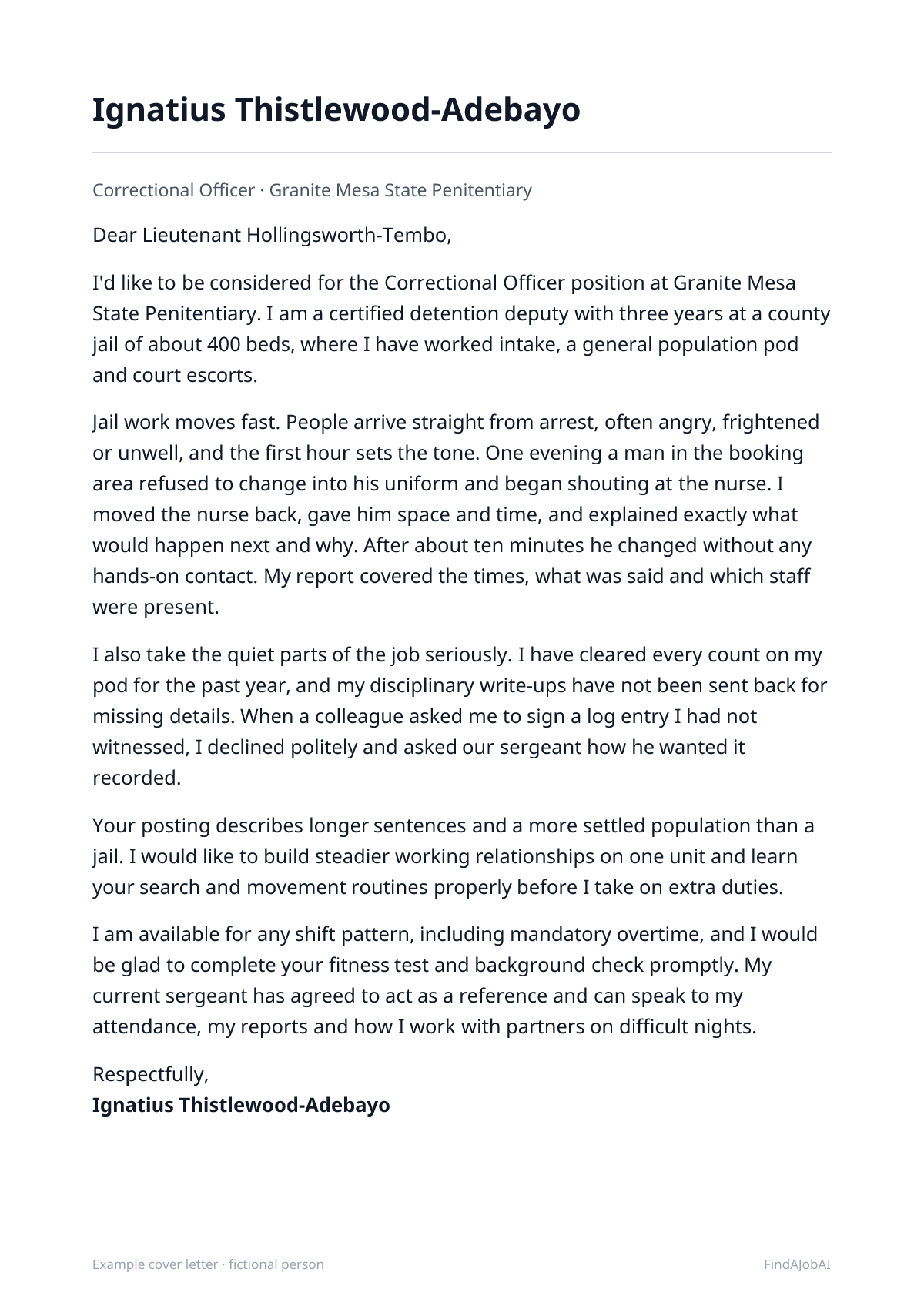
Correctional Officer cover letter template
This letter as a one-page template: an opening that names the job and your strongest fact, proof that answers the ad, a reason for this employer and a short close.
After you sign up, FindAJobAI drafts your own letter for a real job from your CV in this format, and you edit it before you send it.
Example 1 · Experienced
County jail deputy applying to a state prison
Ignatius has three years as a detention deputy at a county jail. The posting is for a correctional officer at a state medium-security prison.
Example letter · fictional
Dear Lieutenant Hollingsworth-Tembo,
I'd like to be considered for the Correctional Officer position at Granite Mesa State Penitentiary. I am a certified detention deputy with three years at a county jail of about 400 beds, where I have worked intake, a general population pod and court escorts.
Jail work moves fast. People arrive straight from arrest, often angry, frightened or unwell, and the first hour sets the tone. One evening a man in the booking area refused to change into his uniform and began shouting at the nurse. I moved the nurse back, gave him space and time, and explained exactly what would happen next and why. After about ten minutes he changed without any hands-on contact. My report covered the times, what was said and which staff were present.
I also take the quiet parts of the job seriously. I have cleared every count on my pod for the past year, and my disciplinary write-ups have not been sent back for missing details. When a colleague asked me to sign a log entry I had not witnessed, I declined politely and asked our sergeant how he wanted it recorded.
Your posting describes longer sentences and a more settled population than a jail. I would like to build steadier working relationships on one unit and learn your search and movement routines properly before I take on extra duties.
I am available for any shift pattern, including mandatory overtime, and I would be glad to complete your fitness test and background check promptly. My current sergeant has agreed to act as a reference and can speak to my attendance, my reports and how I work with partners on difficult nights.
Respectfully,
Ignatius Thistlewood-Adebayo
Example 2 · Career changer
Army military police veteran moving into civilian corrections
Rosalind served four years as an army military police specialist, partly at a detention facility. The ad is for an entry-level county detention officer.
Example letter · fictional
Dear Captain Ravensdale-Okafor,
I am writing to apply for the Detention Officer opening at Saguache Valley Detention Center. I recently finished four years in the army as a military police specialist, including eighteen months at a detention facility, and I would like to continue that work close to home.
In the military facility I worked housing units, escorts and the control room. The rules were strict and written down, and I learned that most trouble starts when officers treat them as optional. I kept the same standard on every shift, whether a unit was calm or not, and detainees came to know what to expect from me. That consistency did more to prevent arguments than any warning I could give. I also learned to write short, factual reports at the end of each shift, because the next team relied on them to know which detainees needed closer attention.
I know civilian corrections differs from the military. State law, local policy and the rights of people awaiting trial all shape what an officer can do, and I expect to learn those carefully at your academy instead of assuming my old training covers them. I have already read your published inmate handbook to understand the rules residents are given.
I hold current CPR and first aid certification, passed the military fitness standard every year and have no trouble with rotating shifts or holiday work. I would value the chance to meet you and explain how my service fits your facility. My platoon sergeant and the detention facility's operations officer have both offered to speak with your background investigator about my conduct and reliability.
Thank you for your time and consideration,
Rosalind Achterberg-Nnamdi
Example 3 · Senior or lead
Correctional sergeant applying for a lieutenant post
Barnaby has eleven years in state corrections and four as a shift sergeant. The posting is for a lieutenant overseeing a facility's night operations.
Example letter · fictional
Dear Major Wetherell-Nakamura,
Please accept my application for the Correctional Lieutenant position at Huerfano Ridge Correctional Facility. I have spent eleven years in state corrections, the last four as a sergeant supervising fourteen officers per shift across four housing units.
When I became sergeant, the night shift relied on a spoken briefing that changed with whoever gave it, and information about tense units often got lost. I replaced it with a one-page written handover covering counts, open incidents, people on watch and staffing gaps. Officers now start each shift knowing which units need extra attention, and the day shift uses the same sheet.
Searches were another gap. We searched cells on a fixed rotation, which residents learned quickly. I worked with our intelligence officer to target searches using incident and mail data, and over eighteen months weapon finds in our two highest-risk units fell noticeably. I also lead quarterly emergency drills with medical and maintenance staff, so each department knows its role before a real event. After each drill I circulate a one-page list of what worked and what we will change.
Your posting emphasizes officer retention. I have not set retention policy at facility level, but I have kept every officer I supervised through probation for the past two years by pairing each new hire with a steady partner and checking in weekly during the first months.
I would welcome a conversation about your night operations and where a lieutenant could help most. I can share the handover sheet and search plan I mentioned, with identifying details removed, if that would help your panel.
Respectfully,
Barnaby Oyelaran-Stroud
All three letters, and the short version below, are fictional: the people, employers and numbers are invented. Borrow the structure, never the facts.
- Prefer to write it yourself? Use the free cover letter template.
- Check your CV against the job first: the free CV score shows the missing keywords.
Why the first letter works, paragraph by paragraph
Paragraph 1: Opening
Names the certification, the facility size and the posts covered, which answers the first questions a corrections panel asks.
Paragraph 2: The booking story
Shows de-escalation under pressure: space, time and clear explanation, ending without hands-on contact and with a factual report.
Paragraph 3: Routine and integrity
Pairs a count record with a refusal to sign a false log entry, two things sergeants value more than bravado.
Paragraph 4: Fit with a state prison
Links a detail of the posting, a settled long-term population, to a realistic goal of building steady unit relationships.
Paragraph 5: Close
Confirms overtime availability and readiness for the fitness test and background check, which keeps hiring moving.
What the career changer's letter does differently
The veteran's letter turns military police work into corrections language: housing units, escorts and control room duty. It admits that civilian law and policy differ and shows a concrete step already taken to learn them.
What the senior letter does differently
A senior corrections letter covers systems rather than single incidents: handovers, search planning, drills and staff retention. It names one honest gap, facility-level policy, and answers it with a record that is directly relevant.
Short correctional officer cover letter: an email-ready version
Many applications arrive as an email or a small text box, and a full page doesn't fit. This version runs 120 to 150 words and keeps only what a reader needs to decide whether to reply. A certified officer emails a county recruiter about a night-shift detention vacancy listed on the sheriff's careers page.
Short version · email · fictional135 words
Subject: Night Shift Detention Officer – certified, 2 years jail experience – Celestine Hardacre-Musa
Hi Ms. Gallowglass-Ruiz,
I'm writing about the night shift Detention Officer vacancy at Rio Blanco Valley Jail. I hold current state detention certification and have worked two years at a neighboring county jail, mostly on overnight housing and intake.
Nights suit me. I'm careful with the 2 a.m. and 5 a.m. counts, I keep the unit log current through the shift, and I've handled several late arrivals from patrol without any trouble. Last winter I noticed a resident on my pod stopped eating for two days, logged it and alerted medical, who moved him to observation that morning.
I can start after a standard two-week notice and work every night rotation, including holidays. My resume and certification card are attached, and I'm happy to come in for an interview this week.
Thank you,
Celestine Hardacre-Musa
The short version leads with certification and the exact shift, then uses one small, believable observation to show attention on overnight posts, which suits a recruiter reading quickly.
Opening lines that work for correctional officer cover letters
The first sentence decides whether the second gets read. Here are six openings, one for each situation you might be in. Pick the one that matches yours and swap in your own facts: every name and number below is invented.
1. You have a standout result
I have cleared every count on a 64-bed jail pod for the past year, and I would like to bring that same care to a unit at your facility.
2. The ad names a problem you've solved
Your posting asks for officers who stay calm when a unit turns tense. Most of my incident reports end with someone sitting down and talking, which is the ending I work for.
3. Someone referred you
After four years as an army military police specialist, including eighteen months in a detention facility, I'm ready to continue that work in civilian corrections.
4. You admire what they build
Sergeant Marchmont-Eze, who supervised my academy field training, suggested I apply for your night shift vacancy.
5. You're new to the field or switching into it
I finished the state detention academy last month near the top of my class in report writing and defensive tactics, and I'm ready to learn your post orders.
6. You have senior scope or a specialism
As a shift sergeant over four housing units, I spend most of my time making sure officers start every shift with the information they need.
How to write a correctional officer cover letter
Five steps, in the order you'd write them. The shape stays the same for every job (a short opening, proof, a reason for this employer, a close), and what goes into each part is what changes with the role.
Lead with certification and the units you worked
In the first lines, say whether you are certified, in an academy or applying for a trainee post, and name the security level and size of the units you have worked. These are the first facts a hiring panel looks for, so answer them before telling any story.
Tell one incident that ends through procedure
Pick a moment from a booking area, a housing unit or an escort where you calmed someone down or followed a response plan. Say what you noticed, what you said, who you called and how it ended. Keep everyone anonymous and avoid any detail that glorifies force.
Show routine done well
Mention one routine record you can back up, such as counts cleared, searches logged or reports accepted at hearings. Corrections runs on routine, and a panel wants to know you will do the hundredth count as carefully as the first one on a quiet night.
Give a sign of integrity
A brief example of refusing to sign something you did not see, or reporting a problem honestly, shows you will resist pressure from residents and colleagues. Keep it factual and short, and don't criticize former coworkers by name or suggest that misconduct was common.
Close with availability and next steps
End by confirming the shifts and overtime you can work and your readiness for the fitness test, background check and academy. Facilities struggle to fill posts, so clear availability can move your application to the interview stage faster than polished language.
Correctional Officer cover letter do's and don'ts
Do
- State your certification, academy status or the training you have completed in the first paragraph.
- Tell one short, anonymous incident story that ends through procedure rather than force.
- Mention shift flexibility, overtime and readiness for fitness and background checks.
Don't
- Don't describe yourself as intimidating or tough; panels screen for calm and consistent officers.
- Don't name or describe identifiable people in custody.
- Don't claim certifications or academy completion you do not have yet.
Common correctional officer cover letter mistakes
Each one is easy to make and quick to fix before you send the letter.
Writing like a recruitment poster
Skip lines about being a warrior or protector. Describe counts, searches, reports and calm conversations instead.
Hiding a gap in certification
Say plainly whether you are certified, enrolled or waiting for an academy date, so the panel can place you on the right track.
Telling a story with identifying details
Remove names, case details and dates that could identify anyone in custody, and keep only what shows your actions.
Ignoring the facility type
A jail, a prison and a juvenile center differ. Mention the one in the posting and why your experience fits it.
Email subject lines for correctional officer applications
Applying by email? Put the job title, any reference number and your name in the subject line.
- Correctional Officer application – certified detention deputy, 3 yrs – Ignatius Thistlewood-Adebayo
- Detention Officer – army military police veteran – Rosalind Achterberg-Nnamdi
- Correctional Lieutenant application – sergeant, 11 years – Barnaby Oyelaran-Stroud
Everything for Correctional Officers
- Correctional Officer resume exampleA full resume, plus bullet and summary examples
- Correctional Officer interview questions30 questions with sample answers
- Correctional Officer job descriptionDuties, skills and requirements
- Career change cover letter: template + examples
Other cover letter examples
Correctional Officer cover letter FAQ
What should a correctional officer cover letter include?
Your certification or academy status, the facilities and units you have worked, one calm incident handled by procedure, your record on counts or reports, and your shift availability. One page is enough.
How do I write a correctional officer cover letter with no experience?
Use work where you followed strict procedures or supervised people: military service, security, hospital transport, youth programs or coaching. Mention fitness, reliability and how you handle people who are upset or testing limits.
Should I mention integrity in a corrections cover letter?
Yes, but through an example rather than a claim. A short story about refusing to cut a corner or reporting a problem honestly tells a panel far more than the word itself.
How we built this page
The FindAJobAI team wrote the three example letters, the short email version, the opening lines and the advice for correctional officer roles. The people, employers and numbers in the letters are invented; the structure, the kind of evidence and the order of the paragraphs are the parts to copy.
Once we track enough live correctional officer job ads, this page also shows the skills they ask for most, counted the same way as our in-demand skills report.
Last reviewed on November 1, 2026.