Reading Specialist Cover Letter Example (2026)
By FindAJobAI Team Updated How we built this page
Reading specialist ads ask for a lot at once: screening, small-group intervention, data meetings, coaching, family contact and paperwork for students with IEPs. A strong letter picks one or two of those, shows how you do them with real students and teachers, and reports growth in a careful, honest way that a principal can trust.
Reading Specialist cover letter template
This letter as a one-page template: an opening that names the job and your strongest fact, proof that answers the ad, a reason for this employer and a short close.
After you sign up, FindAJobAI drafts your own letter for a real job from your CV in this format, and you edit it before you send it.
Example 1 · Experienced
K–3 reading specialist applying to a school rebuilding its intervention model
Clementine leads K–3 intervention and coaches 12 teachers. The ad is for a reading specialist at a school moving to structured literacy.
Example letter · fictional
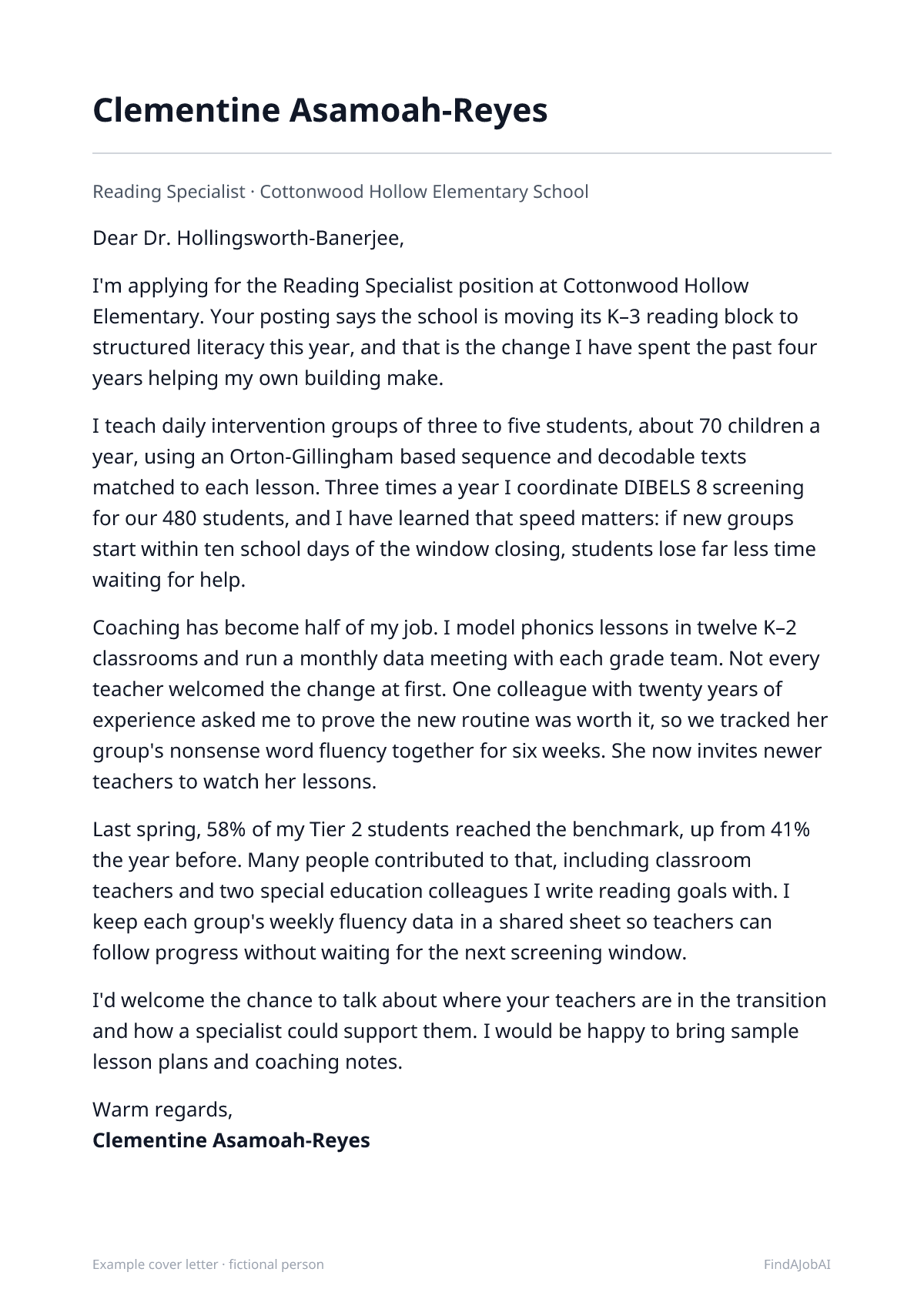
Dear Dr. Hollingsworth-Banerjee,
I'm applying for the Reading Specialist position at Cottonwood Hollow Elementary. Your posting says the school is moving its K–3 reading block to structured literacy this year, and that is the change I have spent the past four years helping my own building make.
I teach daily intervention groups of three to five students, about 70 children a year, using an Orton-Gillingham based sequence and decodable texts matched to each lesson. Three times a year I coordinate DIBELS 8 screening for our 480 students, and I have learned that speed matters: if new groups start within ten school days of the window closing, students lose far less time waiting for help.
Coaching has become half of my job. I model phonics lessons in twelve K–2 classrooms and run a monthly data meeting with each grade team. Not every teacher welcomed the change at first. One colleague with twenty years of experience asked me to prove the new routine was worth it, so we tracked her group's nonsense word fluency together for six weeks. She now invites newer teachers to watch her lessons.
Last spring, 58% of my Tier 2 students reached the benchmark, up from 41% the year before. Many people contributed to that, including classroom teachers and two special education colleagues I write reading goals with. I keep each group's weekly fluency data in a shared sheet so teachers can follow progress without waiting for the next screening window.
I'd welcome the chance to talk about where your teachers are in the transition and how a specialist could support them. I would be happy to bring sample lesson plans and coaching notes.
Warm regards,
Clementine Asamoah-Reyes
Example 2 · Entry level
First grade teacher applying for a first reading interventionist role
Ambrose teaches first grade and is finishing a reading master's with 60 practicum hours. The ad is for a K–2 reading interventionist.
Example letter · fictional
Dear Ms. Ravenscroft-Mbeki,
I'm writing to apply for the K–2 Reading Interventionist position at Sagebrush Flats Elementary. I've taught first grade for three years and will finish my master's degree in reading and literacy in May, and I'm ready to spend my whole day helping the children who find reading hardest.
In my classroom, reading starts with a fifteen-minute phonemic awareness routine every morning, followed by decodable text practice in small groups. I give running records every four weeks and regroup my four guided reading groups after each round, so nobody stays in a group they have outgrown or are not ready for. I also send families a monthly reading note.
Last fall eight of my students were well below benchmark. I started a lunchtime reading club twice a week, using short word-building games and a decodable book each session. By the winter screening six of the eight had met their goal, and the two who had not were referred for further evaluation with my notes attached. Both families received a short summary of what we had tried and what we planned next, written without jargon.
My practicum has given me sixty hours of tutoring second graders in a structured phonics sequence under a licensed specialist. She taught me to watch how a child attacks an unfamiliar word, not only whether the answer is right, and I now take notes on those attempts in every session.
I know I am early in this work, and I would value the chance to learn from your reading team. Thank you for considering my application. I would be glad to share sample lesson plans or progress charts at an interview.
Sincerely,
Ambrose Whitlock-Ndiaye
Example 3 · Referral or internal move
Reading specialist referred by a former colleague to a middle school role
Seraphina supports grades 4–6 readers. A former colleague now teaching at the school recommended her for a grades 6–8 reading specialist post.
Example letter · fictional
Dear Mr. Thistlewood-Akande,
Ingrid Solheim-Abara, who teaches seventh grade science at Larchmere Ridge, suggested I apply for your Reading Specialist opening. We worked together for three years at Bramblewood Intermediate, where I support readers in grades four to six, and she has seen how my students cope once texts get longer and more technical.
Older struggling readers bring a challenge younger ones do not: by eleven or twelve, many have decided they are bad at reading and would rather look bored than be seen sounding out a word. I start with a short diagnostic to find where decoding breaks down, often in multisyllable words, and then teach syllable types and common prefixes and suffixes through science and social studies vocabulary they meet in class that week. Short, frequent wins matter more at this age than long lessons, so sessions stay brisk and students chart their own progress.
This year I work with 34 students in groups of four. Using weekly oral reading fluency checks, my sixth graders gained an average of 19 words correct per minute between fall and spring. More telling to me, several began volunteering to read aloud in their science lessons, which Ingrid noticed before I did.
Your posting mentions supporting content-area teachers. I've co-planned vocabulary routines with a science and a social studies team and would be glad to do the same with your departments, starting by learning their units. I would also want to meet your special education team early, since many of the same students appear on both caseloads.
Thank you for your time. I'd be happy to visit, observe a reading block and talk about what your students need most.
With appreciation,
Seraphina Kowalczyk-Dunn
All three letters, and the short version below, are fictional: the people, employers and numbers are invented. Borrow the structure, never the facts.
- Prefer to write it yourself? Use the free cover letter template.
- Check your CV against the job first: the free CV score shows the missing keywords.
Why the first letter works, paragraph by paragraph
Paragraph 1: Opening
Matches the school's move to structured literacy with the writer's own experience of the same change.
Paragraph 2: Intervention in practice
Gives group size, yearly caseload, method and a practical lesson about timing after screening.
Paragraph 3: Coaching story
Shows how the writer won over a skeptical veteran teacher with shared data rather than authority.
Paragraph 4: Results, stated carefully
Reports benchmark growth with a prior-year comparison and credits colleagues, which builds trust.
Paragraph 5: Close
Asks about the teachers' stage in the transition, signalling a coaching mindset.
What the entry-level letter does differently
The junior letter leans on classroom reading work, a small intervention the writer started and supervised practicum hours. It reports a modest result honestly, mentions referral for the students who did not improve and admits being early in the career without apologizing for it.
What the referral letter does differently
The referral letter names the colleague and explains what she has actually seen, then speaks to the particular difficulty of older readers. It ties decoding work to content-area vocabulary, which fits a middle school, and offers a visit rather than a pitch.
Short reading specialist cover letter: an email-ready version
Many applications arrive as an email or a small text box, and a full page doesn't fit. This version runs 120 to 150 words and keeps only what a reader needs to decide whether to reply. A reading specialist emails an elementary principal after meeting her at a regional literacy conference.
Short version · email · fictional128 words
Subject: Reading Specialist opening – we met at the regional literacy conference – Tobias Merriweather-Osei
Hi Dr. Quintanilla-Rourke,
We spoke briefly after your session on screening timelines at the regional literacy conference, and I was glad to see your Reading Specialist opening this week. I have six years as a K–5 reading specialist and hold my state reading credential.
Your talk about forming groups quickly struck a chord. At my school I moved our intervention start from about four weeks after screening to under two by preparing group templates and schedules before each window opens. Students now begin targeted lessons almost a month sooner each fall.
My resume is attached. I'd welcome a conversation about your intervention model whenever it suits you, and I'm happy to share my one-page screening checklist, which two nearby schools now use as well.
Best wishes,
Tobias Merriweather-Osei
The short email opens with a real shared moment from the conference, links the principal's own topic to a concrete change the writer made and offers a useful document.
Opening lines that work for reading specialist cover letters
The first sentence decides whether the second gets read. Here are six openings, one for each situation you might be in. Pick the one that matches yours and swap in your own facts: every name and number below is invented.
1. You have a standout result
Your school is moving its K–3 reading block to structured literacy this year, a change I have spent four years helping my own building make.
2. The ad names a problem you've solved
By the winter screening, six of the eight first graders in my lunchtime reading club had met their goal, and I'd like to do that work full time.
3. Someone referred you
Ingrid Solheim-Abara, who has watched my students grow more confident with science texts, suggested I contact you about your reading specialist post.
4. You admire what they build
We spoke after your conference session on screening timelines, and your point about forming groups quickly is one I have built my intervention calendar around.
5. You're new to the field or switching into it
Every fall I have about ten school days to turn 480 screening results into working groups, and I've learned exactly where those days get lost.
6. You have senior scope or a specialism
Older readers often hide their difficulty behind boredom; most of my work in grades four to six starts with earning enough trust to find the real gap.
How to write a reading specialist cover letter
Five steps, in the order you'd write them. The shape stays the same for every job (a short opening, proof, a reason for this employer, a close), and what goes into each part is what changes with the role.
Match the school's literacy plans
Read the posting and the school's website for clues: a new curriculum, a dyslexia screening law, a focus on older readers. Open with the one that matches your experience, so the principal sees immediately why you fit this building and not just any school.
Show intervention as you actually run it
Describe group sizes, how often groups meet, the sequence or method you follow and how you pick texts. Specific routines tell a literacy director more about your skill than a list of program names or a general belief in every child's potential.
Include one coaching example
Most specialists support adults as well as children. Tell a brief story about helping a teacher change a routine, ideally one who was hesitant at first, and explain how you used data or modeling rather than pressure to bring them along.
Report results with care
Give a group-level result with its measure and a comparison, such as the share of your students reaching benchmark this year against last year. Credit the teachers involved. Careful wording reassures readers who know how many factors affect reading growth.
State your credential plainly
Say whether you hold the state reading credential or when you expect to complete it, and mention structured literacy training. Many districts screen applications on this, so a clear sentence keeps your letter from being set aside before anyone reads your examples.
Reading Specialist cover letter do's and don'ts
Do
- Name the screener, method and group sizes you use.
- Report growth with the measure and a comparison, and credit colleagues.
- Show how you work with teachers, not only with students.
Don't
- Don't claim you raised a whole school's scores on your own.
- Don't list programs without saying how you use them with children.
- Don't skip your credential status if the posting requires one.
Common reading specialist cover letter mistakes
Each one is easy to make and quick to fix before you send the letter.
Taking credit for a school's whole score rise
Report results for your own groups, name the measure and mention the colleagues who shared the work.
Writing only about children
Add how you coach teachers, lead data meetings or work with families, since most posts include that work.
Listing programs without method
Explain how a program looks in your sessions: group size, pacing, text choice and how you check progress.
Leaving the credential unclear
State whether you hold it or the date you expect it, along with any structured literacy training.
Using sentimental language instead of evidence
Replace lines about a love of reading with one real student story told with care and no names.
Email subject lines for reading specialist applications
Applying by email? Put the job title, any reference number and your name in the subject line.
- Reading Specialist – K–3 intervention and coaching – Clementine Asamoah-Reyes
- K–2 Reading Interventionist – first grade teacher, MEd Reading – Ambrose Whitlock-Ndiaye
- Reading Specialist (Posting 2217) – referred by Ingrid Solheim-Abara – Seraphina Kowalczyk-Dunn
Everything for Reading Specialists
- Reading Specialist resume exampleA full resume, plus bullet and summary examples
- Reading Specialist interview questions30 questions with sample answers
- Reading Specialist job descriptionDuties, skills and requirements
- Cover letter with no experience: templates
Other cover letter examples
Reading Specialist cover letter FAQ
What should a reading specialist cover letter include?
Your grade band and caseload, the screening and intervention methods you use, how you coach teachers, your credential status and one carefully reported growth result. Connect them to the school's current literacy plans.
How do I write a reading specialist cover letter as a classroom teacher?
Lead with the reading work you already do: small groups, running records, phonics routines and any intervention you started. Add your reading coursework, practicum hours and the credential date.
Should I include student data in a cover letter?
Yes, as group-level results without names, such as the share of your students reaching benchmark. Compare with a previous year and avoid claiming sole credit for gains.
How we built this page
The FindAJobAI team wrote the three example letters, the short email version, the opening lines and the advice for reading specialist roles. The people, employers and numbers in the letters are invented; the structure, the kind of evidence and the order of the paragraphs are the parts to copy.
Once we track enough live reading specialist job ads, this page also shows the skills they ask for most, counted the same way as our in-demand skills report.
Last reviewed on November 1, 2026.