Compensation Analyst Cover Letter Example (2026)
By FindAJobAI Team Updated How we built this page
Compensation analyst ads ask for survey experience, strong Excel and an HRIS, but the person reading your letter wants to know whether your analysis led to fair, affordable pay decisions. The letter should name one pricing, cycle or equity project, its scale, and what changed for employees or the budget.
Compensation Analyst cover letter template
This letter as a one-page template: an opening that names the job and your strongest fact, proof that answers the ad, a reason for this employer and a short close.
After you sign up, FindAJobAI drafts your own letter for a real job from your CV in this format, and you edit it before you send it.
Example 1 · Experienced
Healthcare compensation analyst applying to a biotech company
Annika runs market pricing and merit cycles for a hospital system. The ad asks for survey work, pay equity analysis and Workday experience.
Example letter · fictional
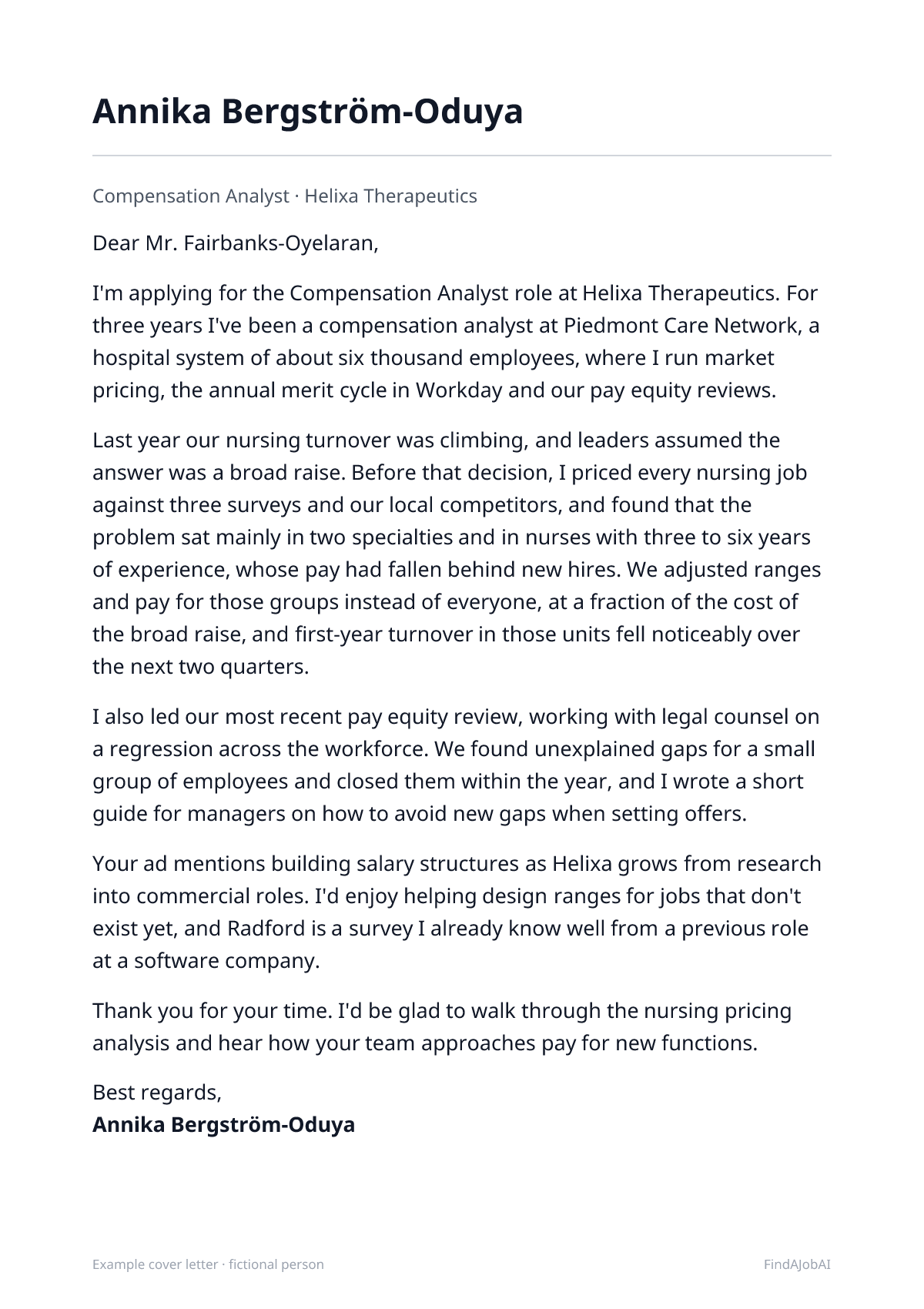
Dear Mr. Fairbanks-Oyelaran,
I'm applying for the Compensation Analyst role at Helixa Therapeutics. For three years I've been a compensation analyst at Piedmont Care Network, a hospital system of about six thousand employees, where I run market pricing, the annual merit cycle in Workday and our pay equity reviews.
Last year our nursing turnover was climbing, and leaders assumed the answer was a broad raise. Before that decision, I priced every nursing job against three surveys and our local competitors, and found that the problem sat mainly in two specialties and in nurses with three to six years of experience, whose pay had fallen behind new hires. We adjusted ranges and pay for those groups instead of everyone, at a fraction of the cost of the broad raise, and first-year turnover in those units fell noticeably over the next two quarters.
I also led our most recent pay equity review, working with legal counsel on a regression across the workforce. We found unexplained gaps for a small group of employees and closed them within the year, and I wrote a short guide for managers on how to avoid new gaps when setting offers.
Your ad mentions building salary structures as Helixa grows from research into commercial roles. I'd enjoy helping design ranges for jobs that don't exist yet, and Radford is a survey I already know well from a previous role at a software company.
Thank you for your time. I'd be glad to walk through the nursing pricing analysis and hear how your team approaches pay for new functions.
Best regards,
Annika Bergström-Oduya
Example 2 · Career changer
Payroll specialist moving into compensation analysis
Desmond has processed payroll for four years and supported merit cycle uploads. The ad is for a compensation analyst at a logistics company.
Example letter · fictional
Dear Ms. Lindqvist-Obi,
I'm applying for the Compensation Analyst role at Northbay Freight. For four years I've worked as a payroll specialist at Harborline Distribution, paying about two thousand hourly and salaried employees across five warehouses, and for the last two merit cycles I've been the person who checks and loads every pay change into our system.
During last year's cycle I noticed that several warehouse supervisors were paid less than the leads who reported to them, because leads had received shift premiums and overtime-based increases for years. I built a simple spreadsheet comparing base pay by job and tenure across sites, shared it with our HR manager, and she used it to propose supervisor adjustments that were approved before the cycle closed. It was a small analysis, but it fixed a problem that had quietly frustrated supervisors at three sites for years, and two of them told me later it had changed whether they planned to stay.
That project made me want to work on pay decisions, not just process them. Since then I've completed two WorldatWork courses toward the CCP and learned how salary surveys, job matching and range design work, practicing on public wage data.
Your ad asks for accuracy with pay data and comfort with hourly workforces across several locations. I'd bring both, along with a payroll specialist's habit of checking every number twice before it reaches an employee's paycheck.
Thank you for considering my application. I'd be happy to share the supervisor comparison and talk about how your team prices warehouse roles today.
Sincerely,
Desmond Achterhof-Rivera
Example 3 · Senior or lead
Total rewards lead applying to head compensation at a scale-up
Octavia leads compensation for a retail group of fifteen thousand employees. The ad is for a head of compensation at a fast-growing software company.
Example letter · fictional
Dear Ms. Arcand,
I'm applying for the Head of Compensation role at Cloudharbor. I lead compensation at Mesa Retail Group, about fifteen thousand employees across stores, distribution and corporate offices, with two analysts on my team, and I'd like to bring that experience to a company building its rewards programs for the next stage of growth.
When I joined, Mesa had more than a thousand job codes, many describing the same work with different titles and pay. I led a job architecture project with HR partners and business leaders, grouping roles into clear career levels with matching ranges. It took a year, but managers now place new hires faster, pay decisions are easier to explain, and our pay equity reviews have far fewer unexplained differences to investigate.
I also prepare executive pay benchmarking for the board's compensation committee and run merit and bonus cycles with a combined budget in the tens of millions. Both taught me to explain trade-offs simply, since committee members and store managers need the same clarity in very different forms.
I haven't managed equity compensation at a private software company, where stock is a large share of pay. I'd expect to learn quickly from your finance team and outside advisers, and I've started a course on equity plan design so I can contribute to those discussions from my first month.
I'd welcome a conversation about where your pay programs feel strained today, how managers currently make offers, and what you'd want a compensation function to deliver in its first year.
Sincerely,
Octavia Lindgren-Mbatha
All three letters, and the short version below, are fictional: the people, employers and numbers are invented. Borrow the structure, never the facts.
- Prefer to write it yourself? Use the free cover letter template.
- Check your CV against the job first: the free CV score shows the missing keywords.
Why the first letter works, paragraph by paragraph
Paragraph 1: Opening
States the employer size and the three areas she owns, pricing, merit and equity, so the reader knows her scope immediately.
Paragraph 2: The pricing analysis
Shows her testing a costly assumption, a broad raise, with survey data and finding a cheaper, targeted fix that worked.
Paragraph 3: Pay equity
Adds a second area with legal partnership and a practical follow-up for managers, which shows judgment beyond the spreadsheet.
Paragraph 4: Why this company
Connects the biotech's growth stage to designing new ranges and names a survey she already knows.
Paragraph 5: Close
Offers to discuss her main analysis and asks about their approach, ending on their needs.
What the career changer's letter does differently
The career changer's letter uses payroll work to show a real compensation insight: supervisors paid below their leads, found with his own analysis and fixed before the cycle closed. The CCP courses show the move is planned, and his payroll accuracy is a strength compensation teams value.
What the senior letter does differently
A lead-level letter describes systems: job architecture, board materials and large cycles. Naming the gap, little experience with private-company equity, and the steps she's already taking makes the letter credible for a move into a new industry.
Short compensation analyst cover letter: an email-ready version
Many applications arrive as an email or a small text box, and a full page doesn't fit. This version runs 120 to 150 words and keeps only what a reader needs to decide whether to reply. A compensation analyst emails an HR director after a referral from a former colleague, attaching a resume.
Short version · email · fictional124 words
Subject: Compensation Analyst role – referred by Priya Ravindran-Holm – Lucian Abara-Whitcombe
Hello Mr. Castellano,
Priya Ravindran-Holm suggested I contact you about the Compensation Analyst role at Granitepeak. I've spent three years in compensation at a regional bank, pricing roles, supporting merit cycles in Workday and preparing salary ranges for job postings.
My most useful project rebuilt our offer guidelines after recruiters kept asking for exceptions. I priced our most-hired roles against two surveys and updated the ranges, and exception requests dropped sharply in the following quarter while acceptance rates held steady. Recruiters now use the guidelines as their first reference before any offer conversation, which has also made approvals faster.
My resume is attached. I'd be glad to talk about the role and how your team prices insurance roles across regions.
Best regards,
Lucian Abara-Whitcombe
The short version leads with the referral, then keeps one project with a clear effect. It drops the pay equity and cycle detail that a full letter would include, leaving the resume to cover them.
Opening lines that work for compensation analyst cover letters
The first sentence decides whether the second gets read. Here are six openings, one for each situation you might be in. Pick the one that matches yours and swap in your own facts: every name and number below is invented.
1. You have a standout result
A targeted pricing review I led for nursing roles cut turnover in two units at a fraction of the cost of a broad raise, and I'd like to bring that kind of analysis to Helixa.
2. The ad names a problem you've solved
Your ad mentions building salary structures for roles that don't exist yet. I've designed ranges during a period of fast hiring, and I'd enjoy doing the same for your commercial team.
3. Someone referred you
Your HR director, Augustin Mbeki-Larsen, and I worked together on a pay equity review at a previous company. He suggested I apply for this role.
4. You admire what they build
I've followed Northbay's growth across the West Coast this year, and pricing hourly roles in that many markets is exactly the kind of problem I enjoy.
5. You're new to the field or switching into it
After four years processing payroll and loading every merit change, I've moved toward compensation through WorldatWork courses and my own pay analysis. I'm ready to make it my full-time work.
6. You have senior scope or a specialism
As the analyst managers call when an offer doesn't fit the range, I've learned that clear ranges prevent most exceptions. I'm looking for a team that wants to build them well.
How to write a compensation analyst cover letter
Five steps, in the order you'd write them. The shape stays the same for every job (a short opening, proof, a reason for this employer, a close), and what goes into each part is what changes with the role.
Find the compensation focus in the ad
Compensation analyst roles differ in focus: market pricing, cycle management, pay equity, sales incentives or executive pay. Read the ad for the main one, then choose an example from your work that matches it and the size of workforce the company has.
Open with a pay decision you influenced
Start with a situation where leaders needed to decide something about pay, such as raises, ranges or offers. Hiring managers want to see that your analysis changes decisions, so lead with the decision and the question it raised.
Show scale and method without sharing secrets
Give the number of roles priced, employees in the cycle or the method used, such as regression for pay equity. Use rounded figures and percentages instead of exact salaries, since compensation teams value discretion as much as skill.
Mention surveys and systems in context
Name the surveys and HRIS the ad lists inside your example, such as Radford or Workday. This helps applicant tracking systems match your letter while showing how you used the tools rather than simply listing them.
Close with their pay challenge
End by naming a challenge the company likely faces, such as pricing new roles or growing across states, and ask how they handle it today. This shows you've thought about their situation and gives the reader a reason to call you.
Compensation Analyst cover letter do's and don'ts
Do
- Name one pricing, cycle or equity project with its population or budget.
- Show the decision your analysis supported and what it cost or saved.
- Mention the surveys and systems the ad lists inside your example.
Don't
- Don't share exact salaries or budgets from your current employer.
- Don't list every survey you've touched; name the ones that matter for this role.
- Don't describe pay equity work without saying how you handled confidentiality.
Common compensation analyst cover letter mistakes
Each one is easy to make and quick to fix before you send the letter.
Listing tasks without decisions
Saying you ran surveys and cycles describes activity. Name one decision your analysis supported and what it changed for employees or costs.
Sharing confidential pay figures
Exact salaries or executive pay from your employer are a red flag. Use rounded numbers, percentages and general descriptions.
Ignoring pay equity
Most compensation roles now include equity reviews. If you've done one, mention the method and outcome; if not, show interest in learning.
Writing only for HR readers
Compensation analysts work with finance and managers too. Show you can explain pay decisions simply to people outside HR.
Generic interest in compensation
Saying you love numbers and people doesn't stand out. Name a pay challenge at the company that you'd want to work on first.
Email subject lines for compensation analyst applications
Applying by email? Put the job title, any reference number and your name in the subject line.
- Compensation Analyst application – market pricing and pay equity – Annika Bergström-Oduya
- Compensation Analyst – payroll specialist with merit cycle experience – Desmond Achterhof-Rivera
- Application: Compensation Analyst, Total Rewards (Req. 6672) – Annika Bergström-Oduya
Everything for Compensation Analysts
- Compensation Analyst resume exampleA full resume, plus bullet and summary examples
- Compensation Analyst interview questions30 questions with sample answers
- Compensation Analyst job descriptionDuties, skills and requirements
- Career change cover letter: template + examples
Other cover letter examples
Compensation Analyst cover letter FAQ
What should a compensation analyst cover letter include?
One project such as a market pricing review, merit cycle or pay equity study, with its scale and the decision it supported. Add the surveys and systems you used and a reason the company's pay challenges interest you.
How do I move from payroll or HR into compensation?
Describe a time you analyzed pay data and spotted a problem, then mention courses such as WorldatWork's toward the CCP. Payroll and HR roles give strong data accuracy and policy knowledge that compensation teams need.
Should I mention pay equity in a compensation analyst cover letter?
Yes, if you've done it. Give the method, such as regression analysis, and the outcome in general terms, without sharing confidential figures or names.
How we built this page
The FindAJobAI team wrote the three example letters, the short email version, the opening lines and the advice for compensation analyst roles. The people, employers and numbers in the letters are invented; the structure, the kind of evidence and the order of the paragraphs are the parts to copy.
Once we track enough live compensation analyst job ads, this page also shows the skills they ask for most, counted the same way as our in-demand skills report.
Last reviewed on November 1, 2026.