Veterinarian Cover Letter Example (2026)
By FindAJobAI Team Updated How we built this page
Practices hiring a veterinarian usually have more open roles than applicants, so a cover letter is less about getting noticed and more about fit. Use it to show the medicine and surgery you're comfortable with, how you talk to clients about cost and prognosis, and what kind of team and mentoring you want.
Veterinarian cover letter template
This letter as a one-page template: an opening that names the job and your strongest fact, proof that answers the ad, a reason for this employer and a short close.
After you sign up, FindAJobAI drafts your own letter for a real job from your CV in this format, and you edit it before you send it.
Example 1 · Experienced
Small animal associate applying to a four-doctor practice
Dr. Henrietta Lindgren has four years in general practice. The ad asks for an associate who enjoys surgery and dentistry and can see a full appointment book.
Example letter · fictional
Dear Dr. Ashworth,
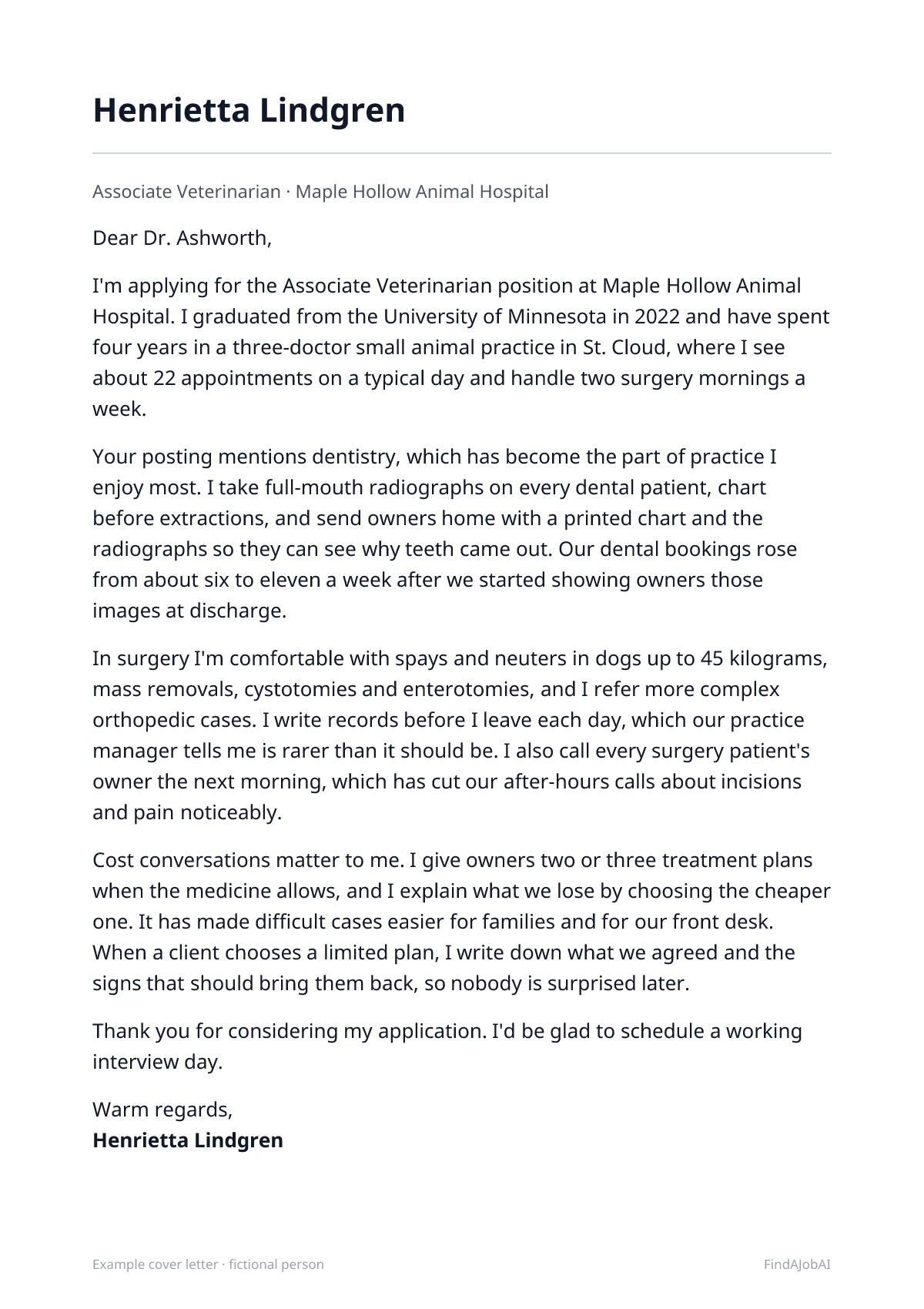
I'm applying for the Associate Veterinarian position at Maple Hollow Animal Hospital. I graduated from the University of Minnesota in 2022 and have spent four years in a three-doctor small animal practice in St. Cloud, where I see about 22 appointments on a typical day and handle two surgery mornings a week.
Your posting mentions dentistry, which has become the part of practice I enjoy most. I take full-mouth radiographs on every dental patient, chart before extractions, and send owners home with a printed chart and the radiographs so they can see why teeth came out. Our dental bookings rose from about six to eleven a week after we started showing owners those images at discharge.
In surgery I'm comfortable with spays and neuters in dogs up to 45 kilograms, mass removals, cystotomies and enterotomies, and I refer more complex orthopedic cases. I write records before I leave each day, which our practice manager tells me is rarer than it should be. I also call every surgery patient's owner the next morning, which has cut our after-hours calls about incisions and pain noticeably.
Cost conversations matter to me. I give owners two or three treatment plans when the medicine allows, and I explain what we lose by choosing the cheaper one. It has made difficult cases easier for families and for our front desk. When a client chooses a limited plan, I write down what we agreed and the signs that should bring them back, so nobody is surprised later.
Thank you for considering my application. I'd be glad to schedule a working interview day.
Warm regards,
Henrietta Lindgren
Example 2 · Career changer
New graduate who worked as a veterinary technician before vet school
Dr. Oluwaseun Brandt just passed the NAVLE after eight years as a credentialed technician. The ad is for a new-graduate associate with structured mentorship.
Example letter · fictional
Dear Dr. Mancuso,
I'm applying for the New Graduate Associate Veterinarian position at Briarwood Veterinary Clinic. I graduate from Colorado State University in May, passed the NAVLE in November, and before vet school I worked for eight years as a credentialed veterinary technician in a busy emergency hospital.
Those years mean I already know how a treatment area runs. I've placed hundreds of catheters, monitored anesthesia on everything from neonatal kittens to giant breeds, and run the lab work and radiographs that doctors depend on. I hope that lets me lean on your technicians well from the start, because I know exactly what I'm asking when I request something.
What I need now is surgical and medical judgment that only comes with time as a doctor. During school I completed about 40 spays and neuters at a shelter rotation and a two-week externship in general practice dentistry. Your posting describes six months of paired surgeries and weekly case rounds, and that is the main reason I'm applying. I would rather spend a slower first year doing surgery well than rush to a full schedule before I'm ready.
Clients have trusted me as a technician to explain discharge instructions, and I'd like to grow into the harder conversations about diagnosis, cost and end-of-life care with mentors watching. I've sat in on dozens of those conversations from the technician's side, and I know how much the doctor's words stay with a family afterward.
Thank you for your time. I'm available to start in June and would welcome a working interview.
Sincerely,
Oluwaseun Brandt
Example 3 · Senior or lead
Senior associate applying to become medical director
Dr. Cornelius Faraday has practiced for 15 years and leads case rounds at his clinic. The ad is for a Medical Director at a growing six-doctor hospital.
Example letter · fictional
Dear Ms. Halloran,
I'm applying for the Medical Director position at Riverbend Pet Hospital. I've practiced small animal medicine for 15 years, the last eight as senior associate at Fairmont Animal Clinic, a five-doctor hospital where I lead weekly case rounds and mentor our new graduates.
Your posting mentions inconsistent protocols between doctors. We had the same issue with anesthesia: each doctor used their own drug plan and monitoring threshold. I worked with our head technician to write four standard protocols by patient risk level and a one-page monitoring sheet. Over the following year, recorded anesthetic complications fell from nine to three, and new doctors could start surgery with far less guesswork. Our technicians told me they felt more confident speaking up during procedures once the thresholds were written down.
I've mentored six new graduates through their first year using paired surgeries, a weekly case review and a rule that no one euthanizes a patient alone in their first month. Five are still in practice with us, and two now lead our dental program. I also set aside one hour a week for any doctor to bring me a case they are unsure about, without it being logged as a formal review.
I haven't yet owned a hospital budget or handled hiring decisions alone. I'd rely on your practice manager in those areas while I focus on medical quality, protocols and team development, and I'd plan to complete a practice management course during my first year in the role.
I'd welcome the chance to visit Riverbend, meet the doctors and hear which cases are causing the most friction right now.
Kind regards,
Cornelius Faraday
All three letters, and the short version below, are fictional: the people, employers and numbers are invented. Borrow the structure, never the facts.
- Prefer to write it yourself? Use the free cover letter template.
- Check your CV against the job first: the free CV score shows the missing keywords.
Why the first letter works, paragraph by paragraph
Paragraph 1: Opening
Gives school, graduation year, years in practice and caseload, which let a medical director picture the candidate's day at once.
Paragraph 2: A focus area with a result
Dentistry with radiographs and a booking increase shows clinical skill and an effect on the practice.
Paragraph 3: Surgical range
Lists the procedures the writer does and what they refer, which is the honest answer every practice wants.
Paragraph 4: Client communication
Offering several treatment plans shows how the vet handles cost, one of the hardest parts of general practice.
Paragraph 5: Close
Asks for a working interview, the normal next step for associate roles.
What the career changer's letter does differently
The new graduate's letter turns technician years into a real asset without overstating them. It is clear about what still needs mentoring, surgery and medical judgment, and it ties the application to the practice's specific mentorship plan.
What the senior letter does differently
A medical director letter is about the whole team's medicine: a protocol change with complication numbers before and after, a mentoring structure and retention of the doctors it trained. It is honest that budget and hiring would be new.
Short veterinarian cover letter: an email-ready version
Many applications arrive as an email or a small text box, and a full page doesn't fit. This version runs 120 to 150 words and keeps only what a reader needs to decide whether to reply. A veterinarian emails a shelter that posted a part-time spay and neuter surgeon opening.
Short version · email · fictional128 words
Subject: Part-time Shelter Veterinarian – high-volume spay/neuter, 3 days a week – Dr. Marisol Thackeray
Dear Dr. Ingram,
I'm applying for the part-time Shelter Veterinarian role at Tri-Lakes Humane Society. I've been licensed in Michigan for seven years and currently work two days a week in general practice and one day at a community spay clinic.
On clinic days I complete 25 to 30 spays and neuters, using pediatric technique for kittens and puppies and keeping surgical times short without cutting corners on sterility or pain control. I'm comfortable with intake exams, ringworm and parvo protocols and population-level decisions, and I have worked closely with shelter staff on vaccinating every animal at intake.
I'm free Mondays, Wednesdays and Fridays and can start next month. My resume and surgical log are attached, and I can visit for a working day.
Best wishes,
Marisol Thackeray
The short version focuses on what a shelter needs: license, surgery volume, technique, comfort with shelter medicine protocols and clear availability.
Opening lines that work for veterinarian cover letters
The first sentence decides whether the second gets read. Here are six openings, one for each situation you might be in. Pick the one that matches yours and swap in your own facts: every name and number below is invented.
1. You have a standout result
After we began showing owners their dental radiographs at discharge, our dental bookings nearly doubled, and I'd like to build the same program at your practice.
2. The ad names a problem you've solved
Your posting mentions mentorship for new doctors. I spent eight years as a technician watching which mentoring worked, and I'm now ready to be on the other side of it.
3. Someone referred you
Dr. Lucan Ferreira, who supervised my externship at your Westfield clinic, suggested I apply when your associate role opened.
4. You admire what they build
I see about 22 appointments a day and finish my records before I leave, and I'd like to bring that pace to a practice that values both.
5. You're new to the field or switching into it
In 15 years of small animal medicine I've learned that most hard cases are really hard conversations, and I've spent the last eight teaching new doctors how to have them.
6. You have senior scope or a specialism
On a busy spay clinic day I complete 25 to 30 surgeries, and I'd like to put that experience to work for your shelter's animals.
How to write a veterinarian cover letter
Five steps, in the order you'd write them. The shape stays the same for every job (a short opening, proof, a reason for this employer, a close), and what goes into each part is what changes with the role.
Open with degree, license and caseload
Name your school, graduation year, license status and a typical day, such as appointments seen and surgery mornings. A practice owner can picture your work right away and judge whether it matches their appointment book, which saves both sides an unnecessary call.
Be precise about surgery and referrals
List the procedures you perform independently, any size or complexity limits, and what you refer. Practices plan their surgery schedule around this, so a precise and honest list builds more trust than a broad statement about being comfortable with surgery.
Show one clinical interest with a result
Pick a focus such as dentistry, ultrasound, dermatology or shelter medicine, and describe what you did and what changed: more bookings, fewer complications or clearer client compliance. One real example shows how you would add value beyond seeing appointments.
Explain how you talk to clients
Describe how you present options, costs and prognosis, or handle euthanasia appointments. Client communication drives reviews, compliance and team morale, and many practice owners care about it as much as medical skill when they compare candidates.
State what you want from the practice
Say what mentoring, schedule or focus area you are looking for, and close by asking for a working interview. Practices that are a good fit will appreciate the clarity, and you avoid an offer that does not match what you need.
Veterinarian cover letter do's and don'ts
Do
- State your school, graduation year, license status and typical caseload in the first paragraph.
- List the surgeries you perform alone and the cases you refer, honestly.
- Say what mentoring or focus area you want, since good practices plan around it.
Don't
- Don't open with a childhood love of animals; every applicant shares it.
- Don't claim surgical range you have only seen or assisted with.
- Don't skip the client side; communication matters as much as medicine to most practices.
Common veterinarian cover letter mistakes
Each one is easy to make and quick to fix before you send the letter.
Opening with a love of animals
Every veterinarian shares it. Start with your license, experience and caseload, and let your examples show the care.
Overstating surgical skill
Name the surgeries you do alone and those you refer. Practices will find out on the first surgery day either way.
Leaving out client communication
Describe how you handle estimates and hard conversations; owners and managers screen for it as much as for medicine.
Writing a generic letter for every practice
Mention the practice's species mix, caseload or mentoring plan from the ad, and connect one of your examples to it.
Negotiating production pay in the letter
Save compensation, CE and benefits for the interview. The letter's job is to show fit and get you a working interview.
Email subject lines for veterinarian applications
Applying by email? Put the job title, any reference number and your name in the subject line.
- Associate Veterinarian application – 4 yrs small animal, dentistry focus – Dr. Henrietta Lindgren
- New Graduate Associate – DVM 2027, former credentialed tech – Dr. Oluwaseun Brandt
- Application: Associate DVM, Relief to Full-Time (Ref. VET-12) – Dr. Henrietta Lindgren
Everything for Veterinarians
- Veterinarian resume exampleA full resume, plus bullet and summary examples
- Veterinarian interview questions30 questions with sample answers
- Veterinarian job descriptionDuties, skills and requirements
- Career change cover letter: template + examples
Other cover letter examples
Veterinarian cover letter FAQ
What should a veterinarian cover letter include?
Your degree, license status, years in practice and typical caseload, then the surgery and medicine you're comfortable with, one focus area with a result, how you talk to clients about cost and what mentoring or schedule you're looking for.
How does a new veterinary graduate write a cover letter?
Mention externships, shelter surgery numbers and any prior work in clinics, and be clear about the mentorship you want. Practices hiring new graduates expect gaps, so naming them honestly helps them judge fit.
Should a veterinarian mention salary or production pay in the cover letter?
Usually not. Leave pay, production percentage and CE allowance for the interview or offer stage, and use the letter to show your medicine, surgery and approach to clients.
How we built this page
The FindAJobAI team wrote the three example letters, the short email version, the opening lines and the advice for veterinarian roles. The people, employers and numbers in the letters are invented; the structure, the kind of evidence and the order of the paragraphs are the parts to copy.
Once we track enough live veterinarian job ads, this page also shows the skills they ask for most, counted the same way as our in-demand skills report.
Last reviewed on November 1, 2026.