Architect Cover Letter Example (2026)
By FindAJobAI team Updated How we built this page
Architect ads list software and licensure status in the first line, so the cover letter has to do the harder work: show how you think about a site, a client's budget and a set of drawings that a contractor can actually build from. Name a project, the problem it posed, and the decision you made.
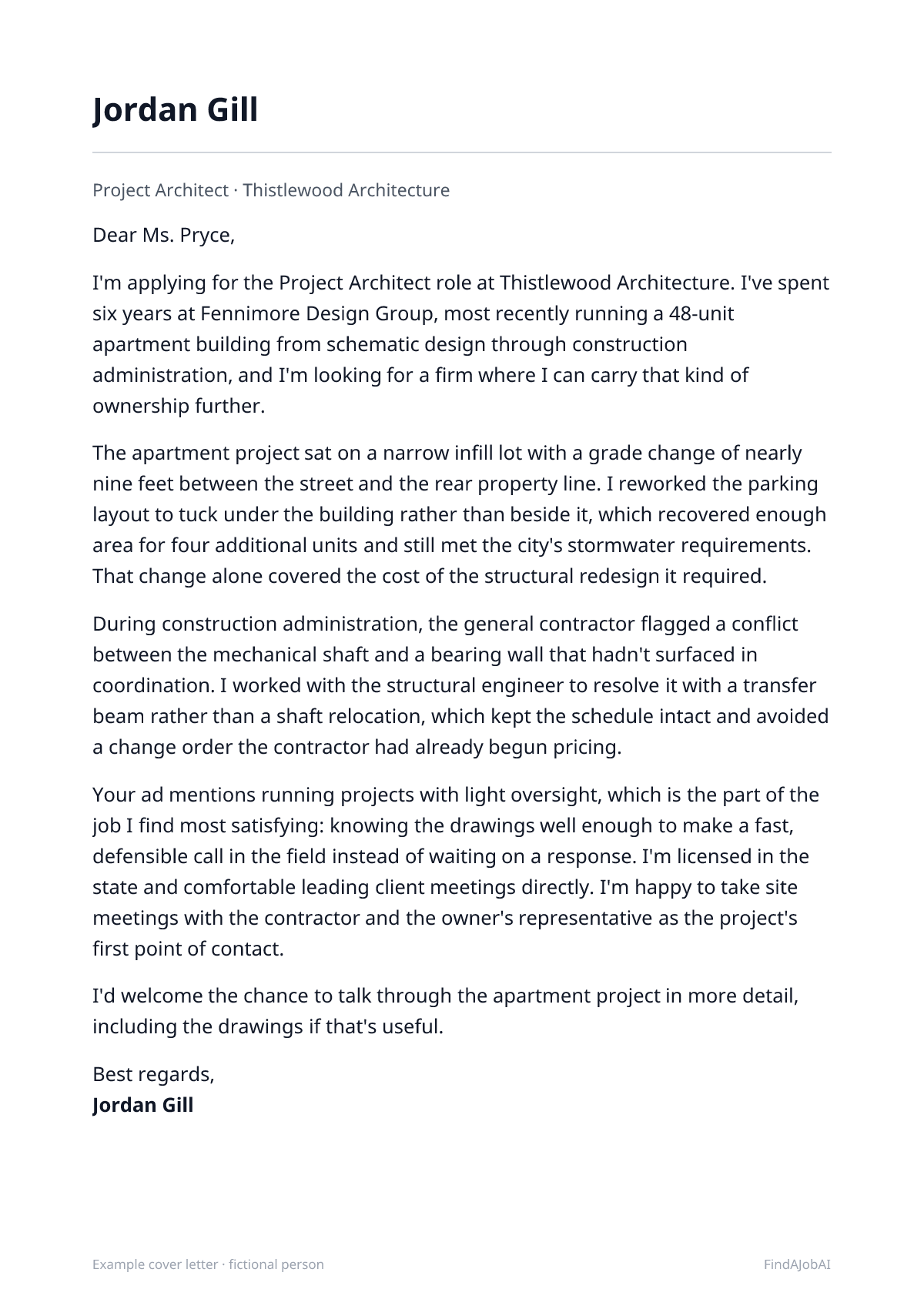
Architect cover letter template
This letter as a one-page template: an opening that names the job and your strongest fact, proof that answers the ad, a reason for this employer and a short close.
After you sign up, FindAJobAI drafts your own letter for a real job from your CV in this format, and you edit it before you send it.
Example 1 · Experienced
Project architect applying to a mid-size residential firm
Jordan leads construction documents and site visits for multifamily projects. The ad asks for someone who can run a project with light oversight.
Example letter · fictional
Dear Ms. Pryce,
I'm applying for the Project Architect role at Thistlewood Architecture. I've spent six years at Fennimore Design Group, most recently running a 48-unit apartment building from schematic design through construction administration, and I'm looking for a firm where I can carry that kind of ownership further.
The apartment project sat on a narrow infill lot with a grade change of nearly nine feet between the street and the rear property line. I reworked the parking layout to tuck under the building rather than beside it, which recovered enough area for four additional units and still met the city's stormwater requirements. That change alone covered the cost of the structural redesign it required.
During construction administration, the general contractor flagged a conflict between the mechanical shaft and a bearing wall that hadn't surfaced in coordination. I worked with the structural engineer to resolve it with a transfer beam rather than a shaft relocation, which kept the schedule intact and avoided a change order the contractor had already begun pricing.
Your ad mentions running projects with light oversight, which is the part of the job I find most satisfying: knowing the drawings well enough to make a fast, defensible call in the field instead of waiting on a response. I'm licensed in the state and comfortable leading client meetings directly. I'm happy to take site meetings with the contractor and the owner's representative as the project's first point of contact.
I'd welcome the chance to talk through the apartment project in more detail, including the drawings if that's useful.
Best regards,
Jordan Gill
Example 2 · Career changer
Structural drafter moving into architectural design
Anika has spent three years detailing structural drawings and just finished her M.Arch. The ad is for an intern architect role.
Example letter · fictional
Dear Hiring Manager,
I'm applying for the Intern Architect position at Oakfern Studio. For three years I worked as a structural drafter at a civil engineering firm, producing detail drawings for retaining walls and foundations, and I completed my Master of Architecture this spring while continuing that work part time.
In my final studio, I designed a small branch library on a flood-prone site, which let me use what I'd learned about foundations directly: I raised the building on a stepped plinth that doubled as seating during dry months and as flood storage during wet ones. My structural background shaped that decision before any instructor suggested it, and the review panel asked me to present it at the school's year-end exhibition.
At the engineering firm, I also caught an error in a contractor's rebar submittal that would have under-reinforced a retaining wall near a school playground, which taught me to read construction documents the way a contractor will, not just the way a designer intends them.
Your studio's portfolio shows civic and community buildings on constrained urban sites, which is the kind of problem I want to keep working on. I bring a reader's eye for what actually gets built, alongside the design training I've just finished. I'm ready to start at the bottom of the learning curve: redlining drawings, building models and sitting in on consultant coordination until I can carry a small package alone.
My portfolio is attached as a PDF, and I'd welcome the chance to discuss the library project or any of my structural drawings.
Sincerely,
Anika Estrada
Example 3 · Senior or lead
Design director applying to lead a growing civic studio
Benedikt directs design across a nine-person studio. The ad is for a design director who will set design standards and mentor junior staff.
Example letter · fictional
Dear Mr. Okonjo,
I'm applying for the Design Director role at Marrowfield Architecture. I've directed design at Calder & Vance for the past four years, overseeing a studio of nine across civic and educational work, and before that spent seven years as a project architect. I'm looking for a studio ready to grow its civic practice further.
Your ad mentions design consistency across project teams, which was the problem I inherited at Calder & Vance: four teams were producing visibly different quality depending on which senior architect ran them. I built a design review at two fixed points per project, schematic and design development, with a one-page checklist covering massing, material logic and daylighting, rather than open-ended critique. Client revision requests after design development dropped by roughly half within a year, and the checklist is still used firm-wide.
The project I'm proudest of directing is a 60,000-square-foot community center on a site split by a seasonal creek. I pushed the team away from an early scheme that bridged the creek and toward one that let the building step around it, preserving the floodplain and cutting the structural budget enough to add a second gymnasium the client had cut for cost. It opened last year and the city has already asked us to study two more sites using the same approach.
I've mentored six architects toward licensure, and I review every exam-eligible hour log personally, but I haven't yet built a studio from a smaller base the way your ad describes, growing from twelve to twenty. I'd want to understand how you currently staff projects before proposing changes.
I'd welcome a conversation about the community center, the design review process, or how you're thinking about staffing growth.
Sincerely,
Benedikt Ashworth
All three letters, and the short version below, are fictional: the people, employers and numbers are invented. Borrow the structure, never the facts.
- Prefer to write it yourself? Use the free cover letter template.
- Check your CV against the job first: the free CV score shows the missing keywords.
Why the first letter works, paragraph by paragraph
Paragraph 1: Opening
Names the scale and type of project (a 48-unit building, start to finish) so the reader immediately knows the writer's level and area of practice.
Paragraph 2: The site problem that changed the design
A specific constraint (the grade change), the decision (tucking parking under the building) and the result (four more units, same stormwater compliance) show design judgment tied to a real outcome.
Paragraph 3: Construction administration
The shaft and bearing wall conflict demonstrates that the writer can solve problems in the field under schedule pressure, which is what 'light oversight' actually requires.
Paragraph 4: Why this firm
Responds directly to the ad's phrase about oversight and states licensure plainly, which answers the firm's practical question before it's asked.
Paragraph 5: Close
Offers to bring drawings to a conversation, a concrete and low-pressure next step.
What the career changer's letter does differently
The career changer's letter leads with the structural drafting work that most directly supports architectural design, then uses a studio project (the flood-site library) to show the instinct transferring into design decisions, with a second, smaller proof point from the drafting job about catching a reinforcement error.
What the senior letter does differently
A design director letter reports studio-wide habits, not just one project: a two-point design review that halved revision requests, six architects mentored toward licensure, and a named project where directing the design meant changing the site strategy, not drawing it personally. The gap, growing a studio rather than running one at steady size, is named directly.
Short architect cover letter: an email-ready version
Many applications arrive as an email or a small text box, and a full page doesn't fit. This version runs 120 to 150 words and keeps only what a reader needs to decide whether to reply. An architect answers a healthcare systems firm's short online application field, sent by email after the portal's attachment upload failed.
Short version · email · fictional129 words
Subject: Architect II application – healthcare, Revit – Idris Fontaine
Hello Ms. Chaudhary,
I'm applying for the Architect II role at Larkspur Health Design. I have five years of experience in Revit-based documentation, most recently leading construction documents for a 40-bed outpatient clinic addition.
On that project, the clinic's infection control team asked for a redesign of the nurse station layout mid-construction. I revised the sightlines and plumbing runs in under two weeks without delaying the schedule, which the contractor credited with keeping the project on its original completion date.
Healthcare work rewards exactly that kind of fast, careful problem-solving, and I'd like to keep doing it on your projects. My resume is attached, and I can send clinic drawings on request. I'm also free for a call or a visit to your office this week.
Best,
Idris Fontaine
The short version keeps one project, the clinic addition, and compresses the mid-construction redesign into two sentences on speed and schedule impact, which a healthcare client's project team cares about most. It drops licensure detail, since the role and years already answer that.
Opening lines that work for architect cover letters
The first sentence decides whether the second gets read. Here are six openings, one for each situation you might be in. Pick the one that matches yours and swap in your own facts: every name and number below is invented.
1. You have a standout result
Last year I redesigned a nurse station layout mid-construction without losing a single day on the schedule. I'd like to bring that kind of fast, careful problem-solving to your clinic projects.
2. The ad names a problem you've solved
Your ad says project teams need someone who can run drawings with light oversight. On my last project, I carried a 48-unit building from schematic design through construction administration essentially on my own.
3. Someone referred you
Your project architect, Hollis Draper, and I worked together on a library competition two years ago. He mentioned you're looking for someone who reads construction documents the way a contractor will, which is exactly how I was trained to.
4. You admire what they build
I toured your firm's riverside pavilion last spring and have thought about its roof detailing ever since. I'd like to help design buildings that get looked at that closely.
5. You're new to the field or switching into it
I spent three years detailing structural drawings before finishing my M.Arch this year, and that background shaped a flood-site library design that my review panel asked me to present publicly.
6. You have senior scope or a specialism
As design director for a nine-person studio, I built the design review process that's still used firm-wide four years later. I'm looking for a studio ready to grow its civic practice with that kind of structure.
How to write an architect cover letter
Five steps, in the order you'd write them. The shape stays the same for every job (a short opening, proof, a reason for this employer, a close), and what goes into each part is what changes with the role.
Pick a project with a real constraint, not just a building type
Firms read dozens of letters describing a 'mixed-use project' or a 'single-family home.' Choose the one with an actual problem: a difficult site, a tight budget, a code conflict, or a client who changed their mind midway. The constraint is what makes the story specific to you.
Open with the decision, then the building
Say what you decided and why before you describe what the building looks like. A reader who sees judgment in the first paragraph, such as a site strategy or a material tradeoff, keeps reading. Save renderings and style descriptions for the portfolio, not the letter.
Include one construction administration story if you have it
A field problem solved under schedule pressure, like a coordination conflict or a submittal error caught, tells a firm you understand that drawings meet reality on site. This single story often matters more to hiring managers than an additional design project.
State software and licensure in one sentence each
Name the software you used for the project you just described, so it's attached to real work rather than listed cold. State your licensure status plainly, whether that's licensed, a specific number of exams passed, or an expected completion date.
Close with a specific, low-pressure next step
Offer to bring drawings, send a portfolio, or discuss a named project in more detail. This is more useful to a hiring manager than a generic statement of enthusiasm, and it signals that you have material ready to back up what you wrote.
Architect cover letter do's and don'ts
Do
- Name one site constraint or client problem and the decision you made about it, not just the building type.
- Mention your software (Revit, AutoCAD, Rhino) inside a project story rather than as a bare list.
- State your licensure status plainly: licensed, number of exams passed, or on track with a timeline.
Don't
- Don't describe a project only by square footage or style; say what problem it solved for the client or site.
- Don't claim sole authorship of a team project; say what you led or decided within it.
- Don't omit construction administration experience if you have it; it's often what separates candidates on paper.
Common architect cover letter mistakes
Each one is easy to make and quick to fix before you send the letter.
Describing a building instead of a decision
A paragraph about square footage, materials and style tells the reader what the building looks like, not how you think. Replace it with the constraint you faced and the choice you made because of it.
Listing software with no project attached
'Proficient in Revit, AutoCAD, Rhino and SketchUp' is true of most applicants. Mention the one or two tools you used for the project you're already describing, so the claim has evidence behind it.
Overstating authorship on a team project
Writing 'I designed the tower' when you led one aspect of a team effort invites an awkward correction in the interview. Say what you specifically led or decided, and credit the team for the rest.
Burying licensure status
Firms often screen on this first. State it in one sentence near the top rather than letting it emerge in the closing paragraph or not at all.
Skipping construction administration entirely
If you have field experience, even limited, mention one moment from it. It separates candidates who can only produce drawings from those who understand how those drawings get built.
Email subject lines for architect applications
Applying by email? Put the job title, any reference number and your name in the subject line.
- Project Architect application – multifamily, licensed – Jordan Gill
- Intern Architect application – structural background, M.Arch – Anika Estrada
- Application: Architect II, Civic Studio (Req. 2041) – Jordan Gill
Everything for Architects
- Architect resume exampleA full resume, plus bullet and summary examples
- Architect interview questions30 questions with sample answers
- Architect job descriptionDuties, skills and requirements
- Career change cover letter: template + examples
Other cover letter examples
Architect cover letter FAQ
What should I write in an architect cover letter?
One project with a real site or client constraint, the decision you made about it, and what happened as a result. Then a sentence on construction administration if you have it, since that's often where firms separate candidates. Software and licensure belong in a sentence, not a list.
How do I write an architect cover letter with no professional experience?
Use a studio project with a real constraint you solved, plus any adjacent work such as drafting, construction, or a related engineering role. Describe one decision and why you made it, and attach a portfolio rather than describing images in text.
Should I mention my licensure exams in the cover letter?
Yes, in one short sentence: licensed and in which state, or the number of exams passed and your expected finish date. Firms read this early, so don't bury it in the closing paragraph.
Is it normal to attach a portfolio with an architect cover letter?
Yes, it's expected. Keep the letter focused on one or two projects in words, and let the portfolio carry the drawings and images; say in one sentence which project to look at first.
How we built this page
The FindAJobAI team wrote the three example letters, the short email version, the opening lines and the advice for architect roles. The people, employers and numbers in the letters are invented; the structure, the kind of evidence and the order of the paragraphs are the parts to copy.
Once we track enough live architect job ads, this page also shows the skills they ask for most, counted the same way as our in-demand skills report.
Last reviewed on November 1, 2026.