Structural Engineer Cover Letter Example (2026)
By FindAJobAI team Updated How we built this page
Structural engineer ads list codes and software every licensed applicant already knows, so the cover letter has to show judgment instead: a specific structure, a load or failure you analyzed, and the decision your calculations supported.
Structural Engineer cover letter template
This letter as a one-page template: an opening that names the job and your strongest fact, proof that answers the ad, a reason for this employer and a short close.
After you sign up, FindAJobAI drafts your own letter for a real job from your CV in this format, and you edit it before you send it.
Example 1 · Experienced
Bridge engineer applying to a transportation design firm
Ingvar inspects and rehabilitates aging bridges for a state department of transportation. The ad asks for steel bridge rehabilitation experience.
Example letter · fictional
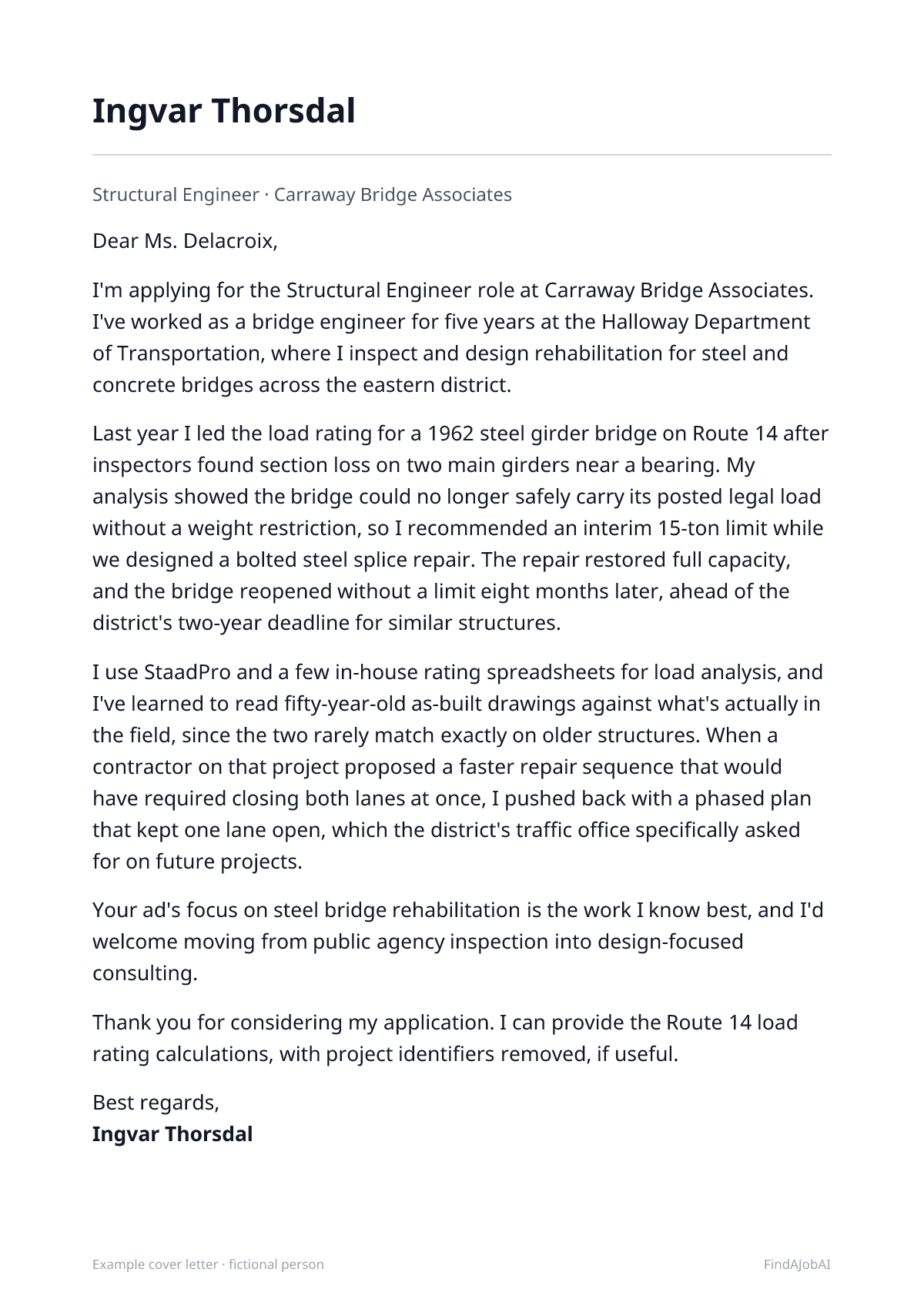
Dear Ms. Delacroix,
I'm applying for the Structural Engineer role at Carraway Bridge Associates. I've worked as a bridge engineer for five years at the Halloway Department of Transportation, where I inspect and design rehabilitation for steel and concrete bridges across the eastern district.
Last year I led the load rating for a 1962 steel girder bridge on Route 14 after inspectors found section loss on two main girders near a bearing. My analysis showed the bridge could no longer safely carry its posted legal load without a weight restriction, so I recommended an interim 15-ton limit while we designed a bolted steel splice repair. The repair restored full capacity, and the bridge reopened without a limit eight months later, ahead of the district's two-year deadline for similar structures.
I use StaadPro and a few in-house rating spreadsheets for load analysis, and I've learned to read fifty-year-old as-built drawings against what's actually in the field, since the two rarely match exactly on older structures. When a contractor on that project proposed a faster repair sequence that would have required closing both lanes at once, I pushed back with a phased plan that kept one lane open, which the district's traffic office specifically asked for on future projects.
Your ad's focus on steel bridge rehabilitation is the work I know best, and I'd welcome moving from public agency inspection into design-focused consulting.
Thank you for considering my application. I can provide the Route 14 load rating calculations, with project identifiers removed, if useful.
Best regards,
Ingvar Thorsdal
Example 2 · Entry level
New civil engineering graduate applying for an entry-level structural role
Priyasha just finished a civil engineering degree with a structures focus. The ad is an entry-level role requiring a capstone project and internship experience.
Example letter · fictional
Dear Hiring Manager,
I'm applying for the Structural Engineer I role at Marrowfield Structural Design. I graduated in May with a civil engineering degree focused on structures, and I completed a ten-month internship at Oakridge Engineering Group during my final year.
My capstone project was the structural redesign of a two-story community center using a steel moment frame instead of the original braced frame, because the client wanted an open floor plan without interior columns. I ran the lateral load analysis in ETABS, sized the moment connections by hand to check the software output, and presented the design to a review panel that included two practicing structural engineers, who asked harder questions about drift limits than I expected but approved the design.
During my internship, I checked rebar placement against shop drawings for a parking garage expansion and found a conflict between two drawings that would have placed a column six inches off its footing. Catching it before the pour saved a rework the project manager estimated at several weeks of schedule.
I passed the FE exam in the spring and I'm studying toward the PE, and I'm comfortable with ETABS, RISA, and AutoCAD from coursework and internship work. Your ad's emphasis on supporting senior engineers on building projects matches exactly what I did at Oakridge, checking and preparing calculations under review. I'm also eager to learn the firm's calculation templates and to have my first sets of calculations reviewed line by line.
Thank you for your time. I'd welcome the chance to discuss my capstone project in more detail.
Sincerely,
Priyasha Banerjee
Example 3 · Senior or lead
Senior structural engineer applying to lead a building design team
Fenwick leads structural design for mid-rise buildings at a design-build firm. The ad is for a senior engineer to mentor juniors and own client design calls.
Example letter · fictional
Dear Mr. Ashgrove,
I'm applying for the Senior Structural Engineer role at Haverstock Design Partners. For the last four years I've led structural design for mid-rise residential buildings at Quillon Structural Group, managing a team of three engineers, and before that I spent seven years designing buildings and parking structures as an individual contributor.
Your ad mentions clients who change program late in design, which strained my team too. On a six-story apartment project, the developer added a rooftop amenity deck after the foundation design was already stamped. Rather than redesign the foundation, I worked with the architect to shift the deck's load path onto two existing shear walls using a steel transfer beam, which kept the schedule and avoided a six-figure foundation change the developer hadn't budgeted for.
I mentor two engineers through their PE exams and review their calculations the way my own mentor once reviewed mine, checking the governing load case before the numbers. When a junior engineer on my team missed a wind uplift case on a canopy design last year, I walked through it with him rather than just correcting it, and he caught the same type of error himself on the next project before I had to flag it.
I haven't managed a firm's fee proposals or led client contract negotiations directly, and at Haverstock I'd expect to build that skill alongside your principals.
I'd welcome a conversation about the kinds of client changes your team sees most often and how design decisions get made when schedule and cost are both tight.
Sincerely,
Fenwick Oyelaran
All three letters, and the short version below, are fictional: the people, employers and numbers are invented. Borrow the structure, never the facts.
- Prefer to write it yourself? Use the free cover letter template.
- Check your CV against the job first: the free CV score shows the missing keywords.
Why the first letter works, paragraph by paragraph
Paragraph 1: Opening
States the writer's current agency, years of experience, and the specific scope (steel and concrete bridges, eastern district), which tells the reader exactly what kind of structures the applicant has handled.
Paragraph 2: The analysis that changed a decision
Names the structure's age and defect, the engineering judgment (a weight restriction), the fix (a bolted splice repair), and a result measured against the agency's own deadline.
Paragraph 3: Tools and judgment under pressure
Names the software and a real discrepancy between old drawings and field conditions, then shows the writer pushing back on a contractor's plan for a concrete reason, traffic impact.
Paragraph 4: Why this move
Names the ad's specific focus (steel bridge rehabilitation) and gives an honest, simple reason for the career move from agency to consulting.
Paragraph 5: Close
Offers a concrete work sample with identifiers removed, respecting the current employer's confidentiality while giving the reader something real to request.
What the entry-level letter does differently
The new graduate's letter leads with a capstone project detailed enough to read as real engineering work: a specific structural system change, the software used, hand calculations as a check, and a review panel's questions. The internship story adds a caught error with a concrete consequence avoided, and the letter closes by matching the ad's description of entry-level work almost exactly.
What the senior letter does differently
A senior structural engineer letter reports team-level judgment: a load path rerouted to avoid a costly foundation redesign, a mentoring habit that produced a measurable change in a junior engineer's work, and an honest gap named around fee and contract experience. The late-program-change story mirrors exactly the pressure the ad describes.
Short structural engineer cover letter: an email-ready version
Many applications arrive as an email or a small text box, and a full page doesn't fit. This version runs 120 to 150 words and keeps only what a reader needs to decide whether to reply. A structural engineer answers a short application field for a seismic retrofit firm, sent by email after the online form failed to upload attachments.
Short version · email · fictional128 words
Subject: Structural Engineer application – seismic retrofit experience – Branwen Castellanos
Hello Mx. Okonjo,
I'm applying for the Structural Engineer role at Faultline Seismic Engineering. I have five years of experience designing seismic retrofits for unreinforced masonry buildings at a firm specializing in older commercial structures.
My most significant project was a retrofit of a three-story 1920s masonry building, where I designed a steel moment frame and new diaphragm connections to meet current seismic code. The design passed city plan review on the first submittal, which the project manager said was unusual for a building with that much undocumented original construction.
Seismic retrofit work is where I want to keep building my career, and your firm's focus on it is exactly why I'm applying. My resume is attached, and the retrofit drawings are available on request.
Best,
Branwen Castellanos
A short field keeps one retrofit project and the detail that makes it credible, a first-submittal approval on a hard building type, instead of a tools list. It drops the software and code names entirely since the resume already lists them.
Opening lines that work for structural engineer cover letters
The first sentence decides whether the second gets read. Here are six openings, one for each situation you might be in. Pick the one that matches yours and swap in your own facts: every name and number below is invented.
1. You have a standout result
A load path I redesigned on a parking structure last year let the owner avoid a full foundation replacement, saving a cost the project manager estimated at several hundred thousand dollars. I'd like to bring that kind of analysis to your building projects.
2. The ad names a problem you've solved
Your ad mentions clients who change scope mid-design. I've managed exactly that on two apartment projects without resetting the schedule, by finding load paths the original design hadn't used.
3. Someone referred you
Your project manager, Ottoline Marchetti, worked with me on a retrofit project two years ago and suggested I apply, since your firm takes on the kind of older masonry buildings I've specialized in.
4. You admire what they build
I walk past your firm's retrofit of the old Granary building most mornings, and the exposed steel bracing on the exterior is part of why I looked into your open structural engineer role.
5. You're new to the field or switching into it
I spent four years as a field engineer before finishing my structural engineering degree part-time, which taught me what actually survives construction versus what only works on paper.
6. You have senior scope or a specialism
As a structural engineer for twelve years, I've led seismic retrofit design for a dozen masonry buildings. I'm looking for a role focused entirely on that kind of work.
How to write a structural engineer cover letter
Five steps, in the order you'd write them. The shape stays the same for every job (a short opening, proof, a reason for this employer, a close), and what goes into each part is what changes with the role.
Open with one structure and one real decision
Name a specific building or bridge, the structural problem it had, and the decision your analysis supported, such as a repair method or a load path change. This separates you immediately from applicants who only list project types without describing judgment calls.
Name the defect, load case, or constraint precisely
Section loss, an added rooftop load, an undocumented masonry wall: say exactly what made the project hard. Vague phrases like "complex structural challenges" tell a reviewer nothing about what you actually analyzed or how you solved it.
Tie your software to a specific calculation, not a list
Mention ETABS, RISA, StaadPro, or SAP2000 attached to what you modeled and why, such as checking a connection or rating a bridge's load capacity. A bare software list reads the same across every applicant; a modeled connection does not.
State your licensure status without hedging
Say plainly whether you're licensed, PE-eligible, or working toward the exam, with a timeline if you have one. Firms hiring structural engineers need to know this early since it determines what you can stamp and what oversight you'll need.
Close with a concrete next step, not just thanks
Offer a work sample with identifying details removed, or name a question about the firm's typical projects you'd like to discuss. This shows you're ready to talk specifics rather than wrapping up with a general expression of interest.
Structural Engineer cover letter do's and don'ts
Do
- Name the structure type, the load or defect involved, and the engineering decision it led to.
- Mention the software the ad names (ETABS, RISA, StaadPro, SAP2000) inside a specific project, not as a bare list.
- Note your FE or PE status plainly; licensure timing matters more in this field than in most.
Don't
- Don't claim a project is "complete" if it's still in design or under review; say what phase it's actually in.
- Don't share drawings, calculations, or client names from a current employer without removing identifying details.
- Don't list every code you've referenced (ASCE 7, AISC 360, ACI 318) without tying at least one to a real decision.
Common structural engineer cover letter mistakes
Each one is easy to make and quick to fix before you send the letter.
Listing every code and standard by name
A string of ASCE 7, AISC 360, ACI 318, and IBC references without context reads as a checklist. Pick one and tie it to an actual decision, such as a load combination that governed a specific design choice.
Describing projects as finished when they're still in review
Saying a project is "complete" when it's only through schematic design misleads the reader about your experience level. State the phase accurately, such as "currently in construction documents," so your experience is represented honestly.
Treating software proficiency as the main qualification
Knowing ETABS or RISA is assumed for most structural roles at this level. Spend your sentence on what you modeled and why it mattered, not simply that you've used the program for several years.
Leaving out licensure timing entirely
Firms need to plan around when you can stamp drawings independently. State your FE or PE status and, if relevant, when you expect to sit for or receive your license.
Sharing client names or addresses from a current employer
Identifying a current client or exact project location in a cover letter can create a conflict with your employer. Describe the structure type and the problem without naming the client or site.
Email subject lines for structural engineer applications
Applying by email? Put the job title, any reference number and your name in the subject line.
- Structural Engineer application – steel bridge rehabilitation – Ingvar Thorsdal
- Structural Engineer I – civil engineering graduate, ETABS and FE certified – Priyasha Banerjee
- Application: Structural Engineer, Building Group (Req. 2207) – Ingvar Thorsdal
Everything for Structural Engineers
- Structural Engineer resume exampleA full resume, plus bullet and summary examples
- Structural Engineer interview questions30 questions with sample answers
- Structural Engineer job descriptionDuties, skills and requirements
- Cover letter with no experience: templates
Other cover letter examples
Structural Engineer cover letter FAQ
What should I write in a structural engineer cover letter?
One project where your analysis led to a real decision: the structure, the load or defect, the method, and what was built or recommended as a result. Then a sentence on how you handle review comments or field conditions that don't match the drawings.
How do I write a structural engineer cover letter with no experience?
Use your capstone or senior design project with the same detail as a work project: the structural system, the software, and a decision the analysis supported. Add internship work and your FE exam status if you have it.
Should I mention PE licensure status in a structural engineer cover letter?
Yes, in one plain sentence: licensed, PE-eligible, or studying toward it with an expected date. Firms hiring structural engineers read licensure timing closely since it affects what you can legally stamp.
How long should a structural engineer cover letter be?
About three-quarters of a page. One well-explained project shows more judgment than a list of every structure type you've touched.
How we built this page
The FindAJobAI team wrote the three example letters, the short email version, the opening lines and the advice for structural engineer roles. The people, employers and numbers in the letters are invented; the structure, the kind of evidence and the order of the paragraphs are the parts to copy.
Once we track enough live structural engineer job ads, this page also shows the skills they ask for most, counted the same way as our in-demand skills report.
Last reviewed on November 1, 2026.