Behavior Analyst Cover Letter Example (2026)
By FindAJobAI Team Updated How we built this page
Behavior analyst roles get many applicants with the same credential, so the cover letter is where you show how you practice. Name your population and settings, your caseload and supervision load, one case where the data changed your plan, and how you work with families. Keep every client detail anonymous.
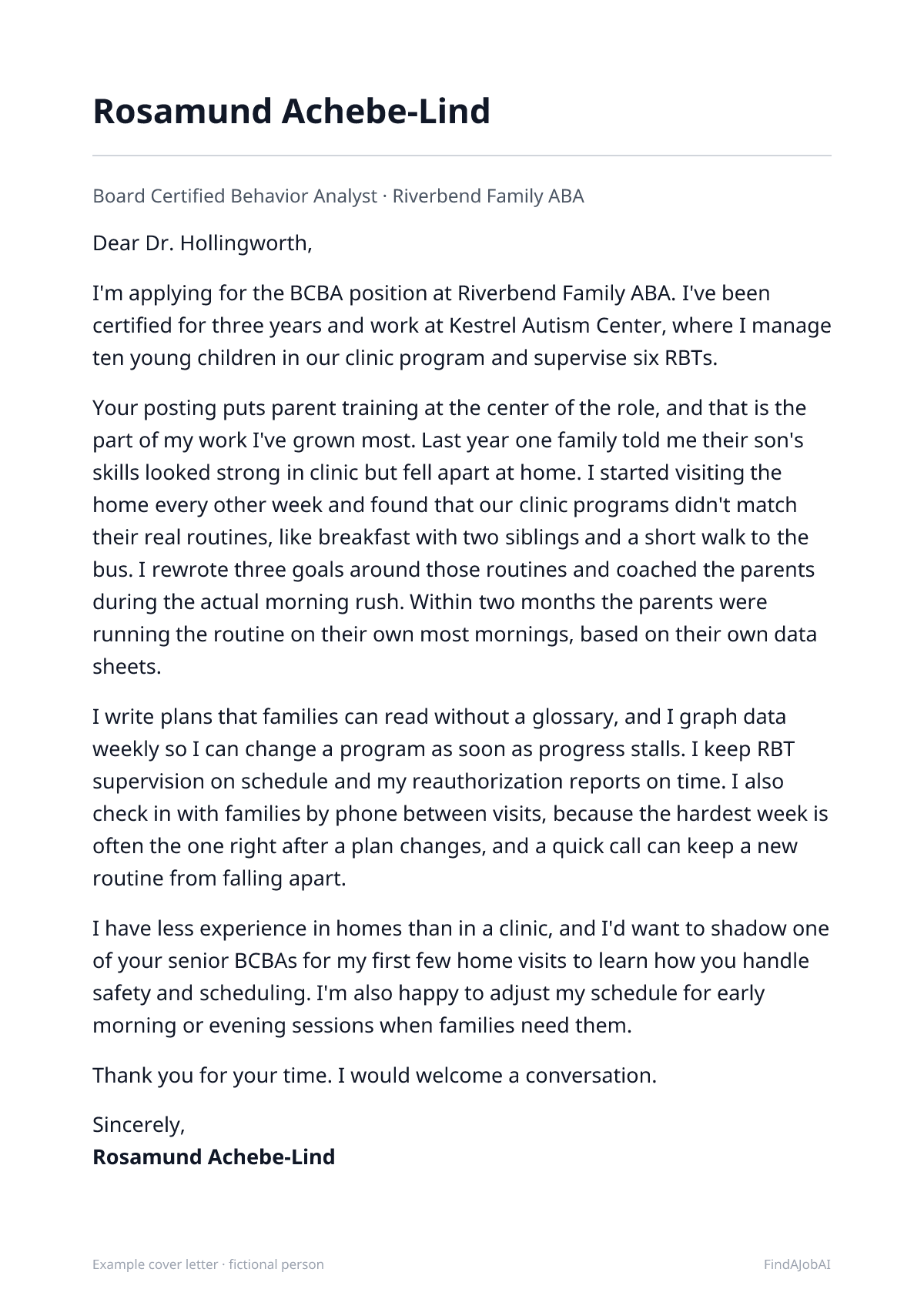
Behavior Analyst cover letter template
This letter as a one-page template: an opening that names the job and your strongest fact, proof that answers the ad, a reason for this employer and a short close.
After you sign up, FindAJobAI drafts your own letter for a real job from your CV in this format, and you edit it before you send it.
Example 1 · Experienced
Clinic BCBA applying to a home-based early intervention program
Rosamund has been a BCBA for three years in a center-based clinic. The ad is for home-based early intervention with heavy parent training.
Example letter · fictional
Dear Dr. Hollingworth,
I'm applying for the BCBA position at Riverbend Family ABA. I've been certified for three years and work at Kestrel Autism Center, where I manage ten young children in our clinic program and supervise six RBTs.
Your posting puts parent training at the center of the role, and that is the part of my work I've grown most. Last year one family told me their son's skills looked strong in clinic but fell apart at home. I started visiting the home every other week and found that our clinic programs didn't match their real routines, like breakfast with two siblings and a short walk to the bus. I rewrote three goals around those routines and coached the parents during the actual morning rush. Within two months the parents were running the routine on their own most mornings, based on their own data sheets.
I write plans that families can read without a glossary, and I graph data weekly so I can change a program as soon as progress stalls. I keep RBT supervision on schedule and my reauthorization reports on time. I also check in with families by phone between visits, because the hardest week is often the one right after a plan changes, and a quick call can keep a new routine from falling apart.
I have less experience in homes than in a clinic, and I'd want to shadow one of your senior BCBAs for my first few home visits to learn how you handle safety and scheduling. I'm also happy to adjust my schedule for early morning or evening sessions when families need them.
Thank you for your time. I would welcome a conversation.
Sincerely,
Rosamund Achebe-Lind
Example 2 · Career changer
Special education teacher moving into a first BCBA role
Everett taught special education for seven years and just earned his BCBA. The ad is for a school-based behavior analyst in a district.
Example letter · fictional
Dear Ms. Ostrowska,
I'm applying for the School Behavior Analyst position at Millbrook Unified. I taught special education for seven years at Larkspur Middle School, and I passed the BCBA exam this fall after completing my master's degree and supervised fieldwork while teaching.
In my classroom I saw how often behavior plans were written once and never used. In my fourth year I had a student whose outbursts were cutting into every math lesson. With our district BCBA, I collected simple data for two weeks and saw the outbursts happened mostly when written work started. We added a short break request card and broke assignments into smaller parts. By the end of the semester his outbursts in math were rare, and he finished most assignments. The plan worked because it fit the class routine, and the teacher next door asked to use the same card for her students.
That experience is why I pursued certification. My fieldwork included four FBAs and behavior plans for students in two schools, and training paraprofessionals to collect data during class without stopping instruction. I also wrote progress summaries for IEP meetings that parents could follow, with simple graphs and a short note on what we would try next.
I know classrooms, IEP meetings and the pressure teachers are under, and I can write plans that fit a real school day. I'm new as a certified BCBA and would value regular case review with your senior analyst during my first year. I can also present short trainings at staff meetings.
Thank you for considering my application.
Best regards,
Everett Calloway
Example 3 · Senior or lead
Lead BCBA applying to become clinical director at a growing ABA provider
Genevieve has been a lead BCBA over five analysts for three years. The ad is for a clinical director across two new clinics.
Example letter · fictional
Dear Mr. Quarshie,
I'm applying for the Clinical Director role at Northstar Behavioral Health. I've been a BCBA for nine years and have been lead BCBA at Cedar Grove ABA for the last three, overseeing five analysts and about forty RBTs in one clinic.
When I took the lead role, plan quality varied widely between analysts, and some plans had no replacement behaviors or clear mastery criteria. I built a short audit checklist and started reviewing two plans per analyst each quarter, with feedback in one-on-one meetings rather than by email. Over eighteen months our audit scores rose steadily, and payer audits that used to send plans back for missing items now pass on the first review.
I also started a mentoring plan for new BCBAs, with weekly case review in their first six months, and supervise fieldwork for three candidates a year. I keep a close eye on caseloads so no analyst carries more than they can supervise well. When a new analyst is struggling, I sit in on a session rather than reviewing paperwork alone, because the problem is often in how the plan is delivered, not how it is written.
Your posting mentions opening two clinics. I've helped open one, not two at once, and I'd want to learn how your operations team handles hiring and intake before setting clinical timelines. I would also want to meet each clinic's first BCBAs early, so they help shape the standards rather than receive them.
I'd welcome the chance to talk about the clinical standards you want both clinics to share.
Sincerely,
Genevieve Paskowitz
All three letters, and the short version below, are fictional: the people, employers and numbers are invented. Borrow the structure, never the facts.
- Prefer to write it yourself? Use the free cover letter template.
- Check your CV against the job first: the free CV score shows the missing keywords.
Why the first letter works, paragraph by paragraph
Paragraph 1: Opening
States certification length, setting, caseload and supervision count, the facts a clinical director checks first.
Paragraph 2: The case
Shows real clinical reasoning: she noticed skills didn't transfer, found the cause in the family's routine, and measured the change with parent data.
Paragraph 3: Her working habits
Covers plan writing, weekly data review, supervision and reports in a few lines, which signals a reliable clinician.
Paragraph 4: Naming the home-visit gap
Admits less home experience and proposes a way to learn it, which reads as safe judgment.
Paragraph 5: Close
Short and polite after the case does the persuading.
What the career changer's letter does differently
The career changer's letter turns teaching into behavior analysis evidence: a data-driven classroom plan, fieldwork FBAs and training paraprofessionals. It asks for case review support as a new BCBA instead of overstating readiness.
What the senior letter does differently
A clinical director letter focuses on quality across a team: an audit process, better plans and a mentoring structure. It names a real gap, opening two clinics at once, and says how she would approach it.
Short behavior analyst cover letter: an email-ready version
Many applications arrive as an email or a small text box, and a full page doesn't fit. This version runs 120 to 150 words and keeps only what a reader needs to decide whether to reply. A BCBA emails a clinic owner after a referral from a former colleague, answering the job board post's request for a short note and availability.
Short version · email · fictional130 words
Subject: BCBA application – early intervention, referred by a former colleague – Maximilian Okafor-Brandt
Hello Ms. Ravensworth,
I'm applying for the BCBA position at Brightpath Learning Clinic. I've been certified for two years and manage eight children in an early intervention clinic, supervising five RBTs. Most of my clients are between two and five, and I run parent training every other week.
Recently, graphs showed one child's requesting skills had stalled for a month. I ran a new preference assessment, found the reinforcers we were using had lost value, and updated them. Progress picked up within two weeks. I now run quick preference checks at the start of each session.
I'm licensed in the state, can start in four weeks, and would be glad to talk. My resume is attached. A former colleague, now on your team, suggested I reach out.
Best,
Maximilian Okafor-Brandt
The short version keeps one data-driven case and the key facts: certification length, caseload, supervision and start date.
Opening lines that work for behavior analyst cover letters
The first sentence decides whether the second gets read. Here are six openings, one for each situation you might be in. Pick the one that matches yours and swap in your own facts: every name and number below is invented.
1. You have a standout result
When a family told me skills from clinic weren't showing up at home, I rebuilt goals around their real morning routine, and I'd like to bring that approach to your home program.
2. The ad names a problem you've solved
After seven years teaching special education, I earned my BCBA so I could write behavior plans that teachers actually use.
3. Someone referred you
As lead BCBA, I built a plan-audit process that helped our plans pass payer reviews on the first try.
4. You admire what they build
Your clinical director, Dr. Imogen Faulkner, suggested I apply after we worked together on a regional training day.
5. You're new to the field or switching into it
I supervise six RBTs and manage ten young learners, and I graph every program weekly so no goal stalls for long.
6. You have senior scope or a specialism
I've been an RBT for four years and earned my BCBA this year, and I'd like to start my first caseload with a team that values supervision.
How to write a behavior analyst cover letter
Five steps, in the order you'd write them. The shape stays the same for every job (a short opening, proof, a reason for this employer, a close), and what goes into each part is what changes with the role.
Lead with certification, license and population
Put BCBA status, your state license and the population and settings you serve in the first lines. Clinical directors filter on these first, and it shows right away whether your experience matches their program. Keep it to one or two short sentences.
Describe one case where the data changed your plan
Pick a case where progress stalled or behavior got worse, explain what the data showed and what you changed. Keep it anonymous. This shows clinical reasoning better than any list of methods or assessment names.
Show how you train others
Mention RBT supervision, parent training or teacher coaching with a number and a result. Much of a behavior analyst's impact happens through other people, so employers look closely at this part. One clear example is enough.
Mention documentation and compliance
Say how you keep reports, supervision and authorizations on time. Clinics depend on this to keep services running, and a short line about it reassures a director that you can manage a caseload responsibly. Give one concrete habit, such as a weekly report check.
Name a gap and how you would close it
If the role includes a new setting or population, say so plainly and suggest how you would learn it, such as shadowing or case review. Honest judgment matters in a field where safety and ethics come first.
Behavior Analyst cover letter do's and don'ts
Do
- State certification, license and the population you serve in the first lines.
- Describe one case where data led you to change the plan, with all details anonymous.
- Show how you train families, teachers or RBTs, since that is much of the job.
Don't
- Don't share names, ages with diagnoses or any detail that could identify a client.
- Don't fill the letter with jargon parents and HR staff won't follow.
- Don't promise specific outcomes for future clients.
Common behavior analyst cover letter mistakes
Each one is easy to make and quick to fix before you send the letter.
Including identifying client information
Remove names, initials, exact ages and rare details. Describe the situation and the data in general terms.
Writing only in technical jargon
Hiring managers and HR staff may not be analysts. Explain methods in plain words and keep acronyms to the common ones.
Listing assessments without results
Pair any assessment or method with what changed for the client or family.
Ignoring families and caregivers
Parent and caregiver training is central to most roles. Show how you coach families.
Promising outcomes
Avoid saying you will achieve specific results with future clients. Describe your process and past data instead.
Email subject lines for behavior analyst applications
Applying by email? Put the job title, any reference number and your name in the subject line.
- BCBA application – early intervention, parent training – Rosamund Achebe-Lind
- School Behavior Analyst application – former special education teacher, new BCBA – Everett Calloway
- Application: Lead BCBA, Adolescent Program (Req. 4418) – Rosamund Achebe-Lind
Everything for Behavior Analysts
- Behavior Analyst resume exampleA full resume, plus bullet and summary examples
- Behavior Analyst interview questions30 questions with sample answers
- Behavior Analyst job descriptionDuties, skills and requirements
- Career change cover letter: template + examples
Other cover letter examples
Behavior Analyst cover letter FAQ
What should a behavior analyst cover letter include?
Your certification and license, population and settings, caseload and supervision load, one anonymous case where data changed your approach, and how you work with families or teachers.
How do I write a BCBA cover letter as a new certificant?
Lead with your certification and fieldwork, then describe assessments and plans you completed under supervision. Related work as an RBT or teacher counts if you describe what you actually did.
Can I mention client cases in a cover letter?
Yes, if you remove anything identifying. Describe the problem, what the data showed and what changed, without names, initials, exact ages or rare details.
How we built this page
The FindAJobAI team wrote the three example letters, the short email version, the opening lines and the advice for behavior analyst roles. The people, employers and numbers in the letters are invented; the structure, the kind of evidence and the order of the paragraphs are the parts to copy.
Once we track enough live behavior analyst job ads, this page also shows the skills they ask for most, counted the same way as our in-demand skills report.
Last reviewed on November 1, 2026.