Cost Estimator Cover Letter Example (2026)
By FindAJobAI team Updated How we built this page
Cost estimator ads all ask for takeoff software and a bid-win rate, so most letters read the same. Yours stands out when it names one bid you built, the number you landed on, and whether the job was won or lost because of it.
Cost Estimator cover letter template
This letter as a one-page template: an opening that names the job and your strongest fact, proof that answers the ad, a reason for this employer and a short close.
After you sign up, FindAJobAI drafts your own letter for a real job from your CV in this format, and you edit it before you send it.
Example 1 · Experienced
Commercial estimator applying to a general contractor
Devon estimates mid-size commercial jobs at a GC. The ad wants someone who can run subcontractor bid leveling without supervision.
Example letter · fictional
Dear Mr. Okonkwo,
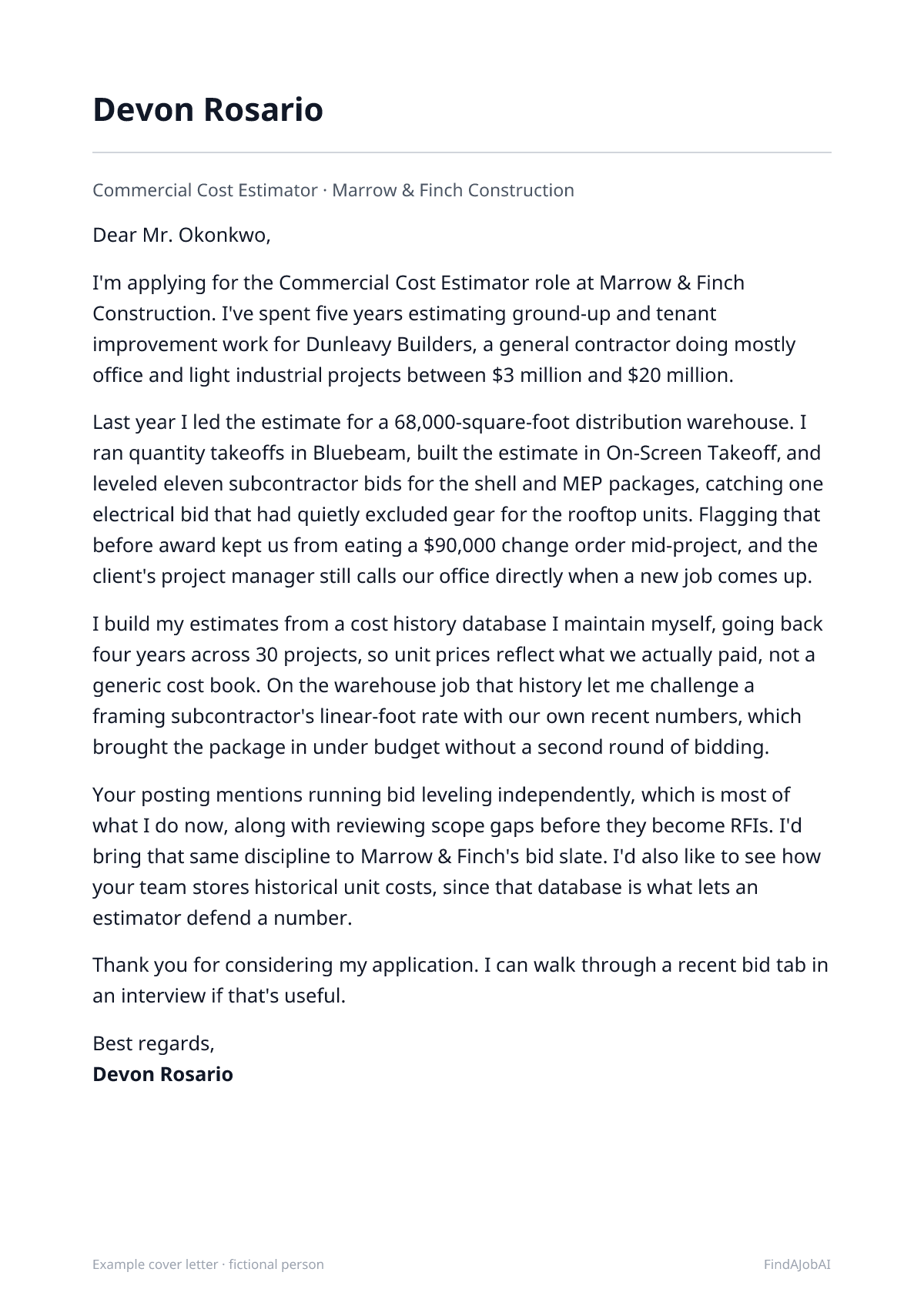
I'm applying for the Commercial Cost Estimator role at Marrow & Finch Construction. I've spent five years estimating ground-up and tenant improvement work for Dunleavy Builders, a general contractor doing mostly office and light industrial projects between $3 million and $20 million.
Last year I led the estimate for a 68,000-square-foot distribution warehouse. I ran quantity takeoffs in Bluebeam, built the estimate in On-Screen Takeoff, and leveled eleven subcontractor bids for the shell and MEP packages, catching one electrical bid that had quietly excluded gear for the rooftop units. Flagging that before award kept us from eating a $90,000 change order mid-project, and the client's project manager still calls our office directly when a new job comes up.
I build my estimates from a cost history database I maintain myself, going back four years across 30 projects, so unit prices reflect what we actually paid, not a generic cost book. On the warehouse job that history let me challenge a framing subcontractor's linear-foot rate with our own recent numbers, which brought the package in under budget without a second round of bidding.
Your posting mentions running bid leveling independently, which is most of what I do now, along with reviewing scope gaps before they become RFIs. I'd bring that same discipline to Marrow & Finch's bid slate. I'd also like to see how your team stores historical unit costs, since that database is what lets an estimator defend a number.
Thank you for considering my application. I can walk through a recent bid tab in an interview if that's useful.
Best regards,
Devon Rosario
Example 2 · Career changer
Field superintendent assistant moving into estimating
Priyanka tracked costs on-site for two years and wants an entry-level estimator seat. The ad mentions reading architectural drawings.
Example letter · fictional
Dear Hiring Manager,
I'm applying for the Assistant Cost Estimator role at Alderbrook Contracting. For two years I've worked as a field assistant to a superintendent at Garrity Build, tracking daily costs and material deliveries on a mixed-use retail job, and I'd like to move from tracking costs on-site to building the estimates before ground is broken.
On that job I noticed our drywall material orders kept running short of what the plans called for, so I built my own takeoff from the architectural set in Bluebeam to check it against the supplier's count. I found the supplier's quantity was off by about 12%, which the superintendent used to renegotiate the next order before it caused a delay. That was the first time I'd read drawings closely enough to price something myself, and I wanted more of it.
Since then I've completed a construction estimating certificate through a community college program and practiced takeoffs on three public plan sets, including a school addition and a strip mall renovation, using both manual measurement and On-Screen Takeoff. I'm comfortable reading structural, mechanical and electrical drawings well enough to flag scope, though I still check unit pricing against published cost data rather than memory.
Your posting asks for someone who can read architectural drawings accurately, which is the exact skill I built catching that drywall shortfall. I'd bring a field perspective to estimates that an office-only background doesn't always have.
Thank you for your time. I'd welcome the chance to walk through one of my practice takeoffs.
Sincerely,
Priyanka Venkatesan
Example 3 · Senior or lead
Chief estimator applying to build an estimating department
Oskar leads a team of five estimators at a mid-size GC. The ad is for a first chief estimator who will standardize bid procedures.
Example letter · fictional
Dear Ms. Farrugia,
I'm applying for the Chief Estimator role at Thistlewood Builders. For four years I've led a team of five estimators at Corrigan Construction, overseeing bids from $1 million tenant fit-outs to a $40 million medical office building, and before that I estimated solo for six years.
Your ad notes that bids go out with inconsistent markup and that two estimators recently priced the same scope differently on a change order. We had the same gap at Corrigan. I wrote a standard markup matrix by project type and risk, built a shared assembly library in our estimating software so unit prices stop drifting between estimators, and required a second-set review on any bid over $5 million. Estimate turnaround time dropped by roughly a third, and we haven't had a repeat of two estimators landing on different numbers for the same scope since.
Estimating earns its keep on the bids that almost go wrong. On the medical office building, my team's takeoff flagged that the mechanical drawings and the specifications disagreed on chiller capacity; we got the discrepancy resolved with the architect before bid day instead of absorbing it as a change order, which would have cost the project close to $280,000. That catch is now part of how we train new estimators to cross-check drawings against specs.
I've hired and mentored three estimators and built our current training path from scratch. I haven't yet set up a formal preconstruction group that works alongside estimating from the earliest design phase, and at Thistlewood I'd want to build that structure with your preconstruction lead rather than assume how it should work.
I'd welcome a conversation about which bid types give Thistlewood the most trouble right now, and how estimators currently get project information before pricing starts.
Sincerely,
Oskar Lindqvist
All three letters, and the short version below, are fictional: the people, employers and numbers are invented. Borrow the structure, never the facts.
- Prefer to write it yourself? Use the free cover letter template.
- Check your CV against the job first: the free CV score shows the missing keywords.
Why the first letter works, paragraph by paragraph
Paragraph 1: Opening
Names the project types and dollar range the writer estimates, which tells the reader the scale of work he's used to before any story starts.
Paragraph 2: The bid that caught a costly gap
A specific project, the tools used, the exact exclusion found, and the dollar amount it would have cost. Catching an error before award is what separates an estimator from a quantity taker.
Paragraph 3: A maintained cost history
Shows the writer's pricing isn't borrowed from a book; it's built from his own project data, and gives a second concrete example of it changing a number.
Paragraph 4: Why this company
Mirrors the ad's specific ask, independent bid leveling, and names the related skill (scope review) the writer already practices.
Paragraph 5: Close
Offers to walk through a real bid tab, a low-cost way for the reader to verify the writer's process in an interview.
What the career changer's letter does differently
The career changer's letter starts from a field problem solved by building her own takeoff (catching a 12% material shortfall) before she had the title. A certificate and practice takeoffs on real plan sets show the skill is now deliberate, and the letter ties her field background directly to the ad's drawing-reading requirement.
What the senior letter does differently
A chief estimator letter reports on an organization's habits, not a single bid: a markup matrix, a shared assembly library, a turnaround time cut by roughly a third. The drawing-versus-spec catch shows the writer's standards preventing a costly error, and the gap, a formal preconstruction group, is named rather than glossed over.
Short cost estimator cover letter: an email-ready version
Many applications arrive as an email or a small text box, and a full page doesn't fit. This version runs 120 to 150 words and keeps only what a reader needs to decide whether to reply. A cost estimator answers a utility contractor's short online application field, sent by email because the portal rejected file attachments over 5MB.
Short version · email · fictional130 words
Subject: Cost Estimator (heavy civil, HCSS) – pipeline bids – Henrique Salgado
Hello Mr. Abernathy,
I'm applying for the Cost Estimator role at Greybourne Utilities. I have four years estimating heavy civil and pipeline work in HCSS HeavyBid, most recently at a contractor specializing in water main replacement.
My strongest example is a 4-mile pipeline bid where I caught a quantity discrepancy between the bid schedule and the plan set: the schedule listed 1,400 linear feet less trenching than the drawings showed. Flagging it before submission kept us from underbidding by roughly $310,000.
Pipeline and utility work is where I want to keep estimating. My resume is attached, and I can send a redacted bid tab from that project on request. I'm also free for a call or a video walk-through of the takeoff at any time this week.
Best,
Henrique Salgado
A short field forces one example, so the email keeps the pipeline quantity catch and its dollar figure, in the exact specialty (pipeline, heavy civil) the employer works in. Offering a redacted bid tab signals rigor without disclosing a current employer's numbers.
Opening lines that work for cost estimator cover letters
The first sentence decides whether the second gets read. Here are six openings, one for each situation you might be in. Pick the one that matches yours and swap in your own facts: every name and number below is invented.
1. You have a standout result
On a recent pipeline bid I caught a 1,400-linear-foot gap between the schedule and the plan set before submission, which kept us from underbidding by roughly $310,000. I'd like to bring that same cross-checking to your bid slate.
2. The ad names a problem you've solved
Your ad mentions bids going out with inconsistent markup. At my current company I built a markup matrix by project type that ended that inconsistency, and I'd like to help Thistlewood do the same.
3. Someone referred you
Your project executive, Ingrid Vossberg, and I worked opposite each other on a joint-venture bid last spring. She mentioned your estimating team is adding headroom, which is why I'm writing.
4. You admire what they build
I've driven past the Castellan Bridge rebuild for two years and finally looked up who estimated it; the trade sequencing on that bid is the kind of problem I'd like to help price.
5. You're new to the field or switching into it
I spent two years tracking costs in the field before teaching myself to read drawings well enough to catch a supplier's quantity error. Estimating is where I want to keep solving problems like that.
6. You have senior scope or a specialism
As the estimator who built our company's current assembly library and training path, I'm looking for a role where I set up that structure for a team from its earliest stage.
How to write a cost estimator cover letter
Five steps, in the order you'd write them. The shape stays the same for every job (a short opening, proof, a reason for this employer, a close), and what goes into each part is what changes with the role.
Open with the project type and scale you estimate
State the kind of work (commercial, heavy civil, residential, utility) and the typical dollar range of the bids you've built. Estimating skill doesn't transfer evenly across project types, so this tells the reader immediately whether your experience fits their work.
Lead with a bid that caught a costly gap
Describe one estimate where your takeoff or bid leveling found a missing scope item, a quantity error, or a drawing-versus-spec conflict, and name the dollar amount it would have cost if missed. This is the single clearest signal of estimating skill a letter can give.
Mention your software within the narrative
Work Bluebeam, On-Screen Takeoff, PlanSwift or HCSS HeavyBid into the bid you're describing, not as a standalone list. Mention the project's rough size or trade count so the software reference carries real weight instead of reading as a keyword match.
Show how you build or check pricing
Mention whether you maintain your own cost history, challenge subcontractor rates against recent data, or cross-check drawings against specifications. This separates an estimator who prices from memory or a cost book from one who verifies numbers against real project data.
Close on fit, not enthusiasm
Tie the ad's specific ask, independent bid leveling, drawing review, or markup standardization, to something you already do, then offer a concrete next step such as walking through a redacted bid tab. Skip general lines about loving construction or numbers.
Cost Estimator cover letter do's and don'ts
Do
- Name the project type, size and dollar range you estimate; estimators are judged by the scale of work they've handled.
- Describe one bid where your takeoff or leveling caught an error, gap or exclusion, and what it would have cost.
- Mention the takeoff software the ad names (Bluebeam, On-Screen Takeoff, PlanSwift) attached to a real project.
Don't
- Don't claim a personal "bid-win rate"; wins depend on many people and factors beyond the estimate.
- Don't list every trade you've priced; pick the one scope area where you caught something others missed.
- Don't share your current employer's actual bid numbers; round or describe the gap as a percentage instead.
Common cost estimator cover letter mistakes
Each one is easy to make and quick to fix before you send the letter.
Claiming a personal win rate
A bid's outcome depends on price, schedule, relationships and timing, not the estimate alone. Describe the accuracy or thoroughness of your takeoff instead, and let the reader judge the rest.
Listing every trade ever priced
A paragraph naming concrete, steel, electrical, mechanical and finishes work suggests shallow familiarity with all of them. Pick the one scope area where you caught a real error and go deep on that instead.
Giving a dollar figure with no context
"Saved $300,000 on a bid" means little without the project size, what caused the gap, and how it was caught. State the project scale and the specific error or omission so the number can be understood.
Treating the estimate as the whole job
A letter that only describes takeoffs ignores leveling, scope review and working with project managers and subcontractors. Mention at least one example of coordinating with people, not just software.
Disclosing a current employer's live bid numbers
Sharing exact prices from an active bid can breach confidentiality and create legal exposure. Round figures, describe gaps as a share of the total, or offer a redacted document instead.
Email subject lines for cost estimator applications
Applying by email? Put the job title, any reference number and your name in the subject line.
- Commercial Cost Estimator application – bid leveling and takeoffs – Devon Rosario
- Assistant Cost Estimator – field background with estimating certificate – Priyanka Venkatesan
- Application: Cost Estimator, Heavy Civil Division (Req. 4417) – Devon Rosario
Everything for Cost Estimators
- Cost Estimator resume exampleA full resume, plus bullet and summary examples
- Cost Estimator interview questions30 questions with sample answers
- Cost Estimator job descriptionDuties, skills and requirements
- Career change cover letter: template + examples
Other cover letter examples
Cost Estimator cover letter FAQ
What should I write in a cost estimator cover letter?
One bid where your takeoff or bid leveling caught an error, gap or savings, told with the dollar figure it affected. Add the software you used and the project type and size. Your certifications belong on the resume, not repeated here.
How do I write a cost estimator cover letter with no experience?
Use a field or office role where you tracked costs, materials or quantities, then describe a practice takeoff on a real plan set with the software the ad names. Name a specific gap or error your takeoff caught, even in practice work.
Should I mention a specific estimating software in my cover letter?
Yes, but only inside a story about a real bid or takeoff. Naming Bluebeam or On-Screen Takeoff without a project attached reads like a checklist the reader has seen a hundred times.
How we built this page
The FindAJobAI team wrote the three example letters, the short email version, the opening lines and the advice for cost estimator roles. The people, employers and numbers in the letters are invented; the structure, the kind of evidence and the order of the paragraphs are the parts to copy.
Once we track enough live cost estimator job ads, this page also shows the skills they ask for most, counted the same way as our in-demand skills report.
Last reviewed on November 1, 2026.