Credit Analyst Cover Letter Example (2026)
By FindAJobAI team Updated How we built this page
Credit analyst ads ask for spreading financial statements, writing up risk, and knowing a few covenant ratios, and most applicants can claim all three. The cover letter earns its place by naming one deal or one borrower where your write-up changed a decision, and being honest about what you'd still need to learn in a bigger portfolio.
Credit Analyst cover letter template
This letter as a one-page template: an opening that names the job and your strongest fact, proof that answers the ad, a reason for this employer and a short close.
After you sign up, FindAJobAI drafts your own letter for a real job from your CV in this format, and you edit it before you send it.
Example 1 · Experienced
Commercial credit analyst applying to a regional bank
Desmond spreads statements and writes credit memos for small business loans. The ad asks for covenant tracking and C&I lending.
Example letter · fictional
Dear Ms. Tran,
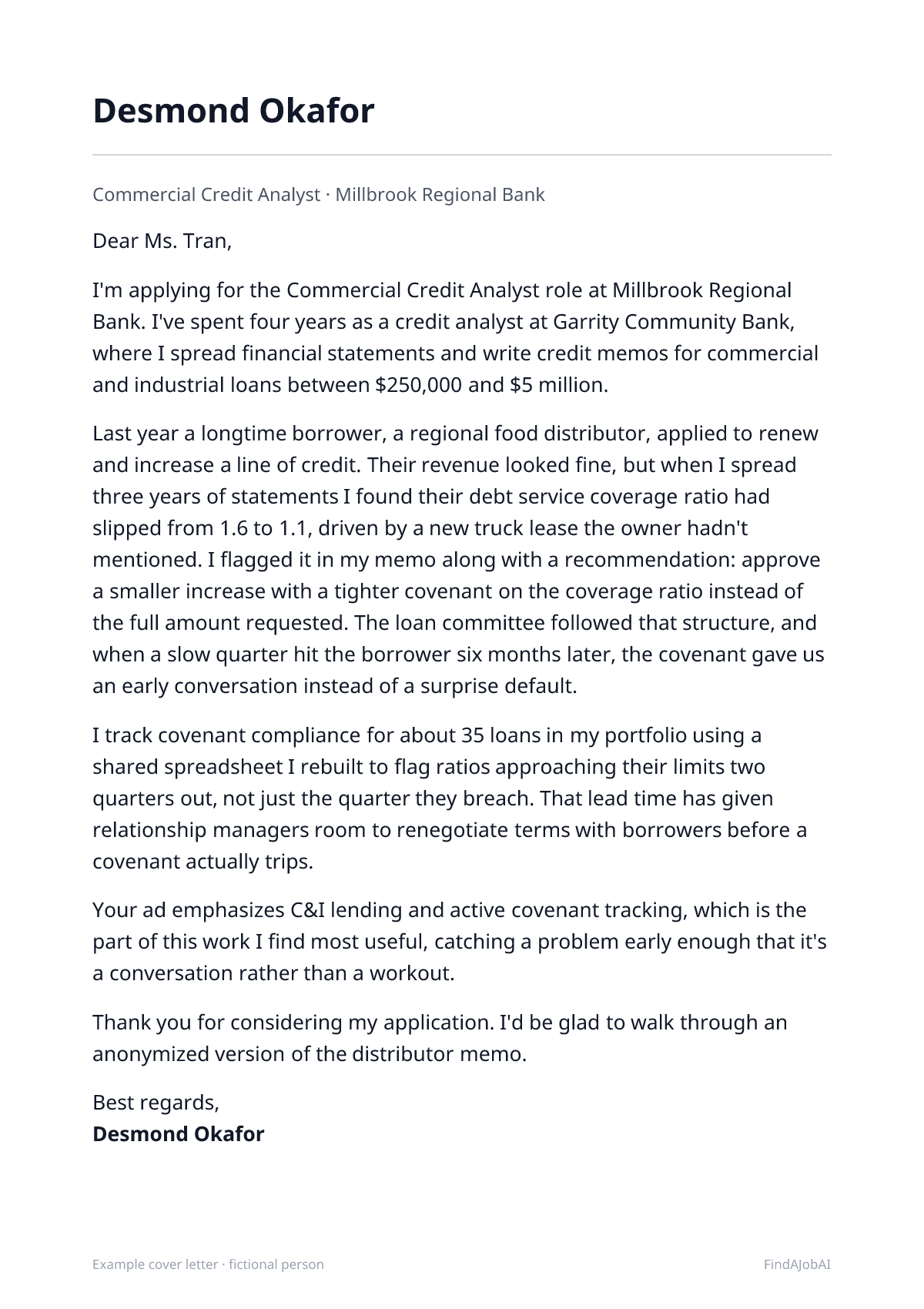
I'm applying for the Commercial Credit Analyst role at Millbrook Regional Bank. I've spent four years as a credit analyst at Garrity Community Bank, where I spread financial statements and write credit memos for commercial and industrial loans between $250,000 and $5 million.
Last year a longtime borrower, a regional food distributor, applied to renew and increase a line of credit. Their revenue looked fine, but when I spread three years of statements I found their debt service coverage ratio had slipped from 1.6 to 1.1, driven by a new truck lease the owner hadn't mentioned. I flagged it in my memo along with a recommendation: approve a smaller increase with a tighter covenant on the coverage ratio instead of the full amount requested. The loan committee followed that structure, and when a slow quarter hit the borrower six months later, the covenant gave us an early conversation instead of a surprise default.
I track covenant compliance for about 35 loans in my portfolio using a shared spreadsheet I rebuilt to flag ratios approaching their limits two quarters out, not just the quarter they breach. That lead time has given relationship managers room to renegotiate terms with borrowers before a covenant actually trips.
Your ad emphasizes C&I lending and active covenant tracking, which is the part of this work I find most useful, catching a problem early enough that it's a conversation rather than a workout.
Thank you for considering my application. I'd be glad to walk through an anonymized version of the distributor memo.
Best regards,
Desmond Okafor
Example 2 · Career changer
Bank teller and personal banker moving into credit analysis
Yara reviewed small consumer loan files as a personal banker and wants to move into formal credit analysis. The ad values attention to financial statements.
Example letter · fictional
Dear Hiring Manager,
I'm applying for the Credit Analyst role at Thistledown Savings Bank. I've worked as a personal banker for three years at a community bank branch, where I process consumer loan applications and have increasingly been the person branch staff ask to double-check a borrower's numbers before a file goes to underwriting.
Last year our underwriting team was short-staffed for two months, and I asked to help review straightforward auto and personal loan files under a senior underwriter's supervision. I caught a self-employed applicant's debt-to-income ratio that looked fine on the application but didn't hold up once I added a car loan missing from their credit report, which the applicant had forgotten to disclose. That file was restructured with a smaller loan amount before approval instead of being approved on an incomplete picture.
Since then I've completed a credit analysis certificate covering ratio analysis and basic statement spreading, and I practice spreading sample financial statements from public company filings on my own to get faster at it. I'm comfortable with Excel and have used Encompass for loan files, though I haven't yet worked with a commercial loan portfolio.
Your posting values attention to financial statements over speed, which matches how I already work at the branch, I'd rather flag something that needs a second look than clear a file quickly and be wrong.
Thank you for your time. I'd welcome the chance to discuss how my branch experience would translate to a formal analyst role.
Kind regards,
Yara Benali
Example 3 · Senior or lead
Credit risk manager applying to build a small portfolio review function
Petronella manages five credit analysts at a mid-size bank. The ad is for a manager to set standards and review concentration risk.
Example letter · fictional
Dear Mr. Delacroix,
I'm applying for the Credit Risk Manager role at Ashgrove Mutual Bank. I've managed a team of five credit analysts at Farrowgate Trust for three years, and before that spent six years as a senior analyst covering commercial and industrial loans. I'd like to take on portfolio-level risk at a bank your size.
Your ad mentions concentration risk as a growing concern, which was the exact problem I inherited. Our commercial portfolio had grown heavily into one regional trucking sector without anyone tracking it as a single exposure. I built a quarterly concentration report grouping loans by industry and geography, which showed that sector made up close to a third of our commercial book. We set a soft cap on new trucking-sector originations and diversified new lending into two other sectors over the following year, and when a regional freight downturn hit, our losses there were contained to a handful of accounts instead of spreading across the book.
I also rebuilt our credit memo template so junior analysts document the same risk factors in the same order every time, which cut loan committee review time and made weak memos easier for me to catch before they reached committee. One analyst's memo missed a guarantor's declining personal financial statement; our new checklist step would have caught it, and now does for every file.
I haven't yet managed a team through a full write-off cycle in a serious downturn, and I've worked mostly with commercial real estate and C&I portfolios rather than the agricultural lending your bank also carries.
I'd welcome a conversation about your current concentration limits and how your analysts' memos are reviewed today.
Sincerely,
Petronella Wickersham
All three letters, and the short version below, are fictional: the people, employers and numbers are invented. Borrow the structure, never the facts.
- Prefer to write it yourself? Use the free cover letter template.
- Check your CV against the job first: the free CV score shows the missing keywords.
Why the first letter works, paragraph by paragraph
Paragraph 1: Opening
States the portfolio size and loan range the writer already handles, which tells a bank reader the scale of risk this person is used to evaluating.
Paragraph 2: The memo that changed a decision
A specific borrower, a ratio that moved (debt service coverage from 1.6 to 1.1), the hidden cause, and the structure the writer recommended, with the payoff named later rather than assumed.
Paragraph 3: Ongoing portfolio management
Shows the work continues after approval: covenant tracking across a real number of loans, with a specific improvement (earlier warning) that helps relationship managers, not just the analyst.
Paragraph 4: Why this bank
Mirrors the ad's own language (C&I lending, covenant tracking) and explains in the writer's own terms why that part of the job matters to them.
Paragraph 5: Close
Offers an anonymized memo, a concrete work sample that respects the confidentiality of an existing borrower relationship.
What the career changer's letter does differently
The personal banker's letter builds its credibility from one borrower file she caught during a short underwriting rotation, showing judgment before she had the title, then adds a certificate and self-directed practice to show the formal skills are developing too, without overstating experience she doesn't have.
What the senior letter does differently
The manager's letter reports portfolio-level patterns, not one borrower: a concentration problem sized and capped, losses contained during a sector downturn, a memo template that catches a specific kind of miss. It also names real gaps, a downturn cycle and agricultural lending, instead of implying full readiness.
Short credit analyst cover letter: an email-ready version
Many applications arrive as an email or a small text box, and a full page doesn't fit. This version runs 120 to 150 words and keeps only what a reader needs to decide whether to reply. A credit analyst answers a credit union's short application form after the posting asked candidates to apply by email with a brief note.
Short version · email · fictional131 words
Subject: Credit Analyst (C&I lending) – covenant monitoring – Idris Thackeray
Hello Ms. Nakamura,
I'm applying for the Credit Analyst role at Hollowmere Credit Union. I have four years of experience spreading financial statements and writing credit memos for commercial loans at a community bank, covering loans up to about $3 million.
My most useful catch was a borrower whose debt service coverage ratio had quietly slipped below 1.2 due to an undisclosed equipment lease. My memo recommended a tighter covenant instead of full approval, which gave us an early conversation months later instead of a surprise default.
I track covenant compliance across roughly 30 loans and like catching problems early enough that they're conversations, not workouts. My resume is attached, and I'm glad to discuss further. I can also share a sample covenant tracker with borrower names removed.
Best,
Idris Thackeray
The short version keeps the single strongest catch, one ratio, one hidden cause, one recommendation, and drops the portfolio-tracking detail to a single sentence, since a brief emailed note has room for one example instead of two.
Opening lines that work for credit analyst cover letters
The first sentence decides whether the second gets read. Here are six openings, one for each situation you might be in. Pick the one that matches yours and swap in your own facts: every name and number below is invented.
1. You have a standout result
One borrower's debt service coverage ratio had quietly slipped below 1.2 due to an undisclosed lease. My memo flagged it before approval, and the tighter covenant I recommended gave us an early conversation rather than a surprise default months later.
2. The ad names a problem you've solved
Your ad mentions concentration risk as a growing concern. I built a quarterly report that revealed one sector made up close to a third of our commercial book, and the soft cap we set afterward contained our losses when that sector slowed.
3. Someone referred you
Your relationship manager, Fenwick Ashdown, and I worked together on a borrower renewal last year, from the credit side. He mentioned your team needs an analyst who catches problems before committee, which is why I'm writing.
4. You admire what they build
I've banked with Hollowmere for six years and have watched your commercial lending grow into new sectors; I'd like to help build the covenant tracking that keeps that growth manageable.
5. You're new to the field or switching into it
I spent three years as a personal banker reviewing consumer loan files, where I caught an applicant's undisclosed car loan before approval. Credit analysis is the part of that work I want to do full time.
6. You have senior scope or a specialism
As the senior analyst on a five-person credit team for six years, I rebuilt the memo template the whole team still uses. I'm looking for a role where I bring that same structure to a new portfolio.
How to write a credit analyst cover letter
Five steps, in the order you'd write them. The shape stays the same for every job (a short opening, proof, a reason for this employer, a close), and what goes into each part is what changes with the role.
Find the loan type and portfolio the ad describes
Credit analyst ads differ by portfolio: commercial and industrial, real estate, consumer, or agricultural, and by loan size. Read for the specifics, then choose an example from your own experience closest to that portfolio, so the ratios and risks you describe match what the reader actually underwrites.
Open with the ratio or red flag, not the spreadsheet
State what you found, like a slipping coverage ratio or an undisclosed debt, in the first sentence or two. The statement spread or memo is how you found it, so mention the tool only after naming what it revealed; a reader who sees the finding first keeps reading.
Name the decision your memo led to
Say what you recommended, a smaller amount, a tighter covenant, a decline, and what the committee or underwriter actually did. If you can name the outcome later, like an early warning before a downturn, include it; it shows the recommendation held up.
Give your portfolio a size
A number, loans up to a certain amount, or a portfolio of a certain count, tells the reader the scale of risk you're used to judging. Round or approximate figures are fine; the point is giving the reader something to measure your experience against.
Be direct about what you haven't underwritten
If the ad's portfolio includes a loan type or sector you haven't worked with, such as agricultural lending or a downturn cycle, say so in one honest sentence rather than implying full coverage. Close by naming a question about their portfolio you'd want to understand first.
Credit Analyst cover letter do's and don'ts
Do
- Name one borrower or deal, the ratio or red flag you found, and the decision your write-up led to.
- Mention the specific ratios the ad asks about (debt service coverage, leverage, current ratio) inside a real example.
- Say how many loans or what size portfolio you track; a number gives the reader scale to judge your experience by.
Don't
- Don't claim you 'approved' loans if you recommend and a committee or underwriter decides; say what your memo led to instead.
- Don't use a real borrower's name or identifying details; anonymize the company and round the numbers.
- Don't list every ratio you know; show the one or two that mattered in your example and let your resume hold the rest.
Common credit analyst cover letter mistakes
Each one is easy to make and quick to fix before you send the letter.
Claiming you approved loans you only recommended
Analysts write memos; committees or underwriters decide. Say what your memo recommended and what the committee did, which is accurate and still shows your judgment drove the outcome.
Naming a real borrower or employer's exact figures
Specific company names or exact loan balances can breach confidentiality. Anonymize the borrower, round the dollar amounts, and offer to share more detail with identifying information removed.
Listing every ratio you know
Debt service coverage, leverage, current ratio, quick ratio, named in a row, reads like a textbook glossary. Use the one or two ratios that mattered in your actual example and let the rest sit on your resume.
Skipping what happened after the recommendation
Finding a red flag is only half the story. Say what the committee decided and, if you know it, what happened to the loan later, since that's what shows your judgment was correct, not just cautious.
Describing speed instead of accuracy
Turning around files quickly isn't the differentiator this role needs. Emphasize what you caught by looking closely, since a fast review that misses a hidden liability costs more than a slower, correct one.
Email subject lines for credit analyst applications
Applying by email? Put the job title, any reference number and your name in the subject line.
- Commercial Credit Analyst application – C&I lending and covenant tracking – Desmond Okafor
- Credit Analyst – personal banker moving into underwriting support – Yara Benali
- Application: Credit Analyst, Commercial Lending (Req. 3041) – Desmond Okafor
Everything for Credit Analysts
- Credit Analyst resume exampleA full resume, plus bullet and summary examples
- Credit Analyst interview questions30 questions with sample answers
- Credit Analyst job descriptionDuties, skills and requirements
- Career change cover letter: template + examples
Other cover letter examples
Credit Analyst cover letter FAQ
What should I write in a credit analyst cover letter?
One borrower or deal: the ratio or risk you found while spreading statements, what you recommended, and what happened because of it. A sentence on how many loans or what portfolio size you manage gives the reader scale.
How do I write a credit analyst cover letter with no direct experience?
Use a loan or finance-adjacent role where you reviewed numbers or files, such as personal banking or bookkeeping, then name a specific catch or judgment call you made, plus any certificate or coursework in ratio analysis or statement spreading.
Should a credit analyst cover letter mention specific financial ratios?
Yes, but only inside an example. Naming debt service coverage or leverage ratios on their own proves you've heard of them; using one to explain a real finding proves you can apply them.
How we built this page
The FindAJobAI team wrote the three example letters, the short email version, the opening lines and the advice for credit analyst roles. The people, employers and numbers in the letters are invented; the structure, the kind of evidence and the order of the paragraphs are the parts to copy.
Once we track enough live credit analyst job ads, this page also shows the skills they ask for most, counted the same way as our in-demand skills report.
Last reviewed on November 1, 2026.