Risk Analyst Cover Letter Example (2026)
By FindAJobAI team Updated How we built this page
Risk analyst ads read like checklists: a modeling tool, a regulation, a reporting cadence. The letter earns its place by naming one risk you caught or sized, what you recommended, and what the business did about it, in plain language a committee could follow.
Risk Analyst cover letter template
This letter as a one-page template: an opening that names the job and your strongest fact, proof that answers the ad, a reason for this employer and a short close.
After you sign up, FindAJobAI drafts your own letter for a real job from your CV in this format, and you edit it before you send it.
Example 1 · Experienced
Credit risk analyst applying to a regional bank
Owen monitors a small-business loan book. The ad asks for portfolio monitoring and early-warning indicators.
Example letter · fictional
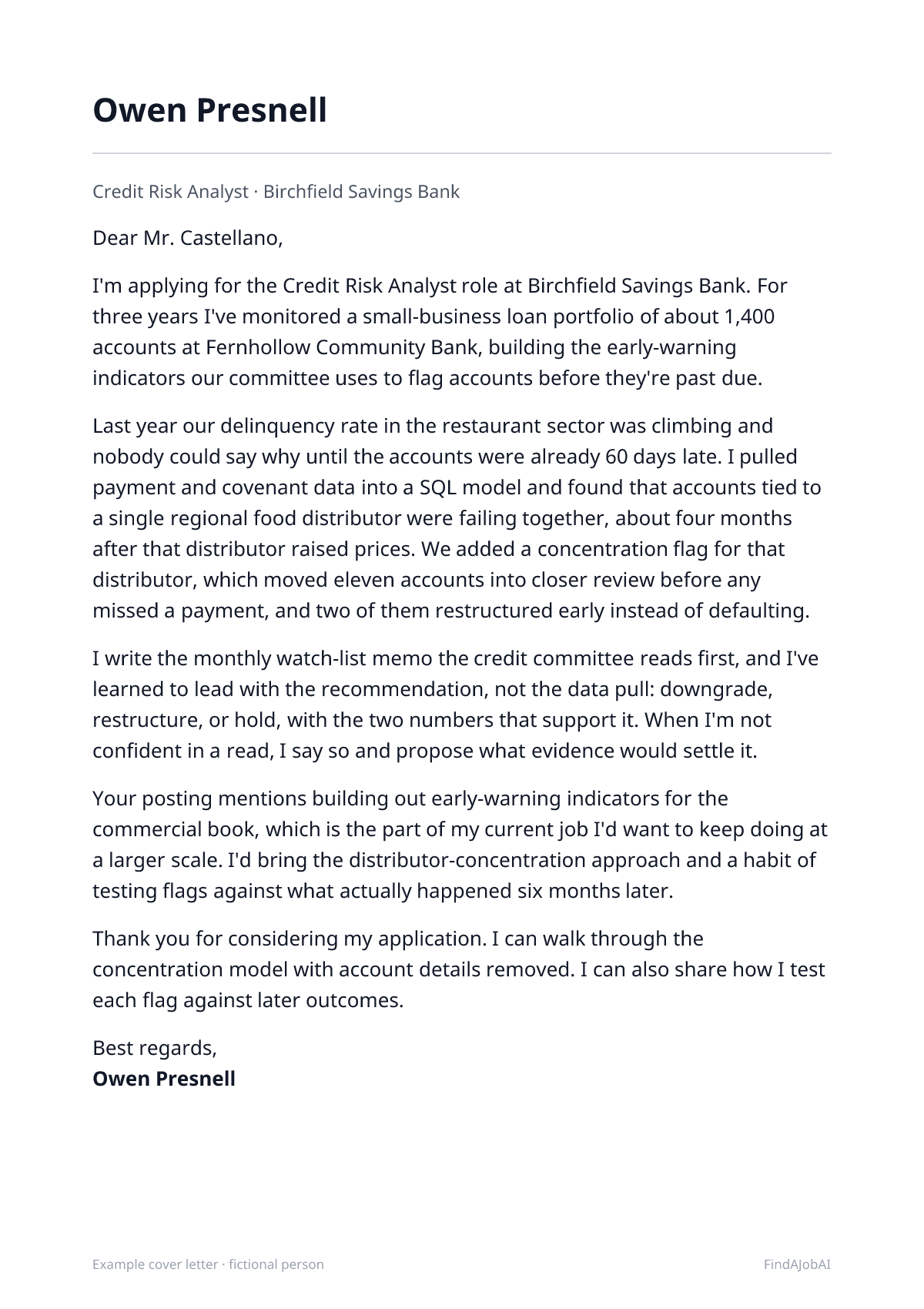
Dear Mr. Castellano,
I'm applying for the Credit Risk Analyst role at Birchfield Savings Bank. For three years I've monitored a small-business loan portfolio of about 1,400 accounts at Fernhollow Community Bank, building the early-warning indicators our committee uses to flag accounts before they're past due.
Last year our delinquency rate in the restaurant sector was climbing and nobody could say why until the accounts were already 60 days late. I pulled payment and covenant data into a SQL model and found that accounts tied to a single regional food distributor were failing together, about four months after that distributor raised prices. We added a concentration flag for that distributor, which moved eleven accounts into closer review before any missed a payment, and two of them restructured early instead of defaulting.
I write the monthly watch-list memo the credit committee reads first, and I've learned to lead with the recommendation, not the data pull: downgrade, restructure, or hold, with the two numbers that support it. When I'm not confident in a read, I say so and propose what evidence would settle it.
Your posting mentions building out early-warning indicators for the commercial book, which is the part of my current job I'd want to keep doing at a larger scale. I'd bring the distributor-concentration approach and a habit of testing flags against what actually happened six months later.
Thank you for considering my application. I can walk through the concentration model with account details removed. I can also share how I test each flag against later outcomes.
Best regards,
Owen Presnell
Example 2 · Career changer
Internal auditor moving into operational risk
Whitney found a control gap during an audit and wants to work in risk full time. The ad covers operational risk and control testing.
Example letter · fictional
Dear Hiring Manager,
I'm applying for the Operational Risk Analyst role at Castlemere Insurance Group. I've spent four years as an internal auditor at Thornbury Mutual, testing controls across claims and underwriting, and I'd like to move from reporting on risk after the fact to managing it as it happens.
During a claims audit last year, I traced a batch of duplicate payments to a control that only checked claim numbers, not payee bank accounts. I quantified the exposure at roughly 90,000 dollars over eighteen months, wrote the finding with a proposed control change, and worked with the claims team to add an account-matching step. A follow-up test six months later found zero duplicates in a sample that previously would have caught several.
That audit is why I want to work in risk directly: I'd rather help design the control than test it after the loss has already happened. I've since completed a course in operational risk frameworks and read Castlemere's public filings on claims risk, since that's the area closest to my audit background.
Your ad asks for control testing and loss-event tracking. I've done both as an auditor, and I'd bring a habit of quantifying exposure in dollars rather than describing it as a vague gap, so the business can weigh the fix against the cost.
Thank you for your time. I'd welcome the chance to discuss how an audit background translates into risk work. I can bring one redacted finding memo to show how I write up exposure and the proposed fix.
Kind regards,
Whitney Barrett
Example 3 · Senior or lead
Risk manager applying to build a first-line risk function
Desmond manages market risk for a trading desk. The ad is for a risk manager setting up first-line risk at a growing brokerage.
Example letter · fictional
Dear Ms. Vantongeren,
I'm applying for the Risk Manager role at Ashgrove Capital Partners. For five years I've managed market risk for a 200-million-dollar trading desk at Quillfeather Securities, setting position limits and running the stress tests the desk trades against daily.
Your ad says traders currently self-report limit breaches after the fact. I built the same kind of first-line function at Quillfeather: a real-time position feed against limits, an automatic flag at 80 percent of any limit, and a weekly report the desk head sees before Monday's open. In the first two quarters after launch, breaches caught before settlement rose from roughly a third to nearly all of them, and one flag avoided a loss we later estimated at 310,000 dollars when a position moved sharply against us overnight.
Risk limits only work if traders trust the number behind them. I spend time explaining how a limit is calculated, not just enforcing it, and I've had traders bring me positions to check before putting them on, which is the behavior change I think a first-line function should produce.
I haven't built a risk function from zero before, only expanded one, and I've never worked with a board risk committee directly, only supplied the numbers to one. At Ashgrove I'd expect to spend real time with your CRO on governance and reporting lines before touching models.
I'd like to talk through which limits matter most to your desk heads today and how breaches currently get escalated. I'd also like to hear how your desk heads feel about the limits they carry today.
Sincerely,
Desmond Okonkwo-Hale
All three letters, and the short version below, are fictional: the people, employers and numbers are invented. Borrow the structure, never the facts.
- Prefer to write it yourself? Use the free cover letter template.
- Check your CV against the job first: the free CV score shows the missing keywords.
Why the first letter works, paragraph by paragraph
Paragraph 1: Opening
Names the portfolio (small-business loans, about 1,400 accounts) and the specific deliverable, early-warning indicators, that the ad asks for.
Paragraph 2: The risk that was caught
A concrete pattern (concentration in one distributor), the method, and the outcome measured in accounts moved to review and restructured before default, not a vague claim of vigilance.
Paragraph 3: How findings reach the committee
Leading a memo with the recommendation before the data shows judgment under time pressure, which risk committees value over a long explanation.
Paragraph 4: Why this company
Matches the ad's specific ask (early-warning indicators for the commercial book) and names what the writer would bring at a larger scale.
Paragraph 5: Close
Offers to walk through the model with details removed, respecting the current employer's confidentiality while still proving the work is real.
What the career changer's letter does differently
The career changer's letter uses an audit finding as proof of risk judgment before the title changes: a control gap, a dollar exposure, and a fix verified by a later test. It names the course and filings read to close the gap, and reframes the audit background as an asset, catching control weaknesses, rather than apologizing for the career change.
What the senior letter does differently
The risk manager letter reports an organization's shift in behavior, from after-the-fact self-reporting to real-time flags, and gives one near-miss with a dollar figure attached. It states plainly what the writer hasn't done (building from zero, working with a board committee), which reads as more credible than a letter claiming full readiness.
Short risk analyst cover letter: an email-ready version
Many applications arrive as an email or a small text box, and a full page doesn't fit. This version runs 120 to 150 words and keeps only what a reader needs to decide whether to reply. A risk analyst answers a fintech lender's short 'why you' field, sent by email after a recruiter asked for a direct follow-up.
Short version · email · fictional130 words
Subject: Risk Analyst (credit, early-warning) – Saoirse Dunmore
Hello Mr. Abiodun,
I'm applying for the Risk Analyst role at Lanternback Lending. I have three years of credit risk experience at a regional lender, where I build the early-warning indicators our credit committee reviews each month.
My strongest result was a concentration flag that caught eleven at-risk small-business accounts tied to one supplier before any missed a payment; two restructured early instead of defaulting, which the committee credited with avoiding roughly 150,000 dollars in losses.
I'd like to apply that same approach to a consumer lending book, where the signals move faster. My resume is attached, and I can share the concentration model with account details removed. I'm happy to talk through how the signals would change for consumer borrowers and which ones I'd test first.
Best,
Saoirse Dunmore
The short version keeps exactly one result and its dollar figure, since a 'why you' field has no room for a second example. Naming the model offer at the end signals the writer has evidence, without turning the email into a case study.
Opening lines that work for risk analyst cover letters
The first sentence decides whether the second gets read. Here are six openings, one for each situation you might be in. Pick the one that matches yours and swap in your own facts: every name and number below is invented.
1. You have a standout result
A concentration flag I built last year caught eleven at-risk accounts before any missed a payment, avoiding an estimated 150,000 dollars in losses. I'd like to build similar indicators for your lending book.
2. The ad names a problem you've solved
Your ad says traders currently self-report limit breaches after they happen. I built a real-time flagging system at my current desk that catches nearly all breaches before settlement, and I'd like to bring that to your desk.
3. Someone referred you
Your credit committee chair, Fenwick Osei, mentioned you need someone who can turn a watch-list memo into a clear recommendation, not just a data dump, which is exactly what prompted this application.
4. You admire what they build
I've followed Ashgrove's growth in regional lending for a year, and the jump in loan volume made me curious how your risk function is scaling with it; I'd like to help answer that.
5. You're new to the field or switching into it
I spent four years as an internal auditor finding control gaps after losses occurred. I'd rather help design the control before the loss happens, which is why I'm moving into risk.
6. You have senior scope or a specialism
As the analyst who built our bank's current early-warning framework, I'm looking for a role where I can set that agenda for a larger, more complex portfolio.
How to write a risk analyst cover letter
Five steps, in the order you'd write them. The shape stays the same for every job (a short opening, proof, a reason for this employer, a close), and what goes into each part is what changes with the role.
Identify the risk type and portfolio in the ad
Risk analyst jobs split by type: credit, market, operational, or compliance, and by portfolio: consumer loans, a trading book, claims. Read the ad for both, then choose an example that matches, not your most impressive but mismatched project.
Open with the risk you caught, not the tool you used
State what could have gone wrong and how you found it before mentioning the model or spreadsheet behind it. A reader scanning a stack of letters remembers the near-miss, not the software, so lead with the former.
Quantify exposure and outcome, not activity
Give a dollar figure, an account count, or a rate, and say what changed because of your finding: a flag, a restructure, a control fix. Avoid describing how many reports you produced or models you maintained without naming what they prevented.
Show how findings reach a decision-maker
Name the committee, memo, or model owner your work feeds, and how you present it, recommendation first or data first. Risk roles depend on being heard under time pressure, so this detail matters as much as the analysis itself.
Be exact about what you haven't done
If you're reaching for a bigger scope, a new risk type, or a governance layer you haven't touched, say so plainly rather than implying full readiness. Naming the gap and how you'd close it reads as more credible than silence.
Risk Analyst cover letter do's and don'ts
Do
- Name the specific risk type the ad covers (credit, operational, market, compliance) and match your example to it exactly.
- State exposure in dollars or accounts, not adjectives like 'significant' or 'material.'
- Show how a finding reached a decision-maker: a memo, a committee, a model owner, and what they did with it.
Don't
- Don't claim a model you built eliminated a risk; say it flagged, reduced, or caught it, and name the residual.
- Don't use your current employer's real loss figures; round or describe the scale instead if the exact number is sensitive.
- Don't list every regulation you know (Basel, Dodd-Frank, SOX); name the one the ad mentions and what you did under it.
Common risk analyst cover letter mistakes
Each one is easy to make and quick to fix before you send the letter.
Naming every regulation instead of one finding
A list of frameworks (Basel, SOX, Dodd-Frank) without a story reads as a glossary. Pick the one the ad mentions and describe what you did under it: a test you ran, a report you filed, a gap you closed.
Describing risk work without a number
'Monitored the loan portfolio for early warning signs' says nothing a reader can check. Give the account count, the dollar exposure, or the rate that changed, and what decision followed.
Claiming a model eliminated a risk
Models flag and reduce risk; they rarely eliminate it. Say what the model caught and what residual risk remained, since overclaiming reads as a lack of risk judgment in a risk role.
Skipping how the finding reached a decision-maker
A great analysis that never reached a committee or a model owner has no business impact. Name who read it, in what format, and what they did, even if the format was a two-line email.
Writing 'strong analytical skills' as the pitch
Every risk applicant claims this. Replace it with the one analysis that proves it, including the data source, the pattern found, and the dollar or account impact of the recommendation that followed.
Email subject lines for risk analyst applications
Applying by email? Put the job title, any reference number and your name in the subject line.
- Credit Risk Analyst application – portfolio monitoring, early-warning indicators – Owen Presnell
- Operational Risk Analyst – internal auditor with control-testing background – Whitney Barrett
- Application: Risk Analyst, Market Risk (Req. 2240) – Owen Presnell
Everything for Risk Analysts
- Risk Analyst resume exampleA full resume, plus bullet and summary examples
- Risk Analyst interview questions30 questions with sample answers
- Risk Analyst job descriptionDuties, skills and requirements
- Career change cover letter: template + examples
Other cover letter examples
Risk Analyst cover letter FAQ
What should I write in a risk analyst cover letter?
One risk you identified or sized, the data or model behind it, and what the business did as a result, such as a flag, a restructure, or a control change. Then one sentence on how your findings reach the people who act on them.
How do I write a risk analyst cover letter with no direct risk experience?
Use a control gap, a fraud pattern, or an exposure you found in audit, finance, or operations work, with the dollar impact if you can state it. Add a relevant course or certification and name the specific risk area the ad covers.
Should a risk analyst cover letter mention specific regulations?
Only the one the ad names, and only attached to something you did under it, such as a control test or a reporting requirement. A list of acronyms without a story behind them reads as padding.
How we built this page
The FindAJobAI team wrote the three example letters, the short email version, the opening lines and the advice for risk analyst roles. The people, employers and numbers in the letters are invented; the structure, the kind of evidence and the order of the paragraphs are the parts to copy.
Once we track enough live risk analyst job ads, this page also shows the skills they ask for most, counted the same way as our in-demand skills report.
Last reviewed on November 1, 2026.