Data Center Technician Cover Letter Example (2026)
By FindAJobAI Team Updated How we built this page
Data center hiring managers read for two things: proof you handle hardware and cabling at volume, and proof you never take shortcuts with power, procedures or customer equipment. A short story about one careful change or one avoided outage says more than a list of server brands.
Data Center Technician cover letter template
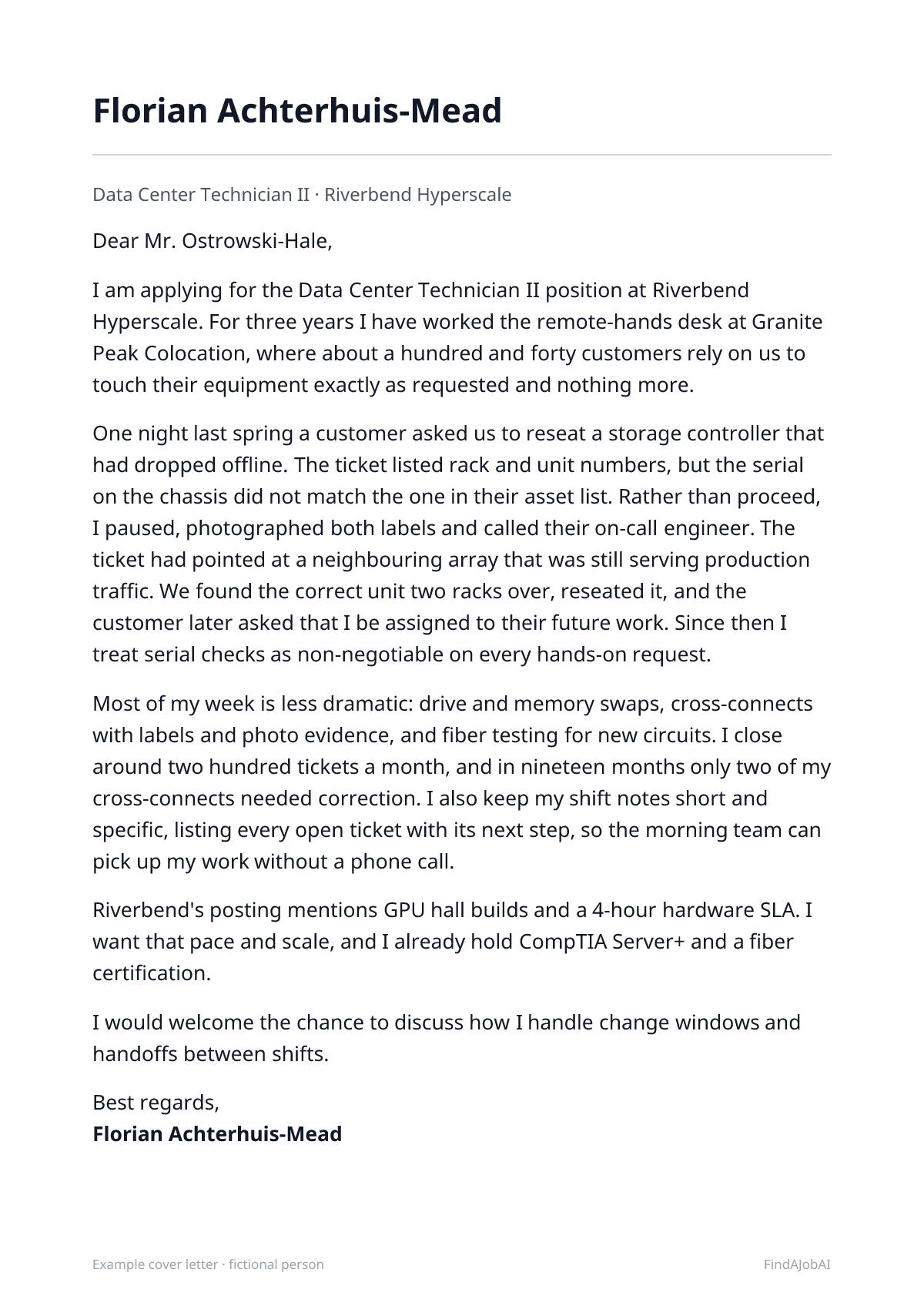
This letter as a one-page template: an opening that names the job and your strongest fact, proof that answers the ad, a reason for this employer and a short close.
After you sign up, FindAJobAI drafts your own letter for a real job from your CV in this format, and you edit it before you send it.
Example 1 · Experienced
Colocation technician applying to a hyperscale campus
Leopold handles remote-hands tickets at a colocation site. The ad asks for high-volume hardware swaps, fiber work and strict change discipline.
Example letter · fictional
Dear Mr. Ostrowski-Hale,
I am applying for the Data Center Technician II position at Riverbend Hyperscale. For three years I have worked the remote-hands desk at Granite Peak Colocation, where about a hundred and forty customers rely on us to touch their equipment exactly as requested and nothing more.
One night last spring a customer asked us to reseat a storage controller that had dropped offline. The ticket listed rack and unit numbers, but the serial on the chassis did not match the one in their asset list. Rather than proceed, I paused, photographed both labels and called their on-call engineer. The ticket had pointed at a neighbouring array that was still serving production traffic. We found the correct unit two racks over, reseated it, and the customer later asked that I be assigned to their future work. Since then I treat serial checks as non-negotiable on every hands-on request.
Most of my week is less dramatic: drive and memory swaps, cross-connects with labels and photo evidence, and fiber testing for new circuits. I close around two hundred tickets a month, and in nineteen months only two of my cross-connects needed correction. I also keep my shift notes short and specific, listing every open ticket with its next step, so the morning team can pick up my work without a phone call.
Riverbend's posting mentions GPU hall builds and a 4-hour hardware SLA. I want that pace and scale, and I already hold CompTIA Server+ and a fiber certification.
I would welcome the chance to discuss how I handle change windows and handoffs between shifts.
Best regards,
Florian Achterhuis-Mead
Example 2 · Career changer
Navy electronics technician moving into data center work
Valentina maintained radar and network equipment aboard a destroyer. The ad is for an entry-level technician on a 24/7 rotation.
Example letter · fictional
Dear Ms. Vukovic-Harlan,
I am writing to apply for the Data Center Technician role at Prairie Line Data. I spent six years in the U.S. Navy as an electronics technician, most recently responsible for shipboard network racks, power conditioning and radar support equipment, and I separated this autumn.
The skills that matter most in your posting are the ones the Navy drilled into me. Every repair aboard ship followed a written procedure with a second person checking critical steps, and tag-out was mandatory before anyone opened a powered cabinet. During one deployment our main network rack lost a power supply in rough seas. I isolated the failed unit under tag-out, swapped in a spare from our parts locker, verified the redundant feed before restoring load, and logged the work so the next watch knew exactly what had changed. The rack never lost service. Afterward my chief asked me to rewrite our spare-parts checklist so the next technician could find the right supply in the dark, and that version stayed in use until I left the ship.
I know the equipment will be different. Commercial server fleets, DCIM software and ticket systems are new to me, so I completed CompTIA A+ and Network+ after leaving and have been practising fiber termination at a local community college lab.
Rotating shifts, long walks between spaces and careful handoffs were normal life for six years. A 24/7 schedule at Prairie Line will feel familiar rather than difficult. I am also used to lifting heavy equipment safely and spending long hours on my feet.
Thank you for considering a veteran moving from ship to shore.
Kind regards,
Valentina Oyelowo-Brandt
Example 3 · Senior or lead
Shift lead applying to run critical operations at a new campus
Hiroshi leads a night shift of eight technicians. The ad is for a lead to staff and run operations at a campus opening next year.
Example letter · fictional
Dear Mr. Achebe-Lindstrom,
Silverpine Digital Campus is looking for an operations lead to open a new site, and that is the stage of a facility I know best. At Fernhollow Cloud I lead eight technicians on nights across three thousand racks, and before that I helped bring two new halls online from empty floor to customer handover.
When I took over the night shift, our hardware SLA hovered around ninety-four percent and the main cause was parts. Technicians would diagnose a failed drive or power supply, then wait hours for stock to arrive from the central store. I pulled a year of failure data from ServiceNow, worked out which components failed most per hall, and set minimum spare levels in locked cabinets near each row. Tickets waiting on parts fell from about nine percent to two, and we have stayed above ninety-nine percent SLA for seven quarters.
The other half of my job is risk. I review every power and network MOP that runs on my shift, and I insist on a second technician confirming each breaker or fiber step. We have had no change-caused outages since early 2022.
I have not yet hired a full team from scratch, which a new campus requires. I have interviewed and onboarded eleven technicians over the past four years, and I would lean on your HR partners for structure while I build the training plan. My first step would be shadowing each existing team for a week to learn your procedures before writing anything new.
I would be glad to talk through how I would staff the first year.
Sincerely,
Hiroshi Bellweather-Tanaka
All three letters, and the short version below, are fictional: the people, employers and numbers are invented. Borrow the structure, never the facts.
- Prefer to write it yourself? Use the free cover letter template.
- Check your CV against the job first: the free CV score shows the missing keywords.
Why the first letter works, paragraph by paragraph
Paragraph 1: Opening
Names the facility type and the trust involved in touching customer equipment, which frames the candidate as careful from the first lines.
Paragraph 2: The serial-number story
A near-miss caught by following verification steps shows the judgment hiring managers screen for, without exaggerating heroics.
Paragraph 3: Everyday volume
Ticket counts and a low error rate prove the careful habit holds at production pace.
Paragraph 4: Why this campus
Connects the ad's GPU builds and SLA to the candidate's goals and existing certifications.
Paragraph 5: Close
Points to change windows and shift handoffs, two topics an interviewer will want to probe anyway.
What the career changer's letter does differently
The veteran's letter translates military habits (written procedures, second-person checks, tag-out) directly into data center language and backs them with one shipboard repair. It names the knowledge gap plainly and shows the certifications already earned to close it.
What the senior letter does differently
The lead's letter shows management through data: a parts problem diagnosed from ticket history, a concrete stocking fix and a sustained SLA result, plus a clear safety rule and an honest note on hiring at full scale.
Short data center technician cover letter: an email-ready version
Many applications arrive as an email or a small text box, and a full page doesn't fit. This version runs 120 to 150 words and keeps only what a reader needs to decide whether to reply. A technician answers a staffing agency recruiter who asked for a resume and a short note about recent data center experience.
Short version · email · fictional128 words
Subject: Data Center Technician (fiber builds, A+ and CFOT) – Eamon Fitzwilliam-Osei
Hi Ms. Ramaswamy,
Thanks for your message about the Data Center Technician contract at Blue Mesa Datacenters. I have two years of build and break-fix work at an enterprise data center, plus CompTIA A+ and a fiber optic certification.
My most relevant recent work was a forty-rack expansion where I ran and tested most of the fiber. Early links were failing at turn-up because of dirty connectors, so I started scoping and cleaning every end face before mating it. Failures dropped to a handful across the whole build, and the site adopted my checklist for later projects.
I am available for nights and weekends and can start within two weeks, and I hold a current driver's license for travel between sites. My resume is attached.
Thanks,
Eamon Fitzwilliam-Osei
The email gives credentials in one line, one measurable build story and the practical details a recruiter needs: shift availability and start date.
Opening lines that work for data center technician cover letters
The first sentence decides whether the second gets read. Here are six openings, one for each situation you might be in. Pick the one that matches yours and swap in your own facts: every name and number below is invented.
1. You have a standout result
Last spring a mismatched serial number stopped me from reseating the wrong customer's storage array. Checks like that are why I want to keep doing remote-hands work at a larger campus.
2. The ad names a problem you've solved
Your posting mentions a 4-hour hardware SLA. I close about two hundred tickets a month and have stayed above ninety-eight percent within that window for the last year.
3. Someone referred you
Darnell Whitcombe, who leads your fiber team, worked beside me on a hall build two years ago and suggested I apply for this role.
4. You admire what they build
Six years maintaining network racks aboard a Navy destroyer taught me to follow every procedure and confirm every power step, habits your site depends on.
5. You're new to the field or switching into it
I've racked, cabled and powered nearly a hundred GPU racks in a six-week build, and I'm ready to do it again at Silverpine's new campus.
6. You have senior scope or a specialism
Under my lead, the night shift went from waiting hours on parts to fixing most hardware within the first hour, and I'd like to bring that planning to your operations team.
How to write a data center technician cover letter
Five steps, in the order you'd write them. The shape stays the same for every job (a short opening, proof, a reason for this employer, a close), and what goes into each part is what changes with the role.
Read the ad for facility type and pace
Colocation, hyperscale and enterprise sites value different things. Colocation stresses customer trust and exact requests, hyperscale stresses volume and SLA, enterprise stresses broad skills. Pick the story from your work that best matches the posting's type.
Tell one story about procedure
Describe a change, repair or request where checking serials, following a MOP or applying lockout prevented a mistake. Keep it factual: what you noticed, what you did and what would have happened otherwise. It shows the judgment managers value most.
Add volume and quality numbers
Mention monthly ticket counts, SLA attainment, cross-connect error rates or racks built. These figures prove that your careful habits hold up at the pace of a real site, not only on a slow day. Round the figures if exact counts are confidential.
Confirm shifts and certifications
One sentence covering your availability for nights, weekends or on-call, and the certifications you hold, answers questions a recruiter would otherwise need to ask before scheduling an interview. If your availability has limits, state them plainly rather than leaving the recruiter to guess.
Close with an operational topic
Offer to discuss something concrete such as change windows, shift handoffs or a build you worked on. It signals that you understand how the site actually runs and gives the reader a natural next step.
Data Center Technician cover letter do's and don'ts
Do
- Describe one change or repair where following procedure prevented a mistake or outage.
- Give your monthly ticket volume, SLA record or error rate if you have them.
- Mention shift availability and any certifications, such as CompTIA or fiber credentials, in a single line.
Don't
- Don't describe skipping steps to finish faster; it reads as a risk, not a strength.
- Don't name customers of a colocation site or share details of their equipment.
- Don't pad the letter with every hardware brand you've seen; keep that on your resume.
Common data center technician cover letter mistakes
Each one is easy to make and quick to fix before you send the letter.
Bragging about speed over safety
Finishing a swap in record time means little if a step was skipped. Show speed only alongside a clean outage or error record.
Writing a generic IT support letter
Replace password resets and desktop tickets with data center work: racking, fiber, PDUs, cooling alarms and RMA handling.
Leaving out shift availability
Most sites run around the clock. If you can work the posted rotation, say so in one line near the end.
Naming colocation customers
Colocation work involves confidential equipment. Describe incidents without naming customers or revealing their systems.
Giving no ticket or build figures
Add at least one figure, such as tickets per month, racks built or SLA percentage, so the reader can judge your level.
Email subject lines for data center technician applications
Applying by email? Put the job title, any reference number and your name in the subject line.
- Data Center Technician II application – colocation remote hands, Server+ – Florian Achterhuis-Mead
- Data Center Technician – Navy electronics veteran, A+ and Network+ – Valentina Oyelowo-Brandt
- Application: Data Center Technician, Night Rotation (Req. 7730) – Florian Achterhuis-Mead
Everything for Data Center Technicians
- Data Center Technician resume exampleA full resume, plus bullet and summary examples
- Data Center Technician interview questions30 questions with sample answers
- Data Center Technician job descriptionDuties, skills and requirements
- Career change cover letter: template + examples
Other cover letter examples
Data Center Technician cover letter FAQ
What should a data center technician cover letter include?
One story showing careful work with hardware, power or customer equipment, your ticket volume or SLA record, your certifications and your availability for the site's shift pattern.
How do I write a data center technician cover letter with no experience?
Draw on hands-on work from IT support, military service, electrical trades or computer repair. Describe a repair you did by following a procedure, and list the certifications you've earned or are studying for.
Should I mention night shifts in my cover letter?
Yes, briefly. If the posting lists a rotation, confirming you can work it removes a common concern and helps your application move forward.
How long should a data center technician cover letter be?
Keep it to roughly 250 to 350 words: an opening, one concrete story, a paragraph on everyday volume or skills, and a short close.
How we built this page
The FindAJobAI team wrote the three example letters, the short email version, the opening lines and the advice for data center technician roles. The people, employers and numbers in the letters are invented; the structure, the kind of evidence and the order of the paragraphs are the parts to copy.
Once we track enough live data center technician job ads, this page also shows the skills they ask for most, counted the same way as our in-demand skills report.
Last reviewed on November 1, 2026.