Network Administrator Cover Letter Example (2026)
By FindAJobAI team Updated How we built this page
Network administrator ads usually list the same acronyms (VLANs, firewalls, a certification or two), so most applicants look identical on paper. A cover letter stands out when it names an outage you actually diagnosed, what it cost the business while it was down, and how you made sure it didn't happen the same way twice.
Network Administrator cover letter template
This letter as a one-page template: an opening that names the job and your strongest fact, proof that answers the ad, a reason for this employer and a short close.
After you sign up, FindAJobAI drafts your own letter for a real job from your CV in this format, and you edit it before you send it.
Example 1 · Experienced
Network administrator applying to a regional hospital system
Darnell runs the network for three clinics with a strict uptime requirement. The ad asks for firewall management and after-hours support.
Example letter · fictional
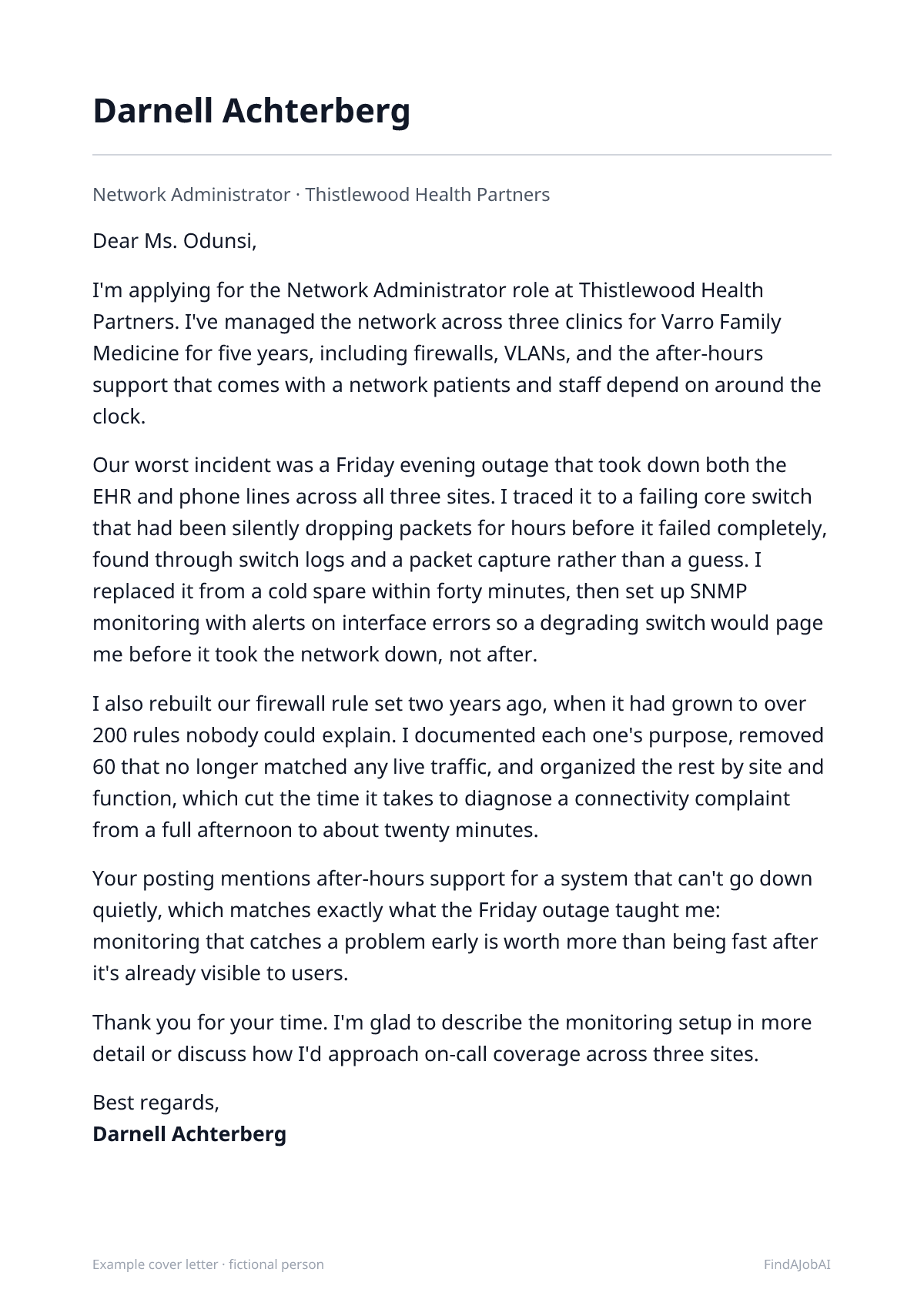
Dear Ms. Odunsi,
I'm applying for the Network Administrator role at Thistlewood Health Partners. I've managed the network across three clinics for Varro Family Medicine for five years, including firewalls, VLANs, and the after-hours support that comes with a network patients and staff depend on around the clock.
Our worst incident was a Friday evening outage that took down both the EHR and phone lines across all three sites. I traced it to a failing core switch that had been silently dropping packets for hours before it failed completely, found through switch logs and a packet capture rather than a guess. I replaced it from a cold spare within forty minutes, then set up SNMP monitoring with alerts on interface errors so a degrading switch would page me before it took the network down, not after.
I also rebuilt our firewall rule set two years ago, when it had grown to over 200 rules nobody could explain. I documented each one's purpose, removed 60 that no longer matched any live traffic, and organized the rest by site and function, which cut the time it takes to diagnose a connectivity complaint from a full afternoon to about twenty minutes.
Your posting mentions after-hours support for a system that can't go down quietly, which matches exactly what the Friday outage taught me: monitoring that catches a problem early is worth more than being fast after it's already visible to users.
Thank you for your time. I'm glad to describe the monitoring setup in more detail or discuss how I'd approach on-call coverage across three sites.
Best regards,
Darnell Achterberg
Example 2 · Career changer
Help desk technician moving into network administration
Yusra fixed a recurring Wi-Fi outage no one else had solved, using switch configs and packet captures. The ad wants hands-on switch and firewall work.
Example letter · fictional
Dear Hiring Manager,
The Junior Network Administrator role at Caldbeck Logistics is the job I've been quietly doing for a year. I started as a help desk technician at Ferrin Warehouse Solutions three years ago, and when our network admin left and nobody replaced him, the troubleshooting landed on me.
The project I'm proudest of is tracking down a Wi-Fi outage that had recurred every few weeks for months before I started looking at it. I pulled switch configs and ran packet captures during the next outage, and found that a misconfigured access point was flooding the network with broadcast traffic every time it rebooted itself on a bad firmware version. I updated the firmware across all twelve access points and the outages stopped entirely.
Since then I've set up VLANs to separate warehouse scanners from office traffic, configured basic firewall rules for a new site, and earned my CompTIA Network+ certification on my own time. I haven't yet managed a network with site-to-site VPNs or redundant routing, which I'd want to grow into with support from a team.
Your ad asks for hands-on switch and firewall work, which is the part of the job I've already been doing without the title, and I'd like to keep doing it as my main focus instead of alongside a help desk queue.
Thank you for considering my application. I'm happy to walk through the access point investigation in an interview. I can bring the packet-capture notes, with company names removed, to an interview.
Sincerely,
Yusra Petrosyan
Example 3 · Senior or lead
Network lead applying to build out infrastructure for a growing logistics firm
Imre leads a team of three network admins at a manufacturing company. The ad is for a first network lead to modernize aging infrastructure.
Example letter · fictional
Dear Mr. Fairweather,
The Network Infrastructure Lead opening at Ondrejka Freight Systems is the next step I've been working toward. At Brackenfield Manufacturing I've led three network administrators for three years, after six years as a senior administrator, and I'd like to use that experience to modernize your infrastructure from the ground up.
Your ad mentions a network that's grown faster than it's been documented, which was exactly our situation at Brackenfield. We had switches from three different vendors with no consistent naming and no current topology map, so a single port misconfiguration once took forty minutes just to locate. I led a full inventory and remapping project, standardized on one vendor for new purchases, and built a topology diagram the team now keeps current as part of every change. Average time to locate a faulty port dropped from around forty minutes to under ten.
Trust in network infrastructure comes from incidents handled well, not uptime numbers alone. When a ransomware attempt hit one segment of our network, I had already set up VLAN segmentation that kept it from reaching our production floor equipment, and we isolated and cleaned the affected segment within the same shift instead of taking the whole plant offline. That incident became the basis for our current segmentation standard.
I've hired two of my three admins and run a monthly review where the team walks through a recent incident together, which has made our postmortems more specific and less about blame. I haven't yet managed a multi-site WAN with SD-WAN failover, and at Ondrejka I'd expect to build that expertise alongside your existing team.
I'd welcome a conversation about which parts of your infrastructure concern you most right now, and how incidents get handled today.
Sincerely,
Imre Castellanos-Baptiste
All three letters, and the short version below, are fictional: the people, employers and numbers are invented. Borrow the structure, never the facts.
- Prefer to write it yourself? Use the free cover letter template.
- Check your CV against the job first: the free CV score shows the missing keywords.
Why the first letter works, paragraph by paragraph
Paragraph 1: Opening
Names the scale (three clinics) and the specific demand of the environment (an uptime requirement), so the reader knows this isn't a generic office network.
Paragraph 2: The outage story
Gives the exact failure (a silently degrading switch), how it was found (logs and a packet capture, not a guess), the fix, and the monitoring built afterward so it's caught earlier next time.
Paragraph 3: The firewall cleanup
Shows ongoing maintenance discipline, not just firefighting, with a concrete before-and-after (200 rules to a documented, pruned set) and the time it saved on routine troubleshooting.
Paragraph 4: Why this company
Directly connects the ad's after-hours support requirement to the lesson from the writer's own outage story.
Paragraph 5: Close
Offers specific, low-risk next steps: more detail on the monitoring setup or a conversation about on-call coverage.
What the career changer's letter does differently
The career changer's letter leads with help desk experience stretched into real network work out of necessity, and carries the whole story through one investigation (the recurring Wi-Fi outage) from symptom to root cause to fix. It names a specific, current certification and is direct about what the writer hasn't managed yet, rather than implying broader experience than she has.
What the senior letter does differently
A network lead letter is judged on how an organization's infrastructure changed, not one fixed cable: the full remapping project, the ten-minute fault location time, and a recurring team habit (the monthly incident review) show lasting improvement. The ransomware story proves segmentation work paid off under a real threat, and the SD-WAN gap is named plainly instead of implied away.
Short network administrator cover letter: an email-ready version
Many applications arrive as an email or a small text box, and a full page doesn't fit. This version runs 120 to 150 words and keeps only what a reader needs to decide whether to reply. A network administrator answers a university IT department's short 'why you' application field, sent by email after the online form timed out.
Short version · email · fictional131 words
Subject: Network Administrator application – campus wired/wireless – Benedek Thorvaldsen
Hello Dr. Mbeki-Larsson,
I'm applying for the Network Administrator role at Ashgrove University. I have five years managing wired and wireless networks for a mid-sized college, including firewall rules, VLANs, and dorm Wi-Fi that gets hit hard every fall move-in week.
My most useful project was redesigning our wireless coverage for one dormitory after years of complaints. I ran a site survey, repositioned and added access points, and support tickets for that building dropped by roughly 70% the following semester.
Campus networks have a scale and seasonal pattern I enjoy working with, and I'd like to bring that experience to Ashgrove. My resume is attached, and I can discuss the wireless redesign in more detail. I'm also glad to talk through how I'd stage upgrades around move-in week.
Best,
Benedek Thorvaldsen
A short field forces one story, so the email keeps the dorm Wi-Fi redesign and its measured drop in tickets instead of a list of certifications or protocols. Naming the specific environment (dorm move-in week) signals direct relevance to a campus network faster than a general skills summary would.
Opening lines that work for network administrator cover letters
The first sentence decides whether the second gets read. Here are six openings, one for each situation you might be in. Pick the one that matches yours and swap in your own facts: every name and number below is invented.
1. You have a standout result
One wireless redesign I led last year cut support tickets for a single dormitory by roughly 70% in a semester. I'd like to bring that kind of hands-on troubleshooting to your network team.
2. The ad names a problem you've solved
Your ad mentions a network that's outgrown its documentation. I led the inventory and remapping project that took our average fault-location time from forty minutes down to under ten at my current company.
3. Someone referred you
Fenna Oyelaran-Krause, your IT director, and I coordinated a firewall migration two years ago, with her team on one side and mine on the other. She told me you want an administrator who owns incidents from first alert to postmortem, which is why I'm getting in touch.
4. You admire what they build
I've been a guest on your campus network as a visiting researcher for two summers, and the way your team handled a lab network outage during my visit made me want to apply when this role opened.
5. You're new to the field or switching into it
I spent three years on a help desk fixing symptoms of network problems before anyone gave me the chance to fix the causes. I'd like to make that root-cause work my full-time focus.
6. You have senior scope or a specialism
After six years as senior network administrator for a three-site healthcare system, I left behind the monitoring runbooks and firewall notes my team still opens every week. I'd like to start the next shop's documentation from the first day.
How to write a network administrator cover letter
Five steps, in the order you'd write them. The shape stays the same for every job (a short opening, proof, a reason for this employer, a close), and what goes into each part is what changes with the role.
Identify the scale and risk the ad implies
Network admin ads differ by what's at stake: patient care, warehouse uptime, or student Wi-Fi during move-in. Read for the number of sites, the criticality of the systems, and any mention of after-hours work. Then pick a project of yours that matched a similar scale or risk.
Open with the incident, not your certification list
Open with the outage or problem and the cause you traced, then name your CompTIA or Cisco credentials. A real diagnosis near the top earns the next paragraph. A certification means more when a story stands behind it.
Give a measured result, not just a task completed
Tie one project to a number: time to diagnose, tickets reduced, downtime avoided. If you can't measure the final effect, describe what changed procedurally, such as a monitoring alert or documentation standard that now exists because of your work.
Name the specific gear and protocols in context
Mention the firewall vendor, whether you configured VLANs or SNMP monitoring, and what scale of network it was. These specifics tell another admin more in one sentence than a skills list does in five lines, and they're easy to verify in an interview.
Show how you prevent repeat incidents
Mention a time you didn't just fix a problem but changed something, a monitoring alert, a documentation habit, a segmentation rule, so it wouldn't happen the same way again. This is the difference between an admin who reacts and one who's trusted to own infrastructure.
Network Administrator cover letter do's and don'ts
Do
- Describe one outage or incident by its symptom, how you diagnosed it, and the fix, the way you'd explain it to another admin.
- Name the specific gear and protocols you've worked with (a firewall vendor, VLANs, SNMP monitoring) inside a real story.
- Mention after-hours or on-call experience directly if the ad asks for it; hiring managers read for this specifically.
Don't
- Don't say 'strong troubleshooting skills' without naming an incident; show the diagnosis, not just the claim.
- Don't list every certification you're studying for as if it's complete; name what you've earned and what's in progress.
- Don't share your current employer's network diagrams or IP ranges; describe the problem and fix in general terms.
Common network administrator cover letter mistakes
Each one is easy to make and quick to fix before you send the letter.
Listing certifications without a story
A row of CompTIA, Cisco, and vendor certifications with no incident behind any of them reads like a copied résumé line. Name the one or two most relevant to the ad, and what you used them for.
Describing tasks completed instead of problems solved
'Configured VLANs and firewall rules' says less than one outage you diagnosed and repaired. A cover letter is where a manager checks how you reason when something breaks, not where they look for a maintenance log.
Vague claims about reliability work
'Improved network uptime' without a baseline or a specific change (monitoring, a redundant link, a firmware fix) sounds unverified. Name what you actually changed and what it bought you.
Skipping the organizational context
A letter that could describe any network, with no mention of the business's scale or risk, suggests the writer didn't read the ad closely. Name the number of sites, users, or the criticality of the systems involved.
Overstating experience with complex infrastructure
Claiming deep experience with multi-site WANs or SD-WAN when your real background is a single office network invites a hard technical question you can't back up. State plainly what you've managed and what you're ready to grow into.
Email subject lines for network administrator applications
Applying by email? Put the job title, any reference number and your name in the subject line.
- Network Administrator application – multi-site healthcare network – Darnell Achterberg
- Junior Network Administrator – help desk background, Network+ certified – Yusra Petrosyan
- Application: Network Administrator, IT Infrastructure (Req. 3391) – Darnell Achterberg
Everything for Network Administrators
- Network Administrator resume exampleA full resume, plus bullet and summary examples
- Network Administrator interview questions30 questions with sample answers
- Network Administrator job descriptionDuties, skills and requirements
- Career change cover letter: template + examples
Other cover letter examples
Network Administrator cover letter FAQ
What should I write in a network administrator cover letter?
Pick one outage or project: the symptom, how you diagnosed it, the fix, and what you changed afterward so it wouldn't repeat. Name the specific gear or protocols involved. Your resume already lists your certifications; the letter should show how you used that knowledge under a real failure.
How do I write a network administrator cover letter with no formal title yet?
Use network troubleshooting from a help desk or support role, even if it wasn't officially your job. Name one investigation from symptom to root cause, add any certifications you've earned, and be upfront about the areas, like VPNs or routing, you haven't managed yet.
Should I mention on-call or after-hours availability?
Yes, directly, if the ad mentions it. Network administrator roles often depend on someone being reachable when something fails outside business hours, and confirming you understand that expectation matters as much as technical skill.
How technical should a network administrator cover letter get?
Technical enough that another network admin could follow the story, without reciting full configs or IP addresses. One clearly explained incident, with what you found and changed, says more than a list of protocols.
How we built this page
The FindAJobAI team wrote the three example letters, the short email version, the opening lines and the advice for network administrator roles. The people, employers and numbers in the letters are invented; the structure, the kind of evidence and the order of the paragraphs are the parts to copy.
Once we track enough live network administrator job ads, this page also shows the skills they ask for most, counted the same way as our in-demand skills report.
Last reviewed on November 1, 2026.