Mathematician Cover Letter Example (2026)
By FindAJobAI Team Updated How we built this page
Employers outside universities hire mathematicians to solve problems, not to admire elegant results. A strong letter names your area of mathematics, describes one problem you turned into a model or proof and what that changed for the people relying on it, and shows you can write code and explain assumptions to engineers or managers. Match the area in the ad, whether optimization, numerical methods, cryptography or probability.
Mathematician cover letter template
This letter as a one-page template: an opening that names the job and your strongest fact, proof that answers the ad, a reason for this employer and a short close.
After you sign up, FindAJobAI drafts your own letter for a real job from your CV in this format, and you edit it before you send it.
Example 1 · Experienced
Applied mathematician applying to a logistics research team
Isidora has four years building optimization models at an engineering consultancy. The ad is for a mathematician on a logistics company's research team.
Example letter · fictional
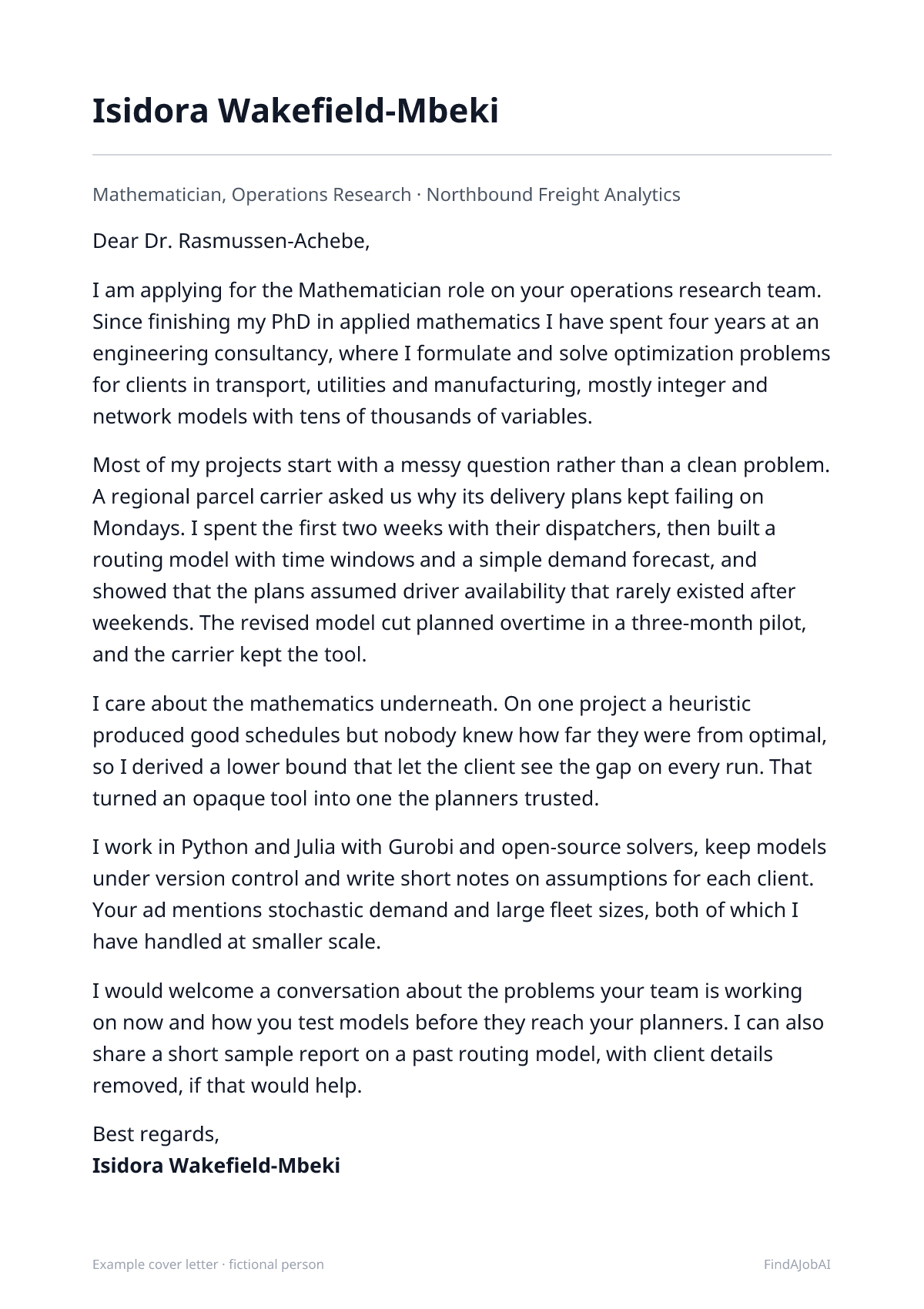
Dear Dr. Rasmussen-Achebe,
I am applying for the Mathematician role on your operations research team. Since finishing my PhD in applied mathematics I have spent four years at an engineering consultancy, where I formulate and solve optimization problems for clients in transport, utilities and manufacturing, mostly integer and network models with tens of thousands of variables.
Most of my projects start with a messy question rather than a clean problem. A regional parcel carrier asked us why its delivery plans kept failing on Mondays. I spent the first two weeks with their dispatchers, then built a routing model with time windows and a simple demand forecast, and showed that the plans assumed driver availability that rarely existed after weekends. The revised model cut planned overtime in a three-month pilot, and the carrier kept the tool.
I care about the mathematics underneath. On one project a heuristic produced good schedules but nobody knew how far they were from optimal, so I derived a lower bound that let the client see the gap on every run. That turned an opaque tool into one the planners trusted.
I work in Python and Julia with Gurobi and open-source solvers, keep models under version control and write short notes on assumptions for each client. Your ad mentions stochastic demand and large fleet sizes, both of which I have handled at smaller scale.
I would welcome a conversation about the problems your team is working on now and how you test models before they reach your planners. I can also share a short sample report on a past routing model, with client details removed, if that would help.
Best regards,
Isidora Wakefield-Mbeki
Example 2 · Career changer
High school math teacher moving into an industry mathematician role
Florentyna taught high school mathematics for six years after a master's in pure mathematics, and has since completed optimization coursework and two projects.
Example letter · fictional
Dear Cedarline Analytics Team,
I am applying for the Associate Mathematician position at Cedarline Energy Systems. I hold a master's degree in mathematics and have taught algebra, calculus and statistics at a public high school for six years. Over the last eighteen months I have retrained in applied mathematics through graduate courses in optimization and numerical methods.
My master's work was in graph theory, and I have kept proving things ever since, if only for my students. Teaching made me good at one skill industry teams often mention: explaining a hard idea clearly to people with very different backgrounds, and checking that they really understood it.
For my optimization course project I built a linear programming model for scheduling a small solar and battery site against hourly prices, using public data. I wrote it in Python with an open-source solver, tested it against a simple rule-based plan and documented where the model's assumptions would break, such as forecast error. I also completed a numerical methods project on solving heat equations with finite differences.
I know I have less industry experience than other applicants. I would expect to learn your tools and data from senior colleagues at first, and I am used to working steadily on problems that take weeks to crack. I would bring patience, careful reasoning and clear communication to your team, along with the habit of writing down every assumption before I trust a result.
I would be glad to walk through my projects and code in an interview, and I can share both repositories in advance. I am available for interviews after school hours and during the winter break.
Sincerely,
Florentyna Quarshie-Vandermolen
Example 3 · Senior or lead
Principal mathematician applying to lead a research group
Maximilian has fifteen years at a national laboratory in optimization and uncertainty work. The ad is to head an aerospace mathematics group.
Example letter · fictional
Dear Ms. Kristiansen-Afolabi,
I am applying for the Head of Mathematical Sciences role at Altamira Aerospace Systems. I have spent fifteen years at a national research laboratory, the last seven leading a group of eight mathematicians and computational scientists working on optimization and uncertainty quantification for engineering programs.
The work I am proudest of is cultural as much as mathematical. When I joined the group, engineering divisions added safety margins by habit rather than by analysis. We built an uncertainty quantification framework with the engineers rather than for them, ran it alongside their existing methods for a year and published the comparisons internally. Three divisions now use it in design reviews, and the conversations about margins have become far more concrete and far less about habit.
I have also learned how to keep a research group productive. I protect time for longer-term problems, pair new staff with experienced mentors and insist that every model ships with a written statement of its assumptions. Two university partnerships I set up have brought in grant funding and several strong hires.
Your posting describes a team that is growing quickly and working closely with flight test engineers. I would want to understand how mathematical work is prioritized against program deadlines today, and how the group shares credit with the engineering teams it supports. In my experience those two questions shape whether strong mathematicians stay.
I would welcome a conversation about the group's next two years and the problems you most want it to solve, and I can visit your site at a time that suits the team.
Kind regards,
Maximilian Oduya-Thornbury
All three letters, and the short version below, are fictional: the people, employers and numbers are invented. Borrow the structure, never the facts.
- Prefer to write it yourself? Use the free cover letter template.
- Check your CV against the job first: the free CV score shows the missing keywords.
Why the first letter works, paragraph by paragraph
Paragraph 1: Opening
Names the degree, years of experience and problem classes, which maps onto an operations research team at once.
Paragraph 2: One real problem
The Monday failures story moves from a vague question to a model and a pilot result the client kept.
Paragraph 3: Depth of mathematics
A derived lower bound shows theoretical skill used for a practical purpose: trust in a tool.
Paragraph 4: Tools and fit
Lists languages, solvers and working habits, then connects them honestly to two items in the ad.
Paragraph 5: Close
Asks about current problems and model testing, which signals genuine interest in how the team works.
What the career changer's letter does differently
The career changer's letter treats teaching as a real strength, clear explanation, and backs the move with graduate coursework and two concrete projects. It is honest about limited industry experience.
What the senior letter does differently
The senior letter moves from individual models to changing how an organization uses mathematics, plus team practices and partnerships. It closes on prioritization, the real question for a group leader.
Short mathematician cover letter: an email-ready version
Many applications arrive as an email or a small text box, and a full page doesn't fit. This version runs 120 to 150 words and keeps only what a reader needs to decide whether to reply. A mathematician replies by email to a cybersecurity firm's ad asking for a brief note and a CV.
Short version · email · fictional126 words
Subject: Cryptography Mathematician application – PhD in number theory – Benedetta Lowenstein-Adeyemi
Hi Dr. Pemberton-Uzoma,
I am writing about the Cryptography Mathematician opening at Ironvale Secure Communications. I completed a PhD in number theory two years ago and have since worked as a postdoctoral researcher on lattice problems related to post-quantum cryptography, with two papers accepted at peer-reviewed venues.
I implement my ideas in Python and C, and last year I wrote a small library for testing lattice reduction attacks that colleagues now use in their own experiments. I enjoy explaining security assumptions clearly to the engineers who build and maintain the systems.
My CV is attached, and I am available to start in the spring. I would be glad to talk whenever suits your team, and I can send my papers and code beforehand.
Best,
Benedetta Lowenstein-Adeyemi
The short email names the specialty, the research focus and one practical tool in two short paragraphs, which is what a cryptography lead screens for. It ends with a start date.
Opening lines that work for mathematician cover letters
The first sentence decides whether the second gets read. Here are six openings, one for each situation you might be in. Pick the one that matches yours and swap in your own facts: every name and number below is invented.
1. You have a standout result
I turn messy operational questions into optimization models, and your logistics research team works on exactly the kind of problems I enjoy most.
2. The ad names a problem you've solved
Your ad asks for a mathematician who can explain models to planners as well as build them, which is how I have worked for four years.
3. Someone referred you
After six years teaching mathematics and eighteen months retraining in optimization, I am ready to apply mathematics to energy problems.
4. You admire what they build
I lead a group of eight in optimization and uncertainty quantification, and your growing mathematical sciences team caught my attention.
5. You're new to the field or switching into it
My research on lattice problems sits close to your post-quantum work, and I would like to apply it to products people use.
6. You have senior scope or a specialism
A member of your research team presented your fleet scheduling work at a conference this year, and it raised questions I would like to help answer.
How to write a mathematician cover letter
Five steps, in the order you'd write them. The shape stays the same for every job (a short opening, proof, a reason for this employer, a close), and what goes into each part is what changes with the role.
Name your area of mathematics
Say whether you work in optimization, numerical analysis, probability, cryptography or another field, and match it to the ad. A hiring manager should know within two lines whether your background fits their problems, and a specific area reads far better than a general claim to be good at mathematics.
Tell one applied story
Describe a problem you turned into a model or proof, the approach you took and what changed afterward. Keep the mathematics brief and the outcome concrete, such as a faster solver, lower costs or a tool people trusted.
Show that you can build, not only prove
Mention the languages, solvers and practices you use to turn mathematics into working code. Industry teams need models that run, can be tested and can be handed over to colleagues without a long explanation. One sentence on a tool you built is often enough.
Explain how you communicate
Most readers of your work will be engineers, analysts or managers. Give an example of explaining assumptions or limits clearly, such as a short note on what a model can and cannot do, and how the people relying on it used that note.
Close with a question about their problems
End by asking about the problems the team is working on or how models are tested. It shows interest in their work and gives the interviewer a natural place to start the conversation when you meet.
Mathematician cover letter do's and don'ts
Do
- Name your area of mathematics and match it to the ad.
- Describe one problem you modeled or proved and what changed because of it.
- Mention the programming tools you use to turn mathematics into working models.
Don't
- Don't list theorems or courses without saying how you used them.
- Don't write only for other mathematicians; most readers are engineers or managers.
- Don't send an academic research statement in place of a cover letter.
Common mathematician cover letter mistakes
Each one is easy to make and quick to fix before you send the letter.
Turning the letter into a research summary
Keep the thesis to one sentence and focus on applied problems the employer will recognize.
Hiding programming skills
Name the languages and solvers you use and one tool or package you built.
Using heavy notation or jargon
Describe the mathematics in words that an engineer or manager can follow.
Ignoring the employer's field
Match your example to their problems, such as logistics, energy, finance or security.
Overstating what a model proves
Be clear about assumptions and limits, since careful readers will notice overclaiming.
Email subject lines for mathematician applications
Applying by email? Put the job title, any reference number and your name in the subject line.
- Mathematician application – Isidora Wakefield-Mbeki
- Associate Mathematician – M.S. mathematics, optimization projects – Florentyna Quarshie-Vandermolen
- Application: Mathematician, Operations Research (Job 7720) – Isidora Wakefield-Mbeki
Everything for Mathematicians
- Mathematician resume exampleA full resume, plus bullet and summary examples
- Mathematician interview questions30 questions with sample answers
- Mathematician job descriptionDuties, skills and requirements
- Career change cover letter: template + examples
Other cover letter examples
Mathematician cover letter FAQ
What should a mathematician cover letter include?
Your area of mathematics, one problem you solved with a model or proof, the result, the tools you use and how you explain your work to non-specialists. Keep it to one page.
How do I write a mathematician cover letter when moving from teaching or academia?
Show applied projects with real data, the code you wrote and how your teaching or research skills transfer. Be honest about limited industry experience and how you are closing the gap.
How long should a mathematician cover letter be?
About 250 to 350 words. Hiring managers want one clear example of applied work, not a summary of your thesis.
How we built this page
The FindAJobAI team wrote the three example letters, the short email version, the opening lines and the advice for mathematician roles. The people, employers and numbers in the letters are invented; the structure, the kind of evidence and the order of the paragraphs are the parts to copy.
Once we track enough live mathematician job ads, this page also shows the skills they ask for most, counted the same way as our in-demand skills report.
Last reviewed on November 1, 2026.