Statistician Cover Letter Example (2026)
By FindAJobAI Team Updated How we built this page
Statistician hiring managers want evidence of judgment, not a list of methods. A strong letter names the kind of data you work with, one study where your design or modeling choice changed what people concluded, and how you explain uncertainty to colleagues who are not statisticians. Matching the field in the ad, whether clinical, survey or industrial, matters more than breadth.
Statistician cover letter template
This letter as a one-page template: an opening that names the job and your strongest fact, proof that answers the ad, a reason for this employer and a short close.
After you sign up, FindAJobAI drafts your own letter for a real job from your CV in this format, and you edit it before you send it.
Example 1 · Experienced
Survey statistician applying to a national statistics office
Siobhan has four years weighting a regional health survey. The ad is for a statistician in a national statistics office's household survey methods team.
Example letter · fictional
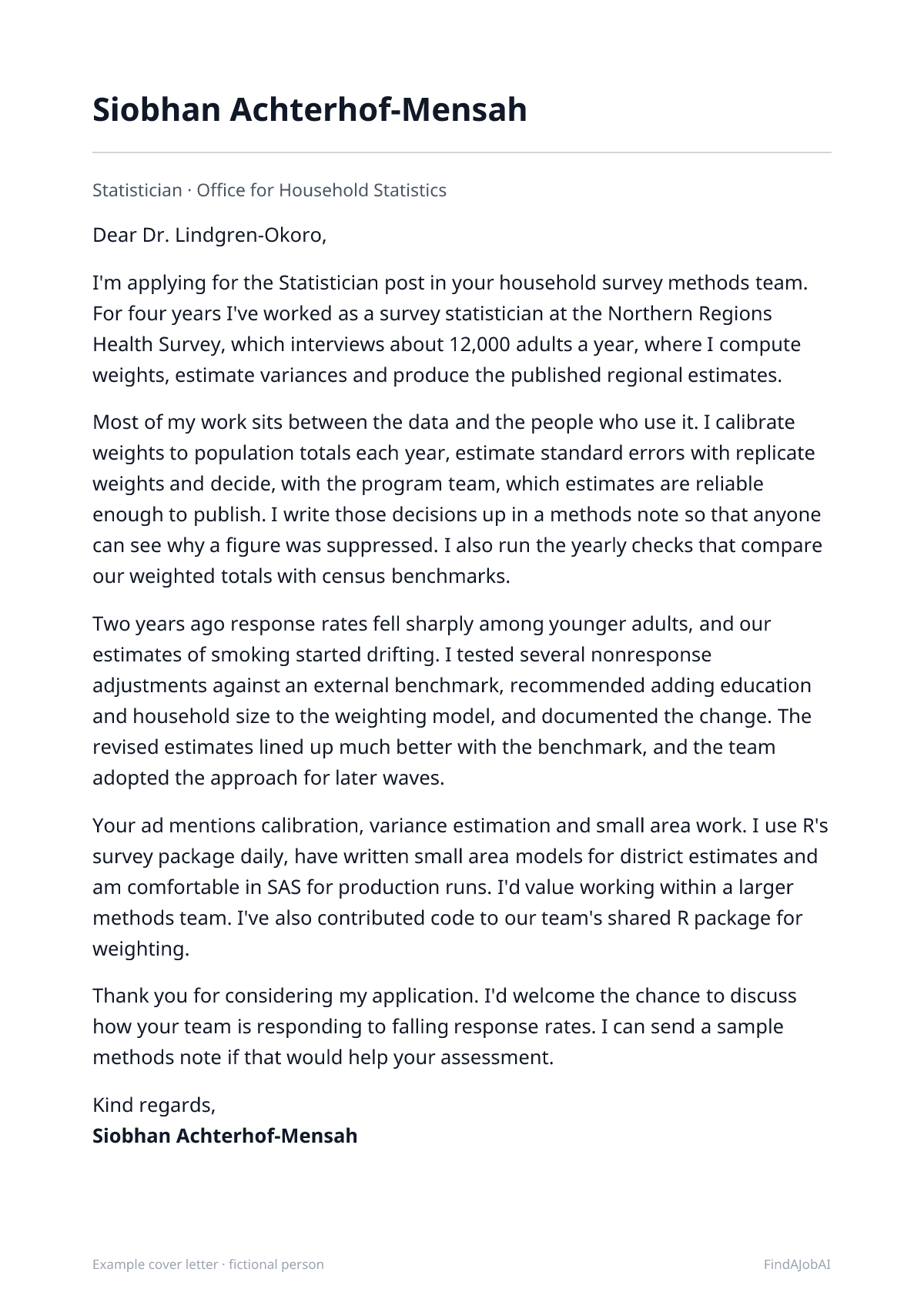
Dear Dr. Lindgren-Okoro,
I'm applying for the Statistician post in your household survey methods team. For four years I've worked as a survey statistician at the Northern Regions Health Survey, which interviews about 12,000 adults a year, where I compute weights, estimate variances and produce the published regional estimates.
Most of my work sits between the data and the people who use it. I calibrate weights to population totals each year, estimate standard errors with replicate weights and decide, with the program team, which estimates are reliable enough to publish. I write those decisions up in a methods note so that anyone can see why a figure was suppressed. I also run the yearly checks that compare our weighted totals with census benchmarks.
Two years ago response rates fell sharply among younger adults, and our estimates of smoking started drifting. I tested several nonresponse adjustments against an external benchmark, recommended adding education and household size to the weighting model, and documented the change. The revised estimates lined up much better with the benchmark, and the team adopted the approach for later waves.
Your ad mentions calibration, variance estimation and small area work. I use R's survey package daily, have written small area models for district estimates and am comfortable in SAS for production runs. I'd value working within a larger methods team. I've also contributed code to our team's shared R package for weighting.
Thank you for considering my application. I'd welcome the chance to discuss how your team is responding to falling response rates. I can send a sample methods note if that would help your assessment.
Kind regards,
Siobhan Achterhof-Mensah
Example 2 · Career changer
Lab scientist moving into a statistician role
Florian, a lab scientist with a part-time master's in applied statistics, is applying for a statistician role at a contract research organization.
Example letter · fictional
Dear Meridale Biostatistics Team,
I'm applying for the Statistician role at Meridale Clinical Services. I've spent five years as a research scientist in an immunology lab, and over that time I became the person colleagues brought their analysis questions to. Last spring I completed a part-time master's in applied statistics and I'm ready to make statistics my full-time work. The analysis was always the part of the job I enjoyed most.
In the lab I designed experiments as well as analyzing them. I introduced blocking by plate and day to our assay experiments after noticing that batch effects were masking real differences, and I ran power calculations before each new mouse study, which reduced animal numbers on two studies without losing precision. I also started keeping analysis code in a shared repository so colleagues could rerun each other's work.
My master's project used mixed-effects models on longitudinal biomarker data from 400 patients, with multiple imputation for dropout. I wrote it fully in R with version control, and I'm now learning SAS and CDISC standards through an online course, since your ad lists both.
I understand the people who generate clinical data and the pressures they work under, which I think helps in writing analysis plans that hold up in practice. I'm aware my regulated-trial experience is limited, and I'd expect to learn under a senior statistician at first. I'd use that time to learn your standard operating procedures and validation practices thoroughly.
Thank you for your time. I'd be glad to talk through my master's project in detail. I can also share code samples from the project on request.
Best regards,
Florian Okonjo-Whitfield
Example 3 · Senior or lead
Principal statistician applying to lead a biostatistics group
Benedikta leads statistics for an immunology portfolio after twelve years in pharma. The ad is for an associate director of biostatistics at a biotech.
Example letter · fictional
Dear Dr. Haverkamp-Oyelowo,
I'm applying for the Associate Director of Biostatistics role at Corrindale Biosciences. I've spent twelve years in pharmaceutical statistics, the last five as principal statistician at Wexford Bio, where I lead statistics for an immunology portfolio of six programs and supervise four statisticians.
Much of my recent work has been design. For a phase II dose-ranging study I proposed a model-based design instead of pairwise comparisons, which let us test more doses with the same number of patients and gave the program team a clearer basis for choosing the phase III dose. I presented the design at an end-of-phase meeting with regulators, and it was accepted with minor questions. The same approach has since been reused on two other programs in the portfolio.
I've also put effort into how my team works. We moved our outputs to shared R and SAS macros with peer code review, and we now write estimand discussions into every analysis plan from the start. Fewer issues reach database lock, and clinical colleagues say the plans are easier to follow. Two of the statisticians I coached have since been promoted to lead study statisticians.
I haven't yet built a group as it grows from a handful of people, and I'd want to understand early how you plan to balance in-house statisticians with contract research partners. I'd also want to understand how statistics is represented in your portfolio decisions today.
I'd welcome a conversation about your pipeline and the statistical support it will need over the next two years.
Sincerely,
Benedikta Ashworth-Nwosu
All three letters, and the short version below, are fictional: the people, employers and numbers are invented. Borrow the structure, never the facts.
- Prefer to write it yourself? Use the free cover letter template.
- Check your CV against the job first: the free CV score shows the missing keywords.
Why the first letter works, paragraph by paragraph
Paragraph 1: Opening
Names the survey, its size and the three core tasks, which maps directly onto a household survey methods team.
Paragraph 2: How the work is done
Describes calibration, replicate weights and publication decisions, showing method and judgment together.
Paragraph 3: One methods problem
The nonresponse story has a cause, a tested fix, a benchmark comparison and adoption by the team.
Paragraph 4: Matching the methods team's needs
Answers three named requirements with the specific tools and experience behind each.
Paragraph 5: Close
Raises a real methodological issue the employer faces, which signals genuine interest in the work.
What the career changer's letter does differently
The career changer's letter uses lab experience as design experience: blocking for batch effects and power calculations are core statistical skills. It is honest about limited trial experience and shows active steps to close the gap.
What the senior letter does differently
A senior letter shifts from analyses to strategy and team practice: a design that improved dose selection, a regulatory interaction and code review standards. It names the gap, growing a team, and turns it into a question about resourcing.
Short statistician cover letter: an email-ready version
Many applications arrive as an email or a small text box, and a full page doesn't fit. This version runs 120 to 150 words and keeps only what a reader needs to decide whether to reply. A statistician replies by email to a manufacturing company's ad asking for a short note and a resume sent to the quality analytics lead.
Short version · email · fictional131 words
Subject: Statistician application – design of experiments and process data – Yusuf Vandermeulen
Hello Mr. Brightwater-Nakamura,
I'm writing about the Statistician opening at Ashcombe Precision Components. For three years I've worked as a statistician at an automotive parts supplier, designing experiments for process changes and building control charts and capability studies for four production lines.
One fractional factorial experiment I designed found the two settings driving a surface defect, and the line's scrap rate dropped noticeably after the change. I work in R and Minitab and explain results to engineers on the floor. I also set up an automated weekly capability report for the quality team, so process drift is spotted before customers see defects.
My resume is attached, and I can start in a month. I'd be glad to walk through the experiment design and analysis in an interview.
Many thanks,
Yusuf Vandermeulen
The short email names the field, the methods and one experiment with a practical result, which is what a quality lead screens for. It keeps to the tools in the ad and mentions working with engineers, since the role is shop-floor facing.
Opening lines that work for statistician cover letters
The first sentence decides whether the second gets read. Here are six openings, one for each situation you might be in. Pick the one that matches yours and swap in your own facts: every name and number below is invented.
1. You have a standout result
I compute the weights and estimates for a 12,000-adult health survey and decide with our program team which figures are reliable enough to publish, and I'd like to bring that work to your methods team.
2. The ad names a problem you've solved
Your ad asks for a statistician who can explain uncertainty to people who need to make decisions, which is the part of my job I care about most.
3. Someone referred you
After five years designing and analyzing lab experiments, and a master's in applied statistics, I'm ready to work as a statistician full time.
4. You admire what they build
When falling response rates pushed our survey estimates off course, I tested new weighting adjustments against a benchmark, and I'd enjoy tackling similar problems with your team.
5. You're new to the field or switching into it
I lead statistics for six drug development programs and have presented designs to regulators, and your growing pipeline caught my attention.
6. You have senior scope or a specialism
A member of your biostatistics team described your approach to estimands at a conference session this spring, and it matched how I like to write analysis plans.
How to write a statistician cover letter
Five steps, in the order you'd write them. The shape stays the same for every job (a short opening, proof, a reason for this employer, a close), and what goes into each part is what changes with the role.
Match the field before the methods
Clinical, survey, industrial and technology statistician roles expect different experience. Name your field and data types in the first paragraph so the reader can judge relevance immediately. A clinical trials team, for example, will look first for analysis plans and regulatory standards.
Show one decision your work shaped
Pick a study where your design, model or adjustment changed what people concluded or did. A clear before and after shows statistical judgment better than any list of techniques. Keep it to a few sentences, naming the method briefly.
Explain how you handle uncertainty
Describe how you report intervals, limitations or suppressed estimates. Employers want statisticians who keep colleagues from overreading the data. Give one short example, such as an estimate you chose not to publish because its interval was too wide, and say how you explained that choice to the people involved.
Name tools and standards from the ad
Mention R, SAS, Python or field standards only where you have used them. Be specific about packages or procedures if the ad lists them. Avoid listing every tool you have touched, since interviewers will ask detailed questions about anything you mention in the letter.
Close with a real question
End by raising a methodological issue the employer is likely facing, such as response rates or dose selection. It shows you have thought about their work, not just your own. Keep the question short and genuine.
Statistician cover letter do's and don'ts
Do
- Name the type of data and field you work in, matching the ad as closely as you honestly can.
- Give one example where your design or method choice changed a conclusion or a plan.
- Show how you communicate uncertainty, such as methods notes or decisions about what to publish.
Don't
- Don't list methods without saying where you used them.
- Don't overstate what an analysis proved; careful wording is part of the job.
- Don't send the same letter to clinical, survey and industry roles; the fields expect different experience.
Common statistician cover letter mistakes
Each one is easy to make and quick to fix before you send the letter.
A methods list with no story
Choose one study and explain the choice you made and its effect. Methods without context look like coursework.
Overclaiming results
Words like proved or confirmed can worry a statistician reading your letter. Describe findings with appropriate caution.
Ignoring the audience for results
Mention who used your analyses and how you explained them, since communication is central to the role.
Hiding gaps in field experience
Be direct about what you have not done yet and how you are learning it. Reviewers will notice anyway.
Using the same letter for every field
Tailor the example and tools to clinical, survey or industrial work, depending on the employer.
Email subject lines for statistician applications
Applying by email? Put the job title, any reference number and your name in the subject line.
- Statistician application – Siobhan Achterhof-Mensah
- Statistician – lab scientist with M.S. in applied statistics – Florian Okonjo-Whitfield
- Application: Statistician, Household Survey Methods (Ref. HSM-2291) – Siobhan Achterhof-Mensah
Everything for Statisticians
- Statistician resume exampleA full resume, plus bullet and summary examples
- Statistician interview questions30 questions with sample answers
- Statistician job descriptionDuties, skills and requirements
- Career change cover letter: template + examples
Other cover letter examples
Statistician cover letter FAQ
What should a statistician cover letter include?
Your field and data types, the methods you use with an example, one study where your judgment mattered, how you communicate results, and how you match the ad. Four or five short paragraphs are enough.
How do I write a statistician cover letter as a career changer?
Show the statistical work you already did in your previous role, such as designing experiments or analyzing data, and explain your training. Be honest about gaps and how you are closing them.
How long should a statistician cover letter be?
About 250 to 350 words. Hiring managers want one concrete example of your judgment, not a full account of your methods training.
How we built this page
The FindAJobAI team wrote the three example letters, the short email version, the opening lines and the advice for statistician roles. The people, employers and numbers in the letters are invented; the structure, the kind of evidence and the order of the paragraphs are the parts to copy.
Once we track enough live statistician job ads, this page also shows the skills they ask for most, counted the same way as our in-demand skills report.
Last reviewed on November 1, 2026.