Network Engineer Cover Letter Example (2026)
By FindAJobAI team Updated How we built this page
Network engineer ads usually list a wall of protocols and certifications, so a cover letter earns its place by describing an outage you diagnosed or a migration you ran, not by repeating the acronyms already on your resume.
Network Engineer cover letter template
This letter as a one-page template: an opening that names the job and your strongest fact, proof that answers the ad, a reason for this employer and a short close.
After you sign up, FindAJobAI drafts your own letter for a real job from your CV in this format, and you edit it before you send it.
Example 1 · Experienced
Regional ISP engineer applying to a managed services provider
Dariusz keeps a multi-site BGP network running for an ISP. The ad asks for routing expertise and client-facing troubleshooting.
Example letter · fictional
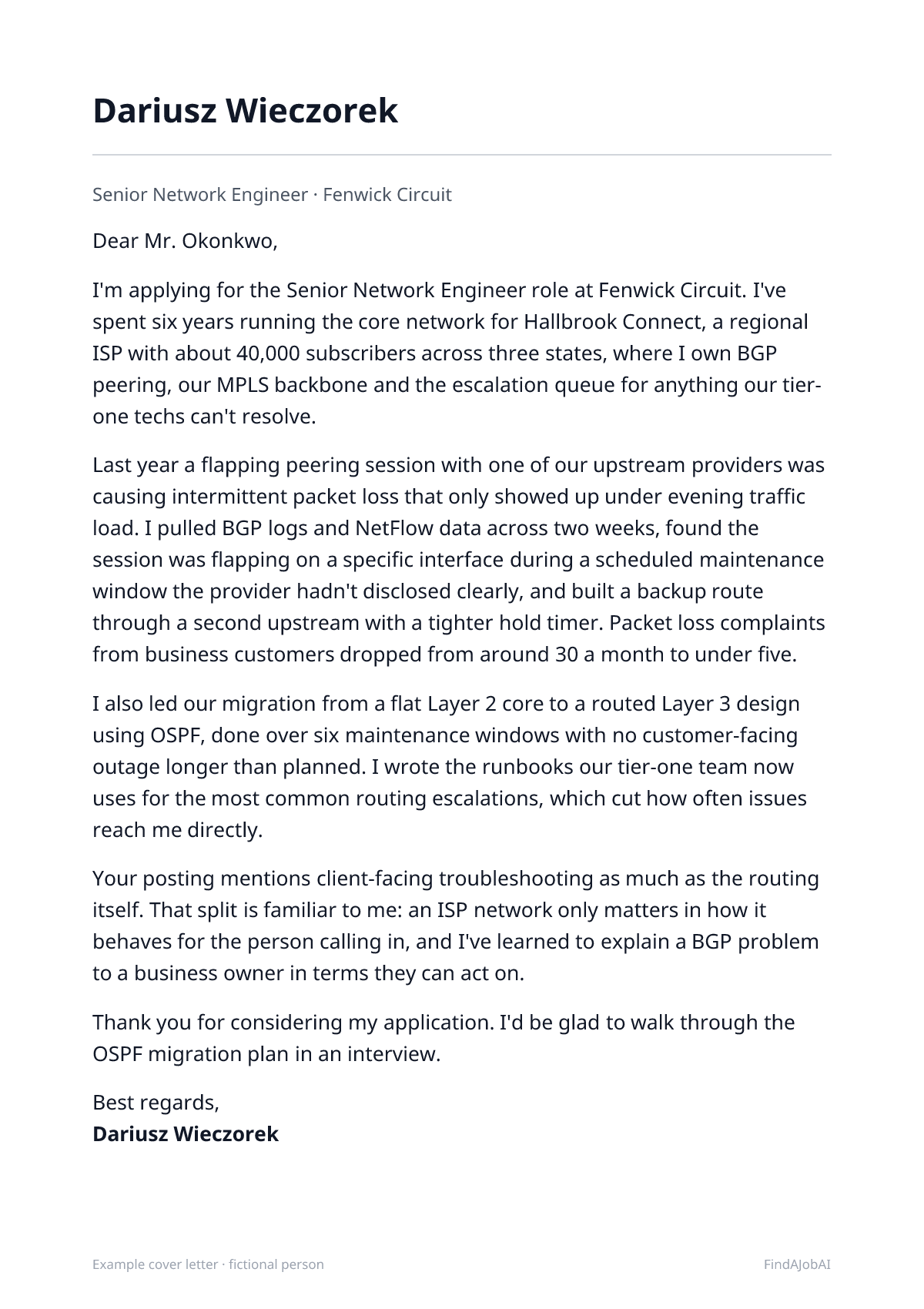
Dear Mr. Okonkwo,
I'm applying for the Senior Network Engineer role at Fenwick Circuit. I've spent six years running the core network for Hallbrook Connect, a regional ISP with about 40,000 subscribers across three states, where I own BGP peering, our MPLS backbone and the escalation queue for anything our tier-one techs can't resolve.
Last year a flapping peering session with one of our upstream providers was causing intermittent packet loss that only showed up under evening traffic load. I pulled BGP logs and NetFlow data across two weeks, found the session was flapping on a specific interface during a scheduled maintenance window the provider hadn't disclosed clearly, and built a backup route through a second upstream with a tighter hold timer. Packet loss complaints from business customers dropped from around 30 a month to under five.
I also led our migration from a flat Layer 2 core to a routed Layer 3 design using OSPF, done over six maintenance windows with no customer-facing outage longer than planned. I wrote the runbooks our tier-one team now uses for the most common routing escalations, which cut how often issues reach me directly.
Your posting mentions client-facing troubleshooting as much as the routing itself. That split is familiar to me: an ISP network only matters in how it behaves for the person calling in, and I've learned to explain a BGP problem to a business owner in terms they can act on.
Thank you for considering my application. I'd be glad to walk through the OSPF migration plan in an interview.
Best regards,
Dariusz Wieczorek
Example 2 · Career changer
Help desk technician moving into network engineering
Priya rebuilt a clinic's VPN and earned her CCNA while working help desk. The ad wants switching, VPN support and growth potential.
Example letter · fictional
Dear Hiring Manager,
I'm applying for the Junior Network Engineer role at Oakfield Health Systems. For three years I've worked help desk support for a group of outpatient clinics, and the work that pulled me toward networking was fixing a VPN that kept dropping between our two largest sites.
The site-to-site VPN failed several times a week, and the previous engineer had left no documentation on it. I read the router configs, found a mismatched IKE phase 2 lifetime between the two sides, corrected it, and added a scheduled ping-based alert so we'd know within minutes if it happened again. The clinics went from losing remote chart access roughly weekly to having no VPN-related outage in the following eight months.
Since then I've earned my CCNA, built a home lab with two switches and a router to practice VLANs and OSPF, and taken over basic switch port and VLAN changes for our clinics instead of escalating them to our contracted MSP. I'm comfortable in Cisco IOS and am working through a Wireshark course to get faster at packet-level troubleshooting.
Your ad asks for switching and VPN support with room to grow into routing, which matches both what I've already fixed and what I want to learn next. Healthcare networks also can't tolerate much downtime, and I already think in those terms from supporting clinics directly.
Thank you for your time. I'd welcome the chance to talk about the VPN fix and my lab setup. I can bring a diagram of my lab to an interview.
Kind regards,
Priya Lintukangas
Example 3 · Senior or lead
Principal engineer applying to lead a network team's first redesign
Oluwaseun manages network architecture for a logistics firm. The ad is for a principal engineer to lead a data center network redesign.
Example letter · fictional
Dear Ms. Falkenrath,
I'm applying for the Principal Network Engineer role at Marrow Logistics. For the last four years I've led network architecture for Dockline Freight, a logistics company running three distribution centers, and before that I spent seven years as a senior engineer. I'd like to lead the kind of ground-up redesign your posting describes.
Your ad mentions a flat network that's outgrown itself and frequent broadcast storms during peak shipping. Dockline had a similar problem: one distribution center's network had grown by adding switches wherever convenience dictated, with no consistent VLAN scheme. I led a redesign to a spine-leaf architecture with route summarization at each leaf, planned and executed across four maintenance windows over three months. Broadcast-related slowdowns, which had been a weekly complaint during peak season, stopped entirely the following peak season.
A redesign only holds if the team trusts it. I wrote a design document that explained not just the topology but the reasoning behind it, so the three engineers inheriting it could extend it without me. When a warehouse automation vendor needed a dedicated low-latency segment, one of my engineers designed it independently using the same principles, which told me the documentation had done its job.
I haven't worked with SD-WAN at the scale your ad implies across multiple countries, and I'd want to lean on your existing team's experience there while I get up to speed. I have run multi-site MPLS and vendor transitions, which overlaps with much of that work.
A conversation about which distribution center is causing the most pain right now, and how your team currently makes architecture decisions, would be a good place to start.
Sincerely,
Oluwaseun Adeyemo
All three letters, and the short version below, are fictional: the people, employers and numbers are invented. Borrow the structure, never the facts.
- Prefer to write it yourself? Use the free cover letter template.
- Check your CV against the job first: the free CV score shows the missing keywords.
Why the first letter works, paragraph by paragraph
Paragraph 1: Opening
Names the scale of network the writer owns (subscriber count, backbone type) and the specific responsibilities, which tells a reader what kind of problems this person has already handled.
Paragraph 2: The outage diagnosed
A clear symptom, the tools used to trace it (BGP logs, NetFlow), the root cause and the fix, measured in a number the business feels: complaint volume.
Paragraph 3: A planned migration
Shows the writer can run change, not just fix breakage, and that the writer documents work so it outlives them on a team.
Paragraph 4: Why this company
Mirrors the ad's own split between technical depth and client communication, and states directly why that combination is familiar.
Paragraph 5: Close
Offers a concrete artifact, the migration plan, as a specific next step rather than a general offer to discuss.
What the career changer's letter does differently
The career changer's letter starts from one specific outage fixed before the job title existed, with a before-and-after result stated in outage frequency rather than a vague claim of improvement. A CCNA and home lab show the learning is now formal, and the letter ties a healthcare uptime expectation to experience already gained supporting clinics.
What the senior letter does differently
A principal engineer letter reports architectural judgment at scale: a redesign spanning multiple maintenance windows, a documentation habit that let another engineer extend the design independently, and a named gap (SD-WAN at multi-country scale) alongside the adjacent experience that offsets it.
Short network engineer cover letter: an email-ready version
Many applications arrive as an email or a small text box, and a full page doesn't fit. This version runs 120 to 150 words and keeps only what a reader needs to decide whether to reply. A network engineer answers a university's short online application after the listed contact email bounced, so the recruiter asked for an emailed resume instead.
Short version · email · fictional140 words
Subject: Network Engineer (routing, campus Wi-Fi) – Tobias Lindqvist
Hello Mr. Ferraro,
I'm applying for the Network Engineer role at Ashcombe University. I have five years of experience managing campus-scale wired and wireless networks at a mid-sized college, including routing, switching, and troubleshooting for roughly 6,000 connected devices.
My most useful project was redesigning Wi-Fi coverage in a dormitory where students had been filing complaints every semester. I ran a site survey, found two access points were on overlapping channels causing interference, redesigned the channel plan and added three access points in dead zones. Complaint tickets from that dormitory fell from about 40 a semester to under ten.
Campus networks have to serve thousands of changing devices without much downtime tolerance, which is the environment I already work in. My resume is attached, and I can walk through the Wi-Fi redesign in more detail if useful.
Best,
Tobias Lindqvist
The short version keeps one concrete project with a before-and-after ticket count, since that's the clearest proof of impact a recruiter can verify quickly, and drops the broader resume narrative that the attached resume already covers.
Opening lines that work for network engineer cover letters
The first sentence decides whether the second gets read. Here are six openings, one for each situation you might be in. Pick the one that matches yours and swap in your own facts: every name and number below is invented.
1. You have a standout result
One VPN redesign I led last year cut dropped connections at our two largest sites to zero in the following eight months. I'd like to bring that same troubleshooting approach to your team.
2. The ad names a problem you've solved
Your ad mentions frequent broadcast storms during peak hours. At my current company I traced a similar problem to a flat VLAN scheme and redesigned it into a segmented network, which ended the slowdowns.
3. Someone referred you
Your infrastructure lead, Nadia Pracht, and I worked together on a vendor conference panel last year. She mentioned your team needs someone comfortable owning BGP peering end to end, which is most of what I do now.
4. You admire what they build
I've relied on your company's public status page during past outages in my own networking work, and the detail in those updates made me want to see how the team behind them operates.
5. You're new to the field or switching into it
I spent four years on help desk support before teaching myself routing and switching well enough to fix problems the senior engineers didn't have time for. Network engineering is where I want to keep solving those problems directly.
6. You have senior scope or a specialism
As the engineer who designed the routing architecture my current company still runs on, I'm looking for a role where I can make that kind of foundational decision again.
How to write a network engineer cover letter
Five steps, in the order you'd write them. The shape stays the same for every job (a short opening, proof, a reason for this employer, a close), and what goes into each part is what changes with the role.
Figure out what kind of network this ad is about
ISP, data center, campus, and enterprise office networks fail in different ways and reward different experience. Read the ad for the environment (multi-site, high device count, client-facing) and pick a story from your background that matches that environment's actual pressures.
Open with the outage or migration, not your toolset
State the symptom and what it cost in plain terms before naming the protocol. A reader who sees a real problem in your first paragraph will keep reading to find out how you solved it; a reader who sees a list of acronyms often won't.
Trace the diagnosis step by step
Name the tool you used to find the cause, whether that's NetFlow, packet captures, or a config review, and the specific misconfiguration or failure you found. This is what separates someone who got lucky from someone who can repeat the process.
State the result in a number the business felt
Complaint volume, downtime minutes, or how often an issue recurred are more convincing than a general claim of improvement. If you can't share an exact figure from a current employer, describe the change in terms like 'weekly' becoming 'rare.'
Show you leave things better documented
One sentence on a runbook, design document, or handoff you wrote shows the fix outlives you on the team. Close by naming a type of problem in their environment you'd want to look into first.
Network Engineer cover letter do's and don'ts
Do
- Name the protocol or technology involved in one specific incident (BGP, OSPF, VPN, VLAN) rather than listing every acronym you know.
- State the before-and-after of an outage or migration in terms the business felt: complaint volume, downtime, or how often an issue recurred.
- Mention any certification (CCNA, CCNP, Network+) once, attached to what you built or fixed with it, not as a bare line item.
Don't
- Don't recite the OSI model or define basic terms; assume the reader already knows them.
- Don't claim perfect uptime or similar absolute figures; describe the specific incident and its outcome instead.
- Don't share a current employer's network diagrams or configs; describe the problem and fix without exposing their infrastructure.
Common network engineer cover letter mistakes
Each one is easy to make and quick to fix before you send the letter.
Opening with a list of protocols and certifications
A paragraph of acronyms reads like the resume repeated in prose. Open with the outage or project instead, and let the protocols appear naturally inside that story.
Claiming perfect uptime
'Maintained perfect uptime' is rarely checkable and reads as exaggeration. Describe one specific incident, how you found the cause, and what changed afterward.
Being vague about scale
'Managed the network' doesn't say whether that's ten devices or ten thousand. Name the number of sites, users, or devices so the reader can judge the complexity of what you handled.
Describing only the fix, not the diagnosis
Jumping straight to 'I fixed the VPN' skips the part that shows real skill. Include how you found the cause, since diagnosis is usually the harder half of the job.
Ignoring the client or stakeholder side of the ad
Many network roles involve explaining problems to non-engineers. If the ad mentions this, include one line on how you communicate a technical issue to someone outside the team.
Email subject lines for network engineer applications
Applying by email? Put the job title, any reference number and your name in the subject line.
- Senior Network Engineer application – BGP and MPLS, ISP background – Dariusz Wieczorek
- Junior Network Engineer – CCNA, VPN troubleshooting – Priya Lintukangas
- Application: Network Engineer, Data Center Team (Req. 2240) – Dariusz Wieczorek
Everything for Network Engineers
- Network Engineer resume exampleA full resume, plus bullet and summary examples
- Network Engineer interview questions30 questions with sample answers
- Network Engineer job descriptionDuties, skills and requirements
- Career change cover letter: template + examples
Other cover letter examples
Network Engineer cover letter FAQ
What should I write in a network engineer cover letter?
One outage or migration you handled: the symptom, how you traced it, the fix, and what changed afterward in terms the business noticed, like fewer complaints or less downtime. Your certifications and protocol list are already on your resume.
How do I write a network engineer cover letter with no experience?
Use a specific problem you solved on a home lab, help desk role, or volunteer setup, name the protocol or technology involved, and add a certification like CCNA to show the skills are now formal. One concrete fix beats a long list of tools you've only read about.
Should I mention specific certifications in a network engineer cover letter?
Yes, but attach each one to what you used it for. A CCNA mentioned beside a VLAN or routing fix you actually performed is more convincing than a certification listed on its own.
How technical should a network engineer cover letter get?
Specific enough that another engineer could believe you did the work: name the protocol, the tool you used to diagnose it, and the result. Save full configuration detail for the interview.
How we built this page
The FindAJobAI team wrote the three example letters, the short email version, the opening lines and the advice for network engineer roles. The people, employers and numbers in the letters are invented; the structure, the kind of evidence and the order of the paragraphs are the parts to copy.
Once we track enough live network engineer job ads, this page also shows the skills they ask for most, counted the same way as our in-demand skills report.
Last reviewed on November 1, 2026.