Physician Assistant Cover Letter Example (2026)
By FindAJobAI team Updated How we built this page
Physician assistant ads mostly list the same certifications and EHR systems, so a cover letter has to show how you actually practice: the patients you see, the physician you collaborate with, and a case where your judgment mattered. Name the setting, the volume, and one decision you made well.
Physician Assistant cover letter template
This letter as a one-page template: an opening that names the job and your strongest fact, proof that answers the ad, a reason for this employer and a short close.
After you sign up, FindAJobAI drafts your own letter for a real job from your CV in this format, and you edit it before you send it.
Example 1 · Experienced
Urgent care PA applying to a multi-site clinic group
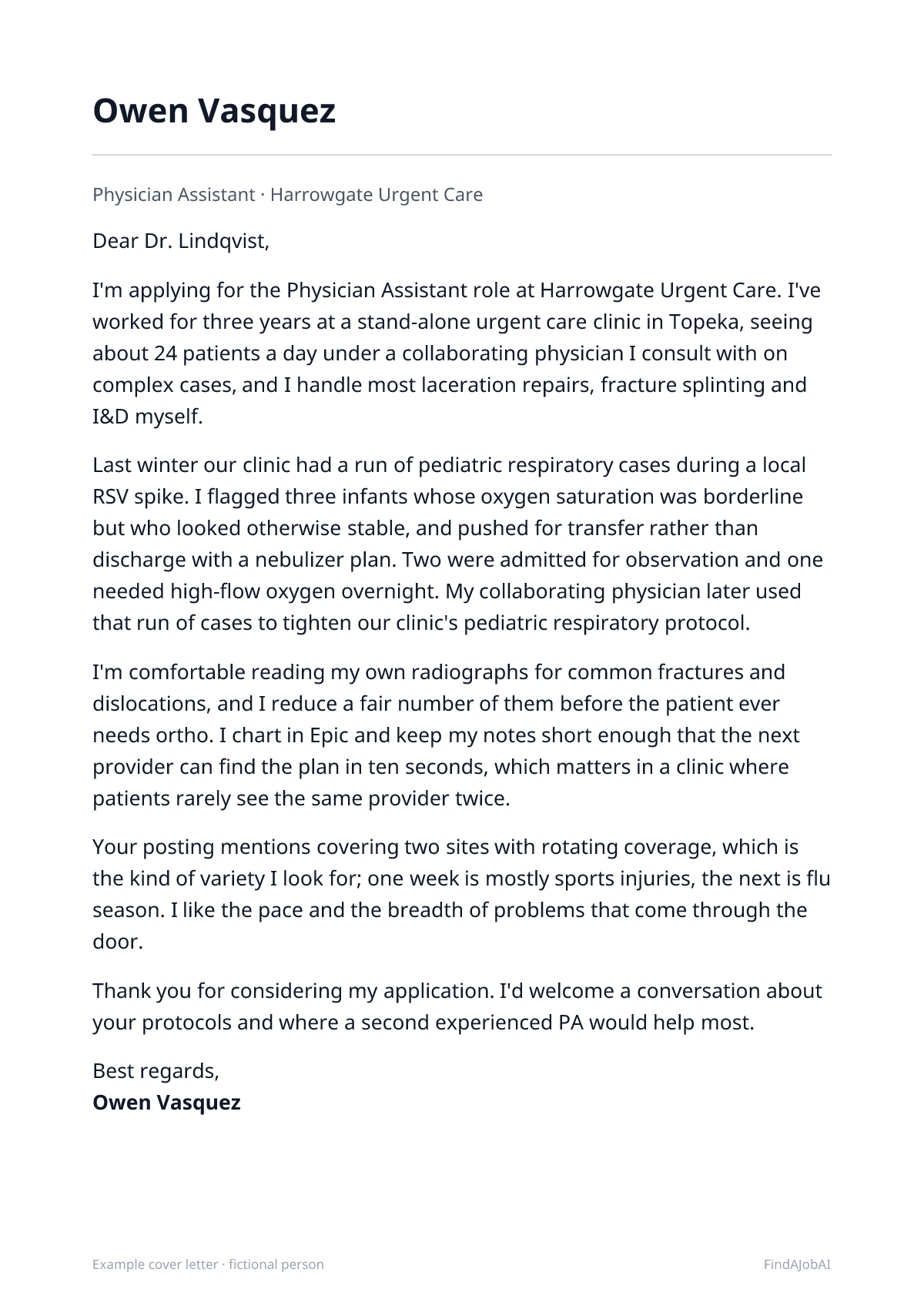
Owen sees walk-in patients independently under a collaborating physician. The ad asks for comfort with high volume and minor procedures.
Example letter · fictional
Dear Dr. Lindqvist,
I'm applying for the Physician Assistant role at Harrowgate Urgent Care. I've worked for three years at a stand-alone urgent care clinic in Topeka, seeing about 24 patients a day under a collaborating physician I consult with on complex cases, and I handle most laceration repairs, fracture splinting and I&D myself.
Last winter our clinic had a run of pediatric respiratory cases during a local RSV spike. I flagged three infants whose oxygen saturation was borderline but who looked otherwise stable, and pushed for transfer rather than discharge with a nebulizer plan. Two were admitted for observation and one needed high-flow oxygen overnight. My collaborating physician later used that run of cases to tighten our clinic's pediatric respiratory protocol.
I'm comfortable reading my own radiographs for common fractures and dislocations, and I reduce a fair number of them before the patient ever needs ortho. I chart in Epic and keep my notes short enough that the next provider can find the plan in ten seconds, which matters in a clinic where patients rarely see the same provider twice.
Your posting mentions covering two sites with rotating coverage, which is the kind of variety I look for; one week is mostly sports injuries, the next is flu season. I like the pace and the breadth of problems that come through the door.
Thank you for considering my application. I'd welcome a conversation about your protocols and where a second experienced PA would help most.
Best regards,
Owen Vasquez
Example 2 · Entry level
New graduate PA applying to an internal medicine practice
Xiomara just finished her PA program and did a strong rotation in internal medicine. The ad wants someone trainable who can manage chronic disease visits.
Example letter · fictional
Dear Hiring Manager,
I'm applying for the Physician Assistant role at Birchfield Internal Medicine. I completed my PA program at Marist College in May, including a twelve-week rotation in internal medicine where I managed a panel of diabetic and hypertensive patients under supervision, and I'm now looking for my first position as a new graduate.
During that rotation I followed a patient whose A1C had been stuck above 9 for a year despite medication changes. Working through her chart, I noticed her pharmacy fill dates didn't match her prescribed schedule, which pointed to a cost problem rather than a dosing one. We switched her to a cheaper generic combination and her A1C came down to 7.8 by her next visit. My preceptor said that kind of chart review is what separates a careful provider from a rushed one.
I passed my PANCE on the first attempt and hold current BLS and ACLS certifications. I used Epic and Athenahealth during rotations and pick up new systems quickly; my preceptors noted I needed less repeating than most students on chart documentation.
Your posting emphasizes chronic disease management and patient education, which is the part of internal medicine I found most satisfying during training. I'd rather spend a visit explaining why a medication matters than just renewing it. On longer visits I use teach-back, asking the patient to explain the plan in their own words, so I can see what actually stuck.
Thank you for your time. I'm available for an interview at your convenience and can start as soon as my license transfer is complete.
Sincerely,
Xiomara Carvalho
Example 3 · Senior or lead
Lead PA applying to direct a clinic's PA team
Quinn supervises six PAs at a cardiology group. The ad is for a lead PA who will set onboarding standards and manage scheduling.
Example letter · fictional
Dear Dr. Marsh,
I'm applying for the Lead Physician Assistant role at Thistlewood Cardiology Partners. For the past four years I've supervised a team of six PAs across two cardiology offices, after seven years of direct patient care, and I'd like to bring that mix of clinical and team leadership to your group.
Your posting mentions inconsistent onboarding for new PAs. I built a structured eight-week onboarding plan at my current practice, pairing new hires with a specific mentor for each clinic day type (new patient visits, device checks, post-op follow-ups), with a checklist of competencies signed off before independent scheduling. Time to full independent caseload dropped from about five months to ten weeks, and two of my hires have since become mentors themselves.
On the clinical side, I noticed our post-MI follow-up visits were catching medication non-adherence too late, often at the three-month mark. I proposed a two-week phone check built into our PA schedule, and readmissions within 30 days for that group fell from six cases to one over the following two quarters. That workflow is now standard across both offices.
I haven't managed PA scheduling across more than two sites or negotiated staffing with a hospital system directly, and at Thistlewood I'd want to learn your current approach to both before changing anything.
I'd welcome a conversation about where your team feels the most strain right now, whether that's onboarding, scheduling or clinical consistency, and how a lead PA could take weight off your physicians.
Sincerely,
Quinn Grayson
All three letters, and the short version below, are fictional: the people, employers and numbers are invented. Borrow the structure, never the facts.
- Prefer to write it yourself? Use the free cover letter template.
- Check your CV against the job first: the free CV score shows the missing keywords.
Why the first letter works, paragraph by paragraph
Paragraph 1: Opening
States the setting (stand-alone urgent care), the volume (about 24 patients a day) and the scope of independent practice. Urgent care employers want to know how much a PA handles alone before a case gets escalated.
Paragraph 2: A judgment call that mattered
Names a specific clinical situation, the decision made against an easier option (discharge with a nebulizer plan), and the outcome, then shows the clinic adopted a protocol change from it.
Paragraph 3: Procedural and documentation skill
Reading radiographs and reducing fractures are concrete scope-of-practice details. Short, findable notes speak to a real pain point in high-turnover clinics.
Paragraph 4: Why this clinic
Responds to the ad's detail about multi-site coverage with a specific reason the variety appeals, rather than a generic compliment.
Paragraph 5: Close
Offers to discuss protocols directly, which signals the writer thinks about process, not just patient load.
What the entry-level letter does differently
The new graduate's letter leans on one well-documented rotation case instead of years of independent practice, naming the A1C figures and the preceptor's specific feedback. It states the PANCE pass and certifications plainly, and matches the ad's language on chronic disease management rather than claiming broad clinical range.
What the senior letter does differently
The lead PA letter reports team-level changes rather than individual patient care: an onboarding plan that cut ramp-up time, a mentoring structure, and a readmission result tied to a scheduling change the writer designed. It names the gap, multi-site scheduling and hospital system negotiation, plainly.
Short physician assistant cover letter: an email-ready version
Many applications arrive as an email or a small text box, and a full page doesn't fit. This version runs 120 to 150 words and keeps only what a reader needs to decide whether to reply. A physician assistant answers a dermatology group's short online application field, sent by email after a referral mentioned a faster response that way.
Short version · email · fictional133 words
Subject: Physician Assistant application – dermatology, procedural – Rosalind Fennimore
Hello Dr. Achterberg,
I'm applying for the Physician Assistant role at Larkspur Dermatology. I have four years of dermatology experience, performing biopsies, cryotherapy and suturing independently under a collaborating physician at a practice in Dayton. My collaborating physician reviews my biopsy selections weekly, and I call every patient myself with the pathology result within two days.
Last year I flagged an atypical mole during a routine visit that the patient almost skipped; biopsy confirmed early melanoma, and she's now a year clear after excision. That case is why I pay close attention to patients who downplay their own concerns.
I'm comfortable with Modernizing Medicine's EHR and would welcome the chance to discuss your procedural volume. My resume is attached. I can also share two sample pathology follow-up scripts on request.
Best,
Rosalind Fennimore
The short version keeps one clinical catch with a real outcome and drops the onboarding or team detail that would belong in a longer letter, since a short application field rewards one memorable case over a full career summary.
Opening lines that work for physician assistant cover letters
The first sentence decides whether the second gets read. Here are six openings, one for each situation you might be in. Pick the one that matches yours and swap in your own facts: every name and number below is invented.
1. You have a standout result
Last year I caught an atypical mole during what was meant to be a quick follow-up visit, and the biopsy came back as early melanoma. I'd like to bring that kind of attention to your dermatology practice.
2. The ad names a problem you've solved
Your ad mentions a high no-show rate for chronic care follow-ups. At my current clinic I built a two-week phone check into our schedule that cut 30-day readmissions for post-MI patients from six cases to one.
3. Someone referred you
Your office manager, Felicity Nwosu, worked with me for two years on our urgent care's scheduling committee. She mentioned your PA opening, which is why I'm writing.
4. You admire what they build
I've been a patient at your clinic for three years, and the way your providers explain a treatment plan before asking about insurance is part of why I want to work here.
5. You're new to the field or switching into it
I spent six years as a paramedic before becoming a PA, and the fast triage decisions from that job are still how I approach a packed urgent care schedule.
6. You have senior scope or a specialism
As the PA who built our practice's current onboarding checklist for new hires, I'm looking for a role where I can do that kind of structural work full time.
How to write a physician assistant cover letter
Five steps, in the order you'd write them. The shape stays the same for every job (a short opening, proof, a reason for this employer, a close), and what goes into each part is what changes with the role.
State your scope of practice up front
Say what setting you work in and how independently you practice: patients seen per day, procedures done without supervision, and how you consult your collaborating physician. This tells the reader your actual clinical range before they read a single example.
Open with a decision, not a diagnosis list
Pick one situation where your judgment changed an outcome: a catch, an escalation, a protocol you questioned. Describe what you noticed and what you did about it in a sentence or two before naming the condition, so the reader sees reasoning first.
Give the outcome in terms a clinic tracks
Readmission counts, time to diagnosis, or a patient's lab value before and after are concrete and checkable. Avoid vague claims like 'excellent patient outcomes.' If you can't cite a number, describe exactly what changed for the patient or the practice.
Name your systems and certifications in context
Mention your EHR, any specialty-specific tools, and certifications like ACLS or a specialty board exam, but attach them to the case you're describing rather than listing them separately. A reader trusts a tool mentioned inside a real example more than a bare list.
Close with what you'd want to know about their practice
Ask about their protocols, caseload, or where they feel short-staffed. This shows you're thinking about fitting into their specific setup, not just looking for any PA opening, and gives the reader something concrete to answer in an interview.
Physician Assistant cover letter do's and don'ts
Do
- Name your scope of practice precisely: what you handle alone versus what you escalate to a collaborating physician.
- Describe one clinical decision with real detail, not just a patient count or a list of conditions seen.
- Mention your EHR system and any procedures or certifications the ad specifically lists.
Don't
- Don't use real patient identifying details; keep clinical examples general enough to be non-identifying.
- Don't claim procedures or scope you haven't actually performed under supervision or independently.
- Don't pad the letter with "compassionate and detail-oriented"; show it through how you describe a patient interaction.
Common physician assistant cover letter mistakes
Each one is easy to make and quick to fix before you send the letter.
Listing conditions seen instead of a decision made
A string of diagnoses tells the reader you've been in a clinic, not how you think. Replace it with one case where you weighed options and made a call, and say what happened next.
Vague scope of practice
"Experienced in primary care" could mean anything from vitals to independent diagnosis. State specifically what you do without supervision and what you escalate, so the reader knows your real autonomy level.
Including identifying patient details
Specific ages, dates or locations tied to a real patient can raise privacy concerns even in a cover letter. Keep clinical examples general enough that no one could identify the patient, while keeping the clinical detail precise.
Treating all certifications as equally worth mentioning
A long list of certifications dilutes the ones that matter for this job. Lead with the one or two the ad specifically asks for, and let your resume carry the rest.
Apologizing for being a new graduate
Phrases like "though I lack experience" undercut a letter before it starts. State your PANCE result and rotation experience plainly and let the clinical example do the convincing.
Email subject lines for physician assistant applications
Applying by email? Put the job title, any reference number and your name in the subject line.
- Physician Assistant application – urgent care, independent practice – Owen Vasquez
- New Graduate PA – internal medicine, PANCE certified – Xiomara Carvalho
- Application: Physician Assistant, Internal Medicine (Req. 2240) – Owen Vasquez
Everything for Physician Assistants
- Physician Assistant resume exampleA full resume, plus bullet and summary examples
- Physician Assistant interview questions30 questions with sample answers
- Physician Assistant job descriptionDuties, skills and requirements
- Cover letter with no experience: templates
Other cover letter examples
Physician Assistant cover letter FAQ
What should I include in a physician assistant cover letter?
State your scope of practice and setting, then describe one clinical situation where your judgment made a difference, including what you decided and why. Name your collaborating physician relationship and any procedures the ad asks about.
How do I write a physician assistant cover letter with no experience?
Use a strong rotation as your example: a patient case you helped manage, what you noticed, and what your preceptor said about your work. Mention your PANCE result and certifications clearly rather than apologizing for being new.
Should I mention my collaborating physician relationship in the letter?
Yes, briefly. Saying how closely you consult with your collaborating physician, and on what kinds of cases, tells the reader how independently you actually practice day to day.
How we built this page
The FindAJobAI team wrote the three example letters, the short email version, the opening lines and the advice for physician assistant roles. The people, employers and numbers in the letters are invented; the structure, the kind of evidence and the order of the paragraphs are the parts to copy.
Once we track enough live physician assistant job ads, this page also shows the skills they ask for most, counted the same way as our in-demand skills report.
Last reviewed on November 1, 2026.