Salesforce Developer Cover Letter Example (2026)
By FindAJobAI Team Updated How we built this page
Salesforce developer ads list Apex, Lightning Web Components, integrations and certifications, and most applicants repeat that list back. A stronger letter picks one piece of work in a real org: what users struggled with, what you built or refactored, how you kept it inside governor limits, and what changed after deployment.
Salesforce Developer cover letter template
This letter as a one-page template: an opening that names the job and your strongest fact, proof that answers the ad, a reason for this employer and a short close.
After you sign up, FindAJobAI drafts your own letter for a real job from your CV in this format, and you edit it before you send it.
Example 1 · Experienced
Salesforce developer applying to an in-house CRM team
Anselm builds Apex and LWC for a consulting partner. The ad wants an in-house developer for a subscription company's Service Cloud org.
Example letter · fictional
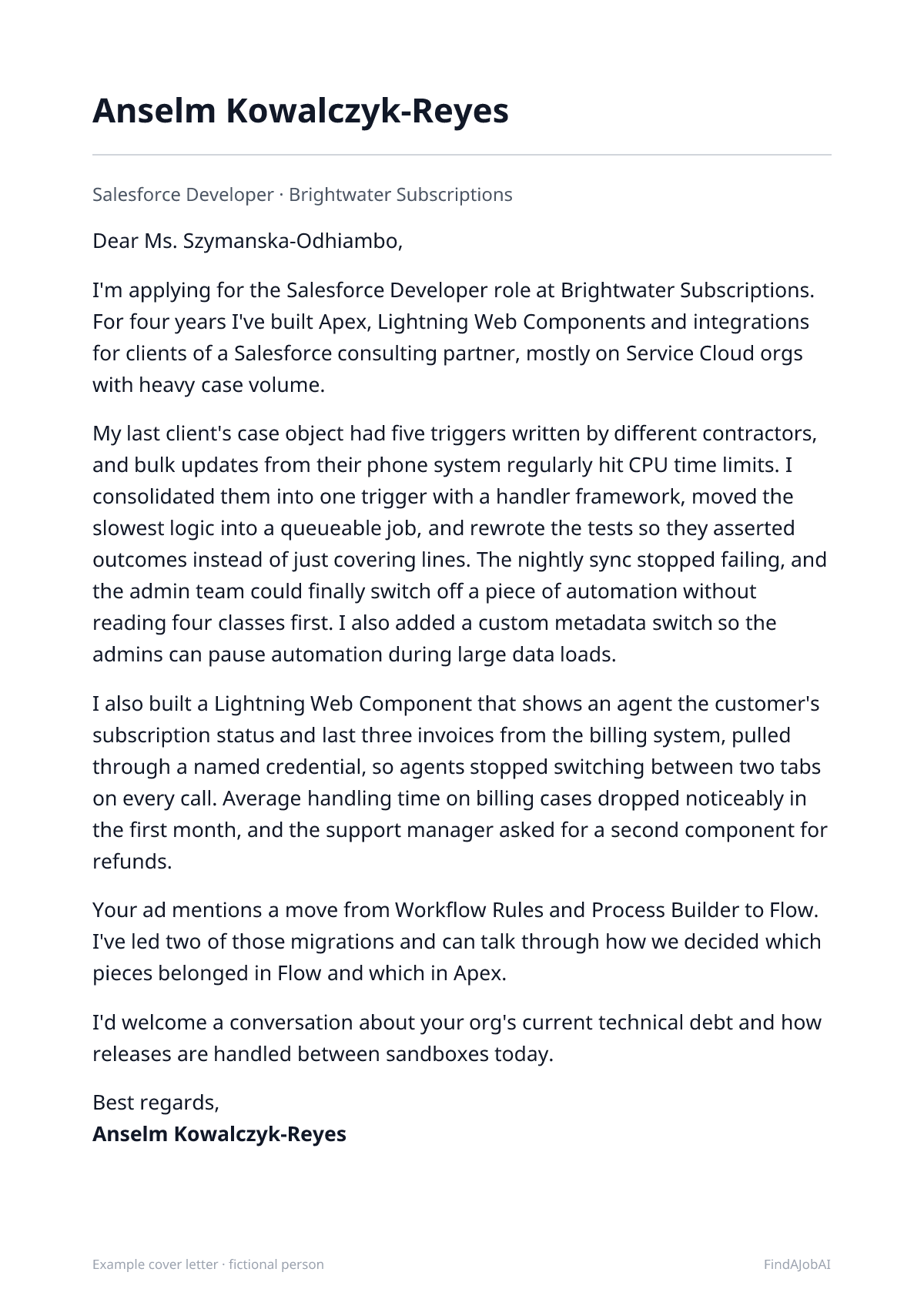
Dear Ms. Szymanska-Odhiambo,
I'm applying for the Salesforce Developer role at Brightwater Subscriptions. For four years I've built Apex, Lightning Web Components and integrations for clients of a Salesforce consulting partner, mostly on Service Cloud orgs with heavy case volume.
My last client's case object had five triggers written by different contractors, and bulk updates from their phone system regularly hit CPU time limits. I consolidated them into one trigger with a handler framework, moved the slowest logic into a queueable job, and rewrote the tests so they asserted outcomes instead of just covering lines. The nightly sync stopped failing, and the admin team could finally switch off a piece of automation without reading four classes first. I also added a custom metadata switch so the admins can pause automation during large data loads.
I also built a Lightning Web Component that shows an agent the customer's subscription status and last three invoices from the billing system, pulled through a named credential, so agents stopped switching between two tabs on every call. Average handling time on billing cases dropped noticeably in the first month, and the support manager asked for a second component for refunds.
Your ad mentions a move from Workflow Rules and Process Builder to Flow. I've led two of those migrations and can talk through how we decided which pieces belonged in Flow and which in Apex.
I'd welcome a conversation about your org's current technical debt and how releases are handled between sandboxes today.
Best regards,
Anselm Kowalczyk-Reyes
Example 2 · Career changer
Salesforce administrator moving into development
Priyanka has been an admin for three years and has started writing Apex. The ad is a junior developer role at a nonprofit tech team.
Example letter · fictional
Dear Harborlight Technology Team,
I'm applying for the Junior Salesforce Developer role at Harborlight Community Fund. I've been the Salesforce administrator at a regional food bank for three years, and over the last year I've started writing the Apex our small team used to pay a contractor for.
Our donation records arrived from an online form tool that created a new contact for every gift, so one donor could appear six times. I first tried to solve it with a Flow, but it broke on bulk imports. I then wrote an Apex class that matched on email and postal code, merged duplicates in batches, and logged every merge for review. Our development director now trusts the donor counts in her board reports. Writing the tests for that class taught me more than any course, especially how to handle records that arrive two hundred at a time.
I passed the Platform Developer I exam this spring and work through Trailhead projects most weekends. I know I still have a lot to learn about integration patterns and code review, and I'd like to learn them on a team with more experienced developers.
Because I've supported users every day, I think about how a change will feel to the person clicking the button, not just whether the tests pass. I also write short release notes for users after every change, which cut the questions our team received after updates.
Thank you for considering my application. I'd be glad to walk through the duplicate-matching code in an interview.
Sincerely,
Priyanka Venkataraman-Cole
Example 3 · Senior or lead
Senior Salesforce developer applying to lead a platform team
Thaddeus is a senior developer at a manufacturer. The ad is for a technical lead over five Salesforce developers at an insurance company.
Example letter · fictional
Dear Mr. Fairweather-Sato,
I'm applying for the Salesforce Technical Lead role at Meridale Mutual Insurance. I've been a senior Salesforce developer at an industrial manufacturer for five years, and for the last two I've set coding standards and reviewed every pull request for a team of four.
When I started, deployments were change sets built by hand on Friday evenings, and roughly one release in three needed a hotfix. I moved the team to source-tracked Salesforce DX projects, added a pipeline that runs all tests against a scratch org on every pull request, and introduced a short code review checklist covering bulk safety, sharing and test assertions. Hotfixes after release became rare, and we now release every two weeks during working hours. New developers now get a working scratch org on their first day instead of spending a week setting up.
I also designed the integration between Salesforce and our ERP using platform events, so order updates no longer depend on a nightly batch that failed whenever the ERP was down for maintenance. Events queue while the ERP is offline and replay in order when it returns, so no order update is lost.
I haven't worked in insurance or with Financial Services Cloud. I'd want to learn how your policy and claims data is modelled before suggesting changes to it.
I'd welcome a conversation about your team's release process and which parts of the org worry the developers most. I could share the review checklist we use as a starting point.
Sincerely,
Thaddeus Okafor-Lindholm
All three letters, and the short version below, are fictional: the people, employers and numbers are invented. Borrow the structure, never the facts.
- Prefer to write it yourself? Use the free cover letter template.
- Check your CV against the job first: the free CV score shows the missing keywords.
Why the first letter works, paragraph by paragraph
Paragraph 1: Opening
Names the platform skills, the employer type and the cloud the writer knows best, Service Cloud, which matches the ad.
Paragraph 2: Fixing a fragile org
Five competing triggers, CPU limit failures and a handler framework with a queueable job show real platform judgment, and the result is stated in operational terms.
Paragraph 3: A user-facing build
An LWC that pulls billing data through a named credential shows integration skill tied to a concrete agent benefit.
Paragraph 4: Matching the migration
Answers the ad's Flow migration directly with past experience and an offer to explain the Flow versus Apex decisions.
Paragraph 5: Close
Asks about technical debt and release flow, two things every Salesforce team has opinions on.
What the career changer's letter does differently
The admin's letter shows the move into code through one honest story: a Flow that broke on bulk imports, then an Apex batch that worked. The Platform Developer I exam makes the skill formal, and the letter names what she still needs to learn instead of overstating her experience.
What the senior letter does differently
A technical lead letter reports team-level changes: source-tracked projects, a test pipeline and a review checklist, with a clear before and after on release quality. The platform event integration shows architecture judgment, and the writer names an industry gap honestly.
Short Salesforce developer cover letter: an email-ready version
Many applications arrive as an email or a small text box, and a full page doesn't fit. This version runs 120 to 150 words and keeps only what a reader needs to decide whether to reply. A Salesforce developer replies by email to a recruiter who shared a contract role at a logistics company.
Short version · email · fictional127 words
Subject: Salesforce Developer contract – Apex, LWC and integrations – Ilse Marchetti-Brook
Hello Mr. Abernathy-Kim,
Thanks for sharing the Salesforce Developer contract at Tidewell Freight. I have five years of Apex, LWC and REST integration work, most recently for a parcel carrier's Sales Cloud org. I hold Platform Developer II and have worked mostly with operations and sales teams.
There I replaced a nightly CSV import of shipment data with a REST endpoint and a queueable job, so account managers saw delivery issues within minutes instead of the next morning. I also added error logging, so failed messages are visible to the admin team and can be replayed without a developer.
I'm available from the start date in the posting. My resume is attached, and I'm happy to talk this week if the team is interested.
Best,
Ilse Marchetti-Brook
A recruiter reply needs one relevant build and availability. The shipment integration fits a freight client directly, and the letter stops there.
Opening lines that work for Salesforce developer cover letters
The first sentence decides whether the second gets read. Here are six openings, one for each situation you might be in. Pick the one that matches yours and swap in your own facts: every name and number below is invented.
1. You have a standout result
I replaced five competing case triggers with one handler and a queueable job, and the nightly sync that used to fail stopped failing. I'd like to do the same kind of cleanup in your org.
2. The ad names a problem you've solved
Your ad mentions moving from Process Builder to Flow. I've led two of those migrations and have opinions on where Apex should still do the work.
3. Someone referred you
As our food bank's Salesforce admin, I wrote the Apex that finally merged our duplicate donors, and I'd like to write code full time.
4. You admire what they build
I've built Lightning Web Components that pull billing data into the agent console, and your Service Cloud roadmap looks like the work I enjoy most.
5. You're new to the field or switching into it
Your team's public talk on platform events at a community conference is the reason I rebuilt our ERP integration around them.
6. You have senior scope or a specialism
As senior developer on a four-person Salesforce team, I moved us from hand-built change sets to a tested pipeline. I'm looking for a team to lead through the same change.
How to write a Salesforce developer cover letter
Five steps, in the order you'd write them. The shape stays the same for every job (a short opening, proof, a reason for this employer, a close), and what goes into each part is what changes with the role.
Name your cloud and org type
Say which clouds you've built on, such as Sales, Service or Experience Cloud, and whether you work in-house or for a consulting partner. Hiring teams read this first to judge how quickly you'll understand their org and its users.
Describe one build with its limits
Pick a trigger, batch job, component or integration you built. Explain what users needed, how you kept it bulk-safe and within governor limits, and what changed once it was in production. Specific limits and patterns show real platform experience.
Show your Flow versus Apex judgment
Many teams want developers who don't write code for everything. Mention a time you chose Flow over Apex, or replaced a fragile Flow with code, and give the reason. This tells the reader you'll keep the org maintainable for admins.
Mention testing and deployment
Describe how you test and release: meaningful assertions, sandboxes, Salesforce DX, a pipeline or a release tool. Teams with a messy release history will look for this before anything else in your letter, so a single clear sentence is worth including.
Tie certifications to work
If you hold Platform Developer I or II, mention it next to the project where you used those skills. A certification alone shows you passed an exam; paired with a build, it shows you can apply it in a real org.
Salesforce Developer cover letter do's and don'ts
Do
- Name the cloud (Sales, Service, Experience) and the org problem you worked on.
- Mention governor limits, bulk handling or test quality inside an example.
- Explain at least one decision between Flow and Apex, since teams care about that judgment.
Don't
- Don't list every Trailhead badge; pick the certification or project that matches the ad.
- Don't present full test coverage as an achievement on its own.
- Don't describe a client's org in enough detail to identify it without permission.
Common Salesforce developer cover letter mistakes
Each one is easy to make and quick to fix before you send the letter.
Repeating the job ad's skill list
Apex, LWC, SOQL and REST appear in every ad. Replace the list with one project that used two or three of them to fix a real problem.
Bragging about test coverage numbers
Coverage is required to deploy, so a percentage alone says little. Talk about tests that caught real bugs or assert real outcomes instead.
Ignoring admins and users
Salesforce developers work beside admins and business users every day. Mention how your work made the org easier for them to run or use.
Exposing client org details
Partner developers often sign confidentiality terms. Describe the industry and problem in general terms, and leave out client names and data.
Leaving out release practice
If you've only deployed with change sets, say so honestly and mention what you've learned about source control. Silence on releases makes teams assume the worst.
Email subject lines for Salesforce developer applications
Applying by email? Put the job title, any reference number and your name in the subject line.
- Salesforce Developer application – Service Cloud, Apex and LWC – Anselm Kowalczyk-Reyes
- Junior Salesforce Developer – admin with Platform Developer I – Priyanka Venkataraman-Cole
- Application: Salesforce Integration Developer – Anselm Kowalczyk-Reyes
Everything for Salesforce Developers
- Salesforce Developer resume exampleA full resume, plus bullet and summary examples
- Salesforce Developer interview questions30 questions with sample answers
- Salesforce Developer job descriptionDuties, skills and requirements
- Career change cover letter: template + examples
Other cover letter examples
Salesforce Developer cover letter FAQ
What should a Salesforce developer cover letter include?
The cloud and org type you work in, one build or refactor with its result, how you handled limits or testing, and a line on how you decide between declarative tools and code.
How do I move from Salesforce admin to developer in a cover letter?
Pick one problem you solved with Apex or LWC in your admin job, explain why configuration wasn't enough, and mention any developer certification or course you've completed.
Should I mention my Salesforce certifications?
Yes, briefly and tied to work. Platform Developer I or II is commonly requested; mention it next to the project where you used those skills rather than as a standalone list.
Should I link to code samples?
If you have a public repository or a sanitized sample that shows clean Apex and tests, a link helps. Never share client code without permission.
How we built this page
The FindAJobAI team wrote the three example letters, the short email version, the opening lines and the advice for Salesforce developer roles. The people, employers and numbers in the letters are invented; the structure, the kind of evidence and the order of the paragraphs are the parts to copy.
Once we track enough live Salesforce developer job ads, this page also shows the skills they ask for most, counted the same way as our in-demand skills report.
Last reviewed on November 1, 2026.