Quantitative Analyst Cover Letter Example (2026)
By FindAJobAI team Updated How we built this page
Quant ads lean hard on math and programming skills that look identical across candidates, so the letter should carry the one model or analysis you'd actually explain in an interview: the question it answered, the assumption you tested, and what changed because of it.
Quantitative Analyst cover letter template
This letter as a one-page template: an opening that names the job and your strongest fact, proof that answers the ad, a reason for this employer and a short close.
After you sign up, FindAJobAI drafts your own letter for a real job from your CV in this format, and you edit it before you send it.
Example 1 · Experienced
Risk desk quant applying to a multi-strategy fund
Finley builds credit risk models at a mid-size bank. The ad asks for someone to rebuild stress-testing models for a new fund.
Example letter · fictional
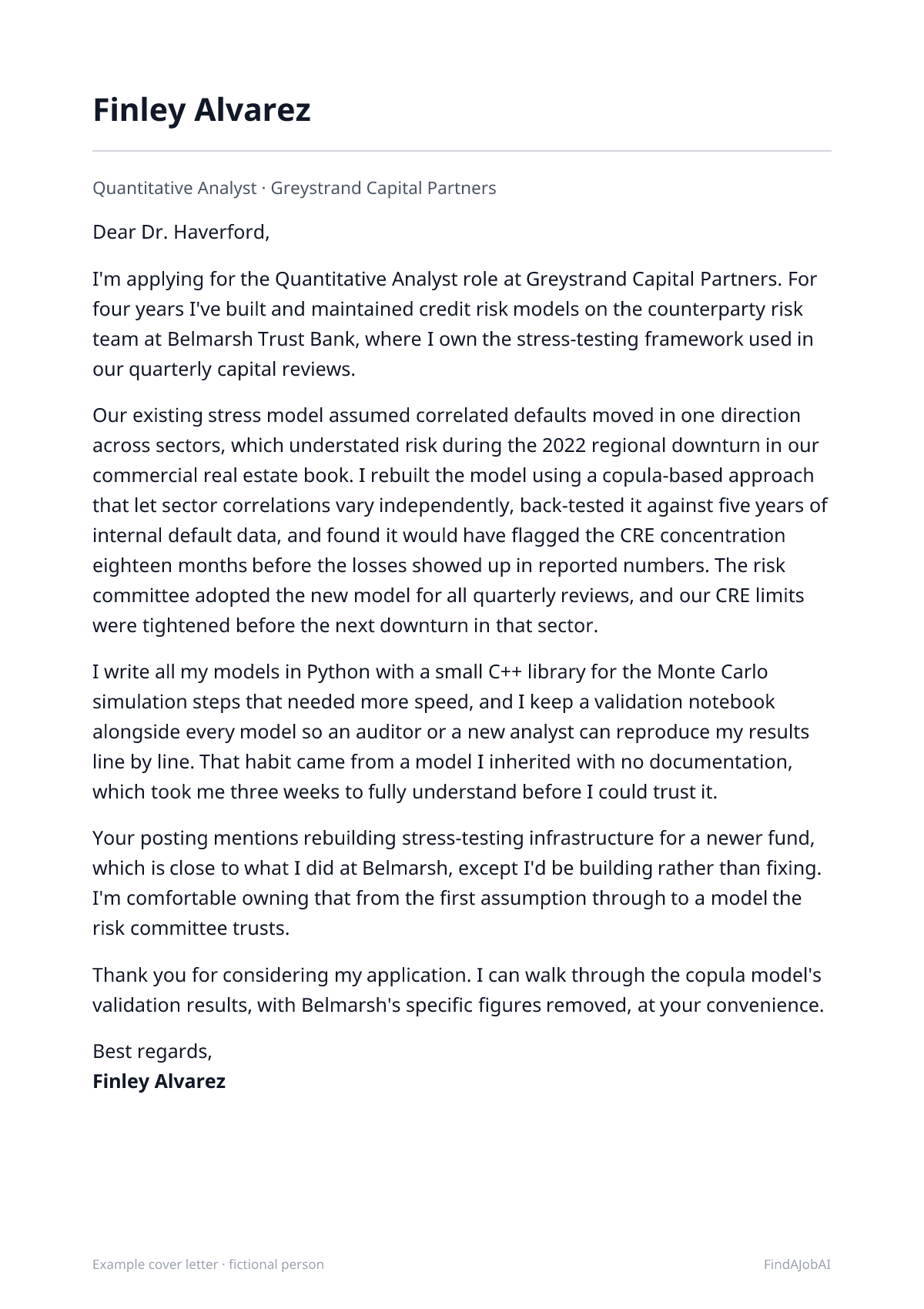
Dear Dr. Haverford,
I'm applying for the Quantitative Analyst role at Greystrand Capital Partners. For four years I've built and maintained credit risk models on the counterparty risk team at Belmarsh Trust Bank, where I own the stress-testing framework used in our quarterly capital reviews.
Our existing stress model assumed correlated defaults moved in one direction across sectors, which understated risk during the 2022 regional downturn in our commercial real estate book. I rebuilt the model using a copula-based approach that let sector correlations vary independently, back-tested it against five years of internal default data, and found it would have flagged the CRE concentration eighteen months before the losses showed up in reported numbers. The risk committee adopted the new model for all quarterly reviews, and our CRE limits were tightened before the next downturn in that sector.
I write all my models in Python with a small C++ library for the Monte Carlo simulation steps that needed more speed, and I keep a validation notebook alongside every model so an auditor or a new analyst can reproduce my results line by line. That habit came from a model I inherited with no documentation, which took me three weeks to fully understand before I could trust it.
Your posting mentions rebuilding stress-testing infrastructure for a newer fund, which is close to what I did at Belmarsh, except I'd be building rather than fixing. I'm comfortable owning that from the first assumption through to a model the risk committee trusts.
Thank you for considering my application. I can walk through the copula model's validation results, with Belmarsh's specific figures removed, at your convenience.
Best regards,
Finley Alvarez
Example 2 · Career changer
Physics PhD moving into quantitative finance
Wendell built particle collision simulations before switching fields. The ad wants someone to build pricing models with no finance background required.
Example letter · fictional
Dear Hiring Manager,
I'm applying for the Junior Quantitative Analyst role at Ferrowind Capital. I completed a PhD in particle physics at Caldwell University, where I spent five years building Monte Carlo simulations of collision data, and I'm now applying that background to financial markets.
My dissertation work involved simulating millions of particle collisions to isolate a rare decay signal from a much larger background of ordinary events, using statistical techniques to separate signal from noise with a known false-positive rate. Translating that into finance, over the past year I've built an options pricing model in Python using Monte Carlo methods, validated it against closed-form Black-Scholes prices for the cases where both apply, and extended it to price a basket option with no closed-form solution, which I couldn't have done without the simulation background from my PhD.
I've also completed coursework in stochastic calculus and a quantitative finance certificate, and I read the Belmarsh Trust risk disclosures and two sell-side research notes on volatility surfaces each week to build market intuition I don't yet have from direct experience.
Your ad says finance experience isn't required if the math and programming are strong, which describes my background closely. I'd bring five years of building and validating models against noisy, high-volume data, plus the discipline of writing code that other researchers could check.
Thank you for your time. My basket option model and its validation notebook are linked on my resume, and I'd welcome the chance to discuss them.
Kind regards,
Wendell Opoku-Hastings
Example 3 · Senior or lead
Quant team lead applying to build a desk's first internal model
Isobel leads three quants at a regional bank. The ad is for a lead quant who will build an options desk's first in-house pricing model.
Example letter · fictional
Dear Mr. Vasquez,
I'm applying for the Lead Quantitative Analyst role at Thorncastle Derivatives Group. For the past three years I've led a team of three quants at Ellingham Capital, where we support the rates and credit desks, and before that I spent six years as a senior quant building fixed income models.
Your ad says the options desk currently prices exotic structures using a vendor model nobody on the desk can fully explain or adjust. We faced a similar handover at Ellingham with our rates desk's inherited curve-building tool. I led a rebuild into an internal model with documented assumptions, ran it in parallel against the vendor tool for two full quarters, and found a systematic pricing gap on long-dated swaps that the vendor tool had been quietly absorbing into its calibration. Once we switched over, desk traders could finally see which assumption drove a given price, and model-related pricing disputes with counterparties dropped from a recurring monthly issue to roughly one a quarter.
On the technical side, I rebuilt the calibration engine in Python with a C++ core for the parts that needed to run intraday, and I set up a daily automated check that compares model output against three independent benchmarks and flags anything outside a tolerance band before traders see the morning numbers. That check has caught two bad market data feeds before they reached a live price.
I haven't built an exotic options pricing model specifically, though I've built and calibrated models of comparable mathematical complexity for interest rate products. At Thorncastle I'd want to spend real time with your traders early to understand which Greeks and edge cases matter most to them before writing a line of code.
I'd welcome a conversation about which pricing disputes or desk frustrations with the current vendor model you'd want solved first.
Sincerely,
Isobel Branwell
All three letters, and the short version below, are fictional: the people, employers and numbers are invented. Borrow the structure, never the facts.
- Prefer to write it yourself? Use the free cover letter template.
- Check your CV against the job first: the free CV score shows the missing keywords.
Why the first letter works, paragraph by paragraph
Paragraph 1: Opening
Names the specific desk (counterparty risk) and the exact responsibility owned (the stress-testing framework), which tells a quant hiring manager the scope of the writer's work immediately.
Paragraph 2: The model rebuild
States the flawed assumption, the technical fix (a copula-based approach), the validation method (back-testing against five years of data), and a concrete institutional result: adopted by the risk committee and tightened limits.
Paragraph 3: Tools and rigor
Names the actual stack (Python, a C++ library for speed) and shows a documentation habit learned from a real frustration, which signals maturity beyond technical skill alone.
Paragraph 4: Why this company
Mirrors the ad's specific need (new stress-testing infrastructure) and distinguishes building from fixing, showing the writer understood the difference in scope.
Paragraph 5: Close
Offers a specific, confidentiality-respecting next step: the validation results with identifying figures removed.
What the career changer's letter does differently
The physics PhD's letter translates dissertation work directly into a finance skill by naming the shared technique (Monte Carlo simulation, signal-to-noise separation) and then showing a self-built, validated pricing model as proof the translation already happened, rather than asking the employer to imagine it.
What the senior letter does differently
A lead quant letter reports team and infrastructure habits, not just one model: a documented rebuild run in parallel for two quarters, an automated daily benchmark check, disputes reduced to a rough frequency instead of a vague improvement. It also names a real gap, exotic options specifically, rather than overclaiming full readiness.
Short quantitative analyst cover letter: an email-ready version
Many applications arrive as an email or a small text box, and a full page doesn't fit. This version runs 120 to 150 words and keeps only what a reader needs to decide whether to reply. A quantitative analyst answers a trading firm's short online application field, sent as an email because the portal's file upload kept timing out.
Short version · email · fictional133 words
Subject: Quantitative Analyst (Python, options pricing) – Taavi Ronkainen
Hello Ms. Okonkwo-Barrett,
I'm applying for the Quantitative Analyst role at Hallowmere Trading. I have three years of experience building options pricing and volatility surface models in Python on a derivatives desk at a regional bank.
My main project was rebuilding our volatility surface interpolation, which produced unstable prices near the edges of our quoted strikes. I switched to a SVI-based parameterization, back-tested it against six months of market data, and cut edge-case mispricing incidents from several per week to nearly zero.
I'm comfortable with Python, basic C++, and stochastic calculus. My resume is attached, and I'm glad to walk through the SVI implementation in more detail. I can also send a short note on how I structured the back-test and what I would check first in your desk's models.
Best,
Taavi Ronkainen
A short application field forces one project, so the short version keeps the volatility surface fix and its concrete result (mispricing incidents down to nearly zero) and drops the documentation and validation detail the longer letters include.
Opening lines that work for quantitative analyst cover letters
The first sentence decides whether the second gets read. Here are six openings, one for each situation you might be in. Pick the one that matches yours and swap in your own facts: every name and number below is invented.
1. You have a standout result
A volatility surface rebuild I led last year cut edge-case mispricing incidents from several per week to nearly zero. I'd like to bring that kind of model work to your desk.
2. The ad names a problem you've solved
Your ad says the desk currently can't explain why its vendor model prices certain structures the way it does. I rebuilt a similar inherited tool into a documented internal model and found a pricing gap the vendor tool had been absorbing silently.
3. Someone referred you
Your head of trading, Benedikt Solheim, and I worked together for a year on curve-building infrastructure, from the quant and trading sides respectively. He mentioned you need someone who can explain a model to traders, not just build one, which is why I'm writing.
4. You admire what they build
I've followed your firm's published research notes on volatility surfaces for two years, and the approach to tail risk in your last note made me want to work on similar problems directly.
5. You're new to the field or switching into it
I spent five years building particle collision simulations in a physics PhD before switching to financial modeling. Quantitative analysis is where I want to keep applying that kind of simulation and validation work.
6. You have senior scope or a specialism
As the quant who's owned our stress-testing framework for four years, I rebuilt it to catch a risk our old model missed entirely. I'm looking for a role with more ownership over a desk's modeling infrastructure.
How to write a quantitative analyst cover letter
Five steps, in the order you'd write them. The shape stays the same for every job (a short opening, proof, a reason for this employer, a close), and what goes into each part is what changes with the role.
Identify the desk and the math this ad actually needs
Quant ads differ by asset class and task: credit risk, options pricing, and algorithmic execution need different math and different stories. Read the ad for the desk and the specific problem it names, then pick a project of yours that used similar methods on similar data.
Open with the question or flaw, not the model
Say what assumption was wrong or what question needed answering, in one or two sentences, before naming the method you used. A reader who sees a real problem in your first paragraph keeps reading past the technical vocabulary.
Explain your validation, not just your result
Quants distrust unvalidated claims more than most readers. Name how you checked your model, back-testing, parallel runs, comparison to a closed-form solution, before stating the result, so the result reads as earned rather than asserted.
Name your stack inside the story of one model
Work Python, C++, R, or specific libraries into the account of what you built and why that tool was the right choice. State the scale of the data or the speed requirement that made the choice matter, rather than listing languages on their own.
Be precise about what you built versus what you used
Distinguish building a model from validating one, calibrating one, or trading off one someone else built. Close by naming a specific gap in your experience and how you'd close it, which reads as more credible than claiming full readiness.
Quantitative Analyst cover letter do's and don'ts
Do
- Name one model or analysis you built or fixed, the assumption it tested, and what changed because of it.
- Name your actual tools (Python, C++, R, specific libraries) inside the story of a model, not as a bare list.
- Mention how you validate your work: back-testing, closed-form comparisons, or documentation that others can check.
- If moving from another quantitative field, name the specific technique that transfers and show one self-built example.
Don't
- Don't claim trading desk experience or P&L responsibility you didn't have; be precise about whether you built, validated, or used a model.
- Don't share your current employer's actual loss figures or proprietary data; use relative changes or anonymized figures.
- Don't list every statistical method you've studied; pick the one that solved a real problem and explain it briefly.
Common quantitative analyst cover letter mistakes
Each one is easy to make and quick to fix before you send the letter.
Listing statistical methods with no application
Naming copulas, SVI, and Monte Carlo methods in a row shows vocabulary, not skill. Pick the one method that solved a real problem and explain briefly what it fixed.
Claiming trading or P&L ownership you didn't have
Being vague about whether you built a model, traded on it, or just used someone else's gets caught quickly in interviews. State your actual role in the model's life cycle clearly.
Skipping how the model was validated
A result with no validation method reads as unverified to a quant reader. Say briefly how you checked it, back-testing, parallel runs, or comparison to a known benchmark, before giving the number.
Overstating readiness for an unfamiliar asset class
Claiming full expertise in a product you've never priced invites a hard technical question you can't answer. Name the closest related work you've done and the specific gap honestly.
Writing finance jargon without a concrete result
Phrases like 'strong quantitative skill set' say nothing a reader can check. Replace them with the one model, its assumption, and the measurable change it produced.
Email subject lines for quantitative analyst applications
Applying by email? Put the job title, any reference number and your name in the subject line.
- Quantitative Analyst application – credit risk and stress testing – Finley Alvarez
- Junior Quantitative Analyst – physics PhD, Monte Carlo methods – Wendell Opoku-Hastings
- Application: Quantitative Analyst, Derivatives Pricing (Req. 3391) – Finley Alvarez
Everything for Quantitative Analysts
- Quantitative Analyst resume exampleA full resume, plus bullet and summary examples
- Quantitative Analyst interview questions30 questions with sample answers
- Quantitative Analyst job descriptionDuties, skills and requirements
- Career change cover letter: template + examples
Other cover letter examples
Quantitative Analyst cover letter FAQ
What should I write in a quantitative analyst cover letter?
One model or analysis you built, the assumption or question it addressed, how you validated it, and what changed because of it. Mention your tools inside that story rather than as a separate list.
How do I write a quantitative analyst cover letter with a non-finance PhD?
Name the specific technique from your research that transfers, such as Monte Carlo simulation or statistical signal extraction, and show a self-built finance project, like a pricing model, that proves you can apply it.
Should I mention specific programming languages in a quant cover letter?
Yes, but attach them to what you built with them. Saying you used Python for a simulation and C++ for the slow part is more convincing than listing five languages with no context.
How technical should a quantitative analyst cover letter be?
Technical enough that a quant reader recognizes the method, but written so the core result, what the model found and what changed, is clear without the reader running the numbers themselves.
How we built this page
The FindAJobAI team wrote the three example letters, the short email version, the opening lines and the advice for quantitative analyst roles. The people, employers and numbers in the letters are invented; the structure, the kind of evidence and the order of the paragraphs are the parts to copy.
Once we track enough live quantitative analyst job ads, this page also shows the skills they ask for most, counted the same way as our in-demand skills report.
Last reviewed on November 1, 2026.