Actuary Resume Example (2026)
By FindAJobAI team Updated How we built this page
Actuary job postings almost always ask for two things up front: your exam progress toward ASA, FSA, FCAS or ACAS, and the line of business you've worked in, whether that's personal auto, health or pensions. What separates strong resumes is evidence that your pricing or reserving work changed a real number, not just a list of methods you've studied. An actuary resume should name the line of business, the method, and what happened to the rate, reserve or loss ratio.
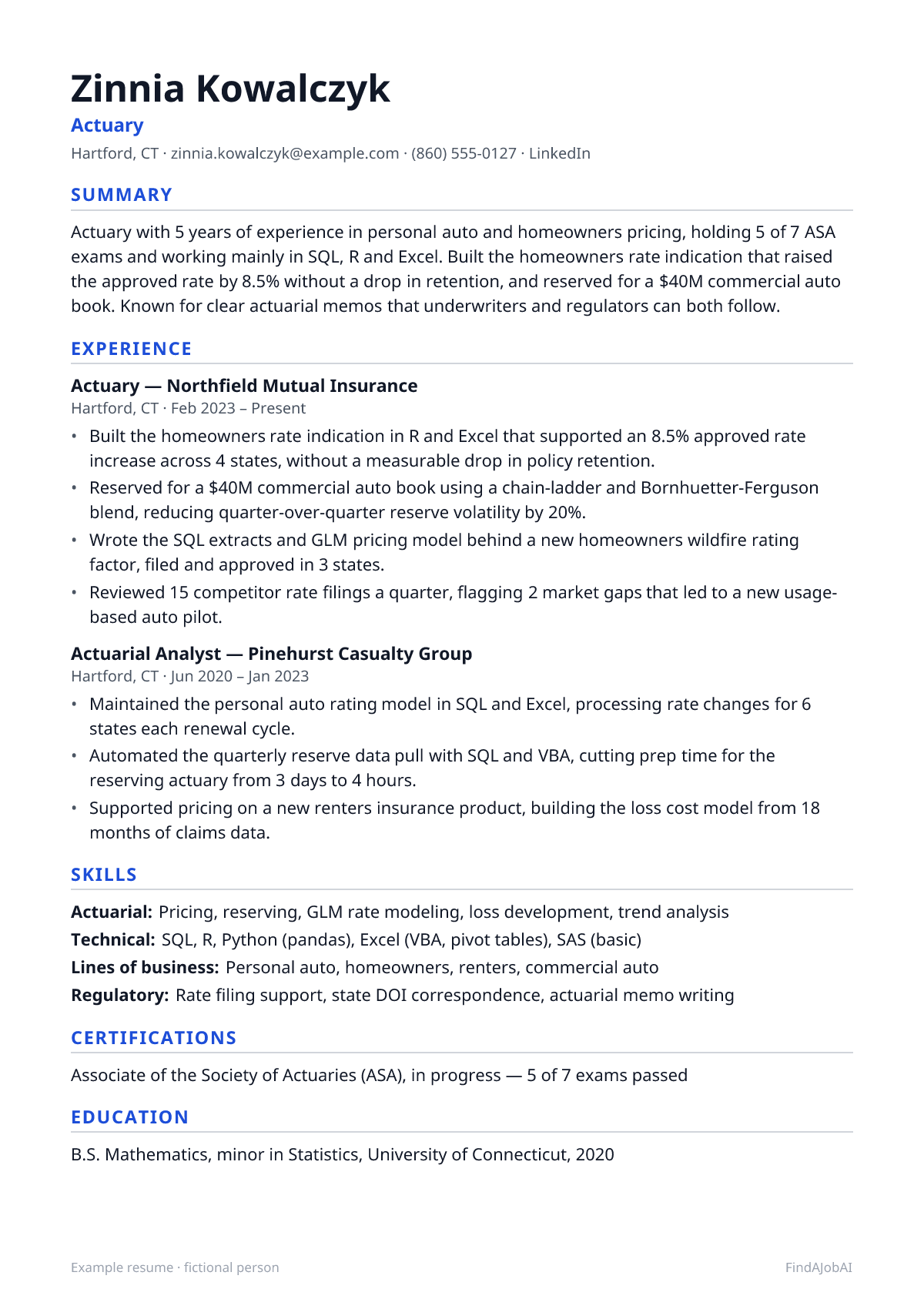
The example below is an actuary with five years split between a pricing analyst role and a slightly broader pricing and reserving role at a personal lines insurer. Notice how each bullet names the method (GLM, chain-ladder, Bornhuetter-Ferguson), the book of business and the result, instead of simply listing exams passed.
Actuary resume template
This example as a one-page template: one column, standard headings and plain text, the format applicant tracking systems read most reliably.
After you sign up, Create my CV builds your own resume in this same one-column layout, from your real experience.
Mid-level actuary resume example
A complete one-page example for a fictional actuary: every bullet pairs an action with what changed because of it.
Example resume · fictional person
Summary
Actuary with 5 years of experience in personal auto and homeowners pricing, holding 5 of 7 ASA exams and working mainly in SQL, R and Excel. Built the homeowners rate indication that raised the approved rate by 8.5% without a drop in retention, and reserved for a $40M commercial auto book. Known for clear actuarial memos that underwriters and regulators can both follow.
Experience
Actuary, Northfield Mutual Insurance
Hartford, CT · Feb 2023 – Present
- Built the homeowners rate indication in R and Excel that supported an 8.5% approved rate increase across 4 states, without a measurable drop in policy retention.
- Reserved for a $40M commercial auto book using a chain-ladder and Bornhuetter-Ferguson blend, reducing quarter-over-quarter reserve volatility by 20%.
- Wrote the SQL extracts and GLM pricing model behind a new homeowners wildfire rating factor, filed and approved in 3 states.
- Reviewed 15 competitor rate filings a quarter, flagging 2 market gaps that led to a new usage-based auto pilot.
Actuarial Analyst, Pinehurst Casualty Group
Hartford, CT · Jun 2020 – Jan 2023
- Maintained the personal auto rating model in SQL and Excel, processing rate changes for 6 states each renewal cycle.
- Automated the quarterly reserve data pull with SQL and VBA, cutting prep time for the reserving actuary from 3 days to 4 hours.
- Supported pricing on a new renters insurance product, building the loss cost model from 18 months of claims data.
Skills
- Actuarial: Pricing, reserving, GLM rate modeling, loss development, trend analysis
- Technical: SQL, R, Python (pandas), Excel (VBA, pivot tables), SAS (basic)
- Lines of business: Personal auto, homeowners, renters, commercial auto
- Regulatory: Rate filing support, state DOI correspondence, actuarial memo writing
Certifications
- Associate of the Society of Actuaries (ASA), in progress — 5 of 7 exams passed
Education
- B.S. Mathematics, minor in Statistics, University of Connecticut, 2020
Fictional example by the FindAJobAI team: the person, employers and numbers are invented. Keep the structure; use your own work and numbers you can explain in an interview.
Entry-level actuary resume example
A recent math graduate with 2 exams passed and one internship in personal auto pricing. Education and exam progress sit right under the summary, and a class project stands in for pricing experience most new grads don't have yet.
Entry-level example resume · fictional person
Thessaly Granger
Actuarial Analyst
Des Moines, IA · [email protected] · (515) 555-0163 · LinkedIn · Portfolio
Summary
Entry-level actuarial analyst with a B.S. in Mathematics, 2 of 7 ASA exams passed, and an internship supporting personal auto pricing at a regional insurer. Built a class project estimating loss reserves on 3 years of public claims data in R, and is comfortable in SQL and Excel. Looking for a first full-time actuarial role in personal or commercial lines.
Education
- B.S. Mathematics, Drake University, 2025
Experience
Actuarial Intern, Cornbelt Mutual Insurance
Des Moines, IA · May 2025 – Aug 2025
- Updated the personal auto rate indication spreadsheet for 2 states, checking loss development factors against 3 years of claims history.
- Wrote SQL queries pulling policy and claims data for 120,000 auto policies, used to test a proposed new rating variable.
- Built a one-page summary of competitor rate filings in 4 states for the pricing team's quarterly review.
Statistics Teaching Assistant, Drake University, Department of Mathematics
Des Moines, IA · Sep 2023 – May 2025
- Graded problem sets and ran weekly review sessions for 45 students in an introductory statistics course.
- Tutored 10 students one-on-one on regression and probability, with 8 improving their course grade by at least one letter.
Skills
- Actuarial: Loss triangles, chain-ladder method, basic GLM concepts, exam-level probability and statistics
- Technical: SQL, R, Excel (pivot tables, VBA basics)
- Exams: P and FM passed; 2 of the remaining 5 ASA exams passed
Certifications
- Exams P and FM passed (2 of 7 ASA exams)
Projects
- Public auto claims reserve estimate (R, chain-ladder): built a loss triangle from 3 years of public claims data and compared results against a Bornhuetter-Ferguson estimate.
- Mortality table analysis (Excel, SQL): analyzed a public mortality dataset to compare select and ultimate mortality rates across 2 cohorts.
Senior actuary resume example
An FSA twelve years in, now leading pricing for a national book and managing a small team. The bullets move from building models to owning the rate review cycle and the pricing budget, and the summary names the premium volume the role is responsible for.
Senior example resume · fictional person
Summary
Senior actuary and FSA with 12 years of experience leading pricing and reserving for a national personal auto book, managing a team of 4 actuarial analysts. Owns the rate indication process behind $300M in annual premium and redesigned the GLM pricing pipeline, cutting the quarterly rate review cycle from 6 weeks to 3. Regularly presents pricing recommendations to the executive committee.
Experience
Senior Actuary, Meridian National Insurance
Bloomington, IL · Jan 2021 – Present
- Lead a team of 4 actuarial analysts covering pricing and reserving for a $300M personal auto book across 22 states.
- Redesigned the GLM pricing pipeline in R and SQL, cutting the quarterly rate review cycle from 6 weeks to 3 and reducing manual data pulls by 80%.
- Presented rate change recommendations to the executive committee quarterly, with 9 of the last 10 filings approved at the requested rate level.
- Set reserve ranges for a $180M book using a blended chain-ladder and Bornhuetter-Ferguson approach, keeping actual-to-expected variance under 4% for 2 straight years.
Actuary, Lakeshore Specialty Insurance
Chicago, IL · Mar 2016 – Dec 2020
- Built the pricing model for a new commercial umbrella product, setting rates that hit the target 65% loss ratio within the first 2 years.
- Managed rate filings in 15 states, responding to DOI objections and keeping average approval time under 60 days.
- Mentored 3 actuarial analysts toward their ASA designation, two of whom passed all required exams within 3 years.
Actuarial Analyst, Redstone Casualty Company
Chicago, IL · Jul 2013 – Feb 2016
- Maintained loss reserve triangles for a $60M workers' comp book, updating quarterly estimates for the appointed actuary's sign-off.
- Automated the monthly claims data refresh in SQL and VBA, cutting a 2-day manual process to under an hour.
Skills
- Actuarial: Pricing, reserving, GLM modeling, rate filing strategy, capital and profitability analysis
- Leadership: Team leadership, executive presentations, mentoring toward ASA/FSA
- Technical: R, SQL, Python, SAS, Excel (VBA)
Certifications
- Fellow of the Society of Actuaries (FSA)
- Associate of the Society of Actuaries (ASA)
Education
- B.S. Actuarial Science, Illinois State University, 2013
How to write an actuary resume
Five steps, in the order a recruiter reads the page. The format around them stays plain for every job: one column, standard headings, newest role first.
Header: name, target title and links
Use the title "Actuary" or "Actuarial Analyst" to match your actual level, and state your exam progress (e.g., "ASA, 5 of 7 exams passed") right in the header area or summary, since it's one of the first filters recruiters apply.
Summary: what you do and your best proof
Name your exam progress, the lines of business you've priced or reserved, and your main tools, then one result: a rate approved, a reserve variance tightened or a filing that cleared review. Skip vague lines like "strong analytical skills"; every actuarial candidate has a math background.
Experience: newest first, a result in every bullet
Open each bullet with the method (GLM, chain-ladder, Bornhuetter-Ferguson) or the line of business, then the result: a rate change, a reserve accuracy figure or a filing outcome. Listing exams passed in a bullet says little; a model that changed a real rate says a lot.
Skills: grouped, in the ad's words
Group them into actuarial methods, technical tools and lines of business. Put your exam progress in its own line or certifications section rather than burying it in a skills list, since it's often searched separately.
Education and certifications
List your degree, year and exam progress (such as 'ASA, 5 of 7 exams passed') clearly, ideally near the top. Without full-time experience, add a Projects section with one or two analyses using public claims or mortality data, each stating its method and result.
Skills to put on an actuary resume
Hard skills are the tools and methods of the job; soft skills are how you work with people. Each comes with one way to prove it, because a skill named only in a list counts for little. Add the ones you really have.
Hard skills
- SQL
- Name the size of the dataset you queried (policies, claims) and the model or report it fed.
- R
- Point to a specific model you built in it, such as a GLM or loss triangle, and its result.
- Python
- Mention a script you wrote that automated a recurring actuarial task and the time it saved.
- SAS
- If the ad lists it, mention the size of the production dataset or process you ran in it.
- Excel (VBA)
- Describe a model or report you automated with VBA and the manual hours it replaced.
- GLM rate modeling
- Name the line of business and a rating variable your model added or changed.
- Loss reserving methods
- Name the method (chain-ladder or Bornhuetter-Ferguson), the book size and how close actual results came to your estimate.
- Rate filing support
- Name the state and the approved rate change your memo or exhibits supported.
- Trend analysis
- Give the trend you measured (frequency, severity) and the action it led to.
- Loss ratio and profitability analysis
- Tie a model to a target loss ratio and whether the product hit it.
Soft skills
- Actuarial memo writing
- Describe a memo that carried a filing through regulator questions without a rate cut.
- Stakeholder communication
- Give an example of translating a model's output into terms underwriters or executives acted on.
- Attention to detail
- Mention an error in data or assumptions you caught before it reached a filing or reserve sign-off.
- Mentoring
- Count analysts you've mentored toward exams and how many passed.
- Prioritization
- State how many filings, models or requests you manage at once and how you sequence them.
- Cross-team collaboration
- Describe working with underwriting, claims or finance to settle on a shared number.
Actuary resume bullet examples: weak vs strong
The same work, written two ways. The strong version names the tool, the scope and a result; the numbers are examples, yours must be real.
Weak: Performed pricing analysis.
Strong: Built a GLM pricing model for a new renters product using 18 months of claims data, setting base rates that beat the prior manual rating plan's loss ratio by 6 points in year one.
Names the method, the data and a measurable pricing result.
Weak: Responsible for reserving.
Strong: Set quarterly reserves for a $55M workers' comp book using a Bornhuetter-Ferguson method, keeping actual-to-expected development within 3% for 6 straight quarters.
Shows the reserving method and how accurate it turned out to be.
Weak: Worked on rate filings.
Strong: Drafted the actuarial memo supporting a 6.2% homeowners rate filing in Ohio, answering 4 rounds of DOI objections without a rate reduction.
Ties filing work to a concrete regulatory outcome.
Weak: Used SQL and Excel.
Strong: Wrote SQL queries pulling 3 years of claims transactions for 400,000 policies, replacing a manual Access process that took 2 analysts a full week each quarter.
Quantifies the data and the manual work it replaced.
Weak: Analyzed loss trends.
Strong: Found that a 2-point jump in auto severity trend was concentrated in 3 ZIP codes with new repair shops, leading underwriting to add a regional rating factor.
A specific finding tied to an underwriting action.
15 more actuary resume bullet examples
Grouped by area of the job, so you can find the ones closest to your work. Keep the shape (action, scope, result) and replace the invented numbers with your own.
Pricing
- Built a GLM model adding a credit-tier rating variable to personal auto, improving the model's Gini coefficient from 0.28 to 0.34.
- Repriced a homeowners book after 2 years of elevated wildfire losses, raising rates by 11% in the 3 highest-risk territories.
- Set rates for a new pet insurance product using 4 years of industry loss data, targeting a 70% loss ratio in year one.
- Found that a proposed telematics discount would have cut premium by 9% with no change in expected loss, and recommended a smaller discount instead.
Reserving
- Set quarterly reserves for a $75M general liability book using a Bornhuetter-Ferguson method, keeping variance to actual under 5%.
- Rebuilt the loss development triangles for a discontinued product line, closing a reserve gap of $1.8M flagged in an internal audit.
- Reviewed IBNR estimates for 6 lines of business each quarter, presenting the summary to the appointed actuary for sign-off.
- Reserved a $25M book of surety bonds with limited loss history, blending company and industry benchmark data.
Rate filings and regulation
- Drafted the actuarial memo for an 8.5% homeowners rate filing, answering 3 rounds of DOI objections without a rate reduction.
- Managed rate filings in 12 states for a new commercial auto product, keeping average approval time under 55 days.
- Responded to a market conduct exam request by reconstructing 2 years of rate change history across 5 states within a 2-week deadline.
- Coordinated with legal and compliance on a rate filing appeal, which recovered 2 points of a previously denied rate increase.
Data and automation
- Automated the monthly loss triangle refresh in Python, cutting a 2-day manual process to about 20 minutes.
- Wrote SQL queries pulling 5 years of claims data for 500,000 policies, replacing a manual Access process run by 2 analysts.
- Built a shared data dictionary for 40 actuarial fields, ending repeated questions about which premium field to use.
Actuary resume summary examples
Two or three lines on what you do and your strongest proof. Start from the one closest to your level and use your own facts.
Actuarial analyst with a math degree, 2 of 7 ASA exams passed, and an internship supporting personal auto pricing at a regional insurer. Built a class project estimating loss reserves on 3 years of public claims data in R. Comfortable in SQL and Excel, looking for a first full-time actuarial role.
Actuary with 5 years in personal lines pricing and reserving, holding 5 of 7 ASA exams, working in SQL, R and Excel. Built a homeowners rate indication that supported an 8.5% approved increase and reserved a $40M commercial auto book with a chain-ladder and Bornhuetter-Ferguson blend.
Senior actuary and FSA with 12 years of experience leading pricing for a national personal auto book, managing 4 actuarial analysts. Owns the rate indication process behind $300M in annual premium and redesigned the company's GLM pricing pipeline, cutting the quarterly rate review cycle from 6 weeks to 3.
Common actuary resume mistakes
Each one is easy to make and quick to fix before you apply.
Burying exam progress in the Education section
Recruiters and ATS filters often search for exam counts directly. State your progress plainly, such as '5 of 7 ASA exams passed,' in the summary or a dedicated certifications line.
Listing methods with no business result
GLM, chain-ladder and Bornhuetter-Ferguson in Skills show what you know; the bullets must show what changed because you used them, like a rate, reserve or loss ratio.
No line of business named
Personal auto, homeowners, health and commercial actuaries solve different problems. Name the lines you've worked in so a hiring manager can match you to their book.
Skipping the size of the book you worked on
A $5M book and a $300M book call for different judgment. State the premium or reserve size you were responsible for.
ATS tips for an actuary resume
Applicant tracking systems turn your file into text that recruiters search, mostly for the skills and titles in the ad. They rarely reject a resume on their own; one that parses badly or misses the ad's words just doesn't come up.
- State your exam progress precisely (e.g., '5 of 7 ASA exams passed') since recruiters and ATS filters look for exact exam counts.
- Name the lines of business you've priced or reserved (personal auto, homeowners, commercial, health) rather than just 'insurance.'
- List the tools you actually used for modeling (SQL, R, Python, SAS, Excel/VBA), since ads often name a specific stack.
- Describe a pricing or reserving result (a rate change approved, a reserve variance reduced) instead of only listing methods you know.
For the format itself, run the free ATS resume checklist.
Everything for Actuaries
- Actuary cover letter examplesThree example letters and a short email version
- Actuary job descriptionDuties, skills and requirements
- How to tailor your resume without lying
Other resume examples
Actuary resume FAQ
What should an actuary put on a resume if exams aren't finished?
State your exact exam progress, such as '4 of 7 ASA exams passed,' and the lines of business you've worked in. Employers expect exams in progress below the Fellowship level and want to see applied pricing or reserving work alongside them.
Should an actuary resume list every software tool from school?
List tools you've used on the job or in a substantial project, such as SQL, R, Python or SAS, and tie at least one to a specific model or analysis. Tools only touched in a single class add little.
How technical should actuary resume bullets be?
Name the method (GLM, chain-ladder, Bornhuetter-Ferguson) so another actuary recognizes it, but close each bullet with a business result, like a rate change approved or a reserve variance reduced, so non-actuaries can follow it too.
Do actuary resumes need a certifications section?
Yes. List your designation progress (ASA, FSA, FCAS, ACAS) and exam count separately from Education, since it's one of the first things recruiters and resume screens look for.
How we built this page
The FindAJobAI team wrote the three example resumes, the bullets, the skills and the advice for actuary roles. The people, employers and numbers in the examples are invented; the structure, the tools and the way each bullet is built are the parts to copy.
Once we track enough live actuary job ads, this page also shows the skills they ask for most, counted the same way as our in-demand skills report.
Last reviewed on November 1, 2026.