Risk Analyst Resume Example (2026)
By FindAJobAI team Updated How we built this page
Risk analyst postings usually ask for a mix of quantitative tools (SQL, Python, Excel, sometimes SAS) and the judgment to explain what a model's output should mean for a lending, capital or operational decision. The resumes that stand out name the risk measured, the model or method used, and what changed because of the finding.
The example below has six years split between a regional bank and a mid-size insurer, moving from running reports to owning a portfolio's credit risk monitoring. Each bullet pairs a specific risk question with the method used and the decision or dollar figure it affected.
Risk Analyst resume template
This example as a one-page template: one column, standard headings and plain text, the format applicant tracking systems read most reliably.
After you sign up, Create my CV builds your own resume in this same one-column layout, from your real experience.
Mid-level risk analyst resume example
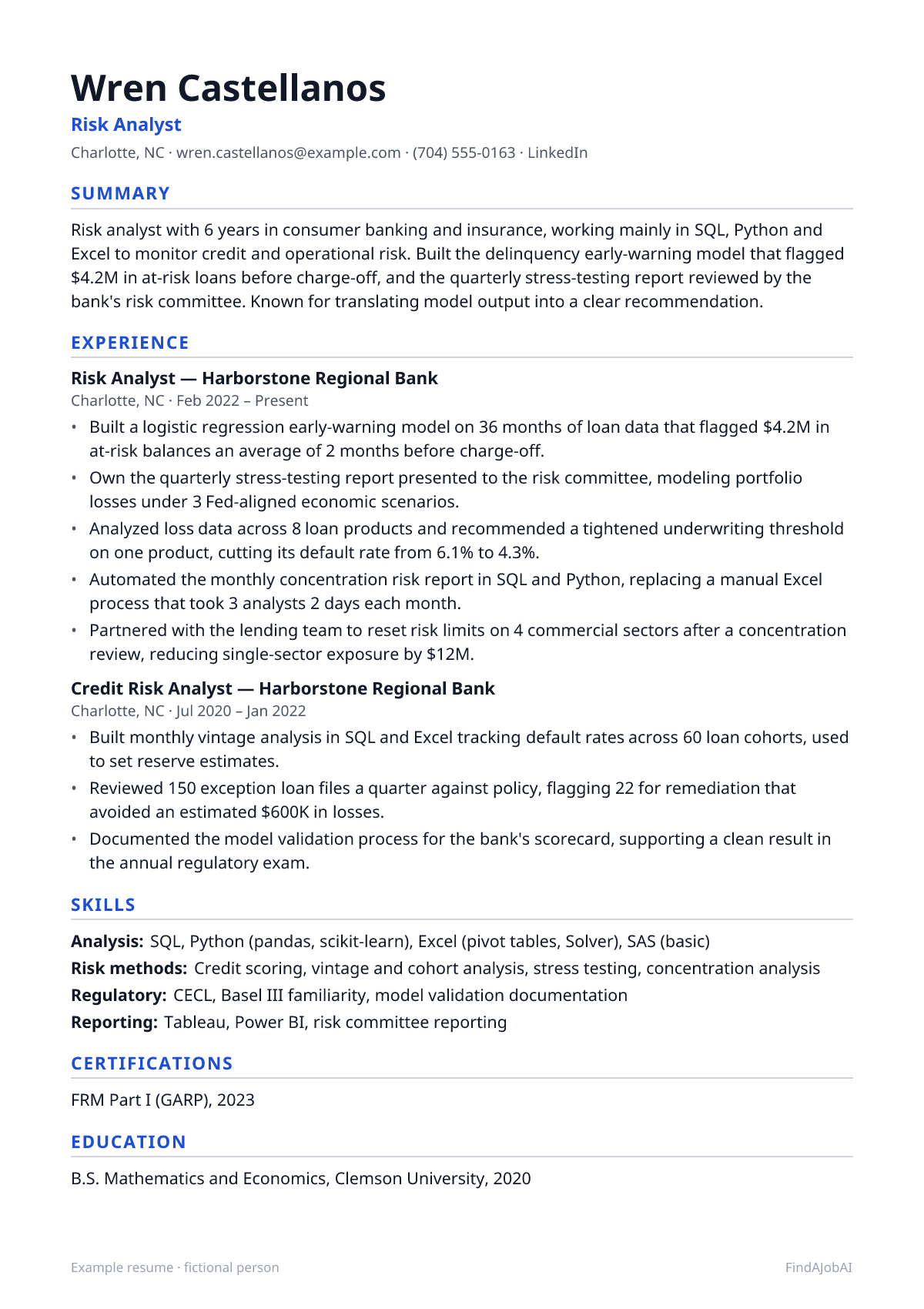
A complete one-page example for a fictional risk analyst: every bullet pairs an action with what changed because of it.
Example resume · fictional person
Summary
Risk analyst with 6 years in consumer banking and insurance, working mainly in SQL, Python and Excel to monitor credit and operational risk. Built the delinquency early-warning model that flagged $4.2M in at-risk loans before charge-off, and the quarterly stress-testing report reviewed by the bank's risk committee. Known for translating model output into a clear recommendation.
Experience
Risk Analyst, Harborstone Regional Bank
Charlotte, NC · Feb 2022 – Present
- Built a logistic regression early-warning model on 36 months of loan data that flagged $4.2M in at-risk balances an average of 2 months before charge-off.
- Own the quarterly stress-testing report presented to the risk committee, modeling portfolio losses under 3 Fed-aligned economic scenarios.
- Analyzed loss data across 8 loan products and recommended a tightened underwriting threshold on one product, cutting its default rate from 6.1% to 4.3%.
- Automated the monthly concentration risk report in SQL and Python, replacing a manual Excel process that took 3 analysts 2 days each month.
- Partnered with the lending team to reset risk limits on 4 commercial sectors after a concentration review, reducing single-sector exposure by $12M.
Credit Risk Analyst, Harborstone Regional Bank
Charlotte, NC · Jul 2020 – Jan 2022
- Built monthly vintage analysis in SQL and Excel tracking default rates across 60 loan cohorts, used to set reserve estimates.
- Reviewed 150 exception loan files a quarter against policy, flagging 22 for remediation that avoided an estimated $600K in losses.
- Documented the model validation process for the bank's scorecard, supporting a clean result in the annual regulatory exam.
Skills
- Analysis: SQL, Python (pandas, scikit-learn), Excel (pivot tables, Solver), SAS (basic)
- Risk methods: Credit scoring, vintage and cohort analysis, stress testing, concentration analysis
- Regulatory: CECL, Basel III familiarity, model validation documentation
- Reporting: Tableau, Power BI, risk committee reporting
Certifications
- FRM Part I (GARP), 2023
Education
- B.S. Mathematics and Economics, Clemson University, 2020
Fictional example by the FindAJobAI team: the person, employers and numbers are invented. Keep the structure; use your own work and numbers you can explain in an interview.
Entry-level risk analyst resume example
A finance graduate with one risk-focused internship and a credit union teller job she's framing for analytical value. Education sits right under the summary, and a capstone default-prediction project stands in for the portfolio experience she doesn't have yet.
Entry-level example resume · fictional person
Perpetua Ashwell
Risk Analyst
Richmond, VA · [email protected] · (804) 555-0198 · LinkedIn · Portfolio
Summary
Entry-level risk analyst with a B.S. in Finance and a summer internship in a bank's credit risk group. Built a logistic regression default-prediction model on public loan data for a capstone project, and supported vintage reporting during the internship. Comfortable in SQL, Excel and Python, and looking for a first full-time risk role in banking.
Education
- B.S. Finance, Virginia Commonwealth University, 2026
Experience
Credit Risk Intern, Willowmere Savings Bank
Richmond, VA · Jun 2026 – Aug 2026
- Supported monthly vintage analysis in Excel and SQL tracking default rates across 20 loan cohorts for the consumer lending team.
- Built a Tableau dashboard of past-due balances by branch that 5 underwriters checked weekly during the internship.
- Reviewed 60 loan files against underwriting policy and flagged 4 for manager review that were missing required income documentation.
Member Services Representative, Oakleigh Community Credit Union
Richmond, VA · Sep 2024 – May 2026
- Processed loan applications and payment exceptions for 40 members a week, learning firsthand which documentation gaps caused delays.
- Flagged unusual account activity to the fraud team twice, both confirmed as early signs of account takeover attempts.
Skills
- Analysis: SQL (PostgreSQL), Excel (pivot tables, Solver), Python (pandas, scikit-learn)
- Risk methods: Credit scoring basics, vintage analysis, ratio analysis
- Regulatory: CECL (coursework), Basel III (coursework)
Certifications
- FRM Part I (GARP), in progress
Projects
- Consumer loan default model (Python, scikit-learn): built a logistic regression model on a public lending dataset of 50,000 loans, reaching 74% accuracy on a holdout set at predicting default.
- Sector concentration analysis (Excel): analyzed 5 years of public bank call-report data to compare commercial real estate concentration across 10 regional banks.
Senior risk analyst resume example
A senior risk analyst ten years in, now owning a multi-billion-dollar portfolio's monitoring and presenting directly to a board risk committee. The bullets move from building individual reports to setting the stress-testing framework and mentoring a small team.
Senior example resume · fictional person
Fitzgerald Okonkwo-Reyes
Senior Risk Analyst
Minneapolis, MN · [email protected] · (612) 555-0145 · LinkedIn
Summary
Senior risk analyst with 10 years across banking and insurance, leading credit risk monitoring for a $3B loan portfolio and presenting quarterly to the board's risk committee. Owns the stress-testing framework adopted bank-wide and mentors 3 analysts in model validation, scenario design and regulatory reporting.
Experience
Senior Risk Analyst, Northfield Trust Bank
Minneapolis, MN · Mar 2021 – Present
- Lead credit risk monitoring for a $3B loan portfolio, presenting quarterly findings and recommendations directly to the board's risk committee.
- Designed the bank's CCAR-aligned stress-testing framework, modeling losses under 4 economic scenarios and informing a $9M increase in loan loss reserves.
- Built the early-warning model layer that flagged $14M in at-risk commercial exposure 3 months ahead of the prior manual process.
- Mentor 3 risk analysts on model validation and regulatory documentation, cutting the time to pass annual exam review by about a third.
- Led the concentration review that reset limits across 6 industry sectors, reducing single-sector exposure by $40M after a construction-sector buildup.
Risk Analyst, Birchwood Mutual Insurance
St. Paul, MN · Jan 2017 – Feb 2021
- Modeled underwriting loss ratios across 8 commercial lines, input to pricing decisions covering $400M in annual premium.
- Built the operational risk incident tracker adopted company-wide, cutting the average time to escalate a reportable incident from 9 days to 2.
- Automated the monthly reserve adequacy report in SAS and Excel, replacing a process that previously took 2 analysts a full week.
Junior Risk Analyst, Birchwood Mutual Insurance
St. Paul, MN · Aug 2015 – Dec 2016
- Tracked claims severity trends across 5 regions in Excel, supporting the actuarial team's quarterly reserve estimates.
- Reviewed 100 underwriting exception files a quarter, flagging 12 for policy review each quarter on average.
Skills
- Analysis: SQL, Python (pandas, statsmodels), SAS, Excel
- Risk methods: CCAR-style stress testing, credit scoring, concentration analysis, operational risk tracking
- Leadership: Board and committee reporting, mentoring analysts, framework design, exam readiness
Certifications
- FRM (GARP), 2019
Education
- B.S. Economics, University of Minnesota, 2015
How to write a risk analyst resume
Five steps, in the order a recruiter reads the page. The format around them stays plain for every job: one column, standard headings, newest role first.
Header: name, target title and links
Use the title “Risk Analyst” even if yours was Credit Analyst or Risk Associate, and specify the risk type (credit, market, operational) in your headline or summary; hiring managers search for their specific type first.
Summary: what you do and your best proof
Name the portfolio size or risk type you cover, your core tools, and one result: a decision, limit or reserve your analysis changed. Avoid lines like "detail-oriented risk professional"; they say nothing a reviewer can verify.
Experience: newest first, a result in every bullet
Open each bullet with the risk question or portfolio, then the method and the result: what you modeled, measured or monitored, and what changed because of it. A list of reports produced says less than one finding that moved a limit or reserve.
Skills: grouped, in the ad's words
Group into analysis tools, risk methods and regulatory frameworks. Name the specific framework (CECL, Basel III, CCAR) only if you've actually worked within it, and put your strongest tool (often SQL or Excel) first.
Education and certifications
List your degree with the year, plus a certification like FRM or PRM if you hold one or are pursuing it. Without direct risk experience, add a Projects section with one default or loss model built on public data, stating its method and result.
Skills to put on a risk analyst resume
Hard skills are the tools and methods of the job; soft skills are how you work with people. Each comes with one way to prove it, because a skill named only in a list counts for little. Add the ones you really have.
Hard skills
- SQL
- Name the portfolio or dataset you queried and a specific risk metric, like delinquency rate, that the query produced.
- Excel
- Mention features like Solver or pivot tables next to a reserve, limit or ratio calculation they supported.
- Python (pandas, scikit-learn)
- Name a model you built, what it predicts, and its accuracy or lift on holdout data.
- SAS
- If the job lists it, mention a specific report or model you built or maintained in it.
- Credit scoring
- Name the model type (logistic regression, scorecard) and the default or delinquency rate it predicts.
- Stress testing
- Name the scenario framework (CCAR-style, internal) and a reserve or capital decision it informed.
- Concentration analysis
- Give the number of sectors or counterparties reviewed and a limit that changed as a result.
- Vintage or cohort analysis
- State how many loan or policy cohorts you tracked and what the trend was used for.
- Value at Risk (VaR)
- Name the portfolio size and how your VaR report changed in speed or accuracy.
- CECL or Basel III familiarity
- Mention a reserve or capital calculation you supported under the framework, even as a contributor.
- Model validation
- Give how many models you validated or documented and the exam or audit outcome.
Soft skills
- Translating analysis into recommendations
- Give one example where your finding led directly to a limit, reserve or policy change.
- Committee or board presentation
- State how often you present and to whom, naming the body if you can.
- Attention to detail
- Mention an error or exception you caught before it reached a regulator or committee, with its size.
- Cross-team collaboration
- Name the team (underwriting, lending, actuarial) you partnered with and the change that resulted.
- Regulatory awareness
- Reference a specific exam or audit your work supported and its outcome.
- Prioritization under deadline
- Give your reporting cadence (weekly, monthly, quarterly) and how you handled a tight deliverable.
- Mentoring
- Count analysts you trained and a skill, like model documentation, they picked up.
Risk Analyst resume bullet examples: weak vs strong
The same work, written two ways. The strong version names the tool, the scope and a result; the numbers are examples, yours must be real.
Weak: Analyzed risk data.
Strong: Analyzed 18 months of delinquency data by region and found 3 branches with default rates double the portfolio average, prompting a targeted underwriting review.
Names the data, the finding and the action it triggered.
Weak: Built risk models.
Strong: Built a logistic regression model predicting 90-day delinquency with 78% accuracy on holdout data, now run monthly against the active loan book.
A model claim backed by a measurable accuracy figure and its use.
Weak: Monitored portfolio risk.
Strong: Tracked exposure concentration across 12 industry sectors and flagged a construction-sector buildup that led the committee to cut its lending limit by $8M.
Monitoring shown through a specific risk caught and its outcome.
Weak: Prepared risk reports.
Strong: Automated the weekly VaR report for a $200M trading book, cutting preparation time from 6 hours to 40 minutes.
Turns a reporting task into a measured time saving with scale.
Weak: Worked on stress testing.
Strong: Modeled portfolio losses under 3 CCAR-style scenarios, presenting results to the risk committee that informed a $5M increase in loan loss reserves.
Stress testing tied to a specific dollar decision it informed.
15 more risk analyst resume bullet examples
Grouped by area of the job, so you can find the ones closest to your work. Keep the shape (action, scope, result) and replace the invented numbers with your own.
Credit risk modeling
- Built a scorecard model on 24 months of consumer loan data, improving default prediction accuracy from 68% to 76% over the prior rules-based approach.
- Segmented the auto loan portfolio into 5 risk tiers, giving underwriting a basis to tighten approval terms on the riskiest tier.
- Backtested the bank's existing credit scorecard against 18 months of outcomes, identifying a 4-point drop in predictive power that triggered a model refresh.
- Analyzed recovery rates across 300 charged-off accounts, informing a change in collections strategy projected to recover an extra $280K a year.
Stress testing and scenario analysis
- Modeled portfolio losses under a severe recession scenario, estimating a $22M capital impact that shaped the bank's contingency funding plan.
- Ran sensitivity analysis on 3 macroeconomic variables against loan performance, isolating unemployment rate as the strongest single predictor of default.
- Built the scenario library used in quarterly stress tests, covering 4 economic paths reviewed each cycle by the risk committee.
Monitoring and reporting
- Automated the weekly exposure report for a $500M trading desk, cutting preparation time from 5 hours to 45 minutes.
- Built a dashboard tracking covenant compliance across 80 commercial borrowers, flagging 6 breaches an average of 3 weeks earlier than the prior manual review.
- Reduced a quarterly risk report from 40 pages to 12 by cutting unused metrics, based on a usage review with the committee's chair.
- Tracked early-delinquency trends across 15 branches, surfacing a regional spike that led to a targeted collections outreach program.
Policy and governance
- Reviewed underwriting policy exceptions across 400 files a year, recommending 2 policy changes that cut exception volume by a quarter.
- Documented model assumptions and limitations for 5 risk models, supporting a clean result in the bank's annual regulatory exam.
- Partnered with compliance to update the risk appetite statement's quantitative limits, aligning them with 3 years of observed loss data.
- Trained 12 loan officers on updated risk flagging criteria, cutting misclassified high-risk applications by about 40% over the following quarter.
Risk Analyst resume summary examples
Two or three lines on what you do and your strongest proof. Start from the one closest to your level and use your own facts.
Risk analyst with a finance degree and an internship in a bank's credit risk group. Built a logistic regression default model on public loan data for a capstone project and supported monthly vintage reporting as an intern. Comfortable in SQL, Excel and Python.
Risk analyst with 4 years in auto lending, working in SQL, Python and SAS to monitor credit risk across a $600M loan portfolio. Built the early-delinquency dashboard used by 10 underwriters and an analysis that cut a key product's default rate by 2 points.
Senior risk analyst with 10 years across banking and insurance, leading credit risk monitoring for a $3B loan portfolio. Owns the stress-testing framework presented to the board's risk committee and mentors 3 analysts in model validation and regulatory reporting.
Common risk analyst resume mistakes
Each one is easy to make and quick to fix before you apply.
Not naming the risk type
Credit, market and operational risk call for different skills and tools. State which one your experience covers so the resume matches the specific opening.
Reporting activity without a resulting decision
"Prepared risk reports" says you did a task. Name the finding in one report and the limit, reserve or policy decision it led to.
Vague portfolio size
A $50M portfolio and a $3B portfolio require different judgment. State an approximate size so reviewers can calibrate your experience.
Overclaiming model ownership
If you contributed to a model a senior analyst owned, say so; claiming full ownership you can't defend in an interview undermines credibility.
Skipping regulatory context
Mentioning CECL, Basel III or a specific exam you supported signals real exposure to regulatory risk work, which many ads specifically screen for.
ATS tips for a risk analyst resume
Applicant tracking systems turn your file into text that recruiters search, mostly for the skills and titles in the ad. They rarely reject a resume on their own; one that parses badly or misses the ad's words just doesn't come up.
- Name the specific risk type (credit, market, operational) since ATS systems and hiring managers both search for it directly.
- State the portfolio or exposure size your analysis covered; a $50M portfolio and a $3B portfolio call for different experience.
- Mention any regulatory framework you've worked with by name, such as CECL, Basel III or CCAR, if your experience includes it.
- Describe models by what they predict and their measured accuracy or lift, not just the modeling technique used.
- If you've presented to a risk committee or similar body, say so directly; it signals you can translate analysis into a recommendation.
For the format itself, run the free ATS resume checklist.
Everything for Risk Analysts
- Risk Analyst cover letter examplesThree example letters and a short email version
- Risk Analyst interview questions30 questions with sample answers
- Risk Analyst job descriptionDuties, skills and requirements
- How to tailor your resume without lying
Other resume examples
Risk Analyst resume FAQ
What skills should a risk analyst resume highlight?
SQL and Excel are close to universal, and Python or SAS matter more as portfolios get larger. Beyond tools, show a specific risk method (credit scoring, stress testing, VaR) and a finding that changed a limit, reserve or underwriting decision.
How do I write a risk analyst resume with no direct risk experience?
Count analytical work from adjacent roles, such as credit underwriting, financial analysis or audit, since the core skills (data analysis, policy judgment, clear reporting) transfer directly. A project modeling default or loss on public data also helps.
Should I mention certifications like FRM or PRM on a risk analyst resume?
Yes, list them, especially if you're early in your career; they signal familiarity with risk frameworks employers would otherwise have to teach you. They matter less once you have several years of portfolio results to show instead.
How specific should I get about dollar amounts and portfolio size?
As specific as you can without disclosing confidential figures; approximate numbers ("a $200M portfolio", "roughly $1.2M in avoided losses") are standard and expected in this field.
How we built this page
The FindAJobAI team wrote the three example resumes, the bullets, the skills and the advice for risk analyst roles. The people, employers and numbers in the examples are invented; the structure, the tools and the way each bullet is built are the parts to copy.
Once we track enough live risk analyst job ads, this page also shows the skills they ask for most, counted the same way as our in-demand skills report.
Last reviewed on November 1, 2026.