Business Systems Analyst Resume Example (2026)
By FindAJobAI Team Updated How we built this page
Business systems analyst resumes are read by systems managers who want to know three things: which platforms you know, whether you can carry a change from a vague request to a tested release, and whether business users ended up better off. A list of methods and tools answers none of those.
The example below belongs to an analyst with five years supporting NetSuite and Salesforce at two mid-sized companies. Each bullet names the system, the change and a result such as hours saved, tickets reduced or a cleaner close, so a hiring manager can judge the scope of the work.
Business Systems Analyst resume template
This example as a one-page template: one column, standard headings and plain text, the format applicant tracking systems read most reliably.
After you sign up, Create my CV builds your own resume in this same one-column layout, from your real experience.
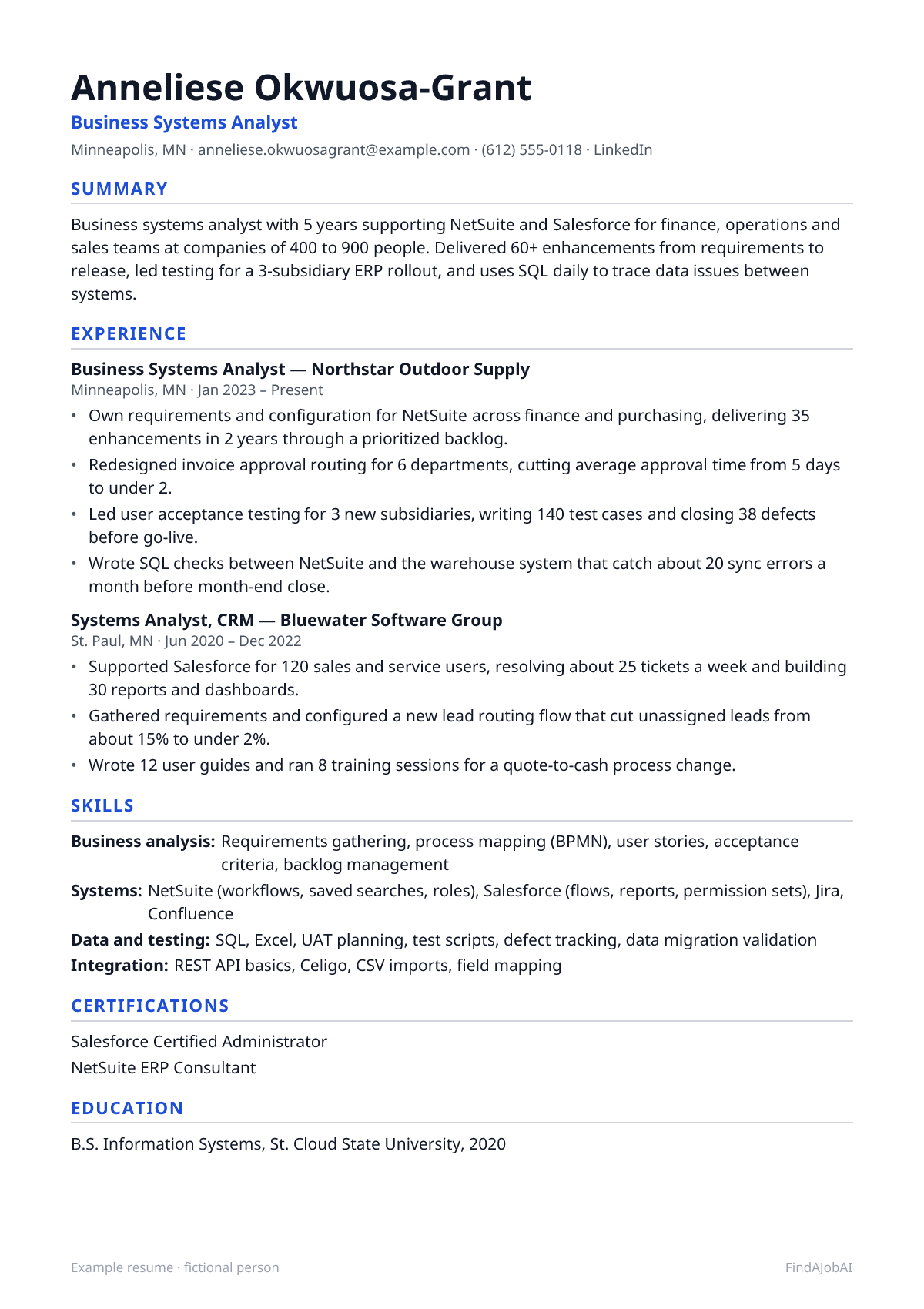
Mid-level business systems analyst resume example
A complete one-page example for a fictional business systems analyst: every bullet pairs an action with what changed because of it.
Example resume · fictional person
Anneliese Okwuosa-Grant
Business Systems Analyst
Minneapolis, MN · [email protected] · (612) 555-0118 · LinkedIn
Summary
Business systems analyst with 5 years supporting NetSuite and Salesforce for finance, operations and sales teams at companies of 400 to 900 people. Delivered 60+ enhancements from requirements to release, led testing for a 3-subsidiary ERP rollout, and uses SQL daily to trace data issues between systems.
Experience
Business Systems Analyst, Northstar Outdoor Supply
Minneapolis, MN · Jan 2023 – Present
- Own requirements and configuration for NetSuite across finance and purchasing, delivering 35 enhancements in 2 years through a prioritized backlog.
- Redesigned invoice approval routing for 6 departments, cutting average approval time from 5 days to under 2.
- Led user acceptance testing for 3 new subsidiaries, writing 140 test cases and closing 38 defects before go-live.
- Wrote SQL checks between NetSuite and the warehouse system that catch about 20 sync errors a month before month-end close.
Systems Analyst, CRM, Bluewater Software Group
St. Paul, MN · Jun 2020 – Dec 2022
- Supported Salesforce for 120 sales and service users, resolving about 25 tickets a week and building 30 reports and dashboards.
- Gathered requirements and configured a new lead routing flow that cut unassigned leads from about 15% to under 2%.
- Wrote 12 user guides and ran 8 training sessions for a quote-to-cash process change.
Skills
- Business analysis: Requirements gathering, process mapping (BPMN), user stories, acceptance criteria, backlog management
- Systems: NetSuite (workflows, saved searches, roles), Salesforce (flows, reports, permission sets), Jira, Confluence
- Data and testing: SQL, Excel, UAT planning, test scripts, defect tracking, data migration validation
- Integration: REST API basics, Celigo, CSV imports, field mapping
Certifications
- Salesforce Certified Administrator
- NetSuite ERP Consultant
Education
- B.S. Information Systems, St. Cloud State University, 2020
Fictional example by the FindAJobAI team: the person, employers and numbers are invented. Keep the structure; use your own work and numbers you can explain in an interview.
Entry-level business systems analyst resume example
A first systems role applicant coming from operations, so the ERP super user work carries the resume. Education is near the top, and bullets show testing, reports and documentation, which a hiring manager reads as early business systems experience.
Entry-level example resume · fictional person
Tomasz Achebe-Holloway
Junior Business Systems Analyst
Milwaukee, WI · [email protected] · (414) 555-0193 · LinkedIn
Summary
Junior business systems analyst with 2 years as an operations coordinator and the team's go-to user for Microsoft Dynamics. Wrote 60 test cases for a system upgrade, builds reports for 3 departments and completed a 40-hour SQL course with weekly practice on real data.
Education
- B.B.A. Supply Chain Management, University of Wisconsin–Milwaukee, 2023
Experience
Operations Coordinator, Lakeshore Medical Supply
Milwaukee, WI · Jul 2023 – Present
- Volunteered for UAT on a Microsoft Dynamics upgrade, writing 60 test cases for order processing and finding 7 defects fixed before go-live.
- Built 14 reports for customer service, purchasing and finance, replacing 4 weekly spreadsheets.
- Documented 9 order-to-cash procedures with screenshots, now used in onboarding for every new coordinator.
- Answered about 15 system questions a week from colleagues, logging recurring issues for the IT team.
Skills
- Systems: Microsoft Dynamics 365 (sales orders, reporting), Jira, Confluence
- Analysis: Process mapping, test cases, requirements notes, user guides
- Data: SQL (intermediate), Excel (pivot tables, lookups), Power BI basics
Training and projects
- SQL for Data Analysis (40 hours, online): joins, aggregations and data quality checks practiced on a public retail dataset.
- Mapped the returns process for a local food bank in BPMN as a volunteer, helping them cut handoffs between 3 volunteers.
Senior business systems analyst resume example
A senior analyst with eleven years who now leads analysis for a large replacement program. Bullets cover scope decisions, team leadership, data migration and cutover, and the summary states company size and the platform being replaced.
Senior example resume · fictional person
Valentina Rasmussen-Obi
Senior Business Systems Analyst
Boston, MA · [email protected] · (617) 555-0141 · LinkedIn
Summary
Senior business systems analyst with 11 years in ERP and CRM programs, leading 3 analysts on a Workday Financials replacement for a 3,000-person company. Owns requirements, data migration validation and cutover planning, working closely with architects, vendors and finance leaders.
Experience
Senior Business Systems Analyst, Harborlight Health Network
Boston, MA · Mar 2021 – Present
- Lead 3 analysts on a Workday Financials program replacing a 15-year-old ERP, covering general ledger, procurement and expenses.
- Cut the initial scope from 400 requests to 120 must-haves with finance leaders, keeping release 1 on its planned date.
- Designed migration validation with 50 SQL reconciliation checks, clearing 3 test loads with 0 balance differences.
- Ran a 6-week cutover plan with 180 tasks across 7 teams, completing go-live over 1 weekend.
Business Systems Analyst, Copley Financial Advisors
Boston, MA · Aug 2017 – Feb 2021
- Owned Salesforce requirements for 250 advisors and service staff, delivering 4 releases a year.
- Replaced a manual client onboarding checklist with a guided flow, cutting onboarding time from 10 days to 4.
- Wrote integration specifications for 5 systems, including the portfolio platform and document management.
Systems Analyst, Copley Financial Advisors
Boston, MA · Jun 2014 – Jul 2017
- Supported 3 internal systems for about 300 users, resolving 40 tickets a week.
- Built 25 operational reports used in weekly management meetings.
Skills
- Leadership: Analyst team lead, scope management, stakeholder workshops, steering updates
- Systems: Workday Financials, Salesforce, Oracle E-Business Suite, ServiceNow
- Data: SQL, migration validation, reconciliation, data mapping, Excel
- Delivery: Cutover planning, UAT strategy, release management, Jira, Confluence
Certifications
- IIBA Certified Business Analysis Professional (CBAP)
- Workday Pro Financials
Education
- M.S. Information Systems, Northeastern University, 2014
- B.A. Economics, University of Massachusetts Amherst, 2012
How to write a business systems analyst resume
Five steps, in the order a recruiter reads the page. The format around them stays plain for every job: one column, standard headings, newest role first.
Header: name, target title and links
Use “Business Systems Analyst” and, if helpful, the platform, such as “Business Systems Analyst, NetSuite”. Add your city, LinkedIn and whether you work hybrid or remote.
Summary: what you do and your best proof
Open with years in systems work, the platforms and teams you support and one large delivery, such as a rollout or upgrade. Mention SQL if you use it regularly.
Experience: newest first, a result in every bullet
Write each bullet as the change, the system and the result: workflows configured, tests run, tickets reduced, hours saved or defects caught. Avoid bullets that only list meetings attended or documents produced.
Skills: grouped, in the ad's words
Group skills into analysis, systems, data and testing, and integration. Name modules, not just platforms, and keep tools you barely used out of the list.
Education and certifications
List your degree and year; information systems, business or computer science are common. Add certifications such as CBAP or platform administrator credentials in their own section.
Skills to put on a business systems analyst resume
Hard skills are the tools and methods of the job; soft skills are how you work with people. Each comes with one way to prove it, because a skill named only in a list counts for little. Add the ones you really have.
Hard skills
- Requirements gathering
- Say how you gathered them, such as workshops or shadowing, and what they became.
- Process mapping
- Mention processes you mapped and the change the map led to.
- ERP configuration
- Name the platform and module, and what you configured, such as workflows or roles.
- CRM administration
- Give the user count and the flows, reports or permissions you built.
- SQL
- Describe a real use, such as reconciling data or validating a migration.
- User acceptance testing
- Give the number of test cases, testers and defects found before release.
- Data migration
- Explain how you checked that migrated data matched the source.
- Integration specifications
- Mention the systems connected and how developers used your specs.
- Reporting and dashboards
- Say who used your reports and which decisions they supported.
- Backlog management
- Show how you prioritized requests with system owners.
- Documentation
- Mention guides, release notes or design docs and who relies on them.
Soft skills
- Facilitation
- Describe a workshop where you brought different teams to an agreed design.
- Translation between business and IT
- Give an example of turning a business complaint into a precise technical change.
- Prioritization
- Show how you reduced a long request list to what mattered most.
- Curiosity
- Explain how you dug into a data issue to find the real cause.
- Patience with users
- Mention training or support that helped reluctant users adopt a change.
- Clear writing
- Point to requirements or guides others used without needing you to explain them.
- Ownership
- Describe following a change through go-live and the weeks after.
Business Systems Analyst resume bullet examples: weak vs strong
The same work, written two ways. The strong version names the tool, the scope and a result; the numbers are examples, yours must be real.
Weak: Gathered requirements from stakeholders.
Strong: Ran 9 workshops with finance and procurement to map the purchase-to-pay process, producing 42 user stories that became the next 2 releases.
Shows the method, the output and how it fed real delivery.
Weak: Configured the ERP system.
Strong: Configured 15 NetSuite workflows and 40 saved searches in 2025, removing 3 manual spreadsheets from the monthly close.
Names the platform, the work and a concrete business benefit.
Weak: Did testing.
Strong: Planned and ran UAT for a CRM upgrade with 18 business testers and 200 test cases, signing off with no severity-one defects open.
Adds scale and a clear quality outcome.
Weak: Supported users.
Strong: Handled about 30 tier-2 tickets a week and turned the 5 most common issues into fixes, cutting ticket volume by roughly a quarter.
Shows you fix causes, not just symptoms.
Weak: Used SQL for analysis.
Strong: Wrote SQL to reconcile 18 months of order data during a migration, finding 2,300 duplicate customer records before cutover.
Gives a real use of SQL and the risk it removed.
Weak: Gave developers specs.
Strong: Wrote specifications for 8 integrations between Salesforce and the billing system, with developers needing 1 round of clarification on average.
Shows requirement quality from the people who used them.
15 more business systems analyst resume bullet examples
Grouped by area of the job, so you can find the ones closest to your work. Keep the shape (action, scope, result) and replace the invented numbers with your own.
Requirements and design
- Shadowed 6 warehouse staff for 2 days before writing requirements, finding 3 steps missing from the official process.
- Wrote 80 user stories with acceptance criteria for a CRM release, accepted by the product owner without rework.
- Mapped 12 finance processes in BPMN ahead of an ERP selection, used by 3 vendors in their demos.
- Cut a 90-item enhancement backlog to 25 priorities in 1 quarter by scoring requests with system owners.
Configuration and delivery
- Configured approval workflows for 4 expense types, reducing rejected expense reports by about a third.
- Built 20 Salesforce flows that replaced manual case assignment for a 40-person service team.
- Delivered 6 releases a year with release notes and short videos for each change.
- Set up role-based permissions for 300 users, passing 2 internal access audits with no findings.
Testing and data
- Ran regression testing on 2 major platform updates a year, catching 11 issues before production.
- Wrote 35 SQL queries for a monthly data quality report, cutting duplicate vendor records by 70%.
- Validated 1.2 million migrated records with reconciliation checks before cutover.
Support and training
- Trained 150 users across 5 sessions on a new purchasing process, with help tickets falling within 1 month.
- Created a 20-article knowledge base for common NetSuite tasks, viewed by most finance staff in its first quarter.
- Acted as tier-2 support for 2 platforms, resolving 85% of escalations without vendor help.
- Ran 4 lunch-and-learn sessions on saved searches, after which ad hoc report requests to IT fell by about half.
Business Systems Analyst resume summary examples
Two or three lines on what you do and your strongest proof. Start from the one closest to your level and use your own facts.
Junior business systems analyst with 2 years as an operations coordinator and the team's go-to user for the ERP. Wrote 60 test cases for a system upgrade, builds saved searches and reports, and completed a 40-hour SQL course with weekly practice on real data.
Business systems analyst with 5 years supporting NetSuite and Salesforce for finance and sales teams. Delivered 60+ enhancements, led UAT for a 3-subsidiary ERP rollout and uses SQL daily to trace data issues.
Senior business systems analyst with 11 years in ERP and CRM programs, leading a team of 3 analysts on a Workday Financials replacement for a 3,000-person company. Owns requirements, data migration validation and cutover planning with architects and vendors.
Common business systems analyst resume mistakes
Each one is easy to make and quick to fix before you apply.
Listing methods instead of changes
Replace “agile, BPMN, UAT” lists with bullets showing what you delivered using them and what improved.
Naming platforms without modules
Write “NetSuite procurement and AP” rather than just “NetSuite”, so a hiring manager can match your experience.
Leaving out the business result
Every change helped someone. Add the time saved, error reduced or process simplified.
Overstating technical depth
Describe what you configured yourself and what developers built from your specifications, so interviews hold no surprises.
ATS tips for a business systems analyst resume
Applicant tracking systems turn your file into text that recruiters search, mostly for the skills and titles in the ad. They rarely reject a resume on their own; one that parses badly or misses the ad's words just doesn't come up.
- Name the platforms and modules you've worked in near the top, since many roles are tied to one system.
- Show the full change cycle in at least one bullet: request, requirements, configuration, testing and result.
- Give SQL a real use, such as reconciling data or validating a migration, not just a skill list entry.
- Measure results in time saved, tickets reduced, defects caught or manual steps removed.
- List platform certifications such as Salesforce Administrator in their own section.
For the format itself, run the free ATS resume checklist.
Everything for Business Systems Analysts
- Business Systems Analyst cover letter examplesThree example letters and a short email version
- Business Systems Analyst interview questions30 questions with sample answers
- Business Systems Analyst job descriptionDuties, skills and requirements
- How to tailor your resume without lying
Other resume examples
Business Systems Analyst resume FAQ
What should a business systems analyst resume highlight?
The systems you know, the changes you delivered from requirements to go-live, your testing and data skills, and results for business users. Name platforms and modules so hiring managers can match you to their stack.
How do I move into business systems analysis without the title?
Highlight systems work you already do: UAT on upgrades, reports and saved searches, process documentation, data reconciliation or acting as a super user. Add SQL or platform training and describe results in numbers.
Should I list every system I've used?
List the ones you have configured or supported in depth, with the modules. Brief exposure to a tool can go in a skills line, but don't present it as experience you could defend in an interview.
How we built this page
The FindAJobAI team wrote the three example resumes, the bullets, the skills and the advice for business systems analyst roles. The people, employers and numbers in the examples are invented; the structure, the tools and the way each bullet is built are the parts to copy.
Once we track enough live business systems analyst job ads, this page also shows the skills they ask for most, counted the same way as our in-demand skills report.
Last reviewed on November 1, 2026.