Embedded Software Engineer Resume Example (2026)
By FindAJobAI team Updated How we built this page
Embedded software job ads tend to name a language (C, C++), an RTOS or bare-metal environment, and a class of hardware: microcontrollers, sensors, communication protocols like SPI, I2C or CAN. What separates candidates is evidence they debugged something at the hardware boundary, not just wrote application code.
The example below is an embedded engineer with five years split between an industrial sensor company and a consumer electronics startup. Each bullet names the chip or protocol, the problem at the hardware level and the measured result, instead of listing languages known.
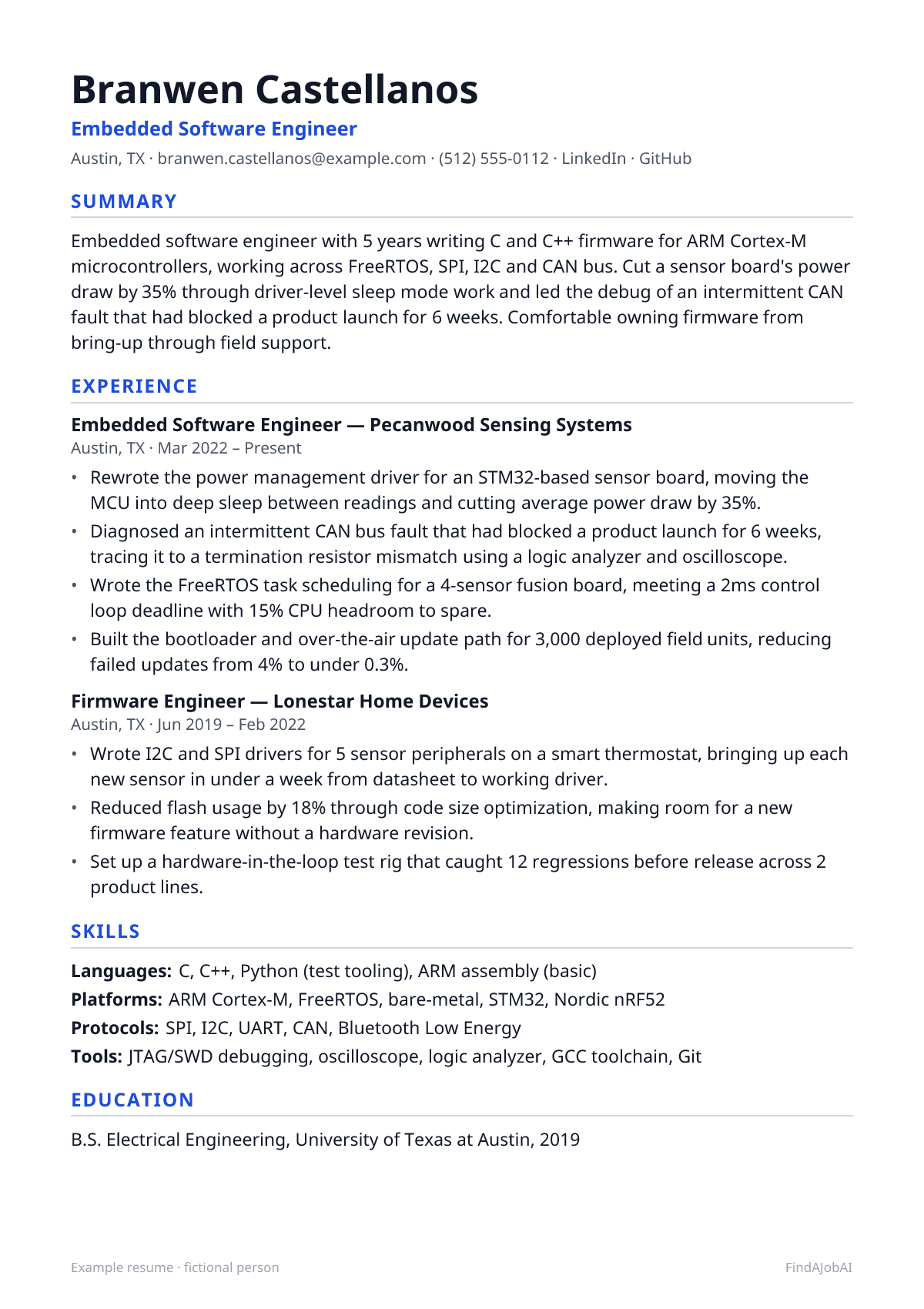
Embedded Software Engineer resume template
This example as a one-page template: one column, standard headings and plain text, the format applicant tracking systems read most reliably.
After you sign up, Create my CV builds your own resume in this same one-column layout, from your real experience.
Mid-level embedded software engineer resume example
A complete one-page example for a fictional embedded software engineer: every bullet pairs an action with what changed because of it.
Example resume · fictional person
Branwen Castellanos
Embedded Software Engineer
Austin, TX · [email protected] · (512) 555-0112 · LinkedIn · GitHub
Summary
Embedded software engineer with 5 years writing C and C++ firmware for ARM Cortex-M microcontrollers, working across FreeRTOS, SPI, I2C and CAN bus. Cut a sensor board's power draw by 35% through driver-level sleep mode work and led the debug of an intermittent CAN fault that had blocked a product launch for 6 weeks. Comfortable owning firmware from bring-up through field support.
Experience
Embedded Software Engineer, Pecanwood Sensing Systems
Austin, TX · Mar 2022 – Present
- Rewrote the power management driver for an STM32-based sensor board, moving the MCU into deep sleep between readings and cutting average power draw by 35%.
- Diagnosed an intermittent CAN bus fault that had blocked a product launch for 6 weeks, tracing it to a termination resistor mismatch using a logic analyzer and oscilloscope.
- Wrote the FreeRTOS task scheduling for a 4-sensor fusion board, meeting a 2ms control loop deadline with 15% CPU headroom to spare.
- Built the bootloader and over-the-air update path for 3,000 deployed field units, reducing failed updates from 4% to under 0.3%.
Firmware Engineer, Lonestar Home Devices
Austin, TX · Jun 2019 – Feb 2022
- Wrote I2C and SPI drivers for 5 sensor peripherals on a smart thermostat, bringing up each new sensor in under a week from datasheet to working driver.
- Reduced flash usage by 18% through code size optimization, making room for a new firmware feature without a hardware revision.
- Set up a hardware-in-the-loop test rig that caught 12 regressions before release across 2 product lines.
Skills
- Languages: C, C++, Python (test tooling), ARM assembly (basic)
- Platforms: ARM Cortex-M, FreeRTOS, bare-metal, STM32, Nordic nRF52
- Protocols: SPI, I2C, UART, CAN, Bluetooth Low Energy
- Tools: JTAG/SWD debugging, oscilloscope, logic analyzer, GCC toolchain, Git
Education
- B.S. Electrical Engineering, University of Texas at Austin, 2019
Fictional example by the FindAJobAI team: the person, employers and numbers are invented. Keep the structure; use your own work and numbers you can explain in an interview.
Entry-level embedded software engineer resume example
A new graduate with a drone firmware co-op and a senior capstone project filling in for work history. Education sits right under the summary, and the project bullets name the board and the specific bug or feature rather than just the course.
Entry-level example resume · fictional person
Percival Adeyinka
Embedded Software Engineer
Atlanta, GA · [email protected] · (404) 555-0176 · LinkedIn · GitHub
Summary
Entry-level embedded software engineer with a B.S. in Computer Engineering from Georgia Tech and a 6-month co-op writing C firmware for a drone flight controller. Wrote drivers for an IMU and GPS module and debugged a sensor timing issue using an oscilloscope. Comfortable with ARM Cortex-M, FreeRTOS and SPI/I2C.
Education
- B.S. Computer Engineering, Georgia Institute of Technology, 2025
Experience
Embedded Firmware Co-op, Peachtree Aerial Robotics
Atlanta, GA · May 2025 – Oct 2025
- Wrote the SPI driver for an IMU on a Cortex-M4 flight controller, bringing it from datasheet to working readings in 4 days.
- Debugged a GPS module that dropped fixes intermittently, tracing it to a UART baud rate mismatch found using a logic analyzer.
- Added a watchdog timer to the flight control loop, recovering from 3 simulated fault conditions without a full reboot.
Undergraduate Research Assistant, Georgia Tech, School of Electrical and Computer Engineering
Atlanta, GA · Jan 2024 – May 2025
- Built a FreeRTOS-based data logger for a lab's wind tunnel sensors, sampling 6 channels at 1kHz without missing a deadline.
- Wrote test scripts in Python to validate sensor output against a reference instrument, catching a calibration drift in 1 of 8 units.
Skills
- Languages: C, C++, Python (test scripts)
- Platforms: ARM Cortex-M, FreeRTOS, STM32, Nordic nRF52
- Protocols: SPI, I2C, UART, BLE basics
Projects
- Capstone: autonomous rover (C, FreeRTOS, nRF52): wrote the motor control and BLE telemetry firmware for a 4-wheel rover, tuning PID gains that cut path deviation from 15cm to 4cm over a 10-meter run.
- Home weather station (STM32, I2C): built a sensor board reading temperature, humidity and pressure over I2C, with a low-power sleep mode that extended battery life from 2 days to 9 days.
Senior embedded software engineer resume example
A senior engineer ten years in, now leading a safety-critical team. The bullets move from writing individual drivers to owning architecture, certification and field failure rates, and the summary names the team size and the standard the product meets.
Senior example resume · fictional person
Ingrid Vashchenko
Senior Embedded Software Engineer
Detroit, MI · [email protected] · (313) 555-0188 · LinkedIn
Summary
Senior embedded engineer with 10 years across industrial and automotive firmware, leading a team of 5 engineers on a safety-critical braking controller certified to ISO 26262 ASIL-C. Owns architecture decisions for 3 product lines and has cut field failure rates by half through better fault handling and diagnostics.
Experience
Senior Embedded Software Engineer, Ironbridge Automotive Systems
Detroit, MI · Apr 2020 – Present
- Lead a team of 5 engineers building firmware for a braking controller certified to ISO 26262 ASIL-C, owning the fault detection and safe-state architecture.
- Redesigned the diagnostic trouble code system across 3 ECU variants, cutting average field failure diagnosis time from 2 days to 3 hours.
- Drove a root-cause investigation into a CAN bus timing fault found in 1 of 4,000 units in the field, shipping a fix that reduced the fault rate to under 1 in 200,000.
- Set coding standards aligned to MISRA C across the team's 4 firmware repositories, cutting static analysis findings by 70% over 2 quarters.
Embedded Software Engineer, Great Lakes Industrial Controls
Detroit, MI · Jul 2016 – Mar 2020
- Owned firmware for a motor controller shipped in 15,000 units a year, maintaining a 5ms control loop deadline under full load.
- Built the bootloader and firmware update system used across 6 product variants, supporting field updates with zero bricked units in 2 years.
- Migrated a legacy bare-metal codebase to FreeRTOS, cutting a recurring missed-deadline bug from 1 in 500 units to effectively zero.
Firmware Engineer, Saginaw Valley Electronics
Saginaw, MI · Aug 2014 – Jun 2016
- Wrote CAN and LIN bus drivers for a dashboard cluster, passing a 500-hour continuous bus-load test with zero dropped messages.
- Reduced flash usage by 22% through code size optimization, avoiding a costly flash chip upgrade across a product line.
Skills
- Languages: C, C++, some Rust (prototyping), Python (tooling)
- Platforms: ARM Cortex-M/R, FreeRTOS, AUTOSAR basics, bare-metal
- Leadership: Safety certification (ISO 26262), MISRA C compliance, mentoring, architecture reviews
Certifications
- ISO 26262 Functional Safety Engineer, 2021
Education
- B.S. Electrical Engineering, Michigan State University, 2014
How to write an embedded software engineer resume
Five steps, in the order a recruiter reads the page. The format around them stays plain for every job: one column, standard headings, newest role first.
Header: name, target title and links
Use the title “Embedded Software Engineer” or “Firmware Engineer,” matching the ad, and link a GitHub with at least one repo showing driver or firmware code. A link to only web projects undercuts an embedded application.
Summary: what you do and your best proof
Name your language (C or C++), your MCU family or RTOS, and one measured result such as a power, timing or memory improvement. Skip general claims like “strong coding skills” that don't name hardware.
Experience: newest first, a result in every bullet
Open each bullet with the chip, peripheral or protocol, then the problem and the measured result: timing in milliseconds, power in milliwatts, memory in kilobytes. A bullet naming only a language used says less than one naming what the firmware had to achieve.
Skills: grouped, in the ad's words
Group into languages, platforms (MCU family, RTOS) and protocols (SPI, I2C, CAN, BLE). List the debugging tools you use (oscilloscope, logic analyzer, JTAG) since they signal hands-on hardware work.
Education and certifications
List your degree and year, plus any safety certification (ISO 26262) or embedded-specific coursework. Without industry experience, add a Projects section naming the board, protocol and a measured result for each project.
Skills to put on an embedded software engineer resume
Hard skills are the tools and methods of the job; soft skills are how you work with people. Each comes with one way to prove it, because a skill named only in a list counts for little. Add the ones you really have.
Hard skills
- C
- Point to a driver or subsystem you wrote in C and a measured result, such as timing or memory footprint.
- C++
- Name the embedded context (object-oriented driver layer, state machine) and avoid implying desktop-only C++ use.
- FreeRTOS
- Mention task count, priorities or a scheduling bug you fixed, such as priority inversion.
- ARM Cortex-M
- Name the specific family (M0, M4, M7) and a project built on it, since ads often specify one.
- SPI / I2C
- Name the peripheral you drove over the bus and how long bring-up took from datasheet to working code.
- CAN bus
- Give the number of devices or message types and a test or fault you resolved on the bus.
- JTAG/SWD debugging
- Describe a bug you found by stepping through hardware registers or breakpoints at the chip level.
- Oscilloscope / logic analyzer
- Name the signal you captured and the timing or protocol issue it revealed.
- Bootloaders / OTA updates
- Give the number of deployed units and the update failure rate before and after your work.
- RTOS scheduling
- State a deadline (in ms) your task met and the CPU headroom or margin you achieved.
- MISRA C / static analysis
- Mention the number of findings reduced or the repositories brought into compliance.
- Power management
- Give the power draw before and after a sleep mode or clock-gating change you made.
Soft skills
- Hardware-software collaboration
- Describe working with a hardware engineer to resolve a signal integrity or layout issue.
- Methodical debugging
- Walk through a bug from symptom to root cause, naming the tool that found it.
- Documentation
- Reference a driver interface or register map you documented that another engineer reused.
- Patience under constraints
- Describe optimizing for a tight memory or timing budget and what you gave up or kept.
- Field support mindset
- Mention a diagnostic feature you added that sped up resolving issues in deployed units.
- Mentoring
- Count junior engineers you onboarded to a codebase or hardware platform.
- Risk awareness
- Describe catching a fault condition before it shipped, naming the testing or review that caught it.
Embedded Software Engineer resume bullet examples: weak vs strong
The same work, written two ways. The strong version names the tool, the scope and a result; the numbers are examples, yours must be real.
Weak: Wrote firmware in C.
Strong: Wrote the C firmware driving a motor controller's PWM output, tuning the switching frequency to cut audible whine reported by 3 pilot customers.
Names the subsystem, the specific change and the complaint it resolved.
Weak: Debugged hardware issues.
Strong: Traced a board that failed 1 in 50 units at power-on to a race condition in the clock startup sequence, found using a logic analyzer trace of the boot timing.
Shows the failure rate, the tool used and the root cause found.
Weak: Worked with RTOS.
Strong: Restructured a FreeRTOS task priority scheme after a missed sensor deadline was traced to priority inversion, restoring the 5ms control loop margin.
Names the RTOS problem by type and the measurable fix.
Weak: Optimized code for performance.
Strong: Profiled a sensor fusion loop and moved a floating-point filter to fixed-point math, cutting per-cycle CPU time from 1.8ms to 0.6ms on a Cortex-M4.
States the before and after timing with the specific chip.
Weak: Implemented communication protocols.
Strong: Implemented a CAN bus message layer for 8 device types, passing a 72-hour bus-load stress test with zero dropped frames.
Ties the protocol work to a concrete test and its pass result.
Weak: Supported product launches.
Strong: Supported the field launch of 3,000 units by building remote log capture into the firmware, which cut average field-issue diagnosis time from 3 days to 4 hours.
Connects firmware work to a measurable support outcome.
15 more embedded software engineer resume bullet examples
Grouped by area of the job, so you can find the ones closest to your work. Keep the shape (action, scope, result) and replace the invented numbers with your own.
Drivers and peripherals
- Wrote a UART driver with DMA for a sensor board, reducing CPU interrupt load from 12% to 2% at full data rate.
- Brought up an SPI flash driver for a new board revision in 3 days, including wear-leveling for 100,000 write cycles.
- Wrote a PWM-based motor driver with current sensing, adding a fault cutoff that prevented 2 motor burnouts during stress testing.
- Implemented a BLE GATT service for a wearable device, passing interoperability testing with 4 different phone models.
Debugging and hardware issues
- Found a brown-out reset occurring in 1 of 200 units, traced to a decoupling capacitor value using an oscilloscope, fixed in the next board revision.
- Resolved an I2C bus lockup occurring under cold temperatures by adding a bus recovery sequence, eliminating the fault across 500 field units.
- Used a JTAG debugger to isolate a stack overflow causing random reboots, fixed by resizing 2 task stacks.
- Diagnosed a 40ms latency spike in a control loop to a blocking flash write, moved to a background task to restore real-time margin.
Performance and optimization
- Cut firmware boot time from 800ms to 220ms by deferring non-critical peripheral initialization.
- Reduced RAM usage by 30% on a memory-constrained Cortex-M0 part by replacing dynamic allocation with static buffers.
- Optimized an interrupt service routine from 45 to 8 microseconds, removing a bottleneck in a high-speed sampling loop.
Testing and reliability
- Built a hardware-in-the-loop test rig simulating 6 fault conditions, catching 9 regressions before a firmware release.
- Wrote unit tests for a CAN message parser using a mocked bus layer, reaching 85% branch coverage on critical paths.
- Ran a 72-hour soak test on a new sensor board, catching a memory leak that would have caused a reboot every 40 hours in the field.
- Set up automated flashing and smoke testing for 3 board revisions, cutting manual test time per release from 4 hours to 30 minutes.
Embedded Software Engineer resume summary examples
Two or three lines on what you do and your strongest proof. Start from the one closest to your level and use your own facts.
Embedded software engineer with a B.S. in Computer Engineering and a co-op writing firmware for a drone flight controller. Wrote C drivers for an IMU and GPS module and debugged a sensor timing issue using an oscilloscope. Comfortable with ARM Cortex-M, FreeRTOS and SPI/I2C.
Embedded software engineer with 5 years writing C and C++ firmware for ARM Cortex-M microcontrollers, working across FreeRTOS, SPI, I2C and CAN bus. Cut a sensor board's power draw by 35% and led the debug of an intermittent CAN fault that had blocked a launch for 6 weeks.
Senior embedded engineer with 10 years across industrial and automotive firmware, leading a team of 5 engineers on a safety-critical braking controller certified to ISO 26262. Owns architecture decisions for 3 product lines and has cut field failure rates by half through better fault handling.
Common embedded software engineer resume mistakes
Each one is easy to make and quick to fix before you apply.
Listing languages with no hardware context
“C, C++” alone reads like a general software resume. Name the chip, peripheral or protocol you used them on.
No debugging story
Embedded interviews often probe for a hardware-level bug you solved. Include one bullet with the symptom, the tool and the root cause.
Vague performance claims
“Optimized the code” without a number leaves the improvement unclear. State the before and after in milliseconds, milliwatts or kilobytes.
Treating RTOS as a buzzword
Naming FreeRTOS or Zephyr without a task, priority or scheduling detail doesn't show real use. Describe a scheduling problem you solved.
GitHub links with only non-embedded projects
A portfolio of web apps undercuts an embedded application. Pin at least one repo with firmware, drivers or hardware test code.
ATS tips for an embedded software engineer resume
Applicant tracking systems turn your file into text that recruiters search, mostly for the skills and titles in the ad. They rarely reject a resume on their own; one that parses badly or misses the ad's words just doesn't come up.
- Name the microcontroller family (Cortex-M, AVR, RISC-V) and the RTOS or bare-metal setup you worked in; ads usually ask for one.
- Show a hardware-level debug in a bullet, naming the tool (oscilloscope, logic analyzer, JTAG) and the root cause found.
- State timing, power or memory numbers (CPU cycles, power draw, flash size) since embedded roles are measured in constraints, not features.
- List the protocols you've implemented (SPI, I2C, CAN, BLE) with a device or test tied to each, not just as a list.
- If you link GitHub, make sure at least one pinned repo shows firmware or driver code, not only application-level projects.
For the format itself, run the free ATS resume checklist.
Everything for Embedded Software Engineers
- Embedded Software Engineer cover letter examplesThree example letters and a short email version
- Embedded Software Engineer interview questions30 questions with sample answers
- Embedded Software Engineer job descriptionDuties, skills and requirements
- How to tailor your resume without lying
Other resume examples
Embedded Software Engineer resume FAQ
What should an embedded software engineer put on a resume with no industry experience?
Lead with coursework projects, co-ops or personal projects that involved real hardware: a microcontroller board, a sensor driver you wrote, or a debugging session with an oscilloscope. Name the chip and protocol even if the project was small.
Should I list both hardware and software skills?
Yes, at a working level. Embedded roles sit at the hardware-software boundary, so mentioning that you can read a datasheet, use a multimeter or interpret a schematic matters alongside your C or C++ skills.
How do I show debugging skills on an embedded resume?
Describe a specific bug: the symptom, the tool you used to find it (logic analyzer, JTAG debugger, oscilloscope) and the root cause. A debugging story is often more convincing than a list of languages.
How we built this page
The FindAJobAI team wrote the three example resumes, the bullets, the skills and the advice for embedded software engineer roles. The people, employers and numbers in the examples are invented; the structure, the tools and the way each bullet is built are the parts to copy.
Once we track enough live embedded software engineer job ads, this page also shows the skills they ask for most, counted the same way as our in-demand skills report.
Last reviewed on November 1, 2026.