SOC Analyst Resume Example (2026)
By FindAJobAI Team Updated How we built this page
SOC analyst postings read almost the same everywhere: shift work in a security operations center, a SIEM queue, an EDR console and a ticketing system. Hiring managers scan for proof that you can triage quickly, escalate the right things with good notes, and leave the queue quieter than you found it. A SOC analyst resume should show shift volume, the quality of your escalations and at least one alert you turned into a real finding.
The example below is a SOC analyst with about three years on rotating shifts, first at a managed security provider and then in an in-house SOC at a logistics company. Each bullet pairs a tool with a measured outcome: time to triage, escalation accuracy, rules tuned or a confirmed intrusion stopped.
SOC Analyst resume template
This example as a one-page template: one column, standard headings and plain text, the format applicant tracking systems read most reliably.
After you sign up, Create my CV builds your own resume in this same one-column layout, from your real experience.
Mid-level SOC analyst resume example
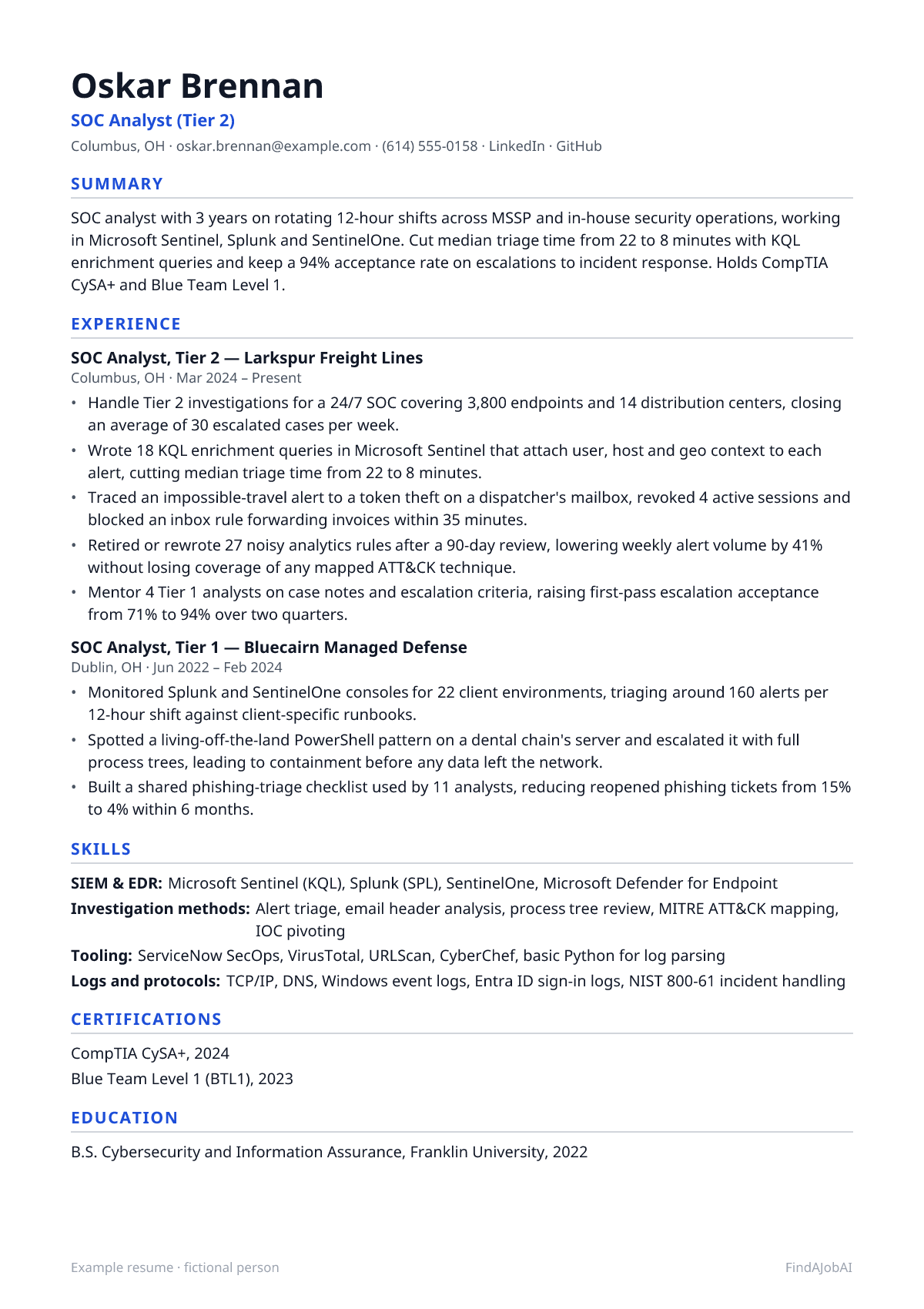
A complete one-page example for a fictional SOC analyst: every bullet pairs an action with what changed because of it.
Example resume · fictional person
Oskar Brennan
SOC Analyst (Tier 2)
Columbus, OH · [email protected] · (614) 555-0158 · LinkedIn · GitHub
Summary
SOC analyst with 3 years on rotating 12-hour shifts across MSSP and in-house security operations, working in Microsoft Sentinel, Splunk and SentinelOne. Cut median triage time from 22 to 8 minutes with KQL enrichment queries and keep a 94% acceptance rate on escalations to incident response. Holds CompTIA CySA+ and Blue Team Level 1.
Experience
SOC Analyst, Tier 2, Larkspur Freight Lines
Columbus, OH · Mar 2024 – Present
- Handle Tier 2 investigations for a 24/7 SOC covering 3,800 endpoints and 14 distribution centers, closing an average of 30 escalated cases per week.
- Wrote 18 KQL enrichment queries in Microsoft Sentinel that attach user, host and geo context to each alert, cutting median triage time from 22 to 8 minutes.
- Traced an impossible-travel alert to a token theft on a dispatcher's mailbox, revoked 4 active sessions and blocked an inbox rule forwarding invoices within 35 minutes.
- Retired or rewrote 27 noisy analytics rules after a 90-day review, lowering weekly alert volume by 41% without losing coverage of any mapped ATT&CK technique.
- Mentor 4 Tier 1 analysts on case notes and escalation criteria, raising first-pass escalation acceptance from 71% to 94% over two quarters.
SOC Analyst, Tier 1, Bluecairn Managed Defense
Dublin, OH · Jun 2022 – Feb 2024
- Monitored Splunk and SentinelOne consoles for 22 client environments, triaging around 160 alerts per 12-hour shift against client-specific runbooks.
- Spotted a living-off-the-land PowerShell pattern on a dental chain's server and escalated it with full process trees, leading to containment before any data left the network.
- Built a shared phishing-triage checklist used by 11 analysts, reducing reopened phishing tickets from 15% to 4% within 6 months.
Skills
- SIEM & EDR: Microsoft Sentinel (KQL), Splunk (SPL), SentinelOne, Microsoft Defender for Endpoint
- Investigation methods: Alert triage, email header analysis, process tree review, MITRE ATT&CK mapping, IOC pivoting
- Tooling: ServiceNow SecOps, VirusTotal, URLScan, CyberChef, basic Python for log parsing
- Logs and protocols: TCP/IP, DNS, Windows event logs, Entra ID sign-in logs, NIST 800-61 incident handling
Certifications
- CompTIA CySA+, 2024
- Blue Team Level 1 (BTL1), 2023
Education
- B.S. Cybersecurity and Information Assurance, Franklin University, 2022
Fictional example by the FindAJobAI team: the person, employers and numbers are invented. Keep the structure; use your own work and numbers you can explain in an interview.
Entry-level SOC analyst resume example
A recent graduate with Security+, an MSSP internship and a home lab. Education and certifications come first, and the lab project ends with a specific detection rather than a list of installed tools.
Entry-level example resume · fictional person
Priya Vandermeer
SOC Analyst (Entry Level)
Tampa, FL · [email protected] · (813) 555-0174 · LinkedIn · GitHub
Summary
Entry-level SOC analyst with a B.S. in Cybersecurity, CompTIA Security+ and a 6-month internship triaging Splunk alerts for 9 MSSP clients. Runs a home lab with Wazuh, Sysmon and a deliberately vulnerable Windows host to practice detection. Ready for rotating night and weekend shifts.
Education
- B.S. Cybersecurity, University of South Florida, 2026
Experience
SOC Intern, Gulfline Security Services
Tampa, FL · Jan 2026 – Jun 2026
- Triaged 40-60 Splunk alerts per shift for 9 small-business clients, with every closure reviewed by a Tier 2 analyst during the first month.
- Analyzed 120 user-reported phishing emails, extracting sender domains and URLs that were added to 3 client blocklists.
- Drafted 6 runbook updates for common false positives, adopted by the team after review by the SOC lead.
Help Desk Technician, University of South Florida IT
Tampa, FL · Aug 2024 – Dec 2025
- Resolved about 25 tickets per day covering account lockouts, MFA resets and malware cleanup for students and staff.
- Flagged 7 accounts showing password-spray patterns in sign-in logs, all confirmed and reset the same day by the security office.
Skills
- Lab monitoring: Splunk, Wazuh, Sysmon, Windows Event Viewer
- Analysis: Phishing header review, VirusTotal, CyberChef, Wireshark basics
- Logs and protocols: TCP/IP, DNS, Active Directory basics, Linux command line
Certifications
- CompTIA Security+, 2025
Projects
- Home detection lab (Wazuh, Sysmon, Windows 11): wrote 12 custom rules and caught a simulated Mimikatz credential dump within 3 minutes.
- Blue Team write-ups: documented 8 investigation challenges from CyberDefenders with timelines and IOCs in a public GitHub repo.
Senior SOC analyst resume example
A shift lead eight years in who now owns the detection backlog and SOAR automation. Bullets move from personal triage numbers to team response times, playbooks and handoff quality.
Senior example resume · fictional person
Tomasz Okonkwo
Senior SOC Analyst, Shift Lead
Phoenix, AZ · [email protected] · (602) 555-0118 · LinkedIn
Summary
Senior SOC analyst with 8 years in 24/7 security operations, leading a 6-person night shift and the detection backlog at a regional utility. Reduced mean time to respond on high-severity cases from 4 hours to 50 minutes with SOAR playbooks and structured shift handoffs. GCIA and GCIH certified.
Experience
Senior SOC Analyst, Shift Lead, Saguaro Power Cooperative
Phoenix, AZ · Apr 2021 – Present
- Lead a 6-analyst night shift monitoring 11,000 IT endpoints and a segmented OT network, reviewing every high-severity case before closure.
- Built 14 SOAR playbooks in Splunk SOAR for phishing, impossible travel and malware quarantine, cutting mean time to respond on high-severity cases from 4 hours to 50 minutes.
- Own a 60-item detection backlog, shipping 35 new or rewritten rules in 2025 mapped to ATT&CK techniques seen in utility-sector threat reports.
- Introduced a written shift handoff template that cut cases dropped between shifts from 9 per month to under 1.
- Coordinated the SOC side of a 3-day contained intrusion on a vendor VPN account, briefing the CISO every 4 hours until closure.
SOC Analyst, Tier 2, Redmesa Health Network
Tucson, AZ · May 2018 – Mar 2021
- Investigated about 35 escalated cases per month in QRadar and CrowdStrike for a 7-hospital network.
- Led the SOC response to a ransomware precursor on 2 radiology workstations, isolating both hosts in under 10 minutes.
- Trained 9 new Tier 1 analysts using a 4-week onboarding plan written with the SOC manager.
SOC Analyst, Tier 1, Copperline MSSP
Tempe, AZ · Jun 2017 – Apr 2018
- Triaged alerts for 18 client environments and escalated confirmed incidents within a 20-minute SLA.
Skills
- Detection & response: Splunk ES, Splunk SOAR, QRadar, CrowdStrike Falcon, detection engineering, ATT&CK mapping
- Operations: Shift leadership, handoff process, case quality review, OT network monitoring
- Scripting: Python, SPL, PowerShell for enrichment and response actions
Certifications
- GIAC Certified Intrusion Analyst (GCIA)
- GIAC Certified Incident Handler (GCIH)
Education
- B.S. Information Systems, Arizona State University, 2017
How to write a SOC analyst resume
Five steps, in the order a recruiter reads the page. The format around them stays plain for every job: one column, standard headings, newest role first.
Header: name, target title and links
Use “SOC Analyst” and your tier (Tier 1, Tier 2) in the headline so recruiters searching either term find you, and keep certifications such as Security+, CySA+ or BTL1 near the top.
Summary: what you do and your best proof
State your years on shift, whether the work was MSSP or in-house, the SIEM and EDR you use, and one measured result such as faster triage or a high escalation acceptance rate. Mention shift availability if the role is 24/7.
Experience: newest first, a result in every bullet
Lead with volume and SLA for triage roles, then show investigation depth: an alert you followed to a confirmed finding, what you did and how long it took. Tier 2 bullets should add tuning, mentoring and containment work.
Skills: grouped, in the ad's words
Group skills into SIEM and EDR platforms, investigation techniques, tooling and foundations. Copy exact platform names from the ad when you have used them, and add the query language you write.
Education and certifications
List your degree or bootcamp with the year and keep certifications in their own line. Without SOC experience, add a Projects section with a home lab or Blue Team challenge write-ups that end in a specific detection.
Skills to put on a SOC analyst resume
Hard skills are the tools and methods of the job; soft skills are how you work with people. Each comes with one way to prove it, because a skill named only in a list counts for little. Add the ones you really have.
Hard skills
- SIEM querying (KQL, SPL, AQL)
- Name the query language and a query you wrote, with what it found or how much time it saved.
- EDR investigation
- Describe reading a process tree or isolating a host in CrowdStrike, SentinelOne or Defender, and how fast you acted.
- Alert triage
- Give your per-shift alert volume, the SLA you worked to and how you decided what to close or escalate.
- Phishing analysis
- Mention header review, URL detonation in a sandbox and the blocklist or rule your findings fed.
- Escalation and case notes
- Quote an acceptance rate or reopen rate, or describe what every escalation you send contains.
- Windows event logs
- Name event IDs or log sources you rely on, such as 4624 logons or Sysmon process creation, inside a finding.
- Identity and sign-in logs
- Point to an investigation of impossible travel, MFA fatigue or token theft in Entra ID or Okta logs.
- MITRE ATT&CK
- Show that you mapped alerts or rules to techniques and used the mapping to find coverage gaps.
- SOAR and automation
- Name a playbook you built or used and the manual steps or minutes it removed.
- Network traffic analysis
- Describe a DNS, proxy or firewall log pivot that confirmed or ruled out command-and-control activity.
- Threat intelligence use
- Give an example of turning a published IOC set into a hunt or watchlist and what it surfaced.
Soft skills
- Calm on a live queue
- Describe a shift where several high-severity alerts landed at once and how you sequenced them.
- Clear written handoffs
- Mention a handoff note or template you wrote and how it changed what the next shift picked up.
- Judgment on escalation
- Give an example of an alert you correctly closed as benign and the evidence you used to decide.
- Teaching newer analysts
- Name how many analysts you coached and a measurable change in their case quality.
- Holding a 24/7 rotation
- State the rotation you worked, such as 12-hour nights or a 2-2-3 pattern, and any coverage you picked up.
- Curiosity past the first verdict
- Describe a hunch you followed past the first verdict that turned a routine alert into a real finding.
SOC Analyst resume bullet examples: weak vs strong
The same work, written two ways. The strong version names the tool, the scope and a result; the numbers are examples, yours must be real.
Weak: Triaged alerts in the SIEM.
Strong: Cleared roughly 160 SIEM alerts per 12-hour shift across 22 client tenants while meeting a 15-minute acknowledgment SLA.
Shows shift volume, scale and the service standard.
Weak: Escalated incidents to Tier 2.
Strong: Raised escalation acceptance from 71% to 94% by attaching process trees, sign-in history and a clear verdict to every case.
Escalation quality is what Tier 2 and IR leads judge you on.
Weak: Tuned detection rules.
Strong: Reviewed 90 days of alert history and rewrote 27 noisy rules, dropping weekly alert volume by 41% with no lost ATT&CK coverage.
Proves you reduced noise without opening blind spots.
Weak: Investigated suspicious logins.
Strong: Linked an impossible-travel alert to stolen session tokens, revoked 4 sessions and removed a malicious forwarding rule in 35 minutes.
Names the threat, the actions and the response time.
Weak: Wrote queries.
Strong: Built 18 KQL enrichment queries that add user, host and location context, taking median triage from 22 to 8 minutes.
Connects a technical skill to a measurable time saving.
Weak: Helped with phishing tickets.
Strong: Created a phishing-triage checklist adopted by 11 analysts that cut reopened phishing tickets from 15% to 4%.
Shows you improved the team, not only your own queue.
15 more SOC analyst resume bullet examples
Grouped by area of the job, so you can find the ones closest to your work. Keep the shape (action, scope, result) and replace the invented numbers with your own.
Triage and escalation
- Kept a 99% acknowledgment rate inside a 15-minute SLA across 400+ shifts on a rotating 2-2-3 schedule.
- Closed 2,300 alerts in a quarter with documented reasoning, escalating 61 that were confirmed as true positives.
- Cut reopened cases from 12% to 3% by adding a short evidence summary and verdict to every closure note.
- Triaged an MFA-fatigue alert to a real push-bombing attempt and locked the account before the user approved a prompt.
- Handled 35% of the team's weekend escalations over 6 months while keeping a 96% case-quality score in peer review.
Investigation and containment
- Isolated 3 hosts running a malicious scheduled task within 12 minutes of the first EDR alert, preventing spread to file servers.
- Pivoted from one suspicious DNS query to 5 infected laptops beaconing to the same domain, all reimaged within a day.
- Pulled mailbox audit logs to scope a business email compromise to 2 users and 14 sent messages for the legal team.
- Confirmed a suspected data exfiltration alert was a sanctioned backup job by matching 30 days of transfer history, avoiding a needless outage.
- Scoped a compromised contractor VPN account to 3 internal hosts using 14 days of firewall and sign-in logs, all cleaned within 24 hours.
Detection tuning and automation
- Rewrote 20 Sentinel analytics rules with entity mapping, cutting duplicate incidents by 55%.
- Built a SOAR playbook that enriches phishing reports with sandbox results, saving about 9 analyst hours per week.
- Added 8 watchlists from published threat intelligence, which surfaced 2 compromised vendor accounts in the first month.
- Mapped 120 active rules to ATT&CK and documented 10 uncovered techniques for the detection engineering backlog.
- Wrote a Python script that parses 5 firewall log formats into one CSV, cutting manual scoping work by about 2 hours per case.
SOC Analyst resume summary examples
Two or three lines on what you do and your strongest proof. Start from the one closest to your level and use your own facts.
Entry-level SOC analyst with CompTIA Security+, a 6-month MSSP internship triaging Splunk alerts, and a home lab running Wazuh and Sysmon. Comfortable with Windows event logs, phishing analysis and clear ticket notes. Available for night and weekend shift rotations.
SOC analyst with 3 years across MSSP and in-house operations in Microsoft Sentinel, Splunk and SentinelOne. Cut median triage time from 22 to 8 minutes and keeps a 94% escalation acceptance rate while mentoring Tier 1 analysts.
Senior SOC analyst and shift lead with 8 years in 24/7 operations, running a 6-person shift and the SOC's detection backlog. Reduced mean time to respond on high-severity cases from 4 hours to 50 minutes through SOAR playbooks and better handoffs.
Common SOC analyst resume mistakes
Each one is easy to make and quick to fix before you apply.
Only listing tool names
Sentinel, Splunk and CrowdStrike in a skills list say nothing about how you use them. Pair each tool with a query, an investigation or a time saving in your experience bullets.
Hiding shift work
24/7 SOCs need people who can hold a rotation. State your shift pattern and SLA so a manager does not have to guess whether you can cover nights.
Counting alerts with no verdicts
“Reviewed thousands of alerts” sounds like a firehose. Add how many you escalated, how many were confirmed and how your escalations were received.
No real finding on the page
Pick one alert that turned into a confirmed compromise or a solid benign verdict and describe the evidence, your action and the timing.
Security+ or CySA+ buried below education
Security+, CySA+, BTL1 and GIAC certifications are often hard filters for SOC roles. Put them right under the summary or in a clearly labeled section.
ATS tips for a SOC analyst resume
Applicant tracking systems turn your file into text that recruiters search, mostly for the skills and titles in the ad. They rarely reject a resume on their own; one that parses badly or misses the ad's words just doesn't come up.
- Put shift volume and SLAs in at least one bullet; SOC managers want to know you can keep pace with a live queue.
- Name the exact SIEM and EDR platforms (Sentinel, Splunk, QRadar, CrowdStrike, SentinelOne) and the query language you write.
- Show escalation quality with an acceptance rate, a reopen rate or a note about what you attach to each case.
- Include one alert that became a confirmed finding, with the detection, your action and the time it took.
- List CySA+, BTL1, GCIA or Security+ near the top, since many SOC job filters screen on certifications first.
For the format itself, run the free ATS resume checklist.
Everything for SOC Analysts
- SOC Analyst cover letter examplesThree example letters and a short email version
- SOC Analyst interview questions30 questions with sample answers
- SOC Analyst job descriptionDuties, skills and requirements
- How to tailor your resume without lying
Other resume examples
SOC Analyst resume FAQ
What should a SOC analyst resume include?
The SIEM, EDR and ticketing tools you use, your shift pattern and alert volume, how you escalate, and one or two real findings with timings. Certifications such as Security+, CySA+ or BTL1 should be easy to spot.
How do I get a Tier 1 SOC analyst job with no experience?
Build a home lab with a free SIEM like Wazuh or Splunk Free, write up a few investigations on GitHub, earn Security+ and point to help desk or network work that shows you know Windows and TCP/IP. Say plainly that you can work shifts.
Should I list Tier 1 and Tier 2 separately on a SOC resume?
Yes, if your duties changed. Separate entries make the progression visible: Tier 1 bullets about triage volume and escalation quality, Tier 2 bullets about investigations, containment and rule tuning.
How we built this page
The FindAJobAI team wrote the three example resumes, the bullets, the skills and the advice for SOC analyst roles. The people, employers and numbers in the examples are invented; the structure, the tools and the way each bullet is built are the parts to copy.
Once we track enough live SOC analyst job ads, this page also shows the skills they ask for most, counted the same way as our in-demand skills report.
Last reviewed on November 1, 2026.