Computer Vision Engineer Cover Letter Example (2026)
By FindAJobAI Team Updated How we built this page
Computer vision roles are judged on what happens outside the lab: in dim warehouses, on low-power cameras and in front of skeptical domain experts. A strong computer vision engineer cover letter describes one model you took into the real world, the data or deployment problem you solved, and the measured result for the people relying on it.
Computer Vision Engineer cover letter template
This letter as a one-page template: an opening that names the job and your strongest fact, proof that answers the ad, a reason for this employer and a short close.
After you sign up, FindAJobAI drafts your own letter for a real job from your CV in this format, and you edit it before you send it.
Example 1 · Experienced
Edge vision engineer applying to a robotics company
Isadora builds detection models for smart cameras in retail. The ad asks for edge deployment, TensorRT and strong data skills for warehouse robots.
Example letter · fictional
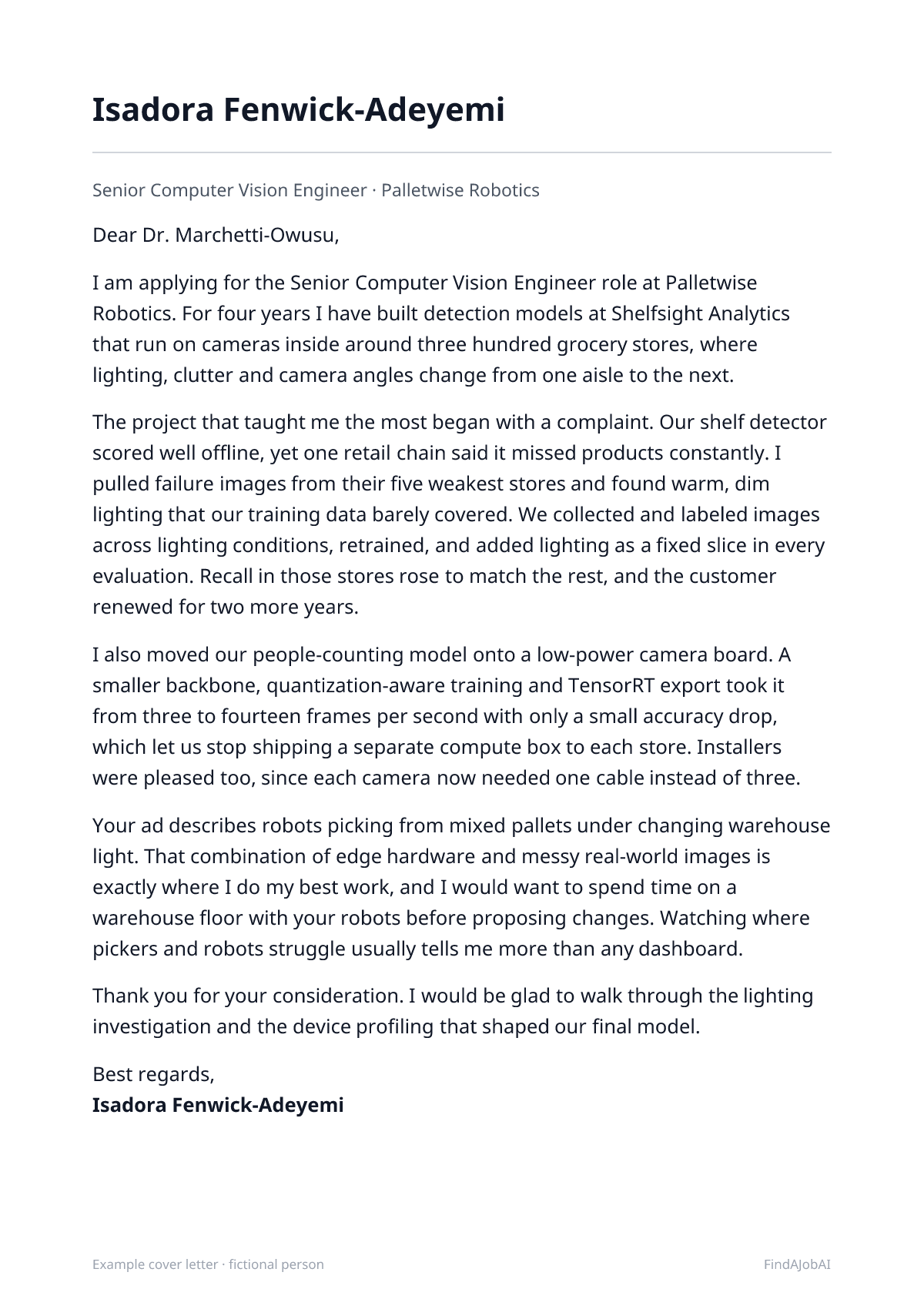
Dear Dr. Marchetti-Owusu,
I am applying for the Senior Computer Vision Engineer role at Palletwise Robotics. For four years I have built detection models at Shelfsight Analytics that run on cameras inside around three hundred grocery stores, where lighting, clutter and camera angles change from one aisle to the next.
The project that taught me the most began with a complaint. Our shelf detector scored well offline, yet one retail chain said it missed products constantly. I pulled failure images from their five weakest stores and found warm, dim lighting that our training data barely covered. We collected and labeled images across lighting conditions, retrained, and added lighting as a fixed slice in every evaluation. Recall in those stores rose to match the rest, and the customer renewed for two more years.
I also moved our people-counting model onto a low-power camera board. A smaller backbone, quantization-aware training and TensorRT export took it from three to fourteen frames per second with only a small accuracy drop, which let us stop shipping a separate compute box to each store. Installers were pleased too, since each camera now needed one cable instead of three.
Your ad describes robots picking from mixed pallets under changing warehouse light. That combination of edge hardware and messy real-world images is exactly where I do my best work, and I would want to spend time on a warehouse floor with your robots before proposing changes. Watching where pickers and robots struggle usually tells me more than any dashboard.
Thank you for your consideration. I would be glad to walk through the lighting investigation and the device profiling that shaped our final model.
Best regards,
Isadora Fenwick-Adeyemi
Example 2 · Career changer
Experimental physicist moving into computer vision
Benedek analysed microscope images in a physics lab for five years and built segmentation models. The ad is for a CV engineer at a medical imaging startup.
Example letter · fictional
Dear Cellwright Hiring Committee,
I would like to apply for the Computer Vision Engineer position at Cellwright Imaging. I am finishing five years as a doctoral researcher in experimental physics at a university lab, where most of my days were spent turning microscope images into reliable measurements.
When manual counting of particles in our images became the bottleneck for the whole lab, I trained a U-Net segmentation model in PyTorch on about eight hundred images I labeled with two colleagues. I split the data by experiment rather than by image to avoid leaks, and checked results against hand counts on held-out runs. The model cut analysis time for each experiment from days to under an hour, and four other students in the lab now use it. Two of them have since extended it to new particle types with my help.
Physics trained me to distrust results that look too good, to understand my instruments, and to report uncertainty honestly. I know I have gaps, especially in serving models in production and working within a software team's release process, and I have started closing them by deploying my model as a small internal web service.
Your ad mentions segmentation of cell images for research customers. That is very close to the work I have done, and I would value the chance to bring the same care to a product used beyond one lab.
My code and a short write-up of the model are on GitHub. I would welcome a conversation about them and about how your team validates models with customers, and how researchers there share feedback when results surprise them.
Kind regards,
Benedek Okafor-Lindholm
Example 3 · Senior or lead
Vision team lead applying to head perception at an agritech company
Philippa leads a perception team for factory inspection. The ad seeks a head of computer vision for crop monitoring drones.
Example letter · fictional
Dear Mr. Adeyinka-Holm,
I am writing to apply for the Head of Computer Vision role at Fieldlark Agritech. For five years I have led a team of seven engineers at Quillstone Inspection, building defect detection systems that run on production lines in eleven factories across Germany, Poland and the Czech Republic.
Early on, our models looked strong in reports but disappointed customers. Overall accuracy hid the fact that rare defects, the ones that cost money, were often missed. I changed how we measured: recall at a false alarm rate each factory agreed to, broken down by defect type, line and camera. That single change reshaped our roadmap. We invested in labeling guides and model-assisted labeling instead of bigger models, and customer escalations fell by more than half over the next year. The team also became more confident, because the numbers they reported finally matched what customers saw on the line.
I also built the habits that let a small team move quickly with confidence: experiment tracking linked to dataset versions, video-level data splits and a release checklist that includes testing on the slowest supported device. Two engineers I hired as juniors now own models on their own.
I have not worked with aerial imagery, and I expect weather, altitude and seasonal crop changes to create problems I have not met before. I would spend my first weeks with your agronomists and flight teams before setting priorities for the perception roadmap, and I would want to ride along on a few survey flights myself.
I would welcome a conversation about where your current models fall short in the field and what your growers ask for most often.
Sincerely,
Philippa Mensah-Vogel
All three letters, and the short version below, are fictional: the people, employers and numbers are invented. Borrow the structure, never the facts.
- Prefer to write it yourself? Use the free cover letter template.
- Check your CV against the job first: the free CV score shows the missing keywords.
Why the first letter works, paragraph by paragraph
Paragraph 1: Opening
Sets the scene of hundreds of real stores with changing light, which tells a robotics reader the writer knows messy deployment conditions.
Paragraph 2: The lighting story
Shows the data-first habit vision leads look for: find failures, trace them to data, fix the data, then measure by slice.
Paragraph 3: Edge deployment paragraph
Adds a hardware result with concrete techniques and a business benefit, matching the ad's edge focus.
Paragraph 4: Why this company
Connects warehouse lighting and edge robots to the writer's past and promises to learn on site first.
Paragraph 5: Close
Offers two specific topics, giving the interviewer an easy starting point.
What the career changer's letter does differently
The career changer's research model already does real vision work: labeled data, a leak-free split, validation against hand counts and adoption by colleagues. Naming production gaps and a first step to close them makes the switch believable.
What the senior letter does differently
A head-of letter should show how the writer changes a team's direction. Fixing the metric, shifting investment to data and building release habits all show leadership, while admitting no aerial imagery experience shows a lead who plans to listen first.
Short computer vision engineer cover letter: an email-ready version
Many applications arrive as an email or a small text box, and a full page doesn't fit. This version runs 120 to 150 words and keeps only what a reader needs to decide whether to reply. A computer vision engineer replies to a startup founder who posted on a machine learning forum and asked for brief emails.
Short version · email · fictional126 words
Subject: Computer Vision Engineer – plate and vehicle detection on edge cameras – Oriana Bakshi-Thornton
Hi Ms. Thistlewood-Rao,
I read your Parkfinch post about building parking occupancy sensors with great interest, since the problem is close to my own work. For three years I have built vehicle detection models for a city traffic monitoring company whose software runs on roughly two thousand roadside cameras in four cities.
My most useful project was cutting false detections at night by retraining with infrared footage and blurring plates on the device, which kept us within the city's privacy rules and roughly halved operator complaints within a quarter.
Your post mentions low-cost hardware in outdoor car parks, which sounds very familiar from our roadside rollout. My GitHub is linked below, and I am free for a call most weekday afternoons, Pacific time.
Thanks,
Oriana Bakshi-Thornton
Founders scan quickly. This email names one closely related system, a measured fix that also handled privacy, and a direct link to the founder's hardware challenge.
Opening lines that work for computer vision engineer cover letters
The first sentence decides whether the second gets read. Here are six openings, one for each situation you might be in. Pick the one that matches yours and swap in your own facts: every name and number below is invented.
1. You have a standout result
Our shelf detector worked in the lab and failed in dim stores. Tracing that gap back to the training data is the kind of work I would like to do for your robots.
2. The ad names a problem you've solved
Your ad mentions running perception on low-power hardware. I recently took a people-counting model from three to fourteen frames per second on a camera board.
3. Someone referred you
Your perception lead, Kofi Lindgren, reviewed my workshop paper on label noise and suggested I apply for this role.
4. You admire what they build
I have used your open-source annotation tool for two years and contributed its keyboard shortcuts for polygon editing.
5. You're new to the field or switching into it
After five years segmenting microscope images as a physicist, I want to build vision models full time for products used beyond one lab.
6. You have senior scope or a specialism
I lead a seven-person perception team for factory inspection and am looking to build a vision group for a new kind of imagery.
How to write a computer vision engineer cover letter
Five steps, in the order you'd write them. The shape stays the same for every job (a short opening, proof, a reason for this employer, a close), and what goes into each part is what changes with the role.
Find the real-world condition behind the opening
Most vision openings exist because models must work somewhere difficult: dim warehouses, outdoor cameras, phones or medical scanners. Read the posting for clues about hardware, environment and users, then choose the project from your own work that handled the most similar conditions.
Start from the failure you fixed
Open your main paragraph with a gap between test results and reality, such as missed detections at night or slow inference on a device. Then explain in a sentence how you traced the cause, whether to data, labels, augmentations or hardware limits.
Show your data judgment
Vision teams value engineers who look at data before changing architectures. Mention a labeling guide you improved, a leak you caught in a data split or a slice you added to evaluation, and say why it mattered for the result.
Measure what users actually feel
Give a metric that reflects real use, such as recall at a set false alarm rate, frames per second on the target device or complaints from operators. Say where the figure came from so it holds up when an interviewer asks how you measured it.
Close with the people around the model
Computer vision engineers work every week with labelers, domain experts, hardware teams and customers. Mention one of those relationships briefly, then end by naming the part of their environment you would want to see in person first.
Computer Vision Engineer cover letter do's and don'ts
Do
- Describe a model in real conditions, not only on a benchmark.
- Explain how you found and fixed a data problem.
- Mention hardware, latency or cost when the role involves deployment.
Don't
- Don't quote benchmark scores without context about the data.
- Don't list every architecture you have read about.
- Don't ignore privacy if the role involves cameras on people.
Common computer vision engineer cover letter mistakes
Each one is easy to make and quick to fix before you send the letter.
Leading with benchmark scores
Leaderboard figures say little about messy deployments. Describe performance on realistic data and how you handled failures.
Skipping the data story
Most vision gains come from better data. Include one line on how you collected, labeled or cleaned images.
Forgetting the hardware
If the model runs on devices, mention latency, memory or power, and the techniques you used to meet them.
Ignoring privacy around cameras
Roles involving people or vehicles care about privacy. Mention blurring, retention limits or consent where relevant.
Listing architectures without results
Naming many model families reads like a reading list. Mention only those you used and what they achieved.
Email subject lines for computer vision engineer applications
Applying by email? Put the job title, any reference number and your name in the subject line.
- Senior Computer Vision Engineer application – edge detection in 300 stores – Isadora Fenwick-Adeyemi
- Computer Vision Engineer – physicist with microscope segmentation model – Benedek Okafor-Lindholm
- Application: Perception Engineer (Req. 6184) – Isadora Fenwick-Adeyemi
Everything for Computer Vision Engineers
- Computer Vision Engineer resume exampleA full resume, plus bullet and summary examples
- Computer Vision Engineer interview questions30 questions with sample answers
- Computer Vision Engineer job descriptionDuties, skills and requirements
- Career change cover letter: template + examples
Other cover letter examples
Computer Vision Engineer cover letter FAQ
What should a computer vision engineer cover letter include?
One model you took from data to real use. Describe the problem, the data or deployment work you did, how you measured results and what changed for users, then link it to the product in the ad.
Can researchers move into computer vision engineering roles?
Yes. Show image models you built for your research, how you labeled and validated data, and any steps you have taken toward production work such as serving a model or writing tests.
Should I mention benchmark results like ImageNet accuracy?
Only with context. Hiring teams care more about performance on realistic data and how you handled failures than about leaderboard numbers.
How we built this page
The FindAJobAI team wrote the three example letters, the short email version, the opening lines and the advice for computer vision engineer roles. The people, employers and numbers in the letters are invented; the structure, the kind of evidence and the order of the paragraphs are the parts to copy.
Once we track enough live computer vision engineer job ads, this page also shows the skills they ask for most, counted the same way as our in-demand skills report.
Last reviewed on November 1, 2026.