Economist Cover Letter Example (2026)
By FindAJobAI Team Updated How we built this page
Economist hiring managers already expect econometrics and R or Stata. A cover letter earns attention when it shows one question you answered, how you checked the result, and who changed course because of it. Keep methods inside the story and write the way you would brief a busy executive or legislator.
Economist cover letter template
This letter as a one-page template: an opening that names the job and your strongest fact, proof that answers the ad, a reason for this employer and a short close.
After you sign up, FindAJobAI drafts your own letter for a real job from your CV in this format, and you edit it before you send it.
Example 1 · Experienced
Bank economist applying to a state revenue office
Cyprian forecasts for a regional bank and wants to move into public finance. The ad stresses revenue forecasting and fiscal notes.
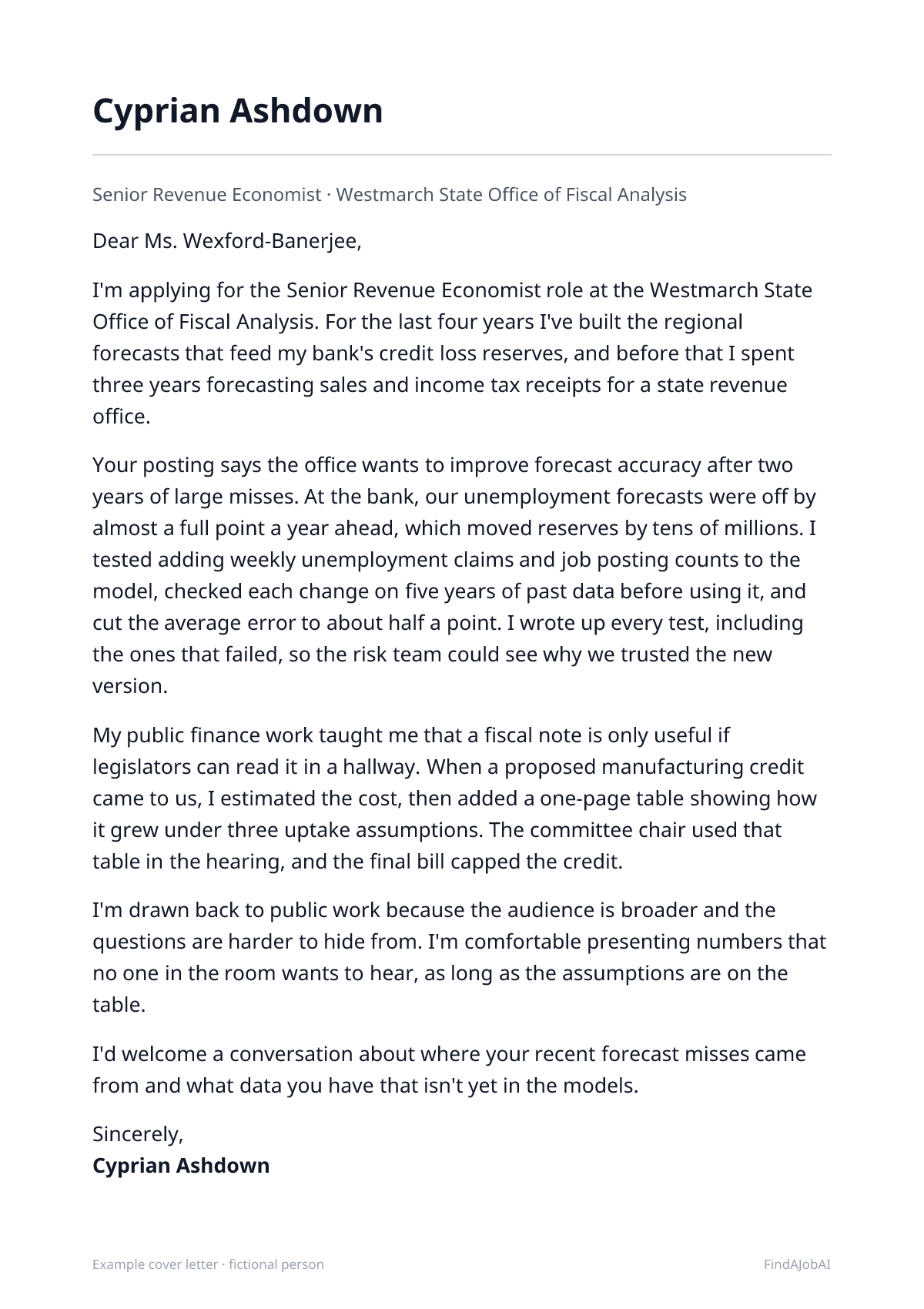
Example letter · fictional
Dear Ms. Wexford-Banerjee,
I'm applying for the Senior Revenue Economist role at the Westmarch State Office of Fiscal Analysis. For the last four years I've built the regional forecasts that feed my bank's credit loss reserves, and before that I spent three years forecasting sales and income tax receipts for a state revenue office.
Your posting says the office wants to improve forecast accuracy after two years of large misses. At the bank, our unemployment forecasts were off by almost a full point a year ahead, which moved reserves by tens of millions. I tested adding weekly unemployment claims and job posting counts to the model, checked each change on five years of past data before using it, and cut the average error to about half a point. I wrote up every test, including the ones that failed, so the risk team could see why we trusted the new version.
My public finance work taught me that a fiscal note is only useful if legislators can read it in a hallway. When a proposed manufacturing credit came to us, I estimated the cost, then added a one-page table showing how it grew under three uptake assumptions. The committee chair used that table in the hearing, and the final bill capped the credit.
I'm drawn back to public work because the audience is broader and the questions are harder to hide from. I'm comfortable presenting numbers that no one in the room wants to hear, as long as the assumptions are on the table.
I'd welcome a conversation about where your recent forecast misses came from and what data you have that isn't yet in the models.
Sincerely,
Cyprian Ashdown
Example 2 · Entry level
New master's graduate applying to a research institute
Ottilie finished an applied economics master's and a research assistant year. The institute wants a junior economist for housing research.
Example letter · fictional
Dear Dr. Oyekunle-Haas,
I'm writing to apply for the Research Economist position at the Greyfriars Urban Economics Institute. I completed a master's in applied economics in May and have spent the past year as a research assistant on housing affordability studies at a policy institute in Washington.
Your posting mentions a new project on zoning and rents across metro areas. My main project this year was building a county-level rent burden dataset from Census survey data and private listing records for more than three thousand counties. Halfway through, I noticed rents in several rural counties jumped in a single year in a way that made no sense. I traced it to a change in how one listing source defined its market areas, documented the break, and adjusted the series before any results went out.
That dataset fed two published briefs, and I ran most of the regression work in R, keeping every specification in a shared project so senior staff could rerun it without asking me which version of the data or code I had used. I learned to write short method notes that a reviewer could follow without asking me questions.
I'd like to keep working on housing because the questions connect directly to decisions cities are making right now, and good data can change those decisions. I'm still building depth in spatial methods and would value working near researchers who use them often, since your institute's recent metro papers rely on them heavily.
I'm available to talk any time in the next few weeks and can share a short writing sample from one of the briefs.
Kind regards,
Ottilie Nakagawa
Example 3 · Senior or lead
Chief economist applying to lead research at an asset manager
Leander leads a consulting economics team and is applying to head macro research at an investment firm.
Example letter · fictional
Dear Mr. Abernathy-Coles,
I'm applying for the Chief Economist role at Ravensworth Capital Partners. I lead a team of nine economists at an advisory firm, where we set the macro outlook for about two hundred institutional clients, and I spent eight years before that as a senior economist at a regional Federal Reserve bank.
Your posting says the investment team wants research that leads to positions, not only commentary. That was the gap I found when I took over my current team. Our reports were well read but rarely acted on. I changed the format so every outlook ends with three explicit calls, a probability and the data that would change our mind, and we scored ourselves each quarter. Client renewals rose, and subscription revenue grew from about three to nearly six million dollars over five years.
I've also learned to be honest when the view is uncomfortable. In early 2022 our team moved to a higher inflation path than most forecasters, and I presented it to clients who were not happy to hear it. We were not perfectly right, but we were closer than consensus, and several clients later told us that call protected their portfolios. We also published our misses from that year, which I think built more trust than the hits.
I have not worked inside a buy-side firm, and I would want to learn how your portfolio managers prefer to receive research before changing anything about the process.
I'd welcome a conversation about which recent calls your team felt least supported on and how research could help next time.
Sincerely,
Leander Quisenberry
All three letters, and the short version below, are fictional: the people, employers and numbers are invented. Borrow the structure, never the facts.
- Prefer to write it yourself? Use the free cover letter template.
- Check your CV against the job first: the free CV score shows the missing keywords.
Why the first letter works, paragraph by paragraph
Paragraph 1: Opening
Names the current forecasting role, the prior public revenue work and the years in each, so the reader sees a direct match to the posting.
Paragraph 2: Answering the ad's problem
Responds to the office's forecast misses with a specific model change, out-of-sample testing and a measured error reduction.
Paragraph 3: Writing for decision makers
Shows a fiscal note built for legislators, including the one-page table that shaped the final bill.
Paragraph 4: Why public work
Gives a reason for the move and signals independence when presenting unwelcome numbers.
Paragraph 5: Close
Asks about the sources of the office's misses, which invites a technical conversation rather than a generic interview.
What the entry-level letter does differently
The graduate letter uses one data problem the writer found and fixed, explains the tools only where they show care, and admits a skill still being built. That honesty reads as maturity rather than weakness.
What the senior letter does differently
The chief economist letter focuses on making research useful: explicit calls, scoring, revenue growth and one honest forecast that went against consensus. It names the buy-side gap plainly.
Short economist cover letter: an email-ready version
Many applications arrive as an email or a small text box, and a full page doesn't fit. This version runs 120 to 150 words and keeps only what a reader needs to decide whether to reply. An economist replies by email to a consulting firm's posting for a labor economist, keeping it short for a hiring partner.
Short version · email · fictional124 words
Subject: Labor Economist – minimum wage and training studies – Mirela Abernathy
Hi Dr. Vasquez-Lindgren,
I'm interested in the Labor Economist role at Calloway Street Economics. I have five years at a state agency evaluating wage and training policies, mostly with difference-in-differences and matched comparison designs on state wage records, written up as short briefs for agency leaders and legislative staff.
My most used study looked at a three-year training subsidy for eight thousand workers. We found smaller earnings gains than expected, and the legislature redesigned the program around the occupations that did show gains. The agency still uses our comparison group method for new programs.
My resume and a short policy brief are attached. I'm free for a call most afternoons this week, or early next week if that suits you better.
Best,
Mirela Abernathy
The short email gives one study, its design, an honest result and what changed, which is enough for a partner to decide on a call.
Opening lines that work for economist cover letters
The first sentence decides whether the second gets read. Here are six openings, one for each situation you might be in. Pick the one that matches yours and swap in your own facts: every name and number below is invented.
1. You have a standout result
Our unemployment forecast was off by almost a full point a year ahead, and cutting that error in half is the work I'd like to bring to your office.
2. The ad names a problem you've solved
Your posting asks for research that leads to decisions, and my team now ends every outlook with three explicit calls we score each quarter.
3. Someone referred you
Your senior economist, Dr. Wenceslas Mbatha, suggested I apply after we presented on the same housing panel last spring.
4. You admire what they build
I spent the past year building a rent burden dataset for more than three thousand counties, and your zoning project is where I'd most like to use it.
5. You're new to the field or switching into it
A fiscal note I wrote led legislators to cap a manufacturing credit, and that kind of direct use is why I want to return to public finance.
6. You have senior scope or a specialism
After fifteen years between a Federal Reserve bank and consulting, I'd like to lead research where the calls affect real portfolios.
How to write an economist cover letter
Five steps, in the order you'd write them. The shape stays the same for every job (a short opening, proof, a reason for this employer, a close), and what goes into each part is what changes with the role.
Lead with the question you answer
Open with your sector and the main question your work addresses, such as credit losses, tax revenue or housing costs. A reader should know within two sentences what kind of economist you are and why it fits their posting.
Show one result and how you checked it
Pick a forecast or study, describe the change you made, and explain how you tested it, for example on past data or with robustness checks. Give the improvement in a figure, such as an error cut or a cost estimate, that the reader can compare with their own work.
Show who used your work
Mention the executive, committee or client that acted on your analysis and what they decided. Economists are hired to inform decisions, so evidence of use often matters more to a hiring manager than the elegance of the method.
Keep the language plain
Write as you would brief a manager outside economics. Name a method once if it helps, then move on to what it showed. A clear letter is itself a writing sample for roles where you will explain results every week.
End on their research questions
Close by asking about the forecasts, studies or data the team is working on. It invites a substantive conversation, gives the reader an easy reason to reply, and shows you have already started thinking about their problems and data.
Economist cover letter do's and don'ts
Do
- Pick one question you answered and the decision it influenced.
- Show how you checked your result, such as out-of-sample testing or robustness checks.
- Write in plain language, as you would for a non-economist reader.
Don't
- Don't list every method you studied; the resume carries that.
- Don't claim causal effects your study design couldn't support.
- Don't fill the letter with jargon like "heterogeneous treatment effects" without explaining why it mattered.
Common economist cover letter mistakes
Each one is easy to make and quick to fix before you send the letter.
A methods list instead of a story
Replace the list with one question, the method used, the check and the decision it informed.
Claiming more causality than the design supports
Describe results with the confidence your design supports, and mention the check that makes you trust them.
Dense academic prose
Shorten sentences and translate terms so a non-economist reader understands the point on first read.
No audience named
Say who read or used your work, such as a committee, board or client group, and how often.
Ignoring the posting's sector
Connect your experience to the employer's field, whether that is banking, public finance or consulting, with one concrete example.
Email subject lines for economist applications
Applying by email? Put the job title, any reference number and your name in the subject line.
- Senior Revenue Economist application – forecasting and fiscal notes – Cyprian Ashdown
- Research Economist (housing) – M.A. Applied Economics – Ottilie Nakagawa
- Application: Chief Economist – Leander Quisenberry
Everything for Economists
- Economist resume exampleA full resume, plus bullet and summary examples
- Economist interview questions30 questions with sample answers
- Economist job descriptionDuties, skills and requirements
- Cover letter with no experience: templates
Other cover letter examples
Economist cover letter FAQ
What should an economist cover letter include?
Your sector and main work, one question you answered with the method and check you used, the decision it informed, and why this organization's questions interest you.
How technical should an economist cover letter be?
Name the method briefly, but spend most words on the problem, the check and the result. Readers can ask about technique in the interview.
Should I attach a writing sample?
Offer one, or attach it if the posting asks. A short brief or memo usually works better than a long paper.
How we built this page
The FindAJobAI team wrote the three example letters, the short email version, the opening lines and the advice for economist roles. The people, employers and numbers in the letters are invented; the structure, the kind of evidence and the order of the paragraphs are the parts to copy.
Once we track enough live economist job ads, this page also shows the skills they ask for most, counted the same way as our in-demand skills report.
Last reviewed on November 1, 2026.