Fraud Analyst Cover Letter Example (2026)
By FindAJobAI Team Updated How we built this page
Fraud teams hire people who catch bad actors without punishing honest customers. The strongest letters tell one investigation or rule change and give both results: the money or accounts protected and the effect on false positives, approvals or customer friction.
Fraud Analyst cover letter template
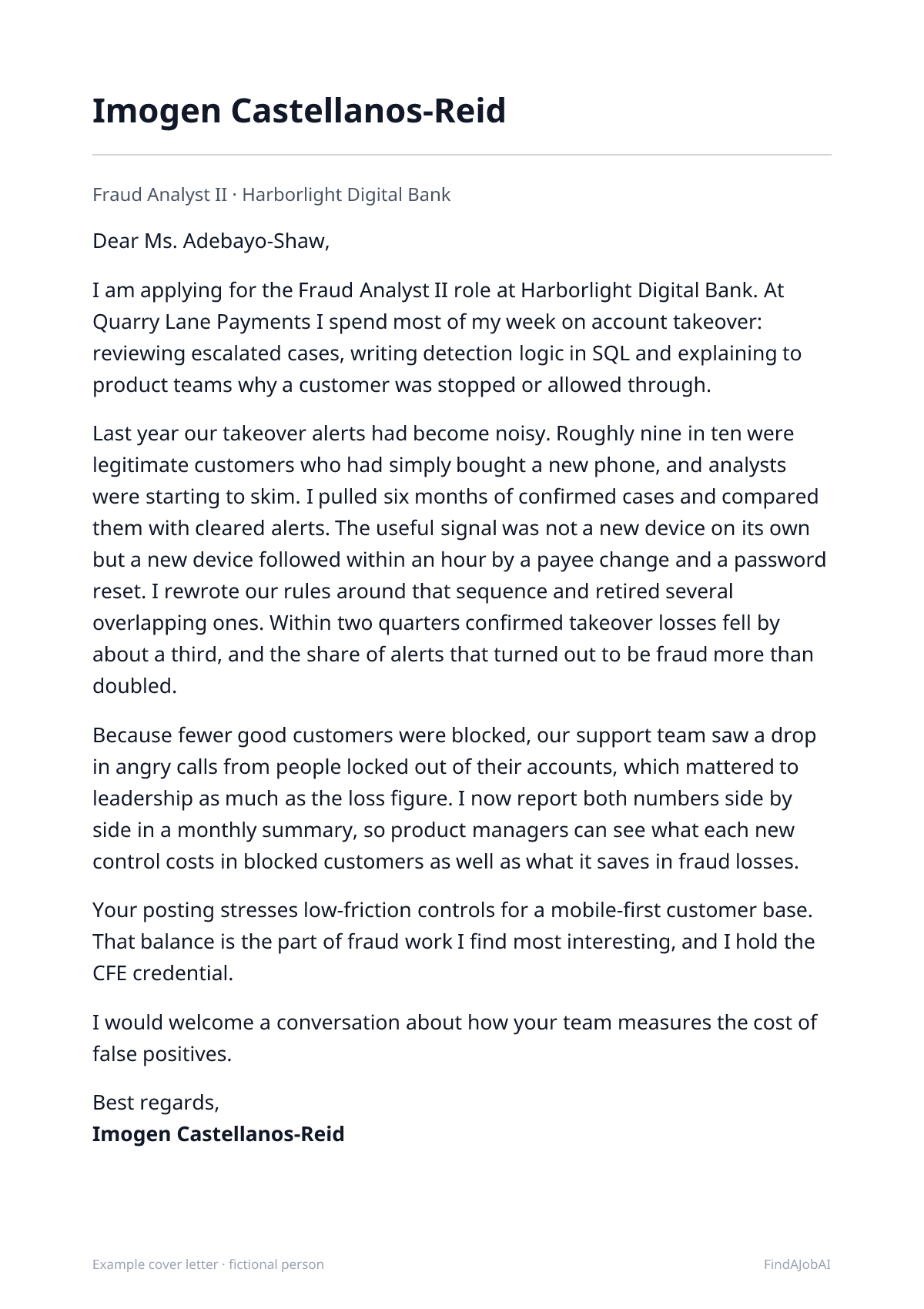
This letter as a one-page template: an opening that names the job and your strongest fact, proof that answers the ad, a reason for this employer and a short close.
After you sign up, FindAJobAI drafts your own letter for a real job from your CV in this format, and you edit it before you send it.
Example 1 · Experienced
Payments fraud analyst applying to a digital bank
Imogen reviews alerts and writes SQL rules at a payments company. The ad wants account takeover expertise and rule tuning that keeps friction low.
Example letter · fictional
Dear Ms. Adebayo-Shaw,
I am applying for the Fraud Analyst II role at Harborlight Digital Bank. At Quarry Lane Payments I spend most of my week on account takeover: reviewing escalated cases, writing detection logic in SQL and explaining to product teams why a customer was stopped or allowed through.
Last year our takeover alerts had become noisy. Roughly nine in ten were legitimate customers who had simply bought a new phone, and analysts were starting to skim. I pulled six months of confirmed cases and compared them with cleared alerts. The useful signal was not a new device on its own but a new device followed within an hour by a payee change and a password reset. I rewrote our rules around that sequence and retired several overlapping ones. Within two quarters confirmed takeover losses fell by about a third, and the share of alerts that turned out to be fraud more than doubled.
Because fewer good customers were blocked, our support team saw a drop in angry calls from people locked out of their accounts, which mattered to leadership as much as the loss figure. I now report both numbers side by side in a monthly summary, so product managers can see what each new control costs in blocked customers as well as what it saves in fraud losses.
Your posting stresses low-friction controls for a mobile-first customer base. That balance is the part of fraud work I find most interesting, and I hold the CFE credential.
I would welcome a conversation about how your team measures the cost of false positives.
Best regards,
Imogen Castellanos-Reid
Example 2 · Career changer
Retail loss prevention lead moving into online fraud
Desmond led store loss prevention for a regional retailer and learned SQL. The ad is for an entry-level e-commerce fraud analyst.
Example letter · fictional
Dear Mr. Lindgren-Ayodele,
I would like to be considered for the Fraud Analyst position at Copperleaf Outfitters Online. For six years I worked in loss prevention for a regional retailer, finishing as the lead for four stores, and I now want to apply the same instincts to online orders.
Store fraud taught me that patterns hide in ordinary-looking data. In my last year I noticed that refunds without receipts at one location were running far above the others. Pulling register reports, I found most of them were processed on the same two evening shifts and paid to a small group of gift cards. Working with our district manager and HR, we confirmed an organised refund scheme involving one employee and several outside accomplices, recovering a significant amount and tightening refund approvals across the region.
That case convinced me to learn proper tools. I completed a SQL course, built practice queries on public transaction datasets, and studied card-not-present fraud, chargebacks and promotion abuse through ACFE materials. I am comfortable writing joins and grouping queries to look for shared addresses, devices and payment details. Last month I used one of those practice datasets to find a cluster of orders sharing a shipping address and card prefix, and wrote up the result as if it were a real case file.
I have not yet worked inside an e-commerce fraud platform, so I expect a learning curve on your tools. What I bring is years of investigating real people, careful documentation and calm conversations with customers and colleagues.
Thank you for reading, and I hope we can talk soon.
Kind regards,
Desmond Achterlonie
Example 3 · Senior or lead
Fraud strategy lead applying to head a fintech's fraud program
Priyanka leads fraud strategy at a card issuer. The ad is for a head of fraud strategy to build rules, vendor models and a small team.
Example letter · fictional
Dear Mr. Haverford-Nwosu,
The Head of Fraud Strategy role at Meridian Wharf Fintech asks for someone to turn a fast-growing rules set into a measured program. That is the work I have done for the past four years at Elmstead Card Services, where I lead five analysts and own fraud strategy for a large consumer card portfolio.
When I took the role, our rules had grown to more than two hundred, many written after single incidents and never reviewed. Approval rates were slipping and nobody could say which rules still earned their place. I introduced quarterly reviews with a ninety-day lookback on precision and catch rate, and we retired forty rules in the first year. Then we ran a champion-challenger test between our rules and a vendor model, settling on a hybrid that approved more good customers while keeping net losses inside our target.
I report these results to the risk committee each quarter, and I have learned that leaders trust fraud teams who can show the cost of declines as clearly as the cost of fraud. Each quarterly pack now opens with one chart showing losses and declined good spend together, followed by the three rule changes we plan next and the result we expect from each.
My experience is in card issuing, and your book includes instant payments and lending, where I have worked less. I would want to understand those flows deeply before changing anything there, starting with a few days beside the operations team that reviews those alerts today.
I would welcome a conversation about where your current controls feel most uncertain.
Sincerely,
Priyanka Ostergaard-Menon
All three letters, and the short version below, are fictional: the people, employers and numbers are invented. Borrow the structure, never the facts.
- Prefer to write it yourself? Use the free cover letter template.
- Check your CV against the job first: the free CV score shows the missing keywords.
Why the first letter works, paragraph by paragraph
Paragraph 1: Opening
Names the fraud type and the three parts of the job (cases, rules, explaining decisions), so the reader knows the level immediately.
Paragraph 2: The rule redesign
Shows analysis grounded in confirmed cases, a specific signal sequence and results on both losses and precision.
Paragraph 3: Customer impact
Connects lower false positives to fewer lockout complaints, proving the writer thinks about honest customers too.
Paragraph 4: Why Harborlight
Mirrors the ad's emphasis on low friction and mentions a credential in one line.
Paragraph 5: Close
Invites a discussion on how the team measures false-positive cost, a topic that signals seniority.
What the career changer's letter does differently
The loss prevention letter turns store experience into fraud evidence with one data-led refund case, then shows deliberate preparation (SQL, ACFE study) and an honest admission about platform tools.
What the senior letter does differently
The senior letter shows program building: a governance process for rules, a structured model test, committee reporting that frames both kinds of cost, and an honest limit around new payment types.
Short fraud analyst cover letter: an email-ready version
Many applications arrive as an email or a small text box, and a full page doesn't fit. This version runs 120 to 150 words and keeps only what a reader needs to decide whether to reply. A fraud analyst replies to a recruiter's LinkedIn message asking for a resume and a few lines on recent fraud work.
Short version · email · fictional126 words
Subject: Fraud Analyst (claims investigations, SQL) – Lucian Abernathy-Okoro
Hi Ms. Pemberton-Kaur,
Thanks for reaching out about the Fraud Analyst role at Northwind Insurance Group. I have three years investigating auto and property claims fraud at a mid-sized insurer, and I use SQL daily to search for linked claims.
My most useful recent work was linking claims through repair shop details and phone numbers. A handful of shops kept appearing on claims filed by unrelated people within days of new policies. I built a query to flag those links, and our special investigations unit confirmed an organised ring that had filed dozens of staged accidents.
Your posting mentions organised claims fraud, so I thought this was relevant. My resume is attached, and I am free to talk any afternoon this week.
Best regards,
Lucian Abernathy-Okoro
The short email keeps one data-driven investigation with a clear method and outcome, and links it to the recruiter's posting in a single closing line.
Opening lines that work for fraud analyst cover letters
The first sentence decides whether the second gets read. Here are six openings, one for each situation you might be in. Pick the one that matches yours and swap in your own facts: every name and number below is invented.
1. You have a standout result
Nine in ten of our takeover alerts were honest customers with new phones until I rebuilt the rules around a sharper sequence of signals. I'd like to bring that balance to your fraud team.
2. The ad names a problem you've solved
Your ad mentions false positives hurting mobile conversion. Cutting them while lowering losses is the work I'm proudest of from the last two years.
3. Someone referred you
Aurelio Fenwick, a senior investigator on your team, suggested I apply after we spoke at an ACFE chapter meeting about account takeover trends.
4. You admire what they build
Six years in retail loss prevention taught me how fraudsters behave in person; I now want to catch the same behaviour in online orders.
5. You're new to the field or switching into it
A ring of sixty linked accounts surfaced last spring because two of them shared a single device, and following that thread is the part of fraud work I enjoy most.
6. You have senior scope or a specialism
I lead a team that retired forty outdated rules and raised approval rates without increasing losses, and your posting asks for exactly that kind of program discipline.
How to write a fraud analyst cover letter
Five steps, in the order you'd write them. The shape stays the same for every job (a short opening, proof, a reason for this employer, a close), and what goes into each part is what changes with the role.
Identify the fraud type and channel in the ad
Card, account takeover, lending, insurance and e-commerce fraud each use different signals. Find the ad's main focus and choose the case from your own work that sits closest to it, even if the industry is different.
Describe the signal you found
Explain what pattern caught your attention and the data you used to confirm it, such as shared devices, login sequences, addresses or refund timing. This shows how you think, which matters more than the size of the case.
Report results on both sides
Give the losses prevented or accounts protected, and the effect on honest customers: false positives, approvals or complaints. Fraud leaders are judged on both, so showing you track both sets you apart. If exact figures are confidential, rounded or relative numbers still work.
Keep confidential details out
Use rounded or relative numbers, avoid exact thresholds and never name customers or merchants. A reader will trust your discretion more if the letter models it. Fraud leaders at your former employer may know people on the hiring team, and many managers reject candidates who reveal internal controls.
Close with a fraud strategy topic
End by offering to discuss something specific, such as measuring false-positive cost or a fraud trend in their market. It shows you think about the program, not only the queue. Keep it to one short sentence.
Fraud Analyst cover letter do's and don'ts
Do
- Tell one investigation or rule change with a clear signal you found and the result.
- Report both sides: losses or accounts protected and the effect on good customers.
- Mention SQL, Excel or case tools inside your story rather than as a list.
Don't
- Don't disclose exact rule thresholds, internal system names or customer details.
- Don't present every customer as a suspect; teams want balanced judgment.
- Don't claim recovery figures you can't support; rounded or relative figures are fine.
Common fraud analyst cover letter mistakes
Each one is easy to make and quick to fix before you send the letter.
Focusing only on fraud caught
Add what happened to good customers. A rule that stops fraud but blocks many honest buyers is not a success most teams will praise.
Revealing rule logic in detail
Describe the type of signal, not the exact threshold or internal name, so you show skill without exposing a former employer's controls.
Listing tools without results
Mention SQL, Excel or case systems inside a story that ends with a measured outcome, rather than in a standalone list.
Sounding suspicious of everyone
Fraud teams want fair judgment. Show at least one moment where you cleared a customer or reduced friction.
Ignoring the employer's channel
If the ad is for insurance or lending fraud, explain how your card or retail experience transfers rather than assuming it is obvious.
Email subject lines for fraud analyst applications
Applying by email? Put the job title, any reference number and your name in the subject line.
- Fraud Analyst II application – account takeover rules, SQL, CFE – Imogen Castellanos-Reid
- Fraud Analyst – loss prevention lead moving into e-commerce fraud – Desmond Achterlonie
- Application: Fraud Analyst, Payments Risk (Job 5186) – Imogen Castellanos-Reid
Everything for Fraud Analysts
- Fraud Analyst resume exampleA full resume, plus bullet and summary examples
- Fraud Analyst interview questions30 questions with sample answers
- Fraud Analyst job descriptionDuties, skills and requirements
- Career change cover letter: template + examples
Other cover letter examples
Fraud Analyst cover letter FAQ
What should a fraud analyst cover letter focus on?
One case or rule change: the pattern you noticed, the data you used, what you changed and the result on losses and on false positives or customer friction.
How do I write a fraud analyst cover letter without fraud experience?
Use investigative or analytical work from loss prevention, auditing, customer service, banking or claims. Describe one pattern you found in data and show the SQL or fraud training you've completed.
Should I mention the CFE in a fraud analyst cover letter?
Yes, briefly, if you hold it or are actively preparing for it. One line is enough, since it already appears on your resume.
How long should a fraud analyst cover letter be?
About 250 to 350 words: an opening tied to the role, one investigation or rule story, a line on customer impact and a short close.
How we built this page
The FindAJobAI team wrote the three example letters, the short email version, the opening lines and the advice for fraud analyst roles. The people, employers and numbers in the letters are invented; the structure, the kind of evidence and the order of the paragraphs are the parts to copy.
Once we track enough live fraud analyst job ads, this page also shows the skills they ask for most, counted the same way as our in-demand skills report.
Last reviewed on November 1, 2026.