Game Designer Cover Letter Example (2026)
By FindAJobAI Team Updated How we built this page
Game studios read cover letters next to a portfolio, so the letter should not repeat it. Use it to explain one design decision: what players were doing, what you changed and what happened next. Then connect that thinking to the studio's game, so the reader can picture you on their team rather than just admiring your past work.
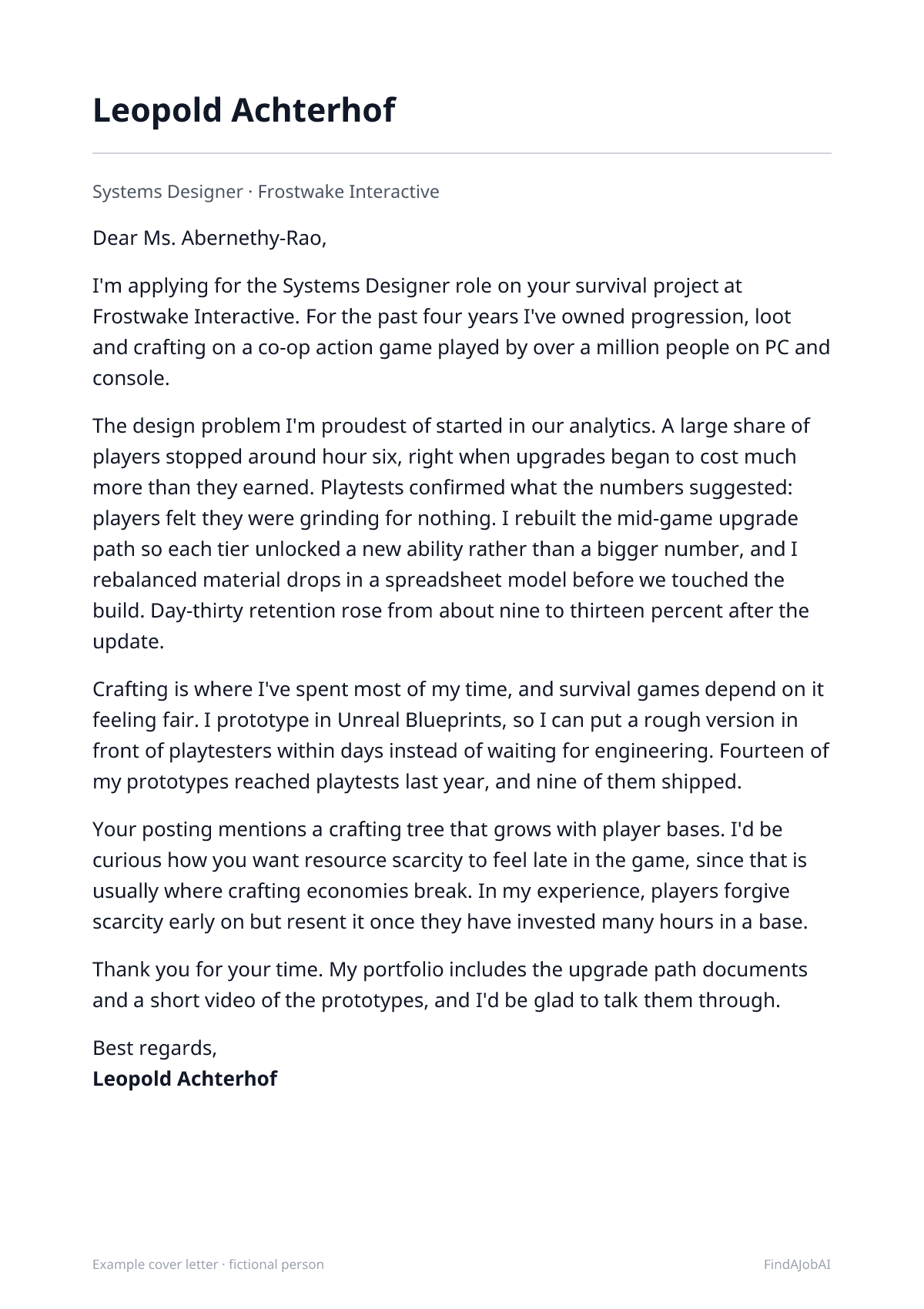
Game Designer cover letter template
This letter as a one-page template: an opening that names the job and your strongest fact, proof that answers the ad, a reason for this employer and a short close.
After you sign up, FindAJobAI drafts your own letter for a real job from your CV in this format, and you edit it before you send it.
Example 1 · Experienced
Systems designer applying to a studio making a survival crafting game
Leopold owns progression on a co-op action game. The ad wants a systems designer for crafting and economy on a survival title.
Example letter · fictional
Dear Ms. Abernethy-Rao,
I'm applying for the Systems Designer role on your survival project at Frostwake Interactive. For the past four years I've owned progression, loot and crafting on a co-op action game played by over a million people on PC and console.
The design problem I'm proudest of started in our analytics. A large share of players stopped around hour six, right when upgrades began to cost much more than they earned. Playtests confirmed what the numbers suggested: players felt they were grinding for nothing. I rebuilt the mid-game upgrade path so each tier unlocked a new ability rather than a bigger number, and I rebalanced material drops in a spreadsheet model before we touched the build. Day-thirty retention rose from about nine to thirteen percent after the update.
Crafting is where I've spent most of my time, and survival games depend on it feeling fair. I prototype in Unreal Blueprints, so I can put a rough version in front of playtesters within days instead of waiting for engineering. Fourteen of my prototypes reached playtests last year, and nine of them shipped.
Your posting mentions a crafting tree that grows with player bases. I'd be curious how you want resource scarcity to feel late in the game, since that is usually where crafting economies break. In my experience, players forgive scarcity early on but resent it once they have invested many hours in a base.
Thank you for your time. My portfolio includes the upgrade path documents and a short video of the prototypes, and I'd be glad to talk them through.
Best regards,
Leopold Achterhof
Example 2 · Career changer
QA tester moving into a junior level designer role
Priyanka has tested games for three years and builds levels in her spare time. The ad is for a junior level designer.
Example letter · fictional
Dear Lanternfish Design Team,
I'm applying for the Junior Level Designer role at Lanternfish Games. I've worked in QA for three years on two shipped platformers, and for the past two I've been building my own levels in Unity in the evenings.
Testing taught me where players get stuck. On our last release I logged that most testers missed a key jump in the second world because the camera hid the landing spot. Instead of only filing a bug, I mocked up two alternative layouts in the level editor and shared them with the designer. She used one of them, and that section stopped showing up in our playtest complaints. Since then I've started attaching rough layout suggestions to level bugs whenever the cause looks like design rather than code, and our design team now asks for them.
Outside work I've built a six-level platformer demo, with each level teaching one new mechanic before testing it. I've had about forty players try it through friends and online communities, and I rebuilt the third level twice based on what they told me. The demo and my notes on each change are in my portfolio.
I know I still have a lot to learn about pacing a full game and working inside a large team's pipeline. I'm used to taking direct feedback, though, and I write clear, specific notes, which I expect will help.
Thank you for considering my application. I'd love to hear how your team teaches new mechanics in the levels you're planning.
Kind regards,
Priyanka Valderrama
Example 3 · Senior or lead
Lead game designer applying to direct design on a new fantasy RPG
Rosalind leads eight designers on an open-world game. The ad wants a lead designer to set direction for a new RPG.
Example letter · fictional
Dear Mr. Lindgren,
I'm applying for the Lead Game Designer role on your new RPG at Ashgrove Studios. I currently lead eight designers across combat, quests and systems on an open-world game built by a team of about one hundred and forty.
Your posting talks about setting the design direction early and keeping a large team aligned. On my current project I wrote five design pillars in the first month and started a decision log that now has around three hundred entries. Whenever a feature request came up, we checked it against the pillars and recorded why we said yes or no. It sounds simple, but it meant new hires could understand past decisions without asking the same questions again.
The hardest call I've made was cutting two planned systems after our vertical slice. Playtests with eighty players showed they were confusing rather than adding depth. Cutting them was painful for the people who had designed them, so I made sure each of those designers moved onto a feature they cared about. We saved roughly six months of team time, and both designers have since led major areas.
I haven't worked in your engine, and I'd expect to spend my first weeks with your tools team before making big changes to the design workflow. I would rather learn how your teams already work than bring my old process across unchanged.
I'd welcome the chance to talk about what you want players to feel in the first hour of the new game, and how you see design working with your narrative team during preproduction.
Sincerely,
Rosalind Featherby-Nkemelu
All three letters, and the short version below, are fictional: the people, employers and numbers are invented. Borrow the structure, never the facts.
- Prefer to write it yourself? Use the free cover letter template.
- Check your CV against the job first: the free CV score shows the missing keywords.
Why the first letter works, paragraph by paragraph
Paragraph 1: Opening
Names the area of ownership and the size of the player base in two sentences, so the reader knows the level of experience straight away.
Paragraph 2: The design problem
Moves from data to playtest to design change to result, showing a full design loop rather than just an idea.
Paragraph 3: Prototyping
Shows the designer can test ideas without engineering help and that many prototypes reached players.
Paragraph 4: Why this studio
Raises a real design question about their game, which shows thought about their project rather than flattery.
Paragraph 5: Close
Points to specific portfolio items, linking the letter to the evidence the studio will review.
What the career changer's letter does differently
The QA tester's letter uses a real moment where she went beyond a bug report to suggest layouts, then backs it with a personal demo tested by real players. Naming what she still needs to learn makes the rest more credible for a junior role.
What the senior letter does differently
The senior letter focuses on direction and people: pillars, a decision log and a hard cut handled with care. It admits an engine gap and treats it as part of a sensible plan for the first weeks.
Short game designer cover letter: an email-ready version
Many applications arrive as an email or a small text box, and a full page doesn't fit. This version runs 120 to 150 words and keeps only what a reader needs to decide whether to reply. A level designer answers a mobile studio's job post by email, since the posting asked for a short note and a portfolio link.
Short version · email · fictional126 words
Subject: Level Designer – 120 shipped puzzle levels, portfolio link – Tobias Ferreira-Lund
Hello Ms. Ishikawa,
I'm applying for the Level Designer role at Pebblecraft Mobile. I designed 120 levels for a puzzle game with several million downloads, working closely with our analytics team on difficulty and with our artists on readability.
My clearest result: by tracking failure rates on every level and keeping most within an agreed target band, we removed the sharp difficulty spikes that had caused many players to quit around level thirty. Players also left noticeably better reviews for the worlds we retuned this way.
Your puzzle games have a similar steady difficulty curve, and I'd like to help keep it that way as you add new worlds. My portfolio link is below, with level maps and the tuning sheet I used.
Best,
Tobias Ferreira-Lund
The short email keeps one result about difficulty tuning, which suits a mobile puzzle studio, and points to the portfolio for everything else.
Opening lines that work for game designer cover letters
The first sentence decides whether the second gets read. Here are six openings, one for each situation you might be in. Pick the one that matches yours and swap in your own facts: every name and number below is invented.
1. You have a standout result
Day-thirty retention on our co-op game rose from about nine to thirteen percent after I rebuilt its mid-game upgrade path, and I'd like to bring that kind of systems thinking to your survival project.
2. The ad names a problem you've solved
Your ad asks for a designer who can prototype without waiting for engineering, which is how I've tested nine features that went on to ship.
3. Someone referred you
Three years in QA taught me exactly where players get stuck, and I've been building my own levels to fix those moments.
4. You admire what they build
I designed 120 puzzle levels for a mobile game, and your new world sounds like exactly the kind of difficulty curve I enjoy tuning.
5. You're new to the field or switching into it
I lead eight designers on an open-world game, and your new RPG's need for early design direction matches the work I've done for the past four years.
6. You have senior scope or a specialism
A designer on your team, Matthias Okonkwo-Brandt, suggested I apply after we spoke at a local game developers' meetup about crafting economies.
How to write a game designer cover letter
Five steps, in the order you'd write them. The shape stays the same for every job (a short opening, proof, a reason for this employer, a close), and what goes into each part is what changes with the role.
Lead with your area of ownership
Say which part of the game you designed, such as systems, levels or combat, and on which titles. Studios hire for specific areas, so make it clear in the first paragraph where your experience fits and how big the games were.
Tell one design story end to end
Pick a single decision and explain the player problem, the evidence you used, the change you made and the result. This shows you can work through the full design loop, which matters more to studios than a list of features or ideas.
Point to matching portfolio pieces
Reference the specific prototype, level map or design document that supports your story. Reviewers often read the letter with your portfolio open, so guiding them to the right piece makes your best work easier to find quickly.
Show you understand their game
Mention a design question or detail about the studio's game or genre. A specific, thoughtful observation shows real interest and gives the interviewer something concrete to discuss, which a general statement of admiration does not.
Be honest about your gaps
If you have not used their engine or worked at their scale, say so briefly and explain how you would handle it. Design teams value designers who know their limits, and honesty makes your other claims easier to trust.
Game Designer cover letter do's and don'ts
Do
- Explain one design decision with the player problem, the change and the result.
- Link to the portfolio items that support your story.
- Show that you know the studio's game or genre with one thoughtful question or observation.
Don't
- Don't spend the letter describing how much you love games; studios assume it.
- Don't pitch your dream game idea to a studio hiring for its own project.
- Don't claim credit for a whole shipped game when you designed one part of it.
Common game designer cover letter mistakes
Each one is easy to make and quick to fix before you send the letter.
Pitching your own game idea
Studios hire you to work on their project. Talk about how your skills fit their game, not about the game you would like to make.
Claiming a whole shipped title
Name the levels, systems or features you designed. Overstating your role is easy to spot in an interview.
Writing about passion instead of decisions
Replace lines about loving games since childhood with one design decision and its effect on players.
No portfolio reference
Link the portfolio and mention the piece that best supports your letter, so the reviewer finds it quickly.
Ignoring the genre
A letter for a puzzle studio should not read like one for a shooter. Adjust your example to match their type of game.
Email subject lines for game designer applications
Applying by email? Put the job title, any reference number and your name in the subject line.
- Systems Designer application – progression and crafting, 1M players – Leopold Achterhof
- Junior Level Designer – QA tester with playable level portfolio – Priyanka Valderrama
- Application: Systems Designer, Survival Project (Req. GD-412) – Leopold Achterhof
Everything for Game Designers
- Game Designer resume exampleA full resume, plus bullet and summary examples
- Game Designer interview questions30 questions with sample answers
- Game Designer job descriptionDuties, skills and requirements
- Career change cover letter: template + examples
Other cover letter examples
Game Designer cover letter FAQ
What should a game designer cover letter include?
One design decision told as a short story: the player problem, what you changed and the result. Add your area of ownership on shipped games and a link to the matching portfolio items.
How do I write a game designer cover letter with no industry experience?
Use jam games, mods or personal projects with playable links. Explain a change you made after playtesting, and show you understand the studio's genre.
Should I mention the studio's games in my cover letter?
Yes, briefly and specifically. A thoughtful question about a design choice in their game shows more interest than general praise.
Do studios still read a cover letter when the portfolio is strong?
Many studios still read one. It explains your thinking and points the reader to the best parts of your portfolio, so keep it short and specific.
How we built this page
The FindAJobAI team wrote the three example letters, the short email version, the opening lines and the advice for game designer roles. The people, employers and numbers in the letters are invented; the structure, the kind of evidence and the order of the paragraphs are the parts to copy.
Once we track enough live game designer job ads, this page also shows the skills they ask for most, counted the same way as our in-demand skills report.
Last reviewed on November 1, 2026.