Health Educator Cover Letter Example (2026)
By FindAJobAI Team Updated How we built this page
Health educator postings ask for the same degree, the same CHES line and the same list of program duties, so applications start to sound identical. A cover letter is your chance to show one program working: who came, what you changed when it wasn't landing, and how you knew participants actually learned something.
Health Educator cover letter template
This letter as a one-page template: an opening that names the job and your strongest fact, proof that answers the ad, a reason for this employer and a short close.
After you sign up, FindAJobAI drafts your own letter for a real job from your CV in this format, and you edit it before you send it.
Example 1 · Experienced
Community health educator applying to a hospital population health team
Isadora runs workshops for a county health department and wants a hospital role. The ad stresses diabetes prevention and evaluation.
Example letter · fictional
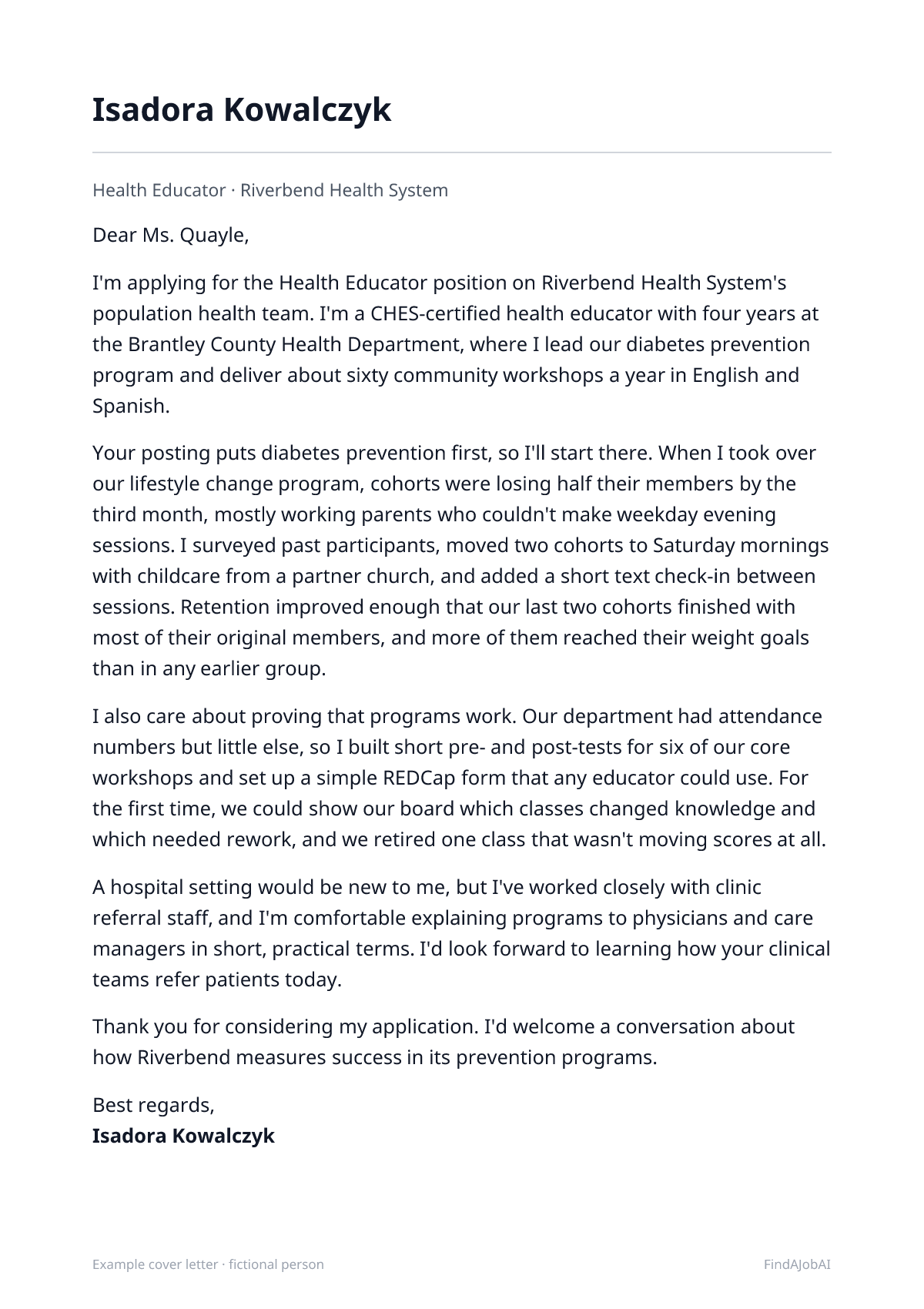
Dear Ms. Quayle,
I'm applying for the Health Educator position on Riverbend Health System's population health team. I'm a CHES-certified health educator with four years at the Brantley County Health Department, where I lead our diabetes prevention program and deliver about sixty community workshops a year in English and Spanish.
Your posting puts diabetes prevention first, so I'll start there. When I took over our lifestyle change program, cohorts were losing half their members by the third month, mostly working parents who couldn't make weekday evening sessions. I surveyed past participants, moved two cohorts to Saturday mornings with childcare from a partner church, and added a short text check-in between sessions. Retention improved enough that our last two cohorts finished with most of their original members, and more of them reached their weight goals than in any earlier group.
I also care about proving that programs work. Our department had attendance numbers but little else, so I built short pre- and post-tests for six of our core workshops and set up a simple REDCap form that any educator could use. For the first time, we could show our board which classes changed knowledge and which needed rework, and we retired one class that wasn't moving scores at all.
A hospital setting would be new to me, but I've worked closely with clinic referral staff, and I'm comfortable explaining programs to physicians and care managers in short, practical terms. I'd look forward to learning how your clinical teams refer patients today.
Thank you for considering my application. I'd welcome a conversation about how Riverbend measures success in its prevention programs.
Best regards,
Isadora Kowalczyk
Example 2 · Career changer
Middle school science teacher moving into public health education
Thaddeus taught science for eight years and finished an MPH. The ad is for a school-based health educator working on vaping.
Example letter · fictional
Dear Mr. Sandoval,
I'm applying for the School Health Educator role at Coldwater Regional Public Health. I taught seventh- and eighth-grade science for eight years at Hollins Ridge Middle School, and this spring I completed a Master of Public Health with a focus on adolescent health. I'm scheduled to sit the CHES exam in October.
The classroom gave me skills your posting asks for directly. I know how to hold the attention of thirty thirteen-year-olds, how to adjust a lesson halfway through when it isn't working, and how to talk with parents who are worried or skeptical. I also coordinated our school's health unit for three years, which is where I first saw how quickly vaping was spreading among students.
For my MPH practicum, I worked with a county coalition on a vaping prevention pilot in four middle schools. I adapted the lessons so students analyzed real e-cigarette ads instead of listening to a lecture, and I wrote a short pre- and post-survey. Students' ability to name specific risks rose clearly between the first and last session, and two schools asked to keep the lessons the following year.
Your program is expanding into new districts, which means building trust with principals and teachers who already have full schedules. I've been the teacher on the other side of that conversation, and I know a program gets invited back when it's easy to schedule, fits the curriculum and respects class time.
Thank you for your time. I'd be glad to share my practicum lessons or teach a sample session for your team.
Kind regards,
Thaddeus Moravec
Example 3 · Senior or lead
Health education manager applying to lead a state program team
Seraphina manages a county health education team and wants to lead a state chronic disease program. The ad stresses grants and evaluation.
Example letter · fictional
Dear Dr. Vossberg,
I'm applying for the Chronic Disease Program Manager position with the Bureau of Community Health. I'm an MCHES-certified health educator with eleven years in public health, the last five as health education manager at Ashland Valley Public Health, where I lead a team of six and a portfolio of nine grant-funded programs.
Your posting emphasizes grant management and evaluation across local partners, which is most of what my job has become. When I started, each of our programs reported to its funder in a different way, and we couldn't compare one to another. I built a shared evaluation framework with common measures for knowledge, behavior and reach, trained staff to use one data system, and began a quarterly review where each lead presents results to the whole team. Two funders have since renewed grants early, citing the clarity of our reports.
I've also learned that programs succeed through partners. We reach far more students now because I negotiated agreements with four school districts that fit our lessons into their health curriculum, instead of asking teachers for spare class periods. Those agreements took months of meetings, but they turned one-off visits into lessons that happen every year.
I haven't worked at the state level, and I know supporting dozens of local agencies is different from running programs directly. I would spend my first months visiting partner sites and listening before changing any reporting requirements.
I still teach one community class each quarter, because it keeps me honest about what participants actually experience. I'd welcome the chance to discuss the Bureau's priorities for the next grant cycle.
Sincerely,
Seraphina Lindqvist
All three letters, and the short version below, are fictional: the people, employers and numbers are invented. Borrow the structure, never the facts.
- Prefer to write it yourself? Use the free cover letter template.
- Check your CV against the job first: the free CV score shows the missing keywords.
Why the first letter works, paragraph by paragraph
Paragraph 1: Opening
Gives credential, setting, the flagship program and languages in two sentences, so the reader knows the fit before the story starts.
Paragraph 2: Program story
Shows a real problem in a diabetes prevention program, the research behind the fix and a retention result, which proves planning skill rather than claiming it.
Paragraph 3: Evaluation
Explains how the writer built simple measures and used them to retire a weak class, which answers the ad's evaluation requirement with a decision.
Paragraph 4: Honest gap
Admits hospital work is new while pointing to referral experience and plain communication with clinicians, which keeps the letter credible.
Paragraph 5: Close
Invites a conversation about how the hospital measures success, tying the close back to the evaluation theme.
What the career changer's letter does differently
The career changer's letter turns classroom experience into health education skills: holding a teen audience, adapting lessons and working with parents. It then uses the MPH practicum as the bridge, with a vaping pilot, a survey and schools asking to continue, and offers a sample session.
What the senior letter does differently
A manager's letter reports systems instead of single workshops: a shared evaluation framework, quarterly reviews and multi-year school agreements. It names state-level work as an honest gap with a listening plan, and keeps one line about still teaching to show the writer stays close to participants.
Short health educator cover letter: an email-ready version
Many applications arrive as an email or a small text box, and a full page doesn't fit. This version runs 120 to 150 words and keeps only what a reader needs to decide whether to reply. A health educator emails a nonprofit's program director after a networking event, attaching a resume for an open community outreach role.
Short version · email · fictional125 words
Subject: Community Health Educator role – met at the health equity forum – Cormac Delacroix
Hi Ms. Yamaguchi,
It was good to meet you at last week's health equity forum. As promised, I'm sending my resume for the Community Health Educator role at Eastgate Neighborhood Health Alliance. I'm CHES certified, bilingual in English and Haitian Creole, and I've spent three years running blood pressure and nutrition programs with churches and barbershops.
You mentioned your outreach team wants to reach more men in the neighborhood. Our barbershop series reached men who rarely visit a clinic, and dozens were referred for follow-up care in its first year. I'd be happy to share how we recruited the barbers and trained them to start those conversations.
I'd be glad to talk more over coffee or a call whenever it suits you.
Best,
Cormac Delacroix
The short version leads with the networking connection, gives credential and languages, and answers the one need the director mentioned in person. It skips program details the director can read in the resume.
Opening lines that work for health educator cover letters
The first sentence decides whether the second gets read. Here are six openings, one for each situation you might be in. Pick the one that matches yours and swap in your own facts: every name and number below is invented.
1. You have a standout result
When our diabetes prevention cohorts kept losing members, I moved sessions to Saturday mornings with childcare and kept most participants to the end. I'd like to bring that kind of practical problem solving to your team.
2. The ad names a problem you've solved
Your posting asks for a health educator who can evaluate programs, not just deliver them. I built the pre- and post-tests my department now uses across six core workshops.
3. Someone referred you
Your outreach coordinator, Annelise Fitzwilliam, and I worked together on a county vaping coalition last year. She told me about your school health expansion, which is why I'm applying.
4. You admire what they build
Your clinic's free cooking classes helped my grandmother manage her diabetes when I was in high school. That experience is part of why I studied public health, and I'd like to help run programs like it.
5. You're new to the field or switching into it
After eight years teaching middle school science, I completed an MPH and a school vaping prevention pilot. I'd like to keep teaching teenagers, now with a focus on their health.
6. You have senior scope or a specialism
As a health education manager, I built a shared evaluation framework for nine grant-funded programs. I'm now looking for a role where I can support that kind of work across many local partners.
How to write a health educator cover letter
Five steps, in the order you'd write them. The shape stays the same for every job (a short opening, proof, a reason for this employer, a close), and what goes into each part is what changes with the role.
Open with a program that worked
Start with a short story about a program you ran: the audience, what wasn't working and what you changed. Hiring managers read many letters listing topics, so one concrete example of planning and adapting stands out and shows how you think about real participants.
Show how you measure results
Public health employers need evidence for funders and boards. Mention a pre- and post-test, completion rate, referral count or behavior change you tracked, and what decision it led to. Even simple measures show you think beyond delivering a session and moving on.
Name the community you serve and how you adapt
Many roles target specific populations, such as teens, older adults or Spanish-speaking families. Say who you've worked with, which languages you use and one way you adapted a program based on their feedback, rather than using general phrases about diverse communities.
Mention partners and how you found them
Health educators reach people through schools, churches, clinics and employers. Describe one partnership you built and what it made possible. This shows you can open doors on your own, which matters when programs depend on hosts and referrals.
Be clear about credentials and next steps
State your CHES or MCHES status in one sentence, or give your exam date if you're eligible. Close by offering a sample session, a set of materials or a conversation about the employer's programs, so the reader has an easy next step.
Health Educator cover letter do's and don'ts
Do
- Describe one program with its audience, a problem you solved and how you measured the result.
- State your CHES status plainly, including your exam date if you're eligible but not certified.
- Mention the languages and communities you serve well if the role targets a specific population.
- Show how you work with partners such as schools, clinics or employers to reach people.
Don't
- Don't list every health topic you've covered; go deep on the one the ad cares about most.
- Don't rely on attendance numbers alone; add a knowledge, behavior or referral outcome.
- Don't describe communities in vague terms; name who you worked with and how you adapted.
Common health educator cover letter mistakes
Each one is easy to make and quick to fix before you send the letter.
Listing health topics instead of results
A paragraph of topics reads like a course catalog. Choose one program and describe the audience, a challenge and a measured result so the reader sees impact rather than coverage.
Using attendance as proof of success
High attendance is good but doesn't show learning or change. Pair it with a knowledge, behavior, completion or referral result, even a modest one, to show the program did something.
Vague phrases about underserved communities
Words like "diverse" and "underserved" without detail sound generic. Name the population, languages and partners, and describe one adjustment you made based on their input.
Skipping evaluation and grant work
Many public health roles depend on funding and reports. If you've written surveys, analyzed data or contributed to grants, mention it with your specific part in the work.
Forgetting to mention CHES status
Employers often require CHES within a set period. Leaving it out makes them guess, so state whether you're certified, eligible or scheduled for the exam.
Email subject lines for health educator applications
Applying by email? Put the job title, any reference number and your name in the subject line.
- Health Educator application – CHES, diabetes prevention and evaluation – Isadora Kowalczyk
- School Health Educator – former science teacher with MPH and vaping pilot – Thaddeus Moravec
- Application: Health Educator, Riverbend Health System (Req. 3157) – Isadora Kowalczyk
Everything for Health Educators
- Health Educator resume exampleA full resume, plus bullet and summary examples
- Health Educator interview questions30 questions with sample answers
- Health Educator job descriptionDuties, skills and requirements
- Career change cover letter: template + examples
Other cover letter examples
Health Educator cover letter FAQ
What should a health educator cover letter include?
Your credential and setting in one line, then one program story with the audience, a challenge and a measured result. Add a sentence on evaluation or partnerships, depending on what the posting stresses, and close with something specific about the employer's programs.
How do I write a health educator cover letter without public health experience?
Connect the work you've done to teaching, outreach or behavior change. Teachers, nurses, coaches and community workers all have relevant skills. Add any practicum, volunteer program or coursework project, and name your CHES plans so the employer sees the path.
Should I include program outcomes in a health educator cover letter?
Yes. One clear outcome, such as better quiz scores, more participants finishing a program or referrals completed, shows your work changes something. Keep it honest and specific rather than claiming large community-wide effects.
How we built this page
The FindAJobAI team wrote the three example letters, the short email version, the opening lines and the advice for health educator roles. The people, employers and numbers in the letters are invented; the structure, the kind of evidence and the order of the paragraphs are the parts to copy.
Once we track enough live health educator job ads, this page also shows the skills they ask for most, counted the same way as our in-demand skills report.
Last reviewed on November 1, 2026.