Linux Administrator Cover Letter Example (2026)
By FindAJobAI Team Updated How we built this page
Linux administrator postings ask for nearly the same distros, shells and config tools, so resumes start to blur. A cover letter gives you room to describe one host you rescued, one migration you finished before a deadline, or one hardening job that passed an audit, in a way a skills list never can.
Linux Administrator cover letter template
This letter as a one-page template: an opening that names the job and your strongest fact, proof that answers the ad, a reason for this employer and a short close.
After you sign up, FindAJobAI drafts your own letter for a real job from your CV in this format, and you edit it before you send it.
Example 1 · Experienced
RHEL fleet administrator applying to a payments processor
Pavel runs 500 RHEL hosts for a regional hosting firm. The ad stresses SELinux, Ansible and PCI audits for a card-processing platform.
Example letter · fictional
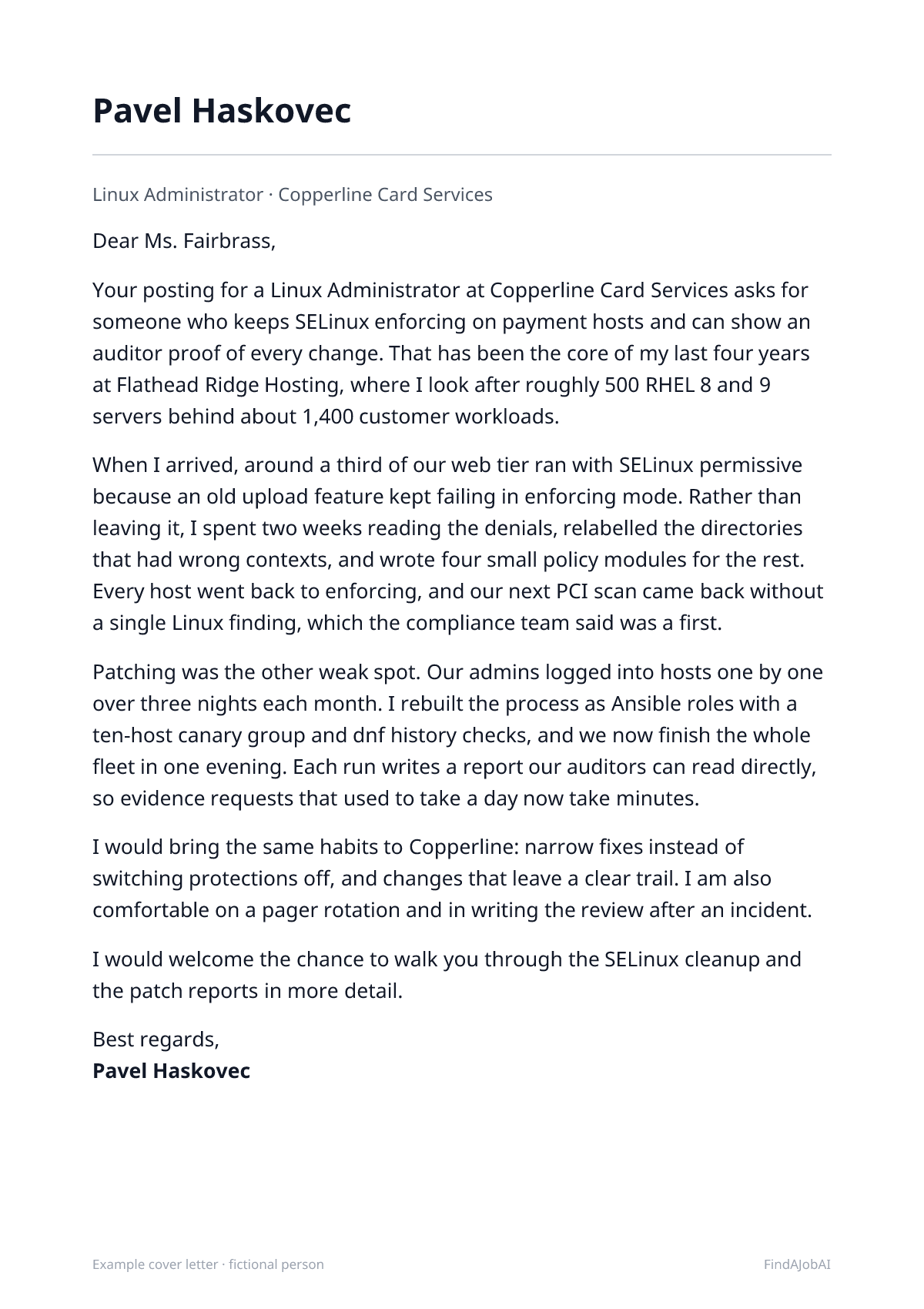
Dear Ms. Fairbrass,
Your posting for a Linux Administrator at Copperline Card Services asks for someone who keeps SELinux enforcing on payment hosts and can show an auditor proof of every change. That has been the core of my last four years at Flathead Ridge Hosting, where I look after roughly 500 RHEL 8 and 9 servers behind about 1,400 customer workloads.
When I arrived, around a third of our web tier ran with SELinux permissive because an old upload feature kept failing in enforcing mode. Rather than leaving it, I spent two weeks reading the denials, relabelled the directories that had wrong contexts, and wrote four small policy modules for the rest. Every host went back to enforcing, and our next PCI scan came back without a single Linux finding, which the compliance team said was a first.
Patching was the other weak spot. Our admins logged into hosts one by one over three nights each month. I rebuilt the process as Ansible roles with a ten-host canary group and dnf history checks, and we now finish the whole fleet in one evening. Each run writes a report our auditors can read directly, so evidence requests that used to take a day now take minutes.
I would bring the same habits to Copperline: narrow fixes instead of switching protections off, and changes that leave a clear trail. I am also comfortable on a pager rotation and in writing the review after an incident.
I would welcome the chance to walk you through the SELinux cleanup and the patch reports in more detail.
Best regards,
Pavel Haskovec
Example 2 · Entry level
Hosting support technician with an RHCSA seeking a first Linux admin role
Moira handles Linux tickets at a web host and passed the RHCSA last spring. The ad is for a junior admin on a small infrastructure team.
Example letter · fictional
Dear Mr. Hrabal,
I am writing about the Junior Linux Administrator opening at Prickly Pear Analytics. For the past two years I have answered support tickets at Elkhorn Basin Web, and most of my day is spent inside Ubuntu and Rocky Linux servers that customers have locked themselves out of, filled up or misconfigured.
Last winter I noticed that a big share of our tickets were the same handful of problems: full disks, expired certificates and broken SSH keys. I wrote a short Bash script that gathers disk, inode, certificate and service status from a host in one pass and pastes it into the ticket. My teammates adopted it within a month, and our average first reply dropped from about fifteen minutes to under five. It also taught me to quote variables carefully after the script failed on a customer path with a space in it.
To go beyond support work I passed the RHCSA in April, and I keep a four-node KVM lab at home. There I practise patching in canary waves with Ansible, recovering from a broken fstab, and fixing SELinux denials with semanage rather than turning enforcement off. I log each exercise in a notebook so I can repeat the steps under pressure.
Your ad mentions mentoring from senior engineers and a mix of RHEL and Ubuntu hosts. I learn fastest when I can ask questions and then own a task end to end, and I would bring careful habits and good notes from day one.
Thank you for reading. I would be glad to show you the triage script or talk through my lab setup.
Kind regards,
Moira Duthie
Example 3 · Senior or lead
Senior Linux administrator applying to lead a university research computing team
Lazlo leads three admins at a regional bank. The ad wants a senior Linux lead to standardise builds and patching for research clusters.
Example letter · fictional
Dear Dr. Iwanicki,
I am applying for the Senior Linux Administrator position with Upper Missouri Research Computing. For six years I have led a team of three Linux administrators at Sweetgrass Hills Bank, where we run about 900 RHEL and Rocky Linux hosts, and before that I spent eight years administering Unix and Linux systems in state government.
Your posting describes research groups building their own servers, each slightly different, and patching that depends on which graduate student remembers. We faced a similar sprawl after the bank absorbed two smaller lenders. I wrote a single build standard based on kickstart, CIS Level 1 and SELinux enforcing, moved every new host onto it, and then rebuilt the older ones during their normal hardware refresh. Within eighteen months, critical patches reached the whole estate in five days rather than three weeks.
The part I am proudest of is the on-call rotation. Pages used to land on whoever answered first, and two people burned out in one year. I set up a fair weekly rotation, wrote runbooks for the twelve most common alerts, and trimmed noisy checks until the average week brought six pages instead of thirty.
I have not worked with HPC schedulers such as Slurm in production, and I know research users expect more freedom than bank staff. I would spend my first weeks with your cluster users and their workloads before proposing any standard.
I would be glad to share the build standard and the runbook format we use if they would help our conversation, and to hear which systems worry your team most.
Sincerely,
Lazlo Pataky
All three letters, and the short version below, are fictional: the people, employers and numbers are invented. Borrow the structure, never the facts.
- Prefer to write it yourself? Use the free cover letter template.
- Check your CV against the job first: the free CV score shows the missing keywords.
Why the first letter works, paragraph by paragraph
Paragraph 1: Opening
Mirrors the two things the ad cares about most, SELinux and audit evidence, and gives the fleet size in the first paragraph so the reader knows the scale of experience straight away.
Paragraph 2: The SELinux cleanup
Shows judgement as well as skill: instead of accepting permissive mode, the writer read denials, fixed labels and wrote small modules. The clean PCI scan gives a concrete, checkable outcome.
Paragraph 3: The patching rebuild
Turns a tool name, Ansible, into a story about time saved and evidence produced, which speaks to both the operations manager and the compliance team.
Paragraph 4: Fit with the new employer
Names the working habits that carry over (narrow fixes, a paper trail, on-call comfort) instead of repeating the posting's requirement list back to the reader.
Paragraph 5: Close
Offers two specific topics for the interview, which invites a technical conversation rather than ending on a polite but empty thank-you.
What the entry-level letter does differently
The entry-level letter builds its case from a support job, not a sysadmin title: a triage script colleagues adopted, an honest lesson about quoting variables, an RHCSA and a home lab with named exercises. That gives a hiring manager real shell work to judge even without production admin experience.
What the senior letter does differently
A senior letter reports systems and habits rather than single fixes: one build standard rolled across a merged estate, patch time cut from weeks to days, and an on-call rotation that stopped burning people out. It also names the gap, Slurm and research users, and explains how the writer would close it.
Short Linux administrator cover letter: an email-ready version
Many applications arrive as an email or a small text box, and a full page doesn't fit. This version runs 120 to 150 words and keeps only what a reader needs to decide whether to reply. A Linux administrator emails a hiring manager directly after the job board's application form timed out twice.
Short version · email · fictional129 words
Subject: Linux Administrator role – Ubuntu, Ansible and on-call – Inez Kallinikos
Hello Mr. Lunderville,
Your application form timed out twice, so I am sending my interest in the Linux Administrator role at Beartooth Logistics Software by email instead. I have five years running Ubuntu and Debian servers for a freight tracking company, currently about 300 hosts across two cloud regions.
My most useful recent project was replacing hand-run upgrades with Ansible and staged reboots. We moved 180 hosts from Ubuntu 18.04 to 22.04 in three waves with a snapshot before every host, and no customer-facing outage. I also rewrote our on-call runbooks, which helped a new teammate handle her first night alone.
My resume is attached, and I would be happy to share the upgrade checklist we used or talk through how I would approach your fleet.
Thanks,
Inez Kallinikos
The short email gives the reason for writing directly, then keeps one project, the staged Ubuntu upgrade, with its scale and clean result. A short note only has space for a single proof point, so the runbook detail is reduced to one sentence.
Opening lines that work for Linux administrator cover letters
The first sentence decides whether the second gets read. Here are six openings, one for each situation you might be in. Pick the one that matches yours and swap in your own facts: every name and number below is invented.
1. You have a standout result
I moved 340 CentOS 7 servers to RHEL 9 five weeks before end of life last year, and your posting suggests you face a similar deadline.
2. The ad names a problem you've solved
Your ad asks for someone who keeps SELinux enforcing on payment hosts. That has been my main job for four years, and our last PCI scan had no Linux findings.
3. Someone referred you
Brigid Pelletreau, who runs your platform team, suggested I apply after we spoke at a regional Linux user group about Ansible patch waves.
4. You admire what they build
Most of my support tickets end inside a Linux shell, and after passing the RHCSA this spring I am ready to own servers rather than only rescue them.
5. You're new to the field or switching into it
I spent a winter replacing three nights of hand patching with one evening of Ansible waves, and I would like to bring that kind of cleanup to your fleet.
6. You have senior scope or a specialism
As the senior Linux administrator at a regional bank, I wrote the build standard every new server still follows, and I want to apply that discipline to research systems.
How to write a Linux administrator cover letter
Five steps, in the order you'd write them. The shape stays the same for every job (a short opening, proof, a reason for this employer, a close), and what goes into each part is what changes with the role.
Find the Linux pain point hidden in the ad
Look past the tool list for the real problem: an end-of-life distro, failed audits, inconsistent builds or a noisy pager. Choose the story from your own work that matches that problem most closely and lead with it.
Give scale in the first paragraph
Say how many hosts, which distros and what they support, such as customer sites or payment systems. A reader who knows you ran 500 RHEL servers will read the rest of the letter with that scale in mind.
Explain the diagnosis, not only the fix
Describe what you saw in the logs, what you ruled out and how you found the cause, whether it was a wrong SELinux label or a mount missing nofail. That reasoning is what separates admins who troubleshoot from those who reboot.
Show a result someone else can check
An audit with no findings, a patch window cut from three nights to one, a migration finished weeks early or pages per week reduced. If you cannot measure it exactly, describe what stopped happening after your change.
Admit one gap and show how you will close it
Senior letters in particular gain trust when they name something new, such as Slurm, Kubernetes nodes or a different distro, and explain how you would learn it. It shows self-awareness and makes the rest of the letter more believable.
Linux Administrator cover letter do's and don'ts
Do
- Pick one host, migration or hardening story and give the fleet size, what you found and what changed.
- Name the distros and tools from the ad inside your example, such as RHEL 9, Ansible or SELinux.
- Mention certifications like RHCSA or RHCE briefly, then show the skill in action.
Don't
- Don't paste a list of commands you know; show what one of them helped you fix.
- Don't claim you would disable SELinux or firewalls to make an app work, even jokingly.
- Don't share a former employer's hostnames, IP ranges or security incidents in detail.
Common Linux administrator cover letter mistakes
Each one is easy to make and quick to fix before you send the letter.
Turning the letter into a command reference
Listing grep, awk, sed, iptables and systemctl tells the reader nothing they cannot see on the resume. Pick one task those tools helped you finish and describe the outcome in plain language.
Praising a fix that weakened security
Stories like disabling SELinux or opening a firewall to make an app work worry hiring managers. If you have one, retell it as the moment you learned the narrow fix, and describe that fix instead.
Leaving out the distro and version
Writing only Linux hides whether you ran RHEL 9, Ubuntu 22.04 or something older. Name the version alongside the host count so the reader can match it to their own estate quickly.
Skipping on-call and incident experience
Most Linux admin roles include a pager. A short line about how you handled a night outage, and what you changed after it, often matters more to the team than another tool name.
Email subject lines for Linux administrator applications
Applying by email? Put the job title, any reference number and your name in the subject line.
- Linux Administrator application: RHEL, SELinux and Ansible – Pavel Haskovec
- Junior Linux Administrator – RHCSA, Ubuntu and Rocky Linux support – Moira Duthie
- Senior Linux Administrator (Req. 4471) – Lazlo Pataky
Everything for Linux Administrators
- Linux Administrator resume exampleA full resume, plus bullet and summary examples
- Linux Administrator interview questions30 questions with sample answers
- Linux Administrator job descriptionDuties, skills and requirements
- Cover letter with no experience: templates
Other cover letter examples
Linux Administrator cover letter FAQ
What should a Linux administrator cover letter focus on?
One concrete piece of Linux work with numbers: a fleet you patched, a host you recovered, a migration you finished or a hardening job that passed an audit. Add a sentence on why the employer's environment suits you. Leave the full tool list to the resume.
How do I write a Linux admin cover letter without professional admin experience?
Use Linux work from support, development or study: scripts you wrote, servers you fixed for customers, an RHCSA or LFCS, and a home lab with specific exercises. Explain what you built and what you learned when something went wrong.
Should I mention both RHEL and Ubuntu experience in the letter?
Mention the one the employer runs first, inside your strongest example. If they use both, a short line showing you can work across rpm and apt based systems helps, but the resume can carry the rest of the detail.
How we built this page
The FindAJobAI team wrote the three example letters, the short email version, the opening lines and the advice for Linux administrator roles. The people, employers and numbers in the letters are invented; the structure, the kind of evidence and the order of the paragraphs are the parts to copy.
Once we track enough live Linux administrator job ads, this page also shows the skills they ask for most, counted the same way as our in-demand skills report.
Last reviewed on November 1, 2026.