MRI Technologist Cover Letter Example (2026)
By FindAJobAI Team Updated How we built this page
MRI technologist ads repeat the same registry, scanner and safety requirements, and most applicants meet them on paper. The cover letter is where you show how you think inside Zone IV: the implant you questioned, the claustrophobic patient you got through a full exam, and the protocol change that cut repeat sequences.
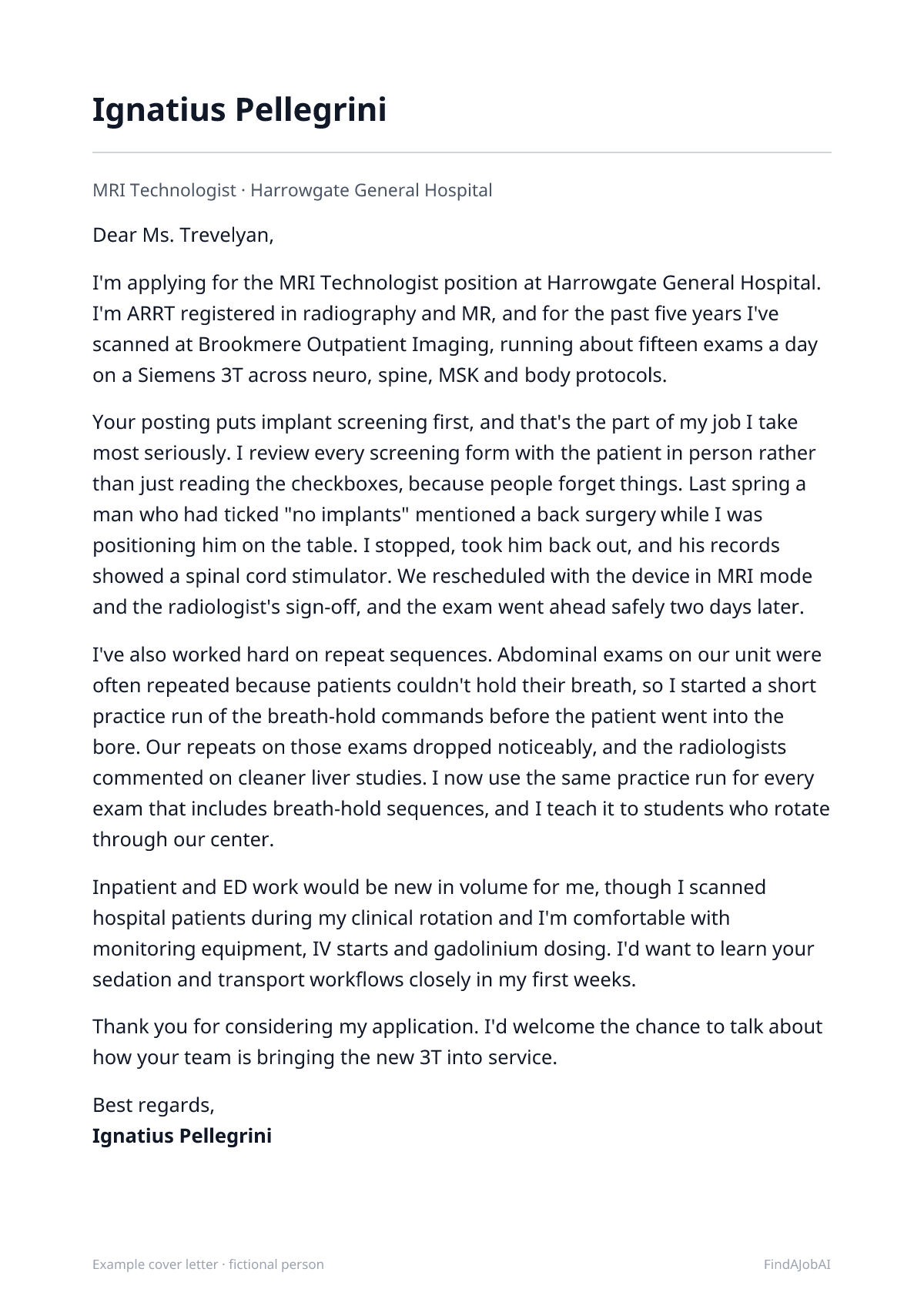
MRI Technologist cover letter template
This letter as a one-page template: an opening that names the job and your strongest fact, proof that answers the ad, a reason for this employer and a short close.
After you sign up, FindAJobAI drafts your own letter for a real job from your CV in this format, and you edit it before you send it.
Example 1 · Experienced
Staff MRI technologist applying to a hospital with a new 3T scanner
Ignatius scans at an outpatient center and wants hospital work. The ad mentions 3T, implant screening and inpatient volume.
Example letter · fictional
Dear Ms. Trevelyan,
I'm applying for the MRI Technologist position at Harrowgate General Hospital. I'm ARRT registered in radiography and MR, and for the past five years I've scanned at Brookmere Outpatient Imaging, running about fifteen exams a day on a Siemens 3T across neuro, spine, MSK and body protocols.
Your posting puts implant screening first, and that's the part of my job I take most seriously. I review every screening form with the patient in person rather than just reading the checkboxes, because people forget things. Last spring a man who had ticked "no implants" mentioned a back surgery while I was positioning him on the table. I stopped, took him back out, and his records showed a spinal cord stimulator. We rescheduled with the device in MRI mode and the radiologist's sign-off, and the exam went ahead safely two days later.
I've also worked hard on repeat sequences. Abdominal exams on our unit were often repeated because patients couldn't hold their breath, so I started a short practice run of the breath-hold commands before the patient went into the bore. Our repeats on those exams dropped noticeably, and the radiologists commented on cleaner liver studies. I now use the same practice run for every exam that includes breath-hold sequences, and I teach it to students who rotate through our center.
Inpatient and ED work would be new in volume for me, though I scanned hospital patients during my clinical rotation and I'm comfortable with monitoring equipment, IV starts and gadolinium dosing. I'd want to learn your sedation and transport workflows closely in my first weeks.
Thank you for considering my application. I'd welcome the chance to talk about how your team is bringing the new 3T into service.
Best regards,
Ignatius Pellegrini
Example 2 · Career changer
Radiologic technologist cross-training into MRI
Theodora has seven years in radiography and CT and just earned ARRT (MR). The ad is for an MRI technologist willing to train on cardiac.
Example letter · fictional
Dear Mr. Moriarty,
I'm applying for the MRI Technologist opening at Larchmont Regional Medical Center. I've been a radiologic technologist for seven years, the last three also covering CT, and this winter I passed the ARRT MR exam after completing 260 supervised MRI exams through my hospital's cross-training program.
Radiography and CT taught me habits that carry straight into MRI. I've positioned trauma patients who couldn't move on their own, started IVs for contrast studies several times a shift, and checked renal function and allergy history before every injection. In CT I also learned to watch a patient closely while the scan runs, which matters even more in a bore where they can feel alone. I've talked many frightened patients through scans over the intercom, and I already know how much a calm, steady voice helps someone stay still.
During my MRI training I focused on safety screening, because it was the part that felt most different from my old role. I learned to question vague answers, to check implant cards against manufacturer labeling, and to involve the radiologist early rather than late. My supervising technologist let me run the screening for our afternoon list independently by my third month, and I caught one pacemaker card that had been scanned into the wrong patient's record.
Your posting mentions training on cardiac MRI. I haven't performed cardiac studies yet, but I'm comfortable with ECG leads from CT angiography, and I'd welcome a structured plan to learn gating and cardiac planes with your senior staff.
Thank you for your time. I'd be glad to come in to meet the team or shadow a shift on your scanners.
Kind regards,
Theodora Wrenshaw
Example 3 · Senior or lead
Lead MRI technologist applying to manage an imaging network's MRI service
Philomena leads MRI at one hospital and wants to run MRI across four sites. The ad stresses safety standards and staffing.
Example letter · fictional
Dear Dr. Cavendish,
I'm applying for the MRI Supervisor role at Northcote Imaging Network. I've been an MRI technologist for twelve years and have led the MRI section at Ellesmere Hospital for the last five, managing eight technologists across two scanners and serving as the department's MR Safety Officer.
Your ad names consistent safety standards across sites as the top priority. When I took over at Ellesmere, screening varied by who was on shift: some technologists phoned device patients ahead, others found out at the door. I wrote a single device workflow, set up pre-visit calls for every patient with an implant, and started a monthly review of near misses with our MR medical director. Same-day device cancellations fell sharply, and we have had no safety incidents in the five years since.
Staffing was the other problem I inherited. We relied on overtime to cover evenings, so I cross-trained two CT technologists into MRI over a year, building a checklist of protocols each had to complete with a senior technologist before scanning alone. Both now cover evening shifts independently, and overtime dropped enough to fund an extra weekend slot that cut our outpatient wait list by about a week.
I still scan two days a week, including our cardiac list, because supervising technologists is easier when you know exactly what a hard day on the magnet feels like. I haven't managed staff across separate sites before, and I'd plan to spend time at each location early to understand how they differ before standardizing anything.
I'd welcome a conversation about your current screening workflows and staffing gaps.
Sincerely,
Philomena Starbuck
All three letters, and the short version below, are fictional: the people, employers and numbers are invented. Borrow the structure, never the facts.
- Prefer to write it yourself? Use the free cover letter template.
- Check your CV against the job first: the free CV score shows the missing keywords.
Why the first letter works, paragraph by paragraph
Paragraph 1: Opening
Gives registry, years, scanner vendor, field strength and daily volume in two sentences, which answers most of the screening questions in the ad.
Paragraph 2: Safety story
One specific catch, a forgotten spinal cord stimulator, shows a screening habit in action and how the writer handled it by protocol.
Paragraph 3: Image quality
A simple coaching change and its effect on repeat sequences shows the writer thinks about quality, not just throughput.
Paragraph 4: Honest gap
Names inpatient and ED volume as new, then lists the related skills already in hand, which builds trust instead of overselling.
Paragraph 5: Close
Refers to the new 3T scanner from the ad, showing the writer read the posting and has something specific to discuss.
What the career changer's letter does differently
The career changer's letter leads with radiography and CT habits that transfer directly to MRI, such as IV starts, contrast checks and close patient watching. It then shows how the writer approached MRI safety screening during training, and names cardiac as an honest gap with a plan.
What the senior letter does differently
A lead technologist's letter reports on systems rather than single scans: a shared device workflow, pre-visit calls, near-miss reviews and a cross-training plan that fixed staffing. It still shows the writer scans complex studies personally, and treats multi-site management as an honest gap with a clear first step.
Short MRI technologist cover letter: an email-ready version
Many applications arrive as an email or a small text box, and a full page doesn't fit. This version runs 120 to 150 words and keeps only what a reader needs to decide whether to reply. An MRI technologist answers a staffing agency recruiter who emailed about a 13-week contract at an outpatient imaging center.
Short version · email · fictional120 words
Subject: MRI Technologist contract – ARRT (MR), GE and Siemens – Evander Holtzclaw
Hello Mr. Bergstrom,
Thanks for reaching out about the 13-week MRI contract at Bluewater Diagnostic Center. I'm ARRT registered in MR with four years of experience on GE 1.5T and Siemens 3T scanners, mostly outpatient neuro, spine and MSK work at about sixteen exams a day.
I start my own IVs, handle gadolinium dosing and renal checks, and I'm careful with implant screening, which matters at a center that sees many referred patients with older devices. I'm also used to settling claustrophobic patients so exams finish on the first visit.
I can start in early March and I'm open to weekend shifts. My resume and license details are attached, and I'm free for a call this week.
Best,
Evander Holtzclaw
The short version keeps registry, scanner platforms, IV skills and start date, which are the facts a contract recruiter needs to submit a candidate, and drops the longer stories that a hiring manager would read later.
Opening lines that work for MRI technologist cover letters
The first sentence decides whether the second gets read. Here are six openings, one for each situation you might be in. Pick the one that matches yours and swap in your own facts: every name and number below is invented.
1. You have a standout result
Last spring I took a patient back off the table when he mentioned a back surgery he hadn't listed, and his records showed a spinal cord stimulator. Careful screening like that is what I'd bring to your MRI team.
2. The ad names a problem you've solved
Your posting asks for a technologist who can keep a busy outpatient schedule on time. I run about fifteen exams a day on a 3T scanner while still taking the extra minutes anxious patients need.
3. Someone referred you
Your lead technologist, Ottilie Marchbanks, precepted me during my MRI clinical rotation and suggested I apply when your evening position opened, knowing I wanted more inpatient work.
4. You admire what they build
My mother had her cancer follow-up scans at your center, and the technologists there talked her through every sequence. That experience is part of why I chose MRI, and I'd like to join that team.
5. You're new to the field or switching into it
After seven years in radiography and CT, I passed the ARRT MR exam this winter with 260 supervised MRI exams behind me. I'd like to bring my patient care and contrast experience into a full-time MRI role.
6. You have senior scope or a specialism
As MRI section lead, I wrote our device workflow and cross-trained two CT technologists to cover evenings. I'm now looking for a role where I can build those systems across several imaging sites.
How to write a MRI technologist cover letter
Five steps, in the order you'd write them. The shape stays the same for every job (a short opening, proof, a reason for this employer, a close), and what goes into each part is what changes with the role.
Open with a safety or patient moment
Start with one real situation: an implant you questioned, a claustrophobic patient who finished the exam, or a protocol fix. MRI hiring managers think about safety and failed exams constantly, so a concrete story in the first lines tells them you share those priorities.
State registry, scanners and field strengths early
Put your ARRT credentials, scanner vendors and field strengths in the first paragraph. These are screening questions for most departments, and answering them up front leaves the rest of the letter free for the stories that show how you actually work.
Show image quality, not just volume
Exams per day matter, but radiologists care about clean images. Describe one change, such as breath-hold coaching, better immobilization or a coil choice, that reduced repeats or improved a study. That proves you think about the reading room, not just the schedule.
Be honest about advanced studies you haven't done
If the ad lists cardiac, breast or pediatric MRI and you haven't run them, say so plainly and name the related skills you already have. Offer to learn on a structured plan with senior staff. Overclaiming advanced studies is easy to spot at the first shadow shift.
Close with something specific to the department
Mention the new scanner, service line or schedule from the ad, and offer to shadow or meet the team. A specific close signals you read the posting carefully and gives the manager a natural reason to call you for a conversation.
MRI Technologist cover letter do's and don'ts
Do
- Tell one safety screening story with the steps you took, not just a statement that you value safety.
- Name your ARRT credentials, scanner vendors and field strengths in the first paragraph.
- Show how you handle claustrophobic or anxious patients, since failed exams cost departments time.
- Mention advanced studies you can run, or the ones you're ready to learn, if the ad lists them.
Don't
- Don't list every protocol you know; pick the ones the ad mentions and show depth in one.
- Don't claim experience with a scanner or study you haven't actually run independently.
- Don't skip patient care; a perfect protocol fails if the patient can't stay still.
Common MRI technologist cover letter mistakes
Each one is easy to make and quick to fix before you send the letter.
Saying you "always prioritize safety" with no example
Every applicant says this. Describe a real screening decision, such as an implant you verified or a person you stopped at the Zone IV door, and what you did next.
Listing protocols like a resume
A paragraph of exam names reads like a skills list. Choose the studies the ad cares about and show depth in one of them with a short example of a difficult case.
Ignoring patient comfort
Claustrophobia and motion cause many failed exams. Mention one technique you use, such as feet-first positioning or breath-hold practice, and the result it produced for a patient.
Overclaiming advanced exams
Claiming cardiac or spectroscopy experience you don't have is easy to expose on a shadow shift. Describe what you have done and how you'd learn the rest with structured supervision.
Forgetting contract or shift details
Agency recruiters and managers need start dates, shift flexibility and license status. Leaving these out slows the process, so add one clear sentence near the close.
Email subject lines for MRI technologist applications
Applying by email? Put the job title, any reference number and your name in the subject line.
- MRI Technologist application – ARRT (R)(MR), Siemens 3T – Ignatius Pellegrini
- MRI Technologist – radiographer with new ARRT (MR) and 260 supervised exams – Theodora Wrenshaw
- Application: MRI Technologist, Harrowgate General Hospital (Req. 6082) – Ignatius Pellegrini
Everything for MRI Technologists
- MRI Technologist resume exampleA full resume, plus bullet and summary examples
- MRI Technologist interview questions30 questions with sample answers
- MRI Technologist job descriptionDuties, skills and requirements
- Career change cover letter: template + examples
Other cover letter examples
MRI Technologist cover letter FAQ
What should an MRI technologist cover letter include?
Your registry and scanner experience in one line, then a story about safety screening or a difficult patient, and one example of protecting image quality. Close with something specific about the department, such as a new scanner or service line from the ad.
How do I write an MRI cover letter if I'm cross-training from radiography or CT?
Lead with the habits that transfer: positioning, IV starts, contrast safety and patient monitoring. Then give your supervised MRI exam count and how you approached safety screening during training, and be honest about any advanced studies you still need to learn.
Should I mention MRI safety certification in my cover letter?
Mention MRSO or similar credentials briefly if you hold them, but spend more space on a real screening decision you made. A certification shows training, while a story shows you apply it under pressure.
How we built this page
The FindAJobAI team wrote the three example letters, the short email version, the opening lines and the advice for MRI technologist roles. The people, employers and numbers in the letters are invented; the structure, the kind of evidence and the order of the paragraphs are the parts to copy.
Once we track enough live MRI technologist job ads, this page also shows the skills they ask for most, counted the same way as our in-demand skills report.
Last reviewed on November 1, 2026.