Nurse Manager Cover Letter Example (2026)
By FindAJobAI Team Updated How we built this page
A nurse manager letter is read by a nursing director who wants to know one thing: will the unit run better with you in charge? Skip the history of why you became a nurse. Describe the unit you lead now, one result you moved through your staff, and how you handle the hard parts of the job, such as short shifts, turnover and difficult conversations.
Nurse Manager cover letter template
This letter as a one-page template: an opening that names the job and your strongest fact, proof that answers the ad, a reason for this employer and a short close.
After you sign up, FindAJobAI drafts your own letter for a real job from your CV in this format, and you edit it before you send it.
Example 1 · Experienced
Med-surg nurse manager moving to a larger hospital
Odalys has managed a 28-bed med-surg unit for four years. The ad is for a 40-bed unit with high turnover and rising falls.
Example letter · fictional
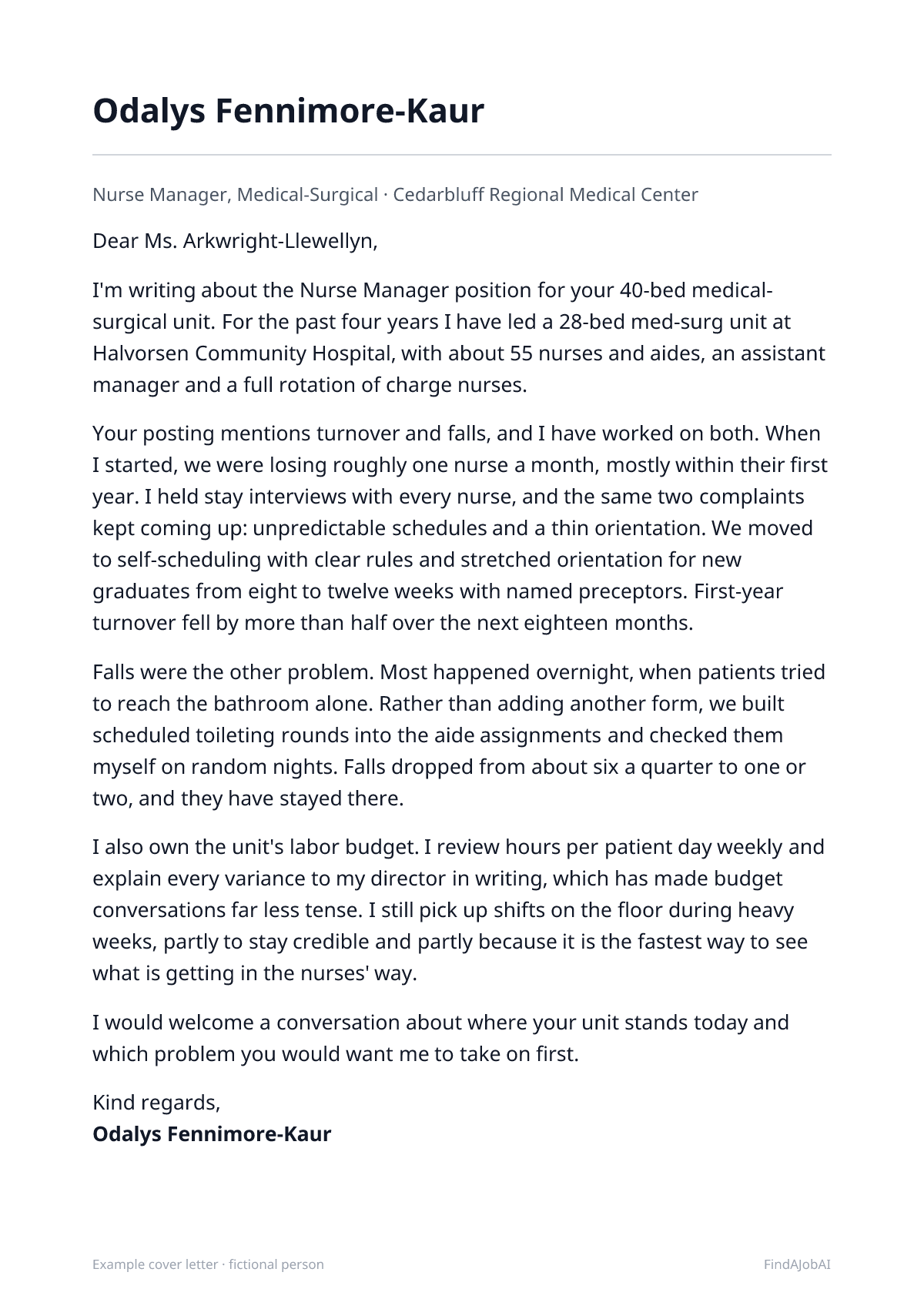
Dear Ms. Arkwright-Llewellyn,
I'm writing about the Nurse Manager position for your 40-bed medical-surgical unit. For the past four years I have led a 28-bed med-surg unit at Halvorsen Community Hospital, with about 55 nurses and aides, an assistant manager and a full rotation of charge nurses.
Your posting mentions turnover and falls, and I have worked on both. When I started, we were losing roughly one nurse a month, mostly within their first year. I held stay interviews with every nurse, and the same two complaints kept coming up: unpredictable schedules and a thin orientation. We moved to self-scheduling with clear rules and stretched orientation for new graduates from eight to twelve weeks with named preceptors. First-year turnover fell by more than half over the next eighteen months.
Falls were the other problem. Most happened overnight, when patients tried to reach the bathroom alone. Rather than adding another form, we built scheduled toileting rounds into the aide assignments and checked them myself on random nights. Falls dropped from about six a quarter to one or two, and they have stayed there.
I also own the unit's labor budget. I review hours per patient day weekly and explain every variance to my director in writing, which has made budget conversations far less tense. I still pick up shifts on the floor during heavy weeks, partly to stay credible and partly because it is the fastest way to see what is getting in the nurses' way.
I would welcome a conversation about where your unit stands today and which problem you would want me to take on first.
Kind regards,
Odalys Fennimore-Kaur
Example 2 · Entry level
Charge nurse applying for a first nurse manager role
Benedikt has been a charge nurse on a telemetry unit for three years and finished his MSN. The ad is for a nurse manager at a smaller hospital.
Example letter · fictional
Dear Mr. Pemberton-Ashdown,
I'm applying for the Nurse Manager role on your telemetry unit. I have worked as a telemetry RN for seven years, the last three as a regular charge nurse on a 24-bed unit at Brightwater Memorial, and I completed my MSN in nursing leadership this spring.
As charge nurse I already handle much of the daily work a manager depends on: assignments by acuity, bed flow with the emergency department and coverage when nurses call out. Last year our unit had trouble with delayed responses to telemetry alarms. I worked with our monitor technicians to sort alarms into urgent and non-urgent, and we agreed on a two-minute response standard for urgent ones. Our manager asked me to audit it monthly, and average response time came down by several minutes within a quarter.
My MSN capstone looked at our unit's overtime. I found that most of it came from nurses staying late to finish charting after a heavy final medication pass. My manager adopted my proposal to move part of that pass earlier, and overtime hours went down over the next two months. It was my first real look at how a small workflow change shows up in a budget.
I have not yet hired staff or managed a full budget on my own, and I would want close support from your director in those areas during my first months. What I bring is a good feel for how nurses experience the shift and a habit of checking whether a fix actually worked.
Thank you for your time. I would be glad to talk about your unit's goals for the coming year.
Sincerely,
Benedikt Ostrowe-Mensah
Example 3 · Senior or lead
Two-unit nurse manager applying to lead critical care
Wilhelmina manages an ICU and a step-down unit. The ad is for a senior nurse manager over critical care at a teaching hospital.
Example letter · fictional
Dear Dr. Vasquez-Ebersole,
I'm applying for the Senior Nurse Manager role over critical care at Thornhallow University Hospital. For six years I have managed both the 18-bed medical ICU and the 22-bed step-down unit at Marrowbeck Health, leading two assistant managers and about 120 staff.
Running two units taught me to build leaders rather than make every decision myself. When I took on the step-down unit, I spent the first three months training its charge nurses to handle staffing changes and family concerns that had always come straight to the manager. Calls to me after hours dropped sharply, and two of those charge nurses have since moved into assistant manager roles at our hospital.
On quality, our central line infections were above the national benchmark when I started. Together with infection prevention, we set up daily line rounds, a short checklist at the bedside and a monthly review of every infection with the nurses involved. We went more than a year without a central line infection in the ICU, and the step-down unit followed the same approach for its patients with lines. Nurses now present those reviews themselves, which keeps the routine theirs rather than mine.
I also helped design our critical care float pool, which now covers both units and has cut our agency spending considerably. Building it meant months of work with finance and HR, and I learned to present staffing needs in budget terms that executives could approve. I also learned to bring a charge nurse to those meetings so leaders heard the floor's view first-hand.
I would value the chance to hear how your critical care units are organized today and where you see the biggest gaps.
With appreciation,
Wilhelmina Szabo-Treloar
All three letters, and the short version below, are fictional: the people, employers and numbers are invented. Borrow the structure, never the facts.
- Prefer to write it yourself? Use the free cover letter template.
- Check your CV against the job first: the free CV score shows the missing keywords.
Why the first letter works, paragraph by paragraph
Paragraph 1: Opening with scope
States unit size, staff count and support structure, so the director can compare it with the 40-bed unit in the ad.
Paragraph 2: Turnover result
Answers the ad's first named problem with a cause found through stay interviews, two specific changes and a measured drop.
Paragraph 3: Falls result
Shows a second quality fix built into daily routines and checked in person, with before and after numbers.
Paragraph 4: Budget and presence on the floor
Covers the financial side of the job and shows the writer stays connected to the bedside work of the unit.
Paragraph 5: Close
Ends with an invitation to discuss the unit's current problems, which keeps the focus on the employer's needs.
What the entry-level letter does differently
The charge nurse's letter treats charge duties and an MSN project as real management evidence: an alarm response standard he audited and an overtime analysis his manager adopted. He is honest that he has not hired or owned a budget, and asks for the support he would need.
What the senior letter does differently
The senior letter shifts from single results to building leaders and systems: charge nurses trained to handle escalations, a line infection routine shared across units, and a float pool negotiated with finance. Scope is stated in the first paragraph so the reader can see it fits a multi-unit role.
Short nurse manager cover letter: an email-ready version
Many applications arrive as an email or a small text box, and a full page doesn't fit. This version runs 120 to 150 words and keeps only what a reader needs to decide whether to reply. A nurse manager replies by email to a hospital recruiter who contacted her about a women's health unit opening.
Short version · email · fictional136 words
Subject: Nurse Manager, Women's Health – reply to your message – Cordelia Mwangi-Hartfield
Hi Ms. Thorvaldsen-Ruiz,
Thank you for reaching out about the Nurse Manager opening on your women's health unit. I have managed a 20-bed postpartum unit at Ridgeway General for three years, with about 40 nurses and a lactation team. Before that I spent eight years as a labor and delivery nurse, mostly on nights.
Our biggest win was discharge timing. Working with pediatrics and case management, we moved most discharges before early afternoon, which freed beds for labor and delivery and cut patient waits for transfer. Patient experience scores on discharge information also rose during the same year, which our staff were proud of.
I'm interested in a larger unit, and the role you described fits that. My resume is attached, and I'm free for a call most weekday afternoons next week.
Best regards,
Cordelia Mwangi-Hartfield
The short reply stays under 150 words: unit size, one result tied to patient flow, and a clear next step. A recruiter reading on a phone gets scope and interest in a few seconds.
Opening lines that work for nurse manager cover letters
The first sentence decides whether the second gets read. Here are six openings, one for each situation you might be in. Pick the one that matches yours and swap in your own facts: every name and number below is invented.
1. You have a standout result
When I took over my med-surg unit, we were losing about one nurse a month. Eighteen months later, first-year turnover was less than half of that, and I'd like to bring the same approach to your unit.
2. The ad names a problem you've solved
Your posting says the unit is rebuilding after a difficult year. I have led a unit through a similar stretch, and the first thing I did was listen to every nurse on staff.
3. Someone referred you
For three years I have been the charge nurse my manager calls when a shift falls apart, and I'm ready to take responsibility for the whole unit.
4. You admire what they build
Our ICU went more than a year without a central line infection after we changed how we rounded on lines, and I would like to bring that discipline to your critical care service.
5. You're new to the field or switching into it
Your director of nursing, whom I met at a regional leadership course, mentioned that your telemetry unit needs a manager who knows the work at the bedside.
6. You have senior scope or a specialism
I manage a 28-bed unit with about 55 staff, and most of my week goes into staffing, quality and coaching rather than paperwork.
How to write a nurse manager cover letter
Five steps, in the order you'd write them. The shape stays the same for every job (a short opening, proof, a reason for this employer, a close), and what goes into each part is what changes with the role.
State the size of the unit you lead
Open with the type of unit, number of beds and how many staff report to you. A nursing director compares this against their own unit right away, and it tells them whether your experience is a step up, a sideways move or a stretch they need to plan for.
Match the problems named in the posting
Postings often hint at the unit's troubles: turnover, falls, patient experience or overtime. Pick the one or two you have actually worked on and describe what you found, what you changed and how the number moved, in plain language a busy director can follow.
Show the business side of the job
Mention budgets, hours per patient day, agency use or overtime in at least one sentence. Directors need managers who can explain cost, and a short example of a variance you understood and fixed shows you can carry that part of the role.
Describe how you develop people
A manager's results come through charge nurses and staff. Name a person or group you coached and what they went on to do, such as taking charge shifts or moving into an assistant manager role. This shows your impact will outlast any single project.
Name your leadership gaps honestly
If you have not hired staff, led a survey or owned a full budget, say so in one sentence and name the support you would want. Directors respect self-awareness, and it keeps the interview focused on how you would grow rather than on doubts.
Nurse Manager cover letter do's and don'ts
Do
- Name the unit size, staff count and type of unit you lead now so the director can compare scope.
- Pick one or two measures the ad mentions, such as turnover or falls, and show how you moved them.
- Explain how you work with the budget and staffing grid, even briefly.
Don't
- Don't spend the letter on your bedside nursing history; the director wants leadership evidence.
- Don't claim credit for a unit result without naming the change you personally led.
- Don't hide gaps like budget ownership; name them and say how you would close them.
Common nurse manager cover letter mistakes
Each one is easy to make and quick to fix before you send the letter.
Writing a clinical nurse letter
Bedside skills are assumed. Replace patient care stories with examples of staffing decisions, quality results and coaching that show how you lead.
Results with no numbers
Say how turnover, falls, infections or overtime changed and over what time. Even a simple before and after makes the claim believable.
Taking sole credit for unit results
Name the staff, committees or departments involved, and describe your part clearly. Directors know unit results come from teams.
Leaving out staffing and budget results
Add one sentence on labor cost, overtime or hours per patient day. Leaving it out suggests you have not handled that side of management.
A generic letter for every hospital
Mention the unit type, size and any challenge from the posting. A letter that could go to any hospital tells the director you have not studied their needs.
Email subject lines for nurse manager applications
Applying by email? Put the job title, any reference number and your name in the subject line.
- Nurse Manager, Med-Surg – 4 years leading a 28-bed unit – Odalys Fennimore-Kaur
- Application: Nurse Manager, Telemetry – charge nurse, MSN – Benedikt Ostrowe-Mensah
- Nurse Manager application (Req. 7715) – Odalys Fennimore-Kaur
Everything for Nurse Managers
- Nurse Manager resume exampleA full resume, plus bullet and summary examples
- Nurse Manager interview questions30 questions with sample answers
- Nurse Manager job descriptionDuties, skills and requirements
- Cover letter with no experience: templates
Other cover letter examples
Nurse Manager cover letter FAQ
What should a nurse manager cover letter focus on?
Leadership results on a unit: staffing, turnover, quality measures and budget, each with a specific change you led. Clinical skill matters less here than how you run a team.
How do I apply for a nurse manager job without management experience?
Use charge nurse duties, committee work and any MSN projects as evidence. Name one change you led and its result, and be honest about the areas where you would need support.
Should I mention my MSN or leadership certification?
Yes, briefly. Many hospitals prefer or require an MSN for managers, so state it plainly, and mention a capstone only if it shows a real unit result.
How we built this page
The FindAJobAI team wrote the three example letters, the short email version, the opening lines and the advice for nurse manager roles. The people, employers and numbers in the letters are invented; the structure, the kind of evidence and the order of the paragraphs are the parts to copy.
Once we track enough live nurse manager job ads, this page also shows the skills they ask for most, counted the same way as our in-demand skills report.
Last reviewed on November 1, 2026.