Prompt Engineer Cover Letter Example (2026)
By FindAJobAI Team Updated How we built this page
Prompt engineer roles usually open because an LLM feature works in demos but disappoints real users: wrong answers, made-up citations, rising costs or unsafe replies. A strong prompt engineer cover letter shows one feature you made dependable, how you measured its quality, and what changed for users or the budget once your work shipped.
Prompt Engineer cover letter template
This letter as a one-page template: an opening that names the job and your strongest fact, proof that answers the ad, a reason for this employer and a short close.
After you sign up, FindAJobAI drafts your own letter for a real job from your CV in this format, and you edit it before you send it.
Example 1 · Experienced
Prompt engineer applying to a fintech support team
Annika improved a customer support assistant at a software company. The ad asks for evaluation, retrieval and guardrails on a banking assistant.
Example letter · fictional
Dear Mr. Okonjo-Halvorsen,
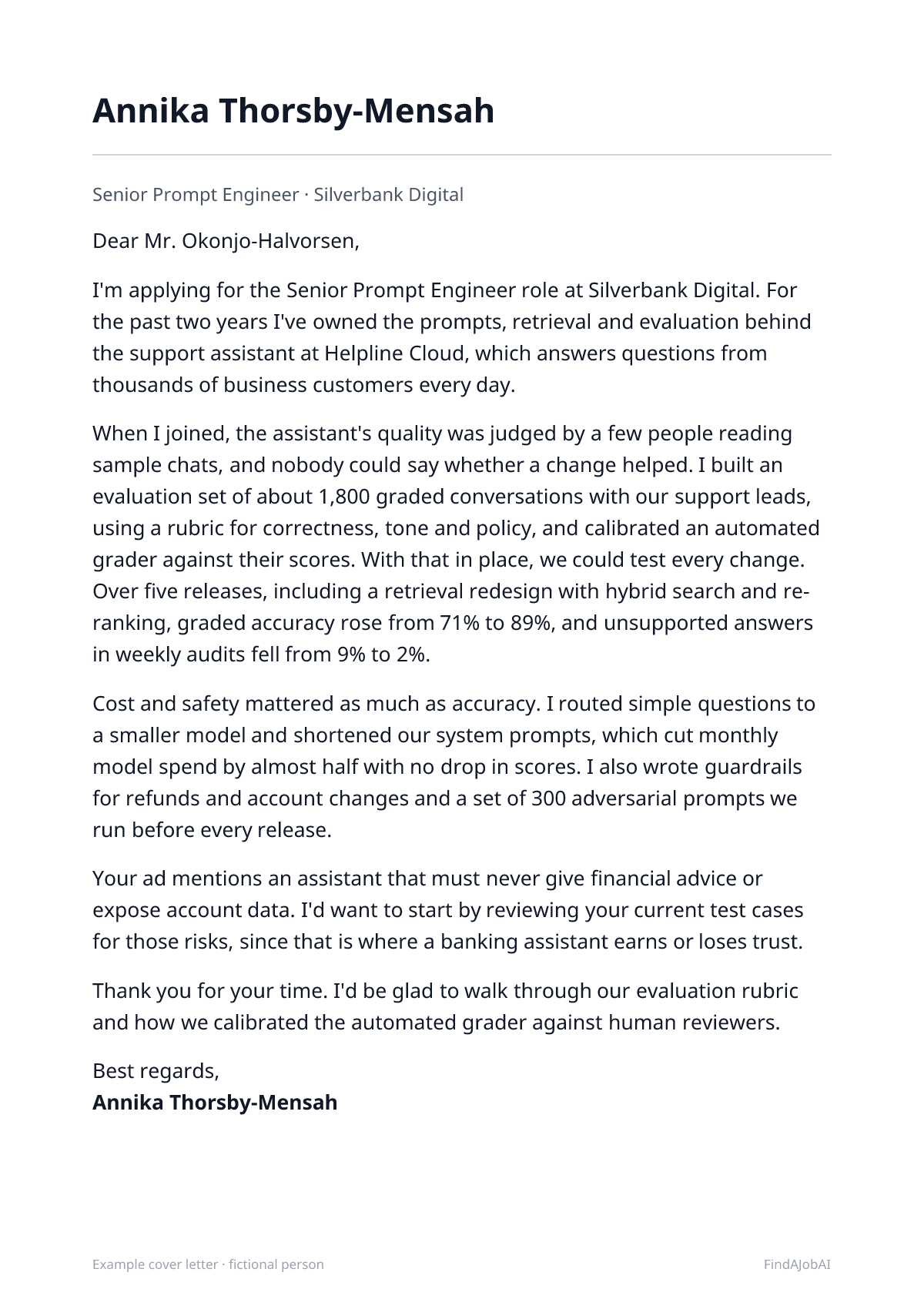
I'm applying for the Senior Prompt Engineer role at Silverbank Digital. For the past two years I've owned the prompts, retrieval and evaluation behind the support assistant at Helpline Cloud, which answers questions from thousands of business customers every day.
When I joined, the assistant's quality was judged by a few people reading sample chats, and nobody could say whether a change helped. I built an evaluation set of about 1,800 graded conversations with our support leads, using a rubric for correctness, tone and policy, and calibrated an automated grader against their scores. With that in place, we could test every change. Over five releases, including a retrieval redesign with hybrid search and re-ranking, graded accuracy rose from 71% to 89%, and unsupported answers in weekly audits fell from 9% to 2%.
Cost and safety mattered as much as accuracy. I routed simple questions to a smaller model and shortened our system prompts, which cut monthly model spend by almost half with no drop in scores. I also wrote guardrails for refunds and account changes and a set of 300 adversarial prompts we run before every release.
Your ad mentions an assistant that must never give financial advice or expose account data. I'd want to start by reviewing your current test cases for those risks, since that is where a banking assistant earns or loses trust.
Thank you for your time. I'd be glad to walk through our evaluation rubric and how we calibrated the automated grader against human reviewers.
Best regards,
Annika Thorsby-Mensah
Example 2 · Career changer
Technical writer moving into prompt engineering
Corentin has been a technical writer for six years and led his team's work on an LLM documentation assistant. The ad is for a prompt engineer.
Example letter · fictional
Dear Northgrid AI Team,
The Prompt Engineer opening at Northgrid Software matches the work I've been doing for the past year and a half. I've been a technical writer at a developer tools company for six years, and I became the person our product team relied on when we added an assistant that answers questions from our documentation.
The first version invented configuration options that did not exist, which frustrated users and alarmed our support team. Because I knew the documentation better than anyone, I rewrote how articles were split for retrieval, added instructions that required the assistant to quote the article it used, and built a test set of 300 real user questions with correct answers. I learned enough Python to run that set automatically on every change. Invented options dropped from about one answer in eight to rare cases, and support tickets about wrong answers fell noticeably.
Since then I've completed a course on LLM application development and built a small evaluation tool that compares two prompt versions side by side. I know I still have more to learn about retrieval at large scale and about production engineering practices.
Your ad says the team wants someone who writes precise instructions and measures results. Writing precise instructions has been my job for six years, and now I measure the results too.
My GitHub has the evaluation tool and the test set format, and I'd be happy to walk through both on a call, including the questions where the assistant still struggles today.
Kind regards,
Corentin Abiola-Westergaard
Example 3 · Senior or lead
LLM team lead applying to set evaluation standards at a health company
Wilhelmina leads an applied LLM team at an insurer. The ad is for a lead to set evaluation and safety standards for clinical LLM features.
Example letter · fictional
Dear Dr. Lindqvist-Obi,
I'm applying for the Lead Prompt Engineer role at Carewell Digital Health. For the past three years I've led an applied LLM team at Bayfront Mutual Insurance, where we run nine LLM features across claims, underwriting and customer service, several of them producing regulated letters.
Your ad says each team currently tests its LLM features in its own way. We started there too, and quality varied widely between features. I proposed a shared standard: every feature needs a graded test set of at least five hundred cases, an automated grader calibrated against human reviewers, and a red-team set before launch. I built the tooling so meeting the standard took days rather than weeks, and teams adopted it because it also made their releases faster and safer.
For regulated outputs, I designed a review flow where trained staff approve every claim letter before it is sent. Their edit rate fell from about a third of letters to under one in ten as we fed their corrections back into prompts and test cases. I also introduced cost tracking per feature, which helped us cut model spend by more than a third.
I haven't worked with clinical content, and I'd expect patient safety rules to require stricter review and faster escalation than insurance letters ever did.
I'd welcome a conversation about which of your LLM features carries the most clinical risk, how your clinicians currently review its outputs, and what they would need from a shared standard to trust it.
Sincerely,
Wilhelmina Asante-Kowalczyk
All three letters, and the short version below, are fictional: the people, employers and numbers are invented. Borrow the structure, never the facts.
- Prefer to write it yourself? Use the free cover letter template.
- Check your CV against the job first: the free CV score shows the missing keywords.
Why the first letter works, paragraph by paragraph
Paragraph 1: Opening
Names the feature and its scale, a support assistant used by thousands daily, so a fintech reader sees comparable experience.
Paragraph 2: The evaluation story
Shows the shift from reading samples to a calibrated test set, then gives accuracy and audit figures across several releases.
Paragraph 3: Cost and safety paragraph
Model spend and adversarial testing are central worries for any LLM product, and both get a concrete result.
Paragraph 4: Why this company
Picks up the ad's compliance risks and proposes reviewing test cases first, which suits a bank.
Paragraph 5: Close
Offers to discuss rubric design and grader calibration, which tests real evaluation skill in the interview.
What the career changer's letter does differently
The career changer turns documentation expertise into prompt engineering evidence: better chunking, a citation requirement and a 300-question test set run automatically. Learning steps are specific, gaps are admitted plainly, and the close links precise writing to measured results.
What the senior letter does differently
This lead letter shows a standard that teams adopted because it helped them, plus a human review flow with falling edit rates. Cost tracking adds business sense, and the clinical-content gap is acknowledged with a sensible expectation of stricter review.
Short prompt engineer cover letter: an email-ready version
Many applications arrive as an email or a small text box, and a full page doesn't fit. This version runs 120 to 150 words and keeps only what a reader needs to decide whether to reply. A prompt engineer emails a startup founder who posted the opening in an applied LLM newsletter and asked for replies by email.
Short version · email · fictional121 words
Subject: Prompt Engineer – legal summaries with citation checks – Leandra Okafor-Brightman
Hi Ms. Fairweather,
Your post in the applied LLM newsletter about a prompt engineer role at Briefwell Legal caught my attention. For two years I've built LLM features at a legal research company, mainly a case summary tool used by about 2,400 attorneys.
The work I'm proudest of is the review loop: six legal editors graded 900 summaries, and I turned their notes into prompt rules and tests that cut citation errors by about seventy percent before every release.
You mentioned summaries that sometimes cite the wrong case, which is exactly the problem that review loop was built to fix for our attorneys. My resume is attached, and I'm free for a short call most afternoons this week.
Thanks,
Leandra Okafor-Brightman
A legal tech founder wants proof you can make summaries trustworthy. This email offers one feature with its users and an error reduction tied to expert review, then names the citation problem from the post.
Opening lines that work for prompt engineer cover letters
The first sentence decides whether the second gets read. Here are six openings, one for each situation you might be in. Pick the one that matches yours and swap in your own facts: every name and number below is invented.
1. You have a standout result
Last year I raised a support assistant's graded accuracy from 71% to 89% while cutting its model spend nearly in half. I'd like to bring that work to your assistant.
2. The ad names a problem you've solved
Your ad says your assistant sometimes invents policy details. I fixed the same problem with better retrieval and a calibrated test set.
3. Someone referred you
Tobias Hartmann, who leads your search team, and I built an evaluation suite together for two years. He mentioned your LLM team is growing.
4. You admire what they build
I use your open-source evaluation library in my own test pipeline, and I contributed a fix for its rubric scoring this spring.
5. You're new to the field or switching into it
After six years as a technical writer, I rebuilt my company's documentation assistant and learned to measure it. I want to do this full time.
6. You have senior scope or a specialism
I've led an applied LLM team running nine production features, and I'm looking to set evaluation standards for a whole organization.
How to write a prompt engineer cover letter
Five steps, in the order you'd write them. The shape stays the same for every job (a short opening, proof, a reason for this employer, a close), and what goes into each part is what changes with the role.
Find the failure the LLM role should fix
Prompt engineer roles usually exist because an LLM feature gives wrong, unsafe or expensive answers. Read the ad for clues such as accuracy, hallucination, compliance or cost, and choose the feature of yours that faced a similar failure with real users.
Explain how quality was judged before you
Open the main paragraph with the starting point: a few people reading sample chats, no test set, or complaints from users and support teams. A clear before picture shows why your evaluation work mattered and gives the reader context for your numbers.
Describe your evaluation method
Say how you measured quality: test set size, rubric, who graded it and how you checked any automated grader against humans. This is the main difference between prompt engineering and trial and error, so hiring managers look for it closely.
Give results for quality, cost and safety
Report the change in graded accuracy or error rates, and add a cost or latency figure if you have one. If the feature carries risk, mention guardrails and adversarial testing with the number of cases you ran before release.
Close with honesty about limits
Note where human review stayed in place or where models still struggle, because realistic candidates earn trust. Then name one feature or risk in their product you would want to examine first, which gives the reader a natural question to open the interview.
Prompt Engineer cover letter do's and don'ts
Do
- Describe one LLM feature you improved and how you measured its quality.
- Give accuracy, error-rate or cost figures from evaluation sets or audits.
- Mention guardrails or safety testing if the ad involves risk or regulation.
Don't
- Don't describe clever prompts with no evidence they worked.
- Don't overstate what models can do; note where human review stays.
- Don't list every model and framework you have tried.
Common prompt engineer cover letter mistakes
Each one is easy to make and quick to fix before you send the letter.
Showcasing clever prompts without evidence
A prompt is only good if it measurably works. Replace descriptions of wording tricks with evaluation results.
Overselling what models can do
Claims that a model never makes mistakes undermine trust. Describe safeguards and where people still review outputs.
Ignoring cost
Model spend grows quickly with usage. One sentence on routing, caching or shorter prompts shows business awareness.
Listing models and frameworks
Tool names change every few months. Focus on methods and results that will still matter next year.
Leaving out domain experts
The best evaluation sets come from people who know the subject. Mention how you worked with them.
Email subject lines for prompt engineer applications
Applying by email? Put the job title, any reference number and your name in the subject line.
- Senior Prompt Engineer – support assistant accuracy from 71% to 89% – Annika Thorsby-Mensah
- Prompt Engineer – technical writer with RAG and evaluation experience – Corentin Abiola-Westergaard
- Application: Prompt Engineer, Customer Assistant (Req. 9024) – Annika Thorsby-Mensah
Everything for Prompt Engineers
- Prompt Engineer resume exampleA full resume, plus bullet and summary examples
- Prompt Engineer interview questions30 questions with sample answers
- Prompt Engineer job descriptionDuties, skills and requirements
- Career change cover letter: template + examples
Other cover letter examples
Prompt Engineer cover letter FAQ
What should I write in a prompt engineer cover letter?
Describe one LLM feature you built or improved, how you evaluated it, and the measured change in accuracy, errors, cost or user outcomes. Add a sentence on safety or guardrails and connect it to the product in the ad.
How do I write a prompt engineer cover letter without an engineering background?
Lead with LLM work you did in your current role, such as building a test set or improving an assistant, and show how you measured it. Mention programming you have learned and present your writing or domain expertise as an advantage.
Should I mention specific models in a prompt engineer cover letter?
Only briefly, and only if it matters to your story, for example routing to a smaller model to cut costs. Hiring managers care more about your evaluation methods and results than about which model you used.
How we built this page
The FindAJobAI team wrote the three example letters, the short email version, the opening lines and the advice for prompt engineer roles. The people, employers and numbers in the letters are invented; the structure, the kind of evidence and the order of the paragraphs are the parts to copy.
Once we track enough live prompt engineer job ads, this page also shows the skills they ask for most, counted the same way as our in-demand skills report.
Last reviewed on November 1, 2026.